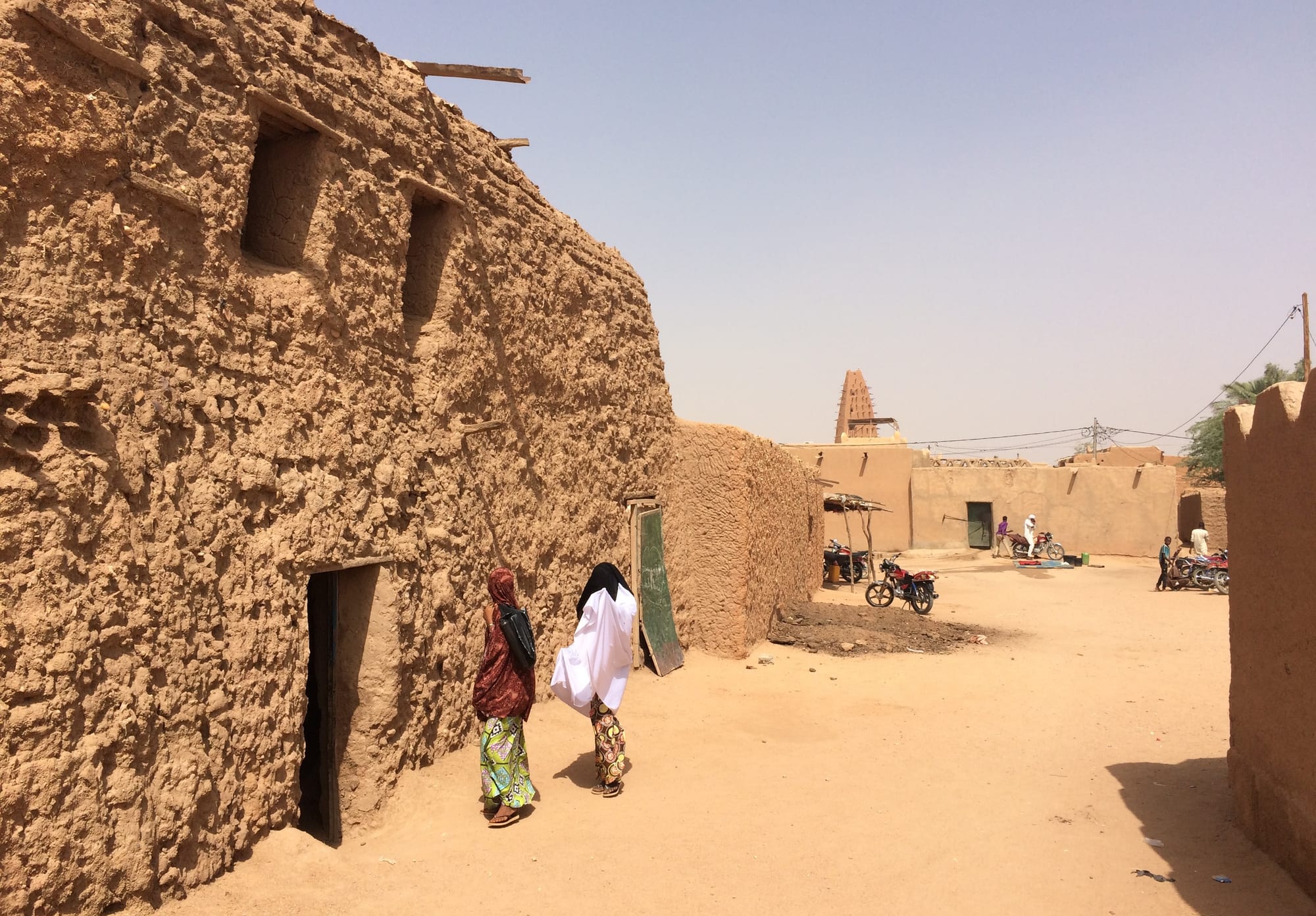
A sandy lane between thick mud-brick walls in Agadez, with the wooden-beamed minaret of the Grand Mosque rising beyond the rooftops

Agadez & the Sahara, Niger

Agadez

A lane of earthen houses in the historic centre of Agadez, with the minaret of the Grand Mosque behind. (Vincent van Zeijst / Wikimedia Commons · CC BY-SA 4.0)

The old caravan city on the southern edge of the Sahara, capital of the Sultanate of Aïr since the fifteenth century and a meeting point of desert and Sahel. Its earthen old town, crowned by a tall mud-brick minaret, is a World Heritage Site. This page is written to explain the city, not to encourage travel.

Neighbourhoods

  • The historic centre
    • First-time visitors
    • Historic district
    • Architecture

    The listed old town of banco houses, blind walls and sandy lanes around the Grand Mosque and the sultan's palace. Doorways, roof terraces and small courtyards give the quarter its character, and craft workshops are folded in among the houses.

    Open in Maps
  • The market quarter
    • Markets
    • Best for food
    • Local life

    The commercial streets around the central market, immediately east of the mosque, where shops, stalls, money changers and motorcycle taxis crowd together. Most of the city's everyday trade in food, cloth and hardware happens here.

    Open in Maps
  • The outer quarters
    • Local life
    • Quiet and residential

    Newer wards of concrete and earth spread outwards towards the Arlit and Tahoua roads, with schools, clinics, administrative buildings and the compounds of transport operators. Lorry yards and livestock enclosures sit on the edges.

    Open in Maps
  • The camel market and the desert edge
    • Markets
    • Photography

    On the northern fringe of the built-up area, the livestock and camel market is where herders from the Aïr and the pastures come in to buy and sell. Beyond it the gravel plain opens towards the mountains.

    Open in Maps

Things to do

The old town

  • Grand Mosque of Agadezlandmark

    The city's landmark and the tallest mud-brick structure in the world, first dated to 1515 and rebuilt in the same style in 1844, its tapering minaret bristling with projecting wooden beams and re-plastered by hand after the rains.

    Open in Maps
  • The Sultan's palacelandmark

    The earthen residence of the sultans of Aïr, an office dating from the fifteenth century, standing close to the mosque at the centre of the old town.

    Open in Maps
  • The silversmiths' workshopsattraction

    Small workshops in the old quarter where Tuareg smiths cut and file the silver Agadez cross and other jewellery, still made by hand for local wear as well as for sale.

    Open in Maps
  • The old town lanesneighborhood

    Sandy streets of flat-roofed banco houses with carved doors and rooftop terraces, the reason the historic centre carries a World Heritage listing.

    Open in Maps

Markets

  • Agadez central marketmarket

    The covered and open rows east of the mosque, selling grain, dates, vegetables from the Aïr gardens, cloth, salt and imported goods.

    Open in Maps
  • The camel and livestock marketmarket

    A ground on the edge of the city where camels, goats and cattle are traded, busiest in the early morning when herders come in from the pastures.

    Open in Maps

Arriving and moving on

  • Mano Dayak International Airporttransit hub

    The city's airport, named after the Tuareg leader and desert-travel organiser Mano Dayak, a few kilometres from the centre.

    Open in Maps

Short trips

  • In-Gallneighborhood

    A small salt-working oasis west of the city, where Tuareg and Wodaabe herders gather around September for the Cure Salée.

    Open in Maps
  • Aïr Mountainsattraction

    A range of dark volcanic and granite massifs north of the city, with valley oases, palm gardens and prehistoric rock engravings.

    Open in Maps

Seasonal events

  • Cure Saléearound September, at In-Gall

    The herders' gathering on the salt pastures west of Agadez, with camel races, markets and the Wodaabe Gerewol.

  • Tabaski (Eid al-Adha)follows the Islamic lunar calendar, so it moves through the year

    The main festival of the year, when a ram is slaughtered in most households and people gather at the sultan's palace.

  • Eid al-Fitrfollows the Islamic lunar calendar, at the end of Ramadan

    The end of the fasting month, marked by prayers on open ground, new clothes and days of visiting.

  • The cool desert seasonNovember to February

    The months when nights are cold, days are clear and the old expeditions into the Aïr and the Ténéré used to set out from the city.

Eat and drink

Long-standing places and food districts in Agadez. Hours, ratings and directions come from your maps app, always current.

Agadez classics

  • Taguellarestaurant

    The Tuareg flatbread of wheat dough baked under embers in hot sand, then broken into pieces and soaked in a sauce of goat or mutton.

    Open in Maps
  • Rice and pasta with saucerestaurant

    The everyday town meal, served with a tomato, onion and meat sauce, alongside brochettes of grilled mutton at street stands.

    Open in Maps
  • Dates, dried cheese and sweet teacafe

    Travel food and hospitality — dates from the oases, hard dried cheese, and three small glasses of sweet green tea brewed over charcoal.

    Open in Maps

Markets and food streets

  • Agadez central marketmarket

    Dates, millet, salt from Bilma, dried meat, and tomatoes, onions and citrus brought in from the irrigated gardens of the Aïr.

    Open in Maps
  • Grill stands of the market streetsneighborhood

    Charcoal grills around the market and the main crossroads sell skewered mutton and goat with pepper and raw onion after dusk.

    Open in Maps

Experience Agadez

History

Agadez grew where the routes of the Sahara meet the roads of the Sahel. Tuareg groups moving south into the Aïr founded a sultanate in the fifteenth century and made the town its capital, and it became the meeting place of caravans between the Hausa cities to the south and the oases of North Africa, trading salt, dates, leather, cloth and enslaved people. The Songhai Empire took the town in 1515 and held it as part of the empire until 1591, and the Grand Mosque is dated to that same year, rebuilt in the same style in 1844. Leo Africanus, in his Description of Africa, described a walled city of well-built houses with a sumptuous palace.

European travellers reached it in the nineteenth century, by which time the population had fallen and much of the town stood empty, though the caravans to Bilma still ran. French forces occupied Agadez in the early twentieth century; in 1916 and 1917 the Tuareg leader Kaocen besieged the French garrison in a revolt that took months to break, and the repression that followed left deep resentment.

Independence in 1960 was followed by uranium mining at Arlit to the north, which brought road traffic and wage work to the region. A small desert-tourism industry grew from the 1980s, sending visitors into the Aïr and the Ténéré, and collapsed with the rebellions of the 1990s and of 2007 to 2009. In the 2010s the city became the main transit town for migrants crossing the Sahara towards Libya, an economy that employed drivers, guesthouse keepers and fixers until crackdowns from 2016 slowed the traffic. The sultanate itself has survived all of this, and the old town was inscribed as a World Heritage Site in 2013.

Culture & Customs

Agadez is the cultural capital of Tuareg Niger. The sultan of Aïr, whose office goes back to the founding of the town, remains a figure of authority, consulted in disputes and central to public ceremony. The tagelmust, the long veil and turban worn by men, is everyday dress, and women hold a strong and public position in family and social life.

The town's craftsmanship is its signature. Smiths of the artisan families make the Agadez cross, the silver pendant known far beyond Niger, along with rings, daggers, locks, camel saddles and tooled leather bags, working in small workshops in the old quarter. Building is a craft too: the banco walls of the old town and the mosque's minaret are maintained by replastering with mud, a skill passed down within the town.

Music runs from the imzad, the single-stringed fiddle played by women, to assouf, the electric Tuareg guitar style that has taken the region's music abroad; the guitarist Bombino was born in the Aïr north-east of the city and began his career here. Weddings are marked with camel parades, drumming and dancing, and hospitality is formal: tea is poured three times, each glass meant to taste different, and a guest is not asked their business until the first has been drunk. The city is also mixed, with Hausa, Zarma, Toubou and Fula residents alongside the Tuareg majority, and Arabic and Hausa are heard beside Tamasheq.

Daily Life

Agadez recorded 110,497 residents at the 2012 census, making it the fifth largest city in Niger and the administrative centre for a region bigger than many countries. People live in compounds of banco or concrete behind high walls, in the old town and in the newer quarters spreading along the roads out.

Work is trade, transport, administration and craft. The city supplies and staffs the mines and gold camps of the north, sells the produce of the Aïr oases — tomatoes, onions, citrus, dates — and handles the salt brought in from Bilma and Fachi. Herders sell animals at the livestock market. Through the 2010s the transport of migrants northwards was a large part of the economy, and the crackdown on it removed the income of many drivers, guides and guesthouse owners without replacing it; migrants still pass through, and the town also receives people returning south.

The day is arranged around the heat and the prayers: business early, a long still middle of the day, and streets that fill again in the late afternoon and after dark under weak lighting. Water, electricity and fuel supply are intermittent, the population has grown with arrivals from the countryside, and the loss of tourism and of the migration trade has left a town with fewer ways to earn than a generation ago.

Food

Desert cooking is simple, filling and made to travel. Taguella, the Tuareg flatbread, is a disc of wheat dough baked in the sand under a fire, then dusted off, broken into fragments and served with a sauce of goat or mutton — the meal offered to guests in camps and in town. Millet porridge with a sauce of baobab leaf or okra is the Sahelian everyday dish, and in the town itself rice or pasta with a tomato and meat sauce is what most people eat.

The oases supply the fresh side of the diet. Gardens in the Aïr valleys send in tomatoes, onions, salad, oranges, grapefruit and above all dates, which are eaten fresh and dried and offered with tea. Camel and goat milk, fresh or soured, is drunk in the camps, and hard dried cheese and strips of dried meat are carried on journeys. Salt from the pans of Bilma and Fachi has reached Agadez by caravan for centuries and is still sold in the market in slabs and cones.

Grilled meat is the town treat: brochettes of mutton or goat cooked over charcoal at stands near the market and eaten with pepper and raw onion. Eghajira, a thick sweet drink of pounded grain, dates and cheese, is made for guests and festivals. Everything ends with green tea boiled with sugar and poured from a height into small glasses, three rounds at a sitting. Alcohol has no place in public life.

Planning tools

Budget

Agadez once had a small desert-tourism trade of guesthouses, Tuareg guides and 4x4 expeditions, largely dormant since the late 2000s. Food and rooms in the town are cheap; the expense is transport and security, since anything beyond the built-up area means a hired vehicle, a guide and often an escort, and fuel costs more than in the south.

Daily Budget Midrange
USD 170–350 where travel is permitted (hired 4x4, driver, guide and escort)
Daily Budget Shoestring
USD 30–55 (basic guesthouse, street food, shared taxis) where travel is permitted

Carry enough CFA francs in cash for the whole trip; cash machines are unreliable and cards are not accepted.

Best Time to Visit

November to February, when days are around 25–30°C and nights cold, is the only comfortable season and the one in which desert travel was traditionally organised. The Cure Salée at In-Gall falls around September. Security, not weather, decides whether a visit is possible at all.

Suggested Number of Days

The old town is small and a day or two covers it. Anything into the Aïr or the desert beyond is measured in days rather than hours, and depends entirely on permissions, vehicles and escorts rather than on distance.

First Visit
1–2 days
With Surroundings
4–7 days

Transportation

The town is covered by motorcycle taxis, shared taxis and carts, and the old town is best crossed on foot. Buses and bush taxis run south on the paved road to Tahoua and Niamey and north to Arlit; everything else is 4x4 travel on desert tracks, usually in convoy and subject to official restrictions.

Never set out into the desert without an experienced local operator, the required permissions and an escort where one is ordered.

Airport & Station Connections

Agadez sits at the end of the paved road that climbs north from Tahoua, and the bus journey up from Niamey takes well over a day. Mano Dayak International Airport lies a short drive from the centre and has handled scheduled and charter flights at times, though service has been intermittent for years.

Walkability

The historic centre is compact and flat, and walking its lanes is the point of being there: the mosque, the palace, the workshops and the market are within a few minutes of each other. Sand, glare and heat are the constraints, so walking works best early and late in the day, and the outer quarters are spread out.

Safety

The desert north has seen Tuareg rebellions, banditry at gold-mining sites, smuggling of arms, drugs and migrants, and the kidnapping of foreigners, including foreign workers taken from the northern uranium towns. The town itself is policed and quieter than the routes around it, but movement outside it is restricted and requires official approval.

Most governments advise against all travel to Niger, or against all but essential travel to Niamey only. Do not travel into the desert without official approval and escort. Check current official travel advice before travelling.

Climate

Saharan, on the edge of the desert, with a wide daily range. A little rain falls in July and August; the rest of the year is dry, with dust in the harmattan months.

Summer
extremely hot, often 40–45°C by day, with rare storms in July and August
Winter
warm, dry days around 25–30°C and cold nights that can fall close to freezing

Local Customs

A Muslim and largely Tuareg town with strong ideas of courtesy. Greetings are unhurried, the right hand is used for eating and giving, and modest dress covering shoulders and knees is expected of everyone. Tuareg men wear the tagelmust, the veil and turban, and offering or accepting three glasses of sweet tea is a social obligation rather than a refreshment.

Ask before photographing people, the palace, soldiers or checkpoints; alcohol is not part of public life; buying silverwork directly from the smiths is normal and bargaining is expected.

Common Payment Methods

The currency is the West African CFA franc, pegged to the euro, and the economy runs on cash. Cards are effectively not accepted, cash machines are scarce and unreliable, and euros are the easiest foreign currency to change. Bring what is needed for the whole stay.