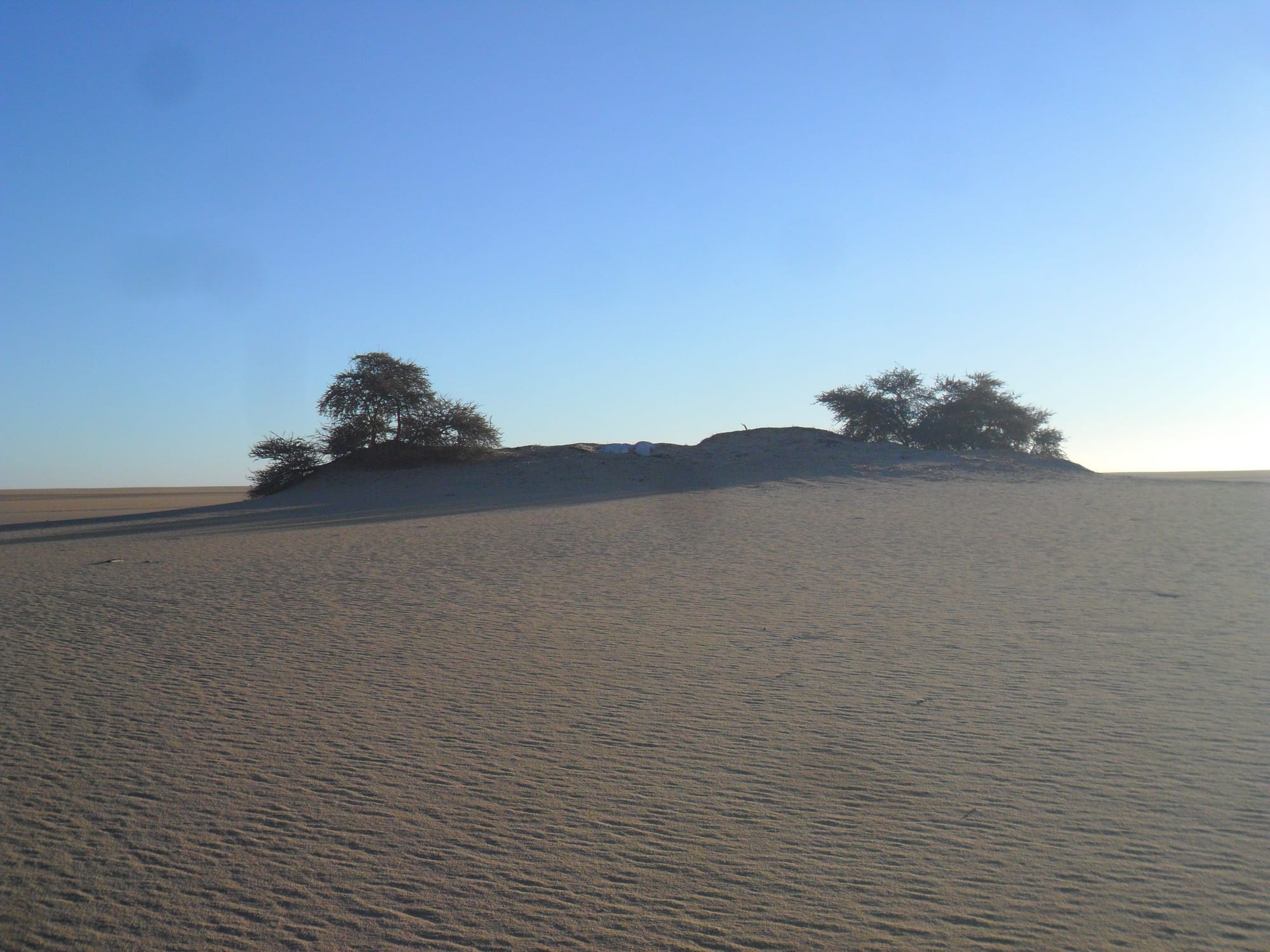
Low acacia trees on a sandy rise in an empty desert of pale rippled sand under a clear sky

Agadez & the Sahara, Niger

Bilma

Acacias standing in the Ténéré, the sand sea that the salt caravans cross on their way to and from Bilma. (Yahiaoui Bellahouel / Wikimedia Commons · CC BY-SA 4.0)

A small oasis town in the far north-east of Niger, set below the cliffs of the Kaouar escarpment on the eastern edge of the Ténéré. Date palms, gardens and salt pans have supported it for centuries, and its salt still leaves by camel caravan. This page is written to explain the town, not to encourage travel.

Neighbourhoods

  • The old town
    • First-time visitors
    • Historic district

    The close-packed earthen houses of the settlement below the escarpment, with narrow shaded lanes, a mosque and the remains of the French colonial fort on the rise above. This is the part of Bilma that looks as the caravans found it.

    Open in Maps
  • The gardens and palm groves
    • Quiet and residential
    • Local life

    Walled plots of date palms, vegetables and fodder watered from shallow wells and springs, strung along the foot of the cliffs. Families work them through the cool hours, and the date harvest is the busiest time of the year.

    Open in Maps
  • The salt pans
    • Local life
    • Photography

    Shallow evaporation basins on the flat ground outside the town, worked by hand into cones and slabs of salt. The pans are the reason Bilma exists and still the town's best-known industry.

    Open in Maps
  • The administrative quarter
    • Services

    Offices, a garrison, a clinic and a school lie on the open ground beyond the gardens. Fuel, supplies and official business are concentrated here, and the road north to Dirkou starts from it.

    Open in Maps

Things to do

In the oasis

  • The salt pansattraction

    Hand-dug evaporation basins where brine is drawn up, dried and shaped in moulds into cones and slabs of salt and natron, a method worked here for centuries.

    Open in Maps
  • The palm gardenspark

    Irrigated plots of date palms, with vegetables and fodder grown in their shade, fed by wells and springs at the base of the cliffs.

    Open in Maps
  • The old fortlandmark

    Fort Dromard, the earthen fort on the rise above the town, a major if isolated French military post built to hold the oasis and its caravan route.

    Open in Maps
  • Kaouar escarpmentviewpoint

    The line of sandstone cliffs running north and south of the town, at whose foot the string of Kaouar oases lies.

    Open in Maps

Short trips

  • Dirkouneighborhood

    An oasis and market town up the escarpment road, long a staging post on the routes north towards Libya.

    Open in Maps

Seasonal events

  • The date harvestlate summer and autumn

    The weeks when the palm gardens are picked and dates are dried, packed and sold on to traders for the desert routes.

  • The salt caravan seasontraditionally around November and March

    The months in which camel caravans, the azalai, have traditionally come from the Aïr to load salt and dates for the journey south.

  • Tabaski (Eid al-Adha)follows the Islamic lunar calendar, so it moves through the year

    The main festival of the year, when a sheep or goat is slaughtered and households visit one another across the oasis.

  • Eid al-Fitrfollows the Islamic lunar calendar, at the end of Ramadan

    The end of the fasting month, marked by prayers on open ground, new clothes and shared meals.

Eat and drink

Long-standing places and food districts in Bilma. Hours, ratings and directions come from your maps app, always current.

Oasis food

  • Dates from the gardensmarket

    The oasis staple, eaten fresh at harvest, dried for the rest of the year and carried as travel food across the desert.

    Open in Maps
  • Millet porridge with saucerestaurant

    Stiff porridge of millet or sorghum with a sauce of okra, baobab leaf or dried tomato, the everyday meal in the Kaouar.

    Open in Maps
  • Taguella and grilled goatrestaurant

    Flatbread baked under embers in hot sand and broken into meat sauce, with goat grilled over charcoal on festive days.

    Open in Maps

Market and tea

  • The town marketmarket

    A small market selling dates, salt, millet, tea, sugar and goods trucked in from Agadez or down from the north.

    Open in Maps
  • Sweet green teacafe

    Tea boiled with sugar over charcoal and poured in three small rounds, the fixed ritual of hospitality and of the long midday pause.

    Open in Maps

Experience Bilma

History

Bilma's history is the history of salt. Springs at the foot of the Kaouar escarpment have allowed dates and vegetables to be grown in an otherwise waterless desert, and the brine of the surrounding flats has been evaporated into salt for many centuries, giving a remote oasis a commodity the Sahel needed. The Kaouar oases were known to Arab geographers in the medieval period, and Bilma lay on the great caravan trail between Bornu and the Fezzan, which drew the oasis into the orbit of the Kanem–Bornu Empire to the south.

Salt tied the oasis to the great caravan routes. Tuareg caravans from the Aïr, the azalai, crossed the Ténéré each year to load salt and dates and carry them south and west to the Hausa markets, returning with millet, cloth and other goods; caravans north linked the town to the Fezzan in what is now Libya. The Toubou of the Kaouar and the Kanuri farmers of the oasis lived alongside each other, with periodic raiding across the desert.

Under French colonial rule Bilma was the site of a major if isolated military post, Fort Dromard, and the town spent the period as a remote garrison and administrative post. Independence changed little. Lorries gradually took over the salt trade, shrinking but not ending the camel caravans, and in recent decades the routes through the Kaouar have carried migrants and smugglers north towards Libya, bringing traffic, money and danger to a town that has always lived off the desert crossing.

Culture & Customs

The oasis is shared by Kanuri and Toubou families, with Tuareg traders and herders passing through and Hausa and Arabic heard in the market. Kanuri is the language of the older gardening families, Tedaga of many Toubou, and Hausa serves for trade; French belongs to the school and the administration. Islam orders the week, and the small mosques of the old town fill for Friday prayer.

Work gives the town its culture. Salt-making is organised by family and by pan, with rights to particular basins passed down, and the shaping of the salt into cones and slabs is a skill learned young. The palm gardens are held in the same way, each plot with its owner and its share of water, and disputes over water and inheritance are settled locally as much as officially.

Hospitality is formal and serious in a place where a visitor may have crossed hundreds of kilometres of desert to arrive: tea is made at once, in three rounds, and food is offered before questions are asked. Weddings bring drumming, singing and shared meals that draw in the whole oasis, and the arrival of a caravan or a convoy is an event in itself. Older men still tell the desert routes as knowledge — where the wells are, how many days to the next water — and that knowledge remains a source of standing.

Daily Life

Bilma recorded 4,016 residents at the 2012 census and is the administrative seat of a department covering some 670,000 square kilometres of north-eastern Niger. Households live in earth-built compounds between the gardens and the escarpment, and most combine several kinds of work: a plot of palms, a share in the salt pans, a government or garrison wage, a stake in transport.

Salt and dates remain the products that leave the oasis, carried out by lorry and still in part by camel. Goods come in the other direction from Agadez or Dirkou at prices that reflect the distance, and fuel, flour, sugar and tea are the staples of the market. The movement of migrants and of smuggled goods along the Libya routes has been a significant source of income in the wider Kaouar, and the crackdown on it has been felt here as in Agadez.

The day is shaped by heat: work in the gardens and the pans from first light, a long pause through the middle of the day, and life resuming in the late afternoon and evening. Water, electricity and supply of almost everything are uncertain, medical care is minimal and distant, and dust, sand encroachment and the drying of wells are constant concerns. The town's isolation is the largest fact of daily life — the nearest city is days away across sand.

Food

Food in Bilma is what the oasis grows and what the desert allows to be carried. Dates are eaten fresh at harvest and dried for the rest of the year, given to guests, traded and taken on journeys; the gardens also yield tomatoes, onions, peppers, a little wheat and fodder for goats and camels. Millet and sorghum come in by lorry from the south and are cooked into a stiff porridge served with sauces of okra, dried tomato or baobab leaf.

Taguella, the desert flatbread baked in the sand under embers and broken into a meat sauce, is the food of the caravan and of hospitality, and goat or mutton is grilled for festivals and for guests. Milk from goats and camels, fresh or soured, is drunk where animals are kept, and dried meat and hard cheese are carried by anyone crossing the Ténéré. Rice and pasta with a tomato sauce are the convenient modern meal in a town supplied by truck.

Bilma's own salt, from the pans on the edge of the town, seasons everything and is also sold in blocks as a mineral lick for livestock, which has long been a large part of the trade. The tea ritual closes every meal and fills every pause: green tea boiled with sugar over charcoal and poured from a height into small glasses, three times over, strong first and sweet at the end. Alcohol has no place here.

Planning tools

Budget

There is no tourist infrastructure in Bilma. Food and the few rooms available are cheap, but reaching the oasis means a hired 4x4, a driver, a guide, fuel for a very long desert crossing and official permissions, and that is where the money goes. Supplies cost more than in the south.

Daily Budget Midrange
USD 170–350 where travel is permitted (hired 4x4, driver, guide and escort)
Daily Budget Shoestring
USD 30–55 (a basic room, local food) where travel is permitted, excluding the cost of getting there

Carry all the cash needed for the whole journey in CFA francs; there are no cash machines and cards are not accepted.

Best Time to Visit

November to February, when days are warm rather than dangerous and the nights are cold, is the only sensible season, and the one in which the caravans have traditionally moved. From March to October the heat is extreme. Security and official permission, not the season, decide whether travel is possible.

Suggested Number of Days

The oasis itself is small and a day covers it. Any longer stay is really a function of the journey: the drive across the desert and the other Kaouar oases account for most of the time, and convoys and permissions set the pace.

First Visit
1 day
With Surroundings
3–5 days

Transportation

The town is walkable end to end. Everything beyond it is 4x4 travel on desert tracks, generally in convoy, and lorries and pick-ups carrying supplies, salt and passengers are the usual way people move between the Kaouar oases and on to Agadez. Camels still work the local routes.

Never travel between oases without an experienced local driver, spare fuel and water, and the permissions that are required.

Airport & Station Connections

Bilma lies roughly 600 kilometres east of Agadez across the Ténéré, a journey of two days or more by 4x4 on desert tracks, and a similar distance north-east of the Zinder road by another route. Almost all arrivals come overland with a convoy.

Walkability

The whole oasis can be crossed on foot: the old town, the gardens and the salt pans lie within a couple of kilometres of one another on flat sandy ground. Heat, glare and blowing sand set the limits, so walking is done early and late, and the middle of the day is spent in the shade.

Safety

The desert north-east has seen smuggling of arms, drugs and migrants, banditry around gold-mining camps and the kidnapping of foreigners, and the routes to Libya pass close by. The oasis itself is small and garrisoned, but movement across the surrounding desert is restricted and hazardous, and breakdowns far from help are a danger in themselves.

Most governments advise against all travel to Niger, or against all but essential travel to Niamey only. Do not travel into the desert without official approval and escort. Check current official travel advice before travelling.

Climate

Hyper-arid, with rain that may not fall at all in a given year. Days and nights differ sharply, and sandstorms blow through in the spring.

Summer
extremely hot, regularly above 40°C by day and little relief at night
Winter
warm days around 25–28°C and cold nights that can approach freezing

Local Customs

A small, conservative Muslim community where everyone knows everyone. Greetings come before business, the right hand is used for eating and handing things over, and modest dress covering shoulders and knees is expected. Guests are received with tea, and hospitality in a place this remote carries real obligations on both sides.

Ask before photographing people, the salt workings, soldiers or the garrison; alcohol is not part of public life; introduce yourself to local authorities on arrival, as visitors are rare and noticed.

Common Payment Methods

The currency is the West African CFA franc, and the oasis runs entirely on cash. There are no cash machines and no card payments; small notes are useful, and everything needed for the trip has to be brought in.