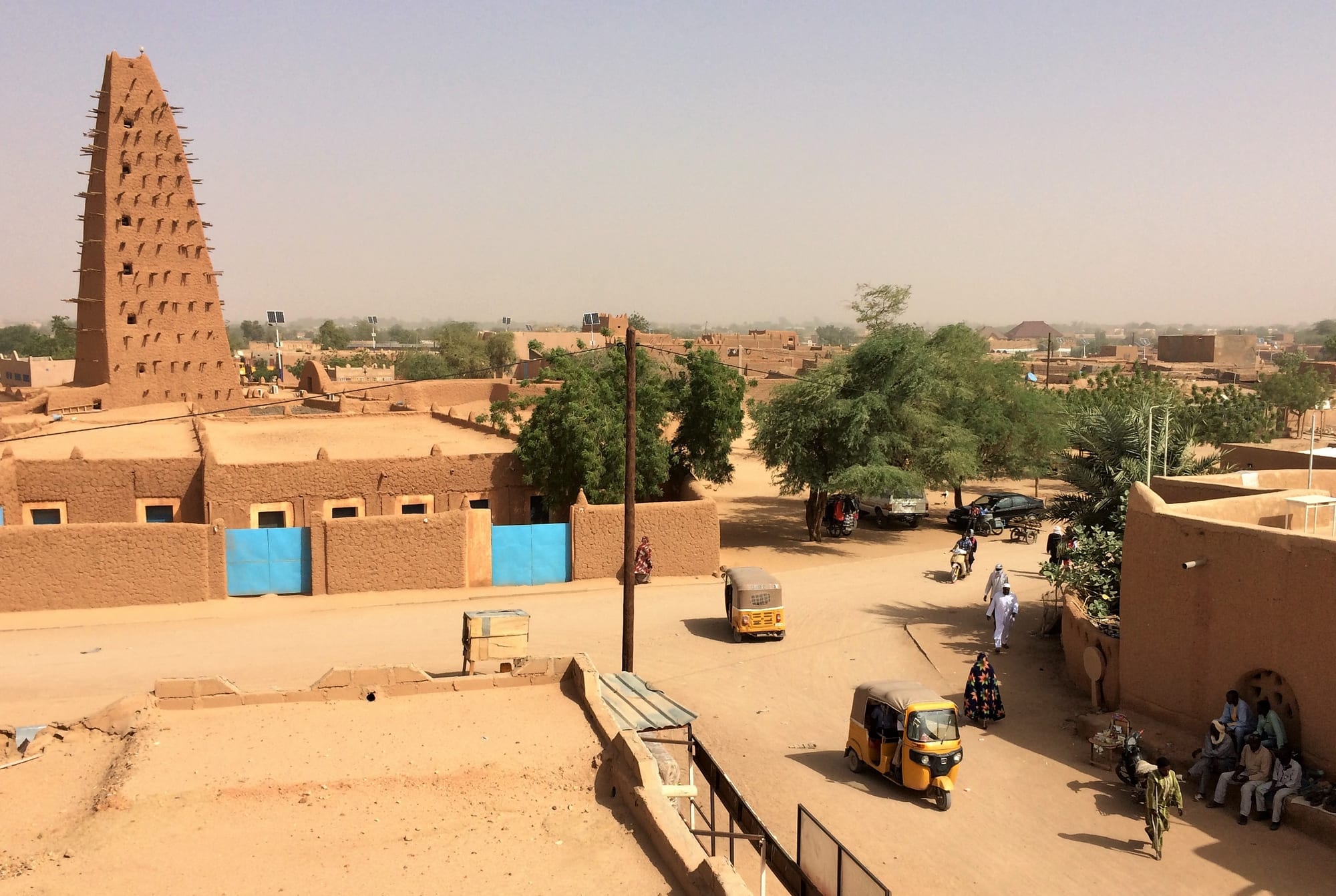
A tall, tapering mud-brick minaret bristling with wooden support beams, rising above the flat earthen roofs of an old desert town

Niger

The Grand Mosque of Agadez, whose 27-metre mud-brick minaret is the tallest of its kind in the world, in the UNESCO-listed old town. (Vincent van Zeijst / Wikimedia Commons · CC BY-SA 4.0)

A vast, landlocked country of Sahara and Sahel named for the river that waters its far southwest corner — one of the poorest and youngest nations on Earth, ruled since a 2023 coup by the military, whose leader was sworn in as president in 2025, and fighting jihadist insurgencies on two fronts.

Explore Niger

History

The desert and Sahel of Niger were crossed for a thousand years by the trans-Saharan trade, and Agadez grew rich as a caravan city and a centre of Islamic learning, its Grand Mosque topped by the tallest mud-brick minaret in the world. The southern lands fell within the reach of the Songhai Empire, the Hausa city-states, the Bornu Empire, and, in the nineteenth century, the Sokoto Caliphate. France conquered the territory around 1900 and ruled it as part of French West Africa; independence came in 1960.

The decades since have run on a loop of drought, coups, and brief democratic openings. Hamani Diori's founding government fell to a 1974 coup after the great Sahel drought; military rule gave way to elected governments in the 1990s; and Mahamadou Issoufou handed power to Mohamed Bazoum in 2021 — the first time one elected president in Niger had succeeded another.

In July 2023 the presidential guard, led by General Abdourahamane Tiani, overthrew and detained Bazoum. The junta expelled French troops and the French ambassador in late 2023, in March 2024 revoked the military agreement with the United States, whose forces left during 2024, and turned toward Russia, which sent military instructors. With the juntas of Mali and Burkina Faso it formed the Alliance of Sahel States and quit the West African bloc ECOWAS, a withdrawal that took effect in January 2025. Tiani was sworn in as president in March 2025 for a five-year transition, and survived an attempted coup by mutinous soldiers in Niamey in August 2026. Meanwhile Niger fights jihadist insurgencies on two fronts — Islamic State and al-Qaeda affiliates in the west, and Boko Haram and its offshoots around Lake Chad in the southeast.

  • Niger: The River and the Sahara — A vast, landlocked country four-fifths desert — the caravan city of Agadez, the trans-Saharan trade, a late and violent French conquest, uranium wealth that never reached the people, and a run of coups ending in a 2023 military takeover

Culture & Customs

Niger is an overwhelmingly Muslim country whose peoples have kept distinct identities: Hausa traders and farmers in the densely settled south; Zarma-Songhai along the river; Tuareg of the Aïr and the deep desert, with their indigo veils, camel caravans, and silver cross pendants; Fula and Wodaabe herders, whose young men wear elaborate makeup and dance for hours at the Gerewol to be judged the most beautiful; and Kanuri near Lake Chad.

Griots keep genealogies and history in song, accompanied by the one-stringed goje and the calabash drum, and traditional wrestling (lutte traditionnelle, kokawa in Hausa) draws enormous crowds, at national championships and at tournaments across West Africa.

Life is organised around the five daily prayers, the extended family and the walled compound, and rituals of hospitality — among the Tuareg, three glasses of sweet tea, each meant to taste different. The rhythm of the year is set by the single short rainy season and the movement of the herds to and from pasture.

  • Niger: The Joking Cousin and the Third Glass — A greeting before anything else, tea poured three times over, teasing between allied peoples that keeps the peace, and a Sahel year marked by naming days, weddings, wrestling and the herders' great gathering

Daily Life

Niger has one of the youngest and fastest-growing populations on Earth, with one of the world's highest birth rates, and it is among the poorest countries by almost every measure. Most people farm millet and sorghum or herd animals in the narrow Sahel band across the south, where the rains are brief and unreliable and the Sahara is advancing.

Niamey, on the river in the far southwest, is the one large city; Maradi and Zinder are the Hausa commercial centres. Uranium mined at Arlit in the northern desert is the signature export, alongside oil refined at Zinder and now piped toward Benin's coast, gold, onions and cowpeas grown for export, and livestock.

Agadez was for years the hub of the trans-Saharan migration route toward Libya, an economy that EU-backed crackdowns slowed from 2016, though migrants still pass through the city in numbers. Drought, locusts, insecurity, and a population growing at close to three per cent a year keep the pressure on relentless.

  • Niger: Where Half the Country Is Under Sixteen — Large families raising more children than almost anywhere else, days set by the single short rainy season and the five calls to prayer, and a river and its markets that carry ordinary life through one of the world's poorest and hottest countries

Food

Millet and sorghum are the staples, pounded and cooked into a stiff porridge (tuwo) or rolled into millet balls (fura) mashed into soured milk, eaten with a sauce of baobab leaf, okra, sorrel, or groundnut. Rice with a meat or tomato sauce is the everyday town meal.

Grilled skewered meat (brochettes), roast mutton, and kilishi — spiced, paper-thin dried beef — are the meat treats, while masa (fermented rice cakes) and kosai (bean fritters) are common street food. Dates from the oases and rounds of sweet tea punctuate the day. Alcohol is little seen.

  • Niger: Food and the National Dish — A firm millet paste eaten with sauce, the everyday staple of a Sahel nation where the grain itself is pounded, sold and drunk in nearly every form

Attractions & Natural Wonders

The security situation places most of the country off-limits, but its landmarks are extraordinary. The historic centre of Agadez, a World Heritage Site, has the bristling mud-brick Grand Mosque, the Sultan's palace, and a maze of earthen lanes, and it is the gateway to the Aïr Mountains — oases, rock art, and Tuareg villages — and to the dunes of the Ténéré, one of the emptiest deserts on Earth, where the "Tree of Ténéré" once stood as the loneliest tree in the world.

The far northeast holds the abandoned mud fortresses of the Djado plateau, and the Termit massif shelters rare addax antelope and Saharan cheetah. In the southwest, the "W" National Park, shared with Benin and Burkina Faso, is one of West Africa's best wildlife areas, with elephant and lion.

The region's last wild herd of West African giraffe roams the community reserve at Kouré, a short drive from Niamey, where they can be walked among on foot. Niamey itself has the National Museum, the Grand Marché, and the Niger River, crowded with pirogues at sunset.

  • Niger: Six Attractions and Natural Wonders — A Saharan caravan city famed for the finest mud architecture in Africa, mountains rising sheer from the desert, and one of West Africa's last strongholds of the elephant — a portrait of a country currently closed to nearly all travel

Planning basics

Budget

Niger is inexpensive for food and local transport, but the practical cost of any trip is security — much travel outside Niamey needs a 4x4, a guide, and in places a military escort. Niamey has a few mid-range hotels; elsewhere accommodation is basic. It is a cash economy.

Daily Budget Midrange
USD 90–200 (better hotel, a hired 4x4 and driver, guided excursions)
Daily Budget Shoestring
USD 25–45 (basic hotel, local food, bush taxis) where travel is possible

Carry CFA francs and euros in cash; card acceptance is minimal and ATMs unreliable outside the capital.

Visa Requirements

Almost all nationalities need a visa, obtained in advance from a Nigerien embassy; there is no general visa on arrival, though travellers with a pre-approval from the national police can be issued one at Niamey. Since the 2023 coup, consular services and entry rules have been in flux, and letters of invitation or tour-operator support are often required.

Typical Validity
30–90 days, single or multiple entry

Check current requirements with a Nigerien mission, and register with your own embassy if you go, as consular help on the ground is very limited.

Safety

This is the decisive fact. Most governments advise against all travel to Niger, or against all but essential travel to Niamey only, citing terrorism, kidnapping, armed banditry, and the aftermath of the July 2023 coup. The worst-affected areas are the west near the Mali and Burkina Faso borders (Tillabéri, Tahoua), the southeast around Diffa and Lake Chad, and the northern desert. Westerners have been kidnapped for ransom, including from cities.

Health
Extreme heat, dry-season meningitis outbreaks, malaria in the south during the rains, and very limited medical care

Read your government's advisory in full; since the coup, Western security cooperation has ended and Russian military instructors have arrived, and consular assistance is minimal.

Climate

Hot and dry. The Sahara covers the northern two-thirds — extreme daytime heat, cold desert nights in winter, and the dust-laden harmattan. The southern Sahel gets a single short rainy season from about June to September; Niamey and the south are punishingly hot before the rains (42–45°C in April and May) and cooler and dusty in December and January.

Cool Dry
December–February, warm days and cool nights
Hot Season
March–May, 40–45°C in the south

Transportation

Niamey's Diori Hamani airport is the main gateway, with smaller airports at Agadez and Zinder. There is no passenger railway. A paved highway links Niamey with Maradi, Zinder, Agadez, and the uranium town of Arlit; beyond it travel is by piste in a 4x4, often in convoy. Bush taxis and buses serve the main southern towns.

Many routes require a military escort or are closed to travel entirely; arrange desert trips only through an established local operator.

Best Time to Visit

November to February, the cool dry season, is the only comfortable time. The Cure Salée gathering of Tuareg and Wodaabe herders, with the Gerewol male beauty contest, takes place around September near In-Gall. The security situation, however, makes most of the country inadvisable to visit.

Events
Cure Salée and Gerewol (late September, In-Gall); national traditional-wrestling championships; Tabaski (Eid al-Adha)

Currency

Niger uses the West African CFA franc (XOF), shared with seven other countries and pegged to the euro. It is a cash economy; there are ATMs in Niamey but few elsewhere, and cards are rarely accepted.

Symbol
CFA
Currency Code
XOF — West African CFA franc

Language

Hausa is the most widely spoken language, the common tongue of markets and daily life, and the official language since the 2025 transitional charter, which reduced French — long the official language, and still used in administration and schooling — to a working language alongside English. Other languages spoken across the country include Zarma-Songhai around Niamey, Tamasheq (Tuareg), Fulfulde, and Kanuri in the southeast.

Lingua Franca
Hausa
Official Language
Hausa (French and English are working languages)