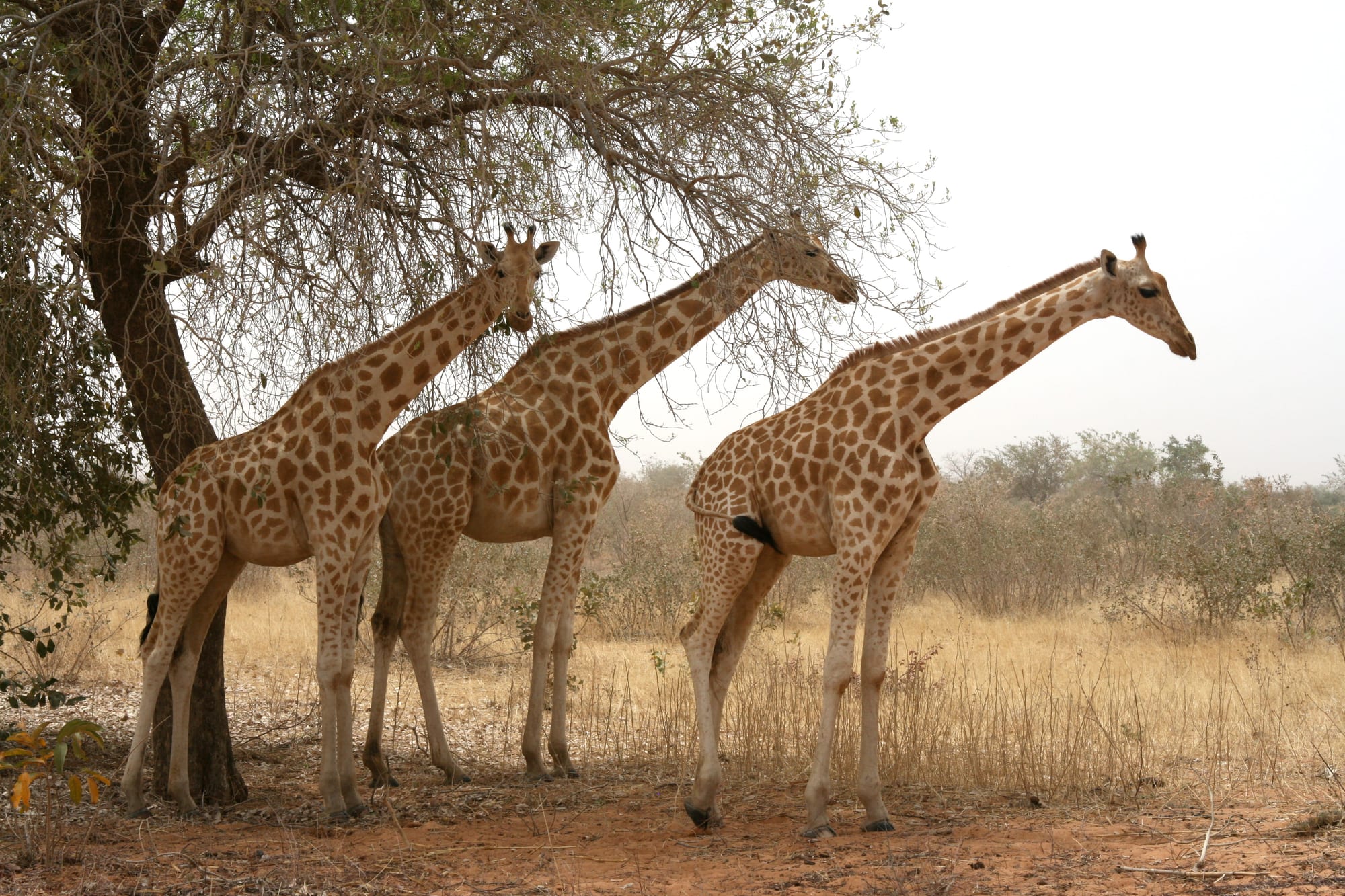
Three giraffes with pale orange patches standing beneath a bare acacia in dry golden savanna

Niger

Niamey & the Southwest

West African giraffes in the bush near Kouré, east of Niamey. (Dominik Schwarz / Wikimedia Commons · CC BY-SA 3.0)

The only part of Niger watered by the Niger river, running from the Mali and Burkina Faso borders through the capital Niamey to the Zarma country of Dosso and the Benin frontier — home to the W national park and the last West African giraffes at Kouré, and also the front line of the country's western insurgency.

Explore Niamey & the Southwest

History

The south-west lies on the Niger river, and its history is tied to the Songhai. The river country around Tillabéri and Ayorou was part of the Songhai Empire ruled from Gao, and after the Moroccan invasion of 1591 Songhai princes retreated down the river and founded small states in this area. Their descendants, and the closely related Zarma, remain the region's majority. The Zarma built a federation of chiefdoms whose leading ruler, the Djermakoy of Dosso, gained power in the 19th century by allying with outside forces against rivals, including, in the 1890s, the French.

Fula herders moved in over the centuries, and in the 19th century the town of Say, on the river south of Niamey, became an Islamic centre founded by the scholar Alfa Mahaman Diobo. The French arrived in the late 1890s and in 1926 moved the colony's capital from Zinder to Niamey, then a small cluster of villages chosen for its river site and its closeness to the rest of French West Africa.

Niamey grew into the capital of independent Niger in 1960 and is the setting of its politics, including the coups of 1974, 1996, 1999, 2010 and 2023. The Kennedy bridge of 1970 tied it to the right bank. Since the late 2010s the Tillabéri region has been drawn into the Sahel's war: a 2017 ambush at Tongo Tongo killed Nigerien and American soldiers, and later attacks on army posts at Inates and elsewhere killed dozens.

Culture & Customs

Zarma-Songhai is the language of the river and the capital's streets, though Hausa is widely spoken, and the region is also home to Fula herders, Tuareg and Hausa minorities in Tillabéri. Islam shapes daily life, but the Zarma and Songhai also keep an older tradition of spirit possession, the holey, in which dancers are taken over by spirits, and the village of Wanzerbé is famous for its sohanci, sorcerers who claim descent from the Songhai king Sonni Ali.

Griots recite genealogies and epics of the Songhai past at weddings, naming ceremonies and royal occasions, and the Djermakoy of Dosso keeps a ceremonial role. Traditional wrestling is followed passionately, and Niamey's arena hosts the national championship in some years.

Niamey is the centre of the country's culture: the ethnographic filmmaker Jean Rouch worked here, Oumarou Ganda and other Nigerien directors made the first films of the country's cinema, and the city's music scene mixes Zarma and Hausa song with Tuareg guitar and hip hop.

Daily Life

Niamey has grown from a few thousand people in the 1930s to well over a million today, spreading across the plateau from the river. Dosso, Tillabéri, Téra, Filingué, Gaya and Say are small towns; most people live in farming villages.

The economy is millet, sorghum, cowpeas and groundnuts on rain-fed fields, rice and market gardens along the river, fishing, and cattle herded between the river and the northern pastures. Gaya is a border market town for trade with Benin and Nigeria, and the capital lives on government, aid agencies, trade and a large informal sector of taxi drivers, tailors, mechanics and vendors.

Niamey days start early before the heat, pause in the hottest hours and pick up again after the afternoon prayer, with evening tea on mats outside compounds and crowds along the river. The war has pushed people into the capital from rural Tillabéri, closed schools and markets in the north-west, and emptied the tourism that once reached the W park, Kouré and Ayorou.

Food

The south-west eats from the millet field and the river. The staple is a stiff millet porridge eaten with a sauce of baobab leaves, okra or groundnut, and rice with tomato sauce is the daily town meal. Fish from the Niger is grilled on riverside fires in Niamey or fried and sold at the roadside.

Moringa leaves are a favourite green, eaten in salads with groundnut paste and onion or cooked into sauces, and dambou is a steamed couscous of millet or rice mixed with moringa leaves. Fura, balls of millet mixed with sour milk, is sold everywhere in the heat.

Niamey's street food includes brochettes of mutton, kilishi dried meat and grilled guinea fowl, with fresh mangoes in season from the gardens near the river and Gaya. Drinks are sweet green tea in small glasses, bissap from hibiscus, ginger juice and, in the city, cold soft drinks. Alcohol is little seen outside a few Niamey bars.

Attractions & Natural Wonders

Niamey and the Niger river are the region's centrepiece. The National Museum, a park-like compound of pavilions, holds dinosaur skeletons from the Sahara, traditional houses, crafts and a small zoo; the Grand Mosque, the Grand Marché and the Petit Marché, and the riverside at sunset with pirogues and gardens, fill out the city.

East of the capital, the Kouré giraffe zone shelters the last herd of West African giraffes, which roam among farms and villages on the plateau; numbers have grown from a few dozen in the 1990s to several hundred. Further east, Dosso has the palace of the Djermakoy and a market at the crossroads of the national road, with the fossil valleys of the Dallol Bosso and Dallol Maouri nearby.

South of Niamey, the W National Park takes its name from the double bend of the Niger along its edge and forms part of a cross-border UNESCO World Heritage Site with Benin and Burkina Faso; elephants, buffalo, antelope and hippos live in its savanna and gallery forest. North-west, Ayorou's riverside market, hippos in the river and the islands of the Niger were once the last stop before Mali.

Cities in Niamey & the Southwest

Planning basics

Budget

Niamey has the country's only real choice of hotels, restaurants and supermarkets, priced for aid workers and officials; outside the capital, Dosso and the river towns have basic lodgings and cheap food. The real cost is security: a hired 4x4, driver and permits for any trip beyond the city, where trips are permitted at all.

Daily Budget Midrange
USD 100–230 (better Niamey hotel, a hired 4x4 and driver)
Daily Budget Shoestring
USD 35–50 (basic hotel, street food, shared taxis in Niamey)

Carry CFA francs in cash, and arrange any trip outside Niamey through an established local operator.

Safety

Most governments advise against all travel to Niger, or all but essential travel to Niamey. The Tillabéri region, bordering Mali and Burkina Faso, is the heart of the western insurgency: fighters linked to the Islamic State Sahel Province and to al-Qaeda's JNIM attack army posts, villages and markets, and kidnappings are frequent. In 2020 six French aid workers and two Nigeriens were killed at Kouré, and the W park area has also seen armed groups. Niamey itself carries a risk of terrorism and kidnapping.

Most governments advise against all travel to Niger, or against all but essential travel to Niamey only. Stay in Niamey unless there is a pressing reason, keep a low profile and vary routines. Check current official travel advice before travelling.

Climate

The wettest corner of Niger, though still Sahelian. The rains fall from about June to September, heavier towards the W park and Gaya than at Tillabéri. Niamey is one of the hottest capitals on Earth in April and May, when temperatures pass 40°C before the rains, and the Harmattan brings dust and cooler nights from December to February. The Niger floods twice a year, from about August to October and, less strongly, from about January to March.

Summer
rainy season June–September, hot and humid, around 25–38°C
Winter
dry and dusty, 15–33°C from December to February; very hot, often above 40°C, from March to May

Transportation

Niamey's Diori Hamani airport is the country's main gateway. The paved national road runs east from Niamey through Dosso towards Maradi, and a branch runs south to Gaya and the Benin border; the Kennedy bridge crosses the river at Niamey. Roads north and west towards Tillabéri, Ayorou and the borders are exposed to attack, and travel outside the capital often needs permission and an escort.

Avoid all road travel west and north of Niamey, and never drive after dark outside the city.

Best Time to Visit

November to February, when the heat is bearable and the W park's animals gather near water; the park has traditionally opened in the dry season only. The security situation now decides whether the park or Kouré can be reached at all.