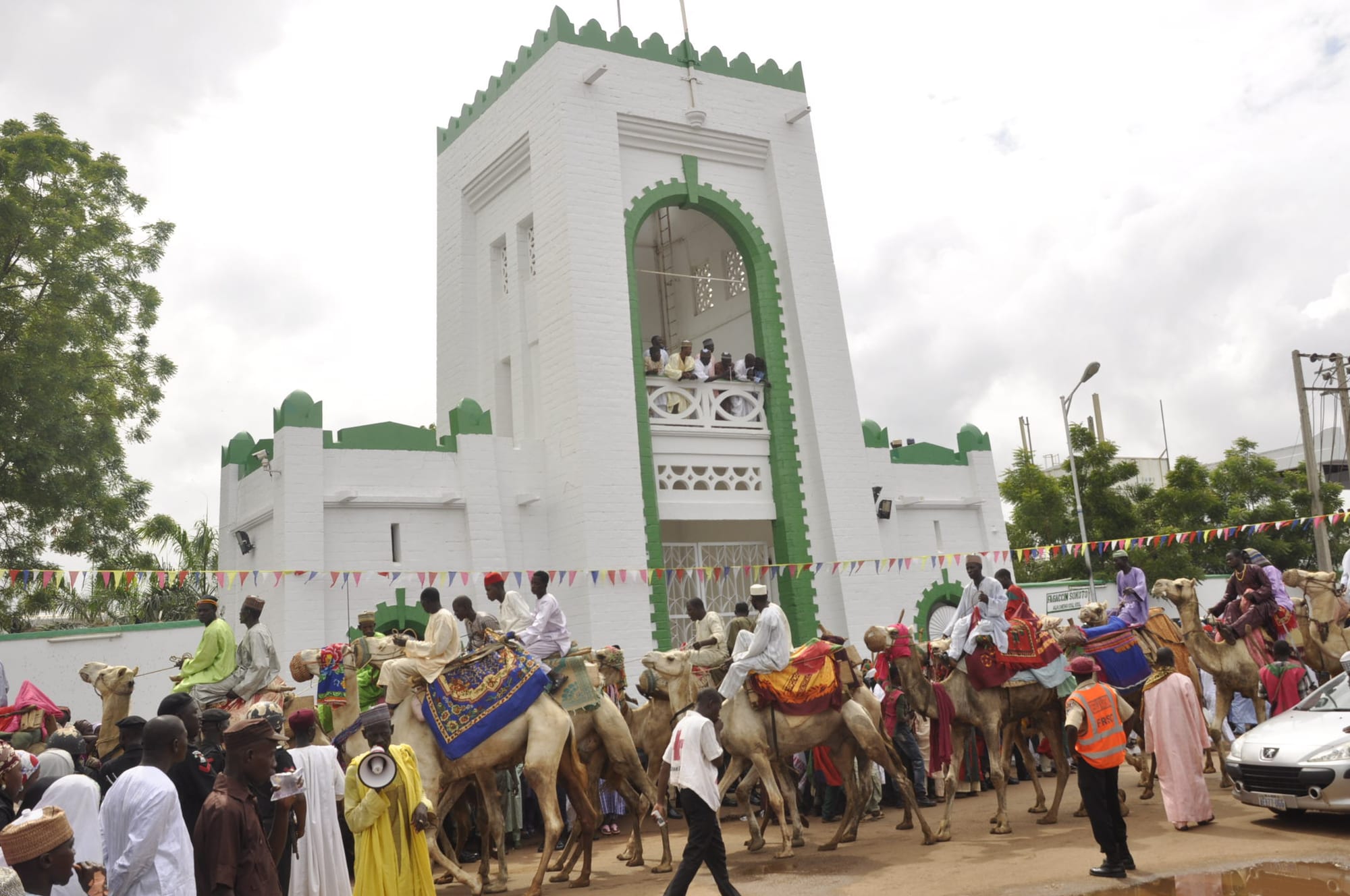
A white and green gatehouse tower with a pointed arch, with men on camels and a crowd in robes passing in front of it

Kano & the Northwest, Nigeria

Sokoto

Camel riders and crowds in front of the gatehouse of the Sultan's palace in Sokoto. (Sani Maikatanga / Wikimedia Commons · CC BY-SA 4.0)

The capital of Sokoto State in Nigeria's far north-west, on the Sokoto River close to the Niger border — the city Muhammad Bello founded as the capital of the Sokoto Caliphate and still the seat of the Sultan of Sokoto, whose office carries religious weight for Muslims across the country. The surrounding countryside is badly affected by armed banditry. This page is written to explain the city, not to encourage travel.

Neighbourhoods

  • Sokoto North
    • Historic district
    • First-time visitors

    The older half of the city, holding the Sultan's palace, the central mosque and the oldest quarters of the caliphate town. Streets of low compounds run back from the main roads, and the markets and small workshops that serve them are close by.

    Open in Maps
  • Sokoto South
    • Local life
    • Markets

    The southern half of the city, more recently built up, with government offices, schools, hotels and busy commercial roads. Much of the everyday trade of the state capital happens here.

    Open in Maps
  • Wamakko
    • Quiet and residential
    • Students

    The local government area on the western edge of the city, where Usmanu Danfodiyo University and its teaching hospital stand. It mixes campus buildings and staff housing with farming villages along the Sokoto River.

    Open in Maps

Things to do

Landmarks of the caliphate

  • Sultan's Palacelandmark

    The walled compound and green-and-white gatehouse of the Sultan of Sokoto, the seat of an office that descends from the caliphate and still carries religious authority for Muslims across Nigeria.

    Open in Maps
  • Sokoto Central Mosquelandmark

    The principal Friday mosque of the city, founded in 1809 by Muhammadu Bello, the second Sultan, and the seat of the Sultan's religious functions.

    Open in Maps
  • Hubbarelandmark

    The tomb of Usman dan Fodio, the scholar who launched the 1804 jihad, in a walled compound in the old city; it draws a steady flow of pilgrims and is a place of prayer rather than sightseeing.

    Open in Maps

Museums and learning

  • National Museum Sokotomuseum

    The city's national museum, one of the outlets run across the country by the National Commission for Museums and Monuments, with collections from the caliphate and the emirates around it.

    Open in Maps
  • Usmanu Danfodiyo Universityattraction

    The federal university founded in 1975 on the western edge of the city, named after the founder of the caliphate and a centre of Islamic and Arabic scholarship.

    Open in Maps

Markets and craft

  • Sokoto central marketmarket

    The main market of the city, known locally as Yardole, selling grain, onions, livestock, cloth and household goods, and long a place to buy the tanned goatskin and leather goods the town is known for.

    Open in Maps
  • Sadiq Abubakar III International Airporttransit hub

    The city's airport, about 16 km out and named after Siddiq Abubakar III, Sultan from 1938 to 1988; it is the normal way in and out of the far north-west.

    Open in Maps

Short trips

  • Argunguattraction

    A town in Kebbi State on the Rima river, known for the fishing festival held on its water and for its emirate and museum.

    Open in Maps
  • Goronyo Damattraction

    A large sand-fill dam on the Rima River north-east of the city, completed in 1984 and commissioned in 1992, holding water for irrigation and for release in the dry season.

    Open in Maps

Seasonal events

  • Eid durbarat Eid al-Fitr and Eid al-Adha, dates moving each year

    Horsemen and camel riders in robes and quilted trappings parade and salute before the Sultan outside the palace, as they do in the other old northern emirates.

  • Argungu Fishing Festivaldry season, usually February or March

    A festival on the river at Argungu, in neighbouring Kebbi State, in which large numbers of fishermen enter the water together to catch the biggest fish; it was suspended for more than a decade before being revived in 2020, and a further edition was held in February 2026.

  • Ramadanthe ninth month of the Islamic calendar, moving each year

    The fasting month reshapes the day across this overwhelmingly Muslim city, with quiet afternoons, evening meals after sunset and long night prayers in the mosques.

Eat and drink

Long-standing places and food districts in Sokoto. Hours, ratings and directions come from your maps app, always current.

Sokoto classics

  • Tuwo and northern soupsrestaurant

    Small eating houses across the city serve tuwo shinkafa, soft pounded rice, with miyan kuka made from dried baobab leaves or miyan taushe, a pumpkin and groundnut soup.

    Open in Maps
  • Suya grillsrestaurant

    Roadside grills fire up in the evening for suya, thin skewers of beef rubbed with peppery groundnut spice, usually eaten standing with raw onion and more pepper.

    Open in Maps

Markets and street food

  • Sokoto central marketmarket

    Grain, onions, dried peppers, spices and slabs of kilishi, the paper-thin dried and spiced beef of the north, alongside cooked-food stalls.

    Open in Maps
  • Masa and kosai stallsmarket

    Morning stalls sell masa, small fermented rice cakes cooked in a dimpled pan, and kosai, fried bean fritters, usually with a peppery sauce.

    Open in Maps

Experience Sokoto

History

Sokoto is a young city by the standards of the Hausa lands around it. When Usman dan Fodio launched his jihad against the Hausa kings in 1804, his movement had no fixed capital; after the war his son Muhammad Bello founded the town in 1809 as a ribat, a fortified frontier settlement, and it became the seat of the new caliphate. From here the Sultan, as commander of the faithful, presided over emirs ruling Kano, Katsina, Zaria and many other cities across what is now northern Nigeria and parts of Niger and Cameroon — one of the largest states in nineteenth-century Africa.

Usman dan Fodio himself died in 1817 and was buried in the town; his tomb, the Hubbare, remains the city's most visited religious site. The caliphate's scholars made Sokoto a centre of Arabic learning and manuscript writing, and its craftsmen supplied leather, cloth and metalwork to the trans-Saharan trade.

British forces under Frederick Lugard took Sokoto in 1903. The reigning Sultan, Attahiru I, left the city rather than submit and was killed later that year; the British installed a successor and then governed through the sultanate itself under indirect rule, which preserved the office and much of its prestige. In the twentieth century Sokoto's leaders were central to northern Nigerian politics: Ahmadu Bello, the Sardauna of Sokoto, led the Northern Region at independence. Sokoto State was created in 1976, and the city has grown as its capital, a university town and the religious focus of Nigerian Islam.

Culture & Customs

The Sultan of Sokoto is the most senior traditional Muslim authority in Nigeria, consulted on religious questions far beyond the city and chairing the Nigerian Supreme Council for Islamic Affairs; the announcement of the start and end of Ramadan from Sokoto is followed across the country. That authority shapes the city's sense of itself as a place of scholarship rather than commerce.

Islamic learning is everywhere: Qur'anic schools in the compounds, Arabic manuscripts copied and studied for two centuries, and a university named for the founder of the caliphate. The population is overwhelmingly Hausa and Fulani, with Hausa as the everyday language and Fulfulde still spoken in the scholarly and herding families. Dress is formal and distinctive — embroidered babban riga robes and caps for men, wrappers and veils for women.

At Eid the city turns out for the durbar, when horsemen and camel riders in bright robes and quilted trappings ride before the Sultan's palace in salute, a custom shared with Kano, Katsina and Zaria. Weddings and naming ceremonies are large, formal and central to social life, and hospitality to strangers is a point of honour. Leatherwork is the craft the town is best known for: goatskins from the Sokoto Red breed were traded north across the Sahara, and northern Nigerian goatskin reached Europe under the name Morocco leather.

Daily Life

Sokoto is a state capital of several hundred thousand people: the 2006 census counted over 427,760 in the city, and it has grown considerably since. Its economy rests on government — the state civil service, courts and schools — together with the university and its teaching hospital, trade in farm produce, and a cement plant opened near the city in 2022.

The country around the city is farmland watered by the Rima and Sokoto rivers and by irrigation schemes: rice, millet, sorghum, onions and vegetables, with Fulani herders moving cattle, sheep and goats through the dry savanna. Tanning and leatherworking survive in workshops in the older quarters, though far less than in the caliphate's heyday.

The day follows the five prayer times. Markets and offices open early, the middle of the day is slow in the heat, and business picks up again in the late afternoon before evening gatherings over sweet tea. Friday prayers are the fixed point of the week. Poverty rates in the state are among the highest in Nigeria and many children, especially girls, are out of school. Banditry in the rural areas has pushed families off their farms and into the city, adding pressure on housing, water and jobs.

Food

Sokoto eats the grain-based food of the Hausa north. Tuwo shinkafa, a soft mash of pounded rice, and tuwo made from millet or sorghum are the everyday staple, served with miyan kuka, a dark soup of dried baobab leaves, or miyan taushe, made from pumpkin and groundnuts. Rice with a tomato and pepper stew is the other common plate, and dan wake, dumplings of bean flour tossed with oil and pepper, is a cheap filling lunch.

Meat matters here. Suya, skewers of beef rubbed with yaji, a peppery groundnut spice mix, is grilled at roadside stalls once the sun goes down, and kilishi, beef sliced paper-thin, spiced and dried in the sun, is the north's great travelling food and a standard gift to take home. Dambun nama, shredded spiced beef, is another way of preserving meat.

Mornings bring masa, small rice cakes cooked in a dimpled iron pan, and kosai, fried bean fritters, from street stalls. Fura da nono — balls of millet dough mixed with fermented cow's milk — is sold by Fulani women and drunk as a meal in itself. Kunu, a light millet drink, zobo made from hibiscus, and strong sweet tea are the everyday refreshments. Alcohol is not sold openly under the state's sharia law.

Planning tools

Budget

Local prices are among the lowest in Nigeria: market food, small eating houses and simple hotels cost very little in naira. The expensive part of any visit is not accommodation but transport and security — a trusted driver, a flight rather than a road journey, and arrangements made through an organisation on the ground.

Daily Budget Midrange
USD 90–230 (best available hotel, restaurants, a car with driver and security arrangements)
Daily Budget Shoestring
USD 25–50 (simple hotel, market food, shared city transport)

Carry naira in cash, as card acceptance is limited outside a few hotels, and change money before arriving rather than relying on local bureaux.

Best Time to Visit

November to February is the only comfortable window. Days are warm rather than punishing and the nights are cool, though the harmattan fills the air with Saharan dust and can delay flights. March to May is extremely hot, often above 40°C, and the rains from June to September bring short violent storms and difficult roads.

Suggested Number of Days

The historic core of the city is small enough to see in a day or two. Longer stays are shaped less by the number of sights than by security arrangements, flight schedules and whether anything outside the city is reachable at the time.

First Visit
1–2 days
With Surroundings
3 days

Transportation

Shared taxis and, above all, motorcycle and tricycle taxis carry most people around the city, and the main roads through Sokoto North and South are the spine of the network. Visitors almost always move by hired car with a driver arranged locally. Intercity road travel across Sokoto, Zamfara and Kebbi is dangerous.

Arrange a car and driver through a local contact, avoid travel after dark, and treat rural roads out of the city as off-limits without professional security advice.

Airport & Station Connections

Sadiq Abubakar III International Airport lies about 16 km from the centre and handles domestic flights; it is named after Siddiq Abubakar III, Sultan of Sokoto from 1938 to 1988. Flying is the normal way in. The roads from Kano, Katsina and Kebbi are long and pass through country affected by banditry and kidnapping.

Walkability

The old quarters around the palace and the market are flat and walkable, and short distances are easily covered on foot in the cooler months. Pavements are patchy, motorcycles use every gap, and the heat between March and May makes walking in the middle of the day hard work.

Safety

Governments advise against all or all but essential travel to Sokoto State. The city itself is calmer than the countryside around it, but the rural parts of the state, like neighbouring Zamfara and Katsina, have suffered mass kidnappings for ransom and village raids by armed groups known locally as bandits, and the risk of kidnapping extends to the roads leading in and out.

Avoid rural areas and intercity roads, travel only with trusted local contacts and security advice, dress conservatively and respect Islamic customs. Check current official travel advice before travelling.

Climate

Sahelian and among the hottest inhabited places in Nigeria. One short rainy season runs from about June to September; the rest of the year is dry, with the harmattan blowing dust off the Sahara from December to February and a fierce hot season before the rains.

Summer
rainy season, roughly 23–34°C, with heavy short storms and high humidity
Winter
dry and dusty, roughly 14–33°C, with cool nights under the harmattan

Local Customs

This is a conservative Muslim city where sharia applies in state law. Modest dress is expected of everyone, with arms and legs covered; women often cover their hair. Greetings are long and matter more than getting to the point. Alcohol is not sold openly. The Sultan and the scholarly families are held in great respect, and the Hubbare is a place of pilgrimage where visitors are guests.

Ask before photographing people, mosques or the palace, remove shoes where required, use the right hand for greeting and eating, and avoid eating or drinking in public during Ramadan daylight hours.

Common Payment Methods

The currency is the naira. Cash is what almost everyone uses; card payment is limited to a few hotels and larger shops, and ATMs may not accept foreign cards. Small notes are useful for transport and market stalls, and the exchange rate moves quickly.