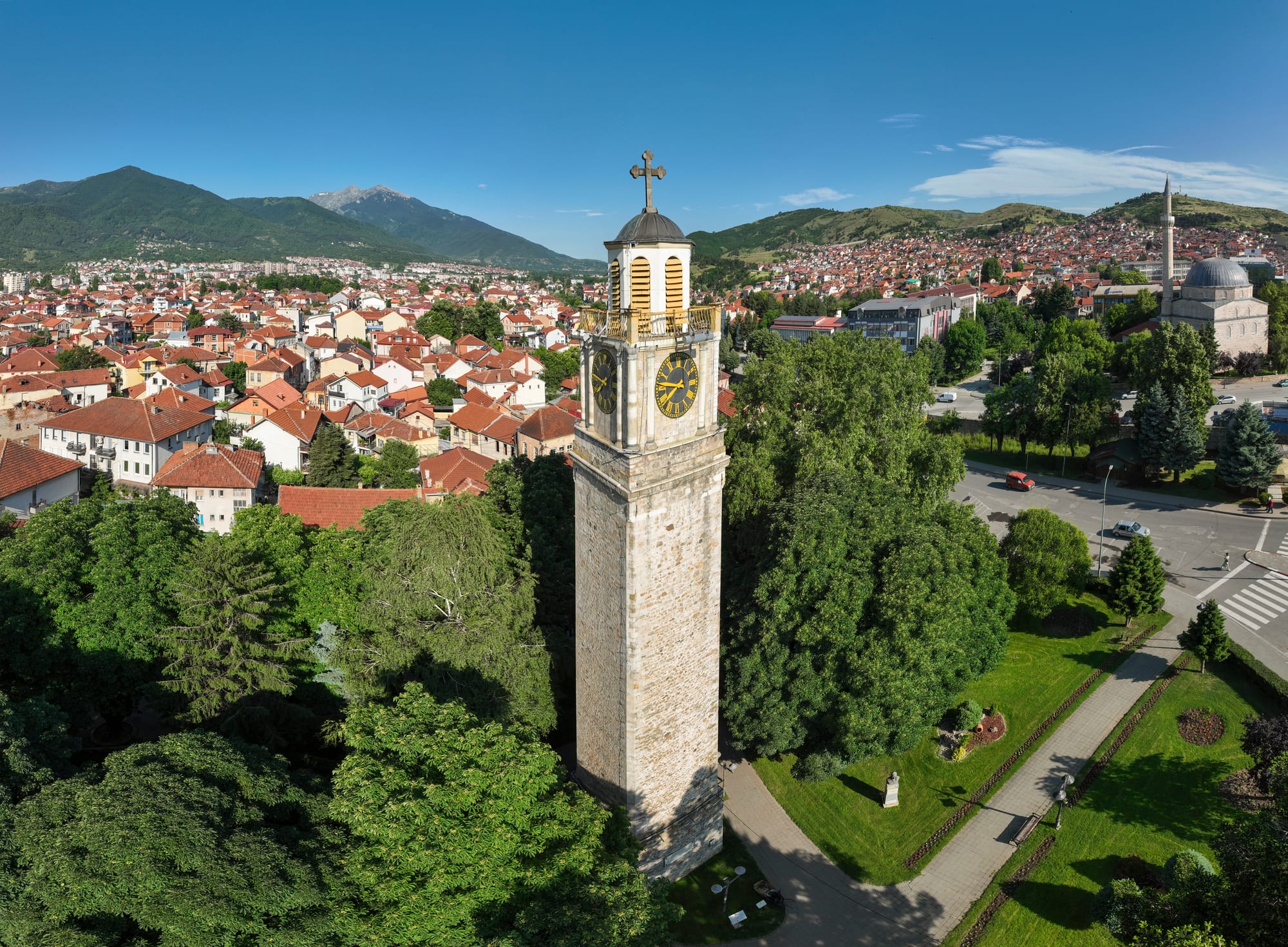
Bitola's stone clock tower rising above trees, with red-roofed houses, a domed mosque and green mountains behind

North Macedonia

Bitola

The clock tower in the centre of Bitola, with Baba Mountain on the skyline. (Petar Milošević / Wikimedia Commons · CC BY-SA 4.0)

A city in the south of the Pelagonia valley, below Baba Mountain and close to the Greek border. Founded as ancient Heraclea Lyncestis, it grew rich as Ottoman Monastir, the 'City of Consuls', and today is a regional centre known for its pedestrian avenue, Ottoman monuments and the national park on its doorstep.

Neighbourhoods

  • Širok Sokak
    • First-time visitors
    • Cafés
    • Architecture

    The long pedestrian street running from Magnolia Square by the Dragor River to the City Park, lined with 19th-century buildings and home to several consulates. It is the city's liveliest street, lined with cafés.

    Open in Maps
  • The old bazaar
    • Historic district
    • Markets

    The Ottoman market quarter on the north bank of the Dragor, around the covered bedesten, with the city's largest mosque on its edge. Described in accounts from the 16th and 17th centuries, it remains a working shopping district.

    Open in Maps
  • The City Park and the south
    • Parks
    • Quiet and residential

    The park at the southern end of Širok Sokak, near the bus and railway stations, beyond which the road continues to the ruins of Heraclea Lyncestis.

    Open in Maps

Things to do

The centre

  • Clock Towerlandmark

    The tower over the centre, first built in 1664 and rebuilt by the Ottomans in the 1830s; legend says some 60,000 eggs from nearby villages were mixed into the mortar to strengthen its walls.

    Open in Maps
  • Širok Sokakneighborhood

    The 'Wide Alley', a pedestrian promenade of 19th-century buildings and cafés, home to several consulates.

    Open in Maps
  • Church of Saint Demetriuslandmark

    The main Orthodox church of the city, built in 1830, plain outside as Ottoman rules required but richly decorated within, with chandeliers, a carved bishop's throne and an engraved iconostasis.

    Open in Maps

Ottoman Bitola

  • Bedestenmarket

    The covered market near the centre, one of the oldest and most impressive Ottoman buildings in the city.

    Open in Maps
  • Deboj Bathlandmark

    An Ottoman-era hammam, one of the surviving public buildings of Ottoman Monastir.

    Open in Maps
  • Ishak Çelebi Mosquelandmark

    The largest mosque in Bitola, built in 1508 in the old bazaar just west of the bedesten and commissioned by the local judge Isak Çelebi.

    Open in Maps
  • New Mosquelandmark

    One of the Ottoman mosques of the city centre.

    Open in Maps
  • Gazi Hajdar Kadi Mosquelandmark

    An Ottoman-era mosque, one of the monuments of the old city.

    Open in Maps

Short trips from the city

  • Heraclea Lyncestislandmark

    The ancient city founded by Philip II of Macedon on the southern edge of town, with a Roman portico, baths, a theatre and early Christian basilicas.

    Open in Maps
  • Dihovoattraction

    A village under Baba Mountain about 6 km from the centre, reached by the city's suburban buses.

    Open in Maps
  • Pelister National Parkpark

    The Baba Mountain massif rising above the city, established in 1948 as Yugoslavia's first national park, with forests of Macedonian pine and two glacial lakes.

    Open in Maps

Seasonal events

  • BitFestlate June to late August

    A summer-long music festival with more than a hundred events around the city.

  • Ilinden Dayslate July to early August

    A folklore festival with dance and music groups from North Macedonia and abroad.

  • Interfestearly October

    An international festival of classical music held every year since 1992.

Eat and drink

Long-standing places and food districts in Bitola. Hours, ratings and directions come from your maps app, always current.

Bitola classics

  • Cafés of Širok Sokakneighborhood

    Terraces along the pedestrian avenue, the centre of the city's café life and evening promenade.

    Open in Maps
  • Old bazaarmarket

    The Ottoman market quarter north of the river, the city's historic commercial centre and still an active place of commerce.

    Open in Maps

Experience Bitola

History

The city's roots lie in Heraclea Lyncestis, founded in the middle of the fourth century BC by Philip II of Macedon on the southern edge of today's town. The Romans conquered the area in 148 BC, but Heraclea remained important; in the early Byzantine period it was an important bishopric whose bishops attended the first church councils. In 1015 Ivan Vladislav moved the capital of the First Bulgarian Empire here from Ohrid and rebuilt its fortress, and Bitola remained the last Bulgarian capital until 1018.

Already a trading town linked to Constantinople, Thessaloniki and Ragusa, it was taken by the Ottomans in the 1380s, and from 1382 to 1912 Monastir, as they called it, was part of their empire. From 1836 to 1867 it was the capital of Ottoman Rumelia. In the last decades of Ottoman rule twelve countries kept consulates here, earning it the name "City of Consuls"; its schools included a military academy attended by Mustafa Kemal Atatürk, and the Manaki brothers shot the first motion picture made in the Balkans here. The region was a stronghold of the Ilinden Uprising of 1903.

The Battle of Monastir in November 1912 ended Ottoman rule, and the city passed to Serbia. In the First World War Bitola stood on the Salonica front, and by 1918 near-daily bombardment had almost destroyed it. On 11 March 1943 the Bulgarian occupation authorities deported 3,276 of the city's Sephardic Jews to Treblinka. Bitola later grew into an administrative, industrial and educational centre.

Culture & Customs

Bitola is often thought of as the most European city in the country, and the neoclassical and romantic 19th-century buildings of Širok Sokak carry the memory of the consular years. About thirteen consulates are based in the city today, keeping the old nickname alive. The Ottoman layer is just as visible, in the clock tower, the covered bedesten, the Deboj hammam and the mosques along the Dragor River.

Cinema is a point of pride. Yanaki and Milton Manaki, Aromanian photography and cinema pioneers who worked in the city, made the first motion picture in the Balkans, and since 1979 the Manaki Brothers festival has brought cinematographers to Bitola from around the world. The summer BitFest, the Ilinden Days folklore festival, the Interfest classical music festival each October and a Shakespeare festival keep the cultural calendar busy.

Sport centres on FK Pelister, the football club that plays at the Petar Miloševski Stadium, and on the handball club RK Eurofarm Pelister. The city's university, named after Clement of Ohrid, adds a student population.

Daily Life

About 69,300 people lived in the city of Bitola at the 2021 census, most of them Macedonians. The mix was far greater around 1900, when one count found Turks, Christian Bulgarians, Aromanians and Jews each numbering in the thousands in a city of some 37,000; by the 1948 census, after war and the loss of the Jewish community, the population had fallen to about 30,800. It is the administrative, commercial and educational centre of the south-west, and it is also an industrial city.

Energy dominates the local economy: the three thermal power stations of REK Bitola produce nearly 80 per cent of the country's electricity. The Pelagonia agricultural combine is the country's largest food producer, and the city also has textile and food industries.

Everyday life gathers along Širok Sokak, the lively, café-lined street between the clock tower and the City Park. The old bazaar remains a place to shop for everyday goods, and local buses link the city with the villages at the foot of Pelister.

Food

Bitola eats the food of the Macedonian south-west, built around beans, peppers, grilled meat and dairy. Macedonian cooking is noted for the quality of its dairy products. Tavče gravče, the national dish, is made with beans and baked and served in an unglazed earthenware pot; ajvar is a spread of roasted red peppers that can be sweet, piquant or very hot, and šopska salad is often eaten as a starter with rakija.

Grill restaurants serve kebapi and other grilled meats, and the pastries include burek and zelnik, layers of thin dough filled with white cheese, eggs, leeks or meat. Selsko meso, beef, pork and lamb with mushrooms, white wine and yellow cheese, usually cooked in a clay pot, is another Macedonian dish.

Café culture is the city's real speciality, and Širok Sokak is lined with cafés. To drink there is rakija, mastika, considered the national drink, and wine, especially from the Vranec grape.

Planning tools

Budget

Bitola is inexpensive. Coffee on the avenue, bakeries and grill houses cost little, city buses charge a flat fare, and the main extras are guided visits to the national park and taxis to the mountain villages.

Daily Budget Midrange
USD 65–130 (mid-range hotel, restaurant meals, taxis or a hire car to Pelister and Heraclea)
Daily Budget Shoestring
USD 30–55 (guesthouse or hostel, bakeries and grills, buses)

Coffee on Širok Sokak is one of the cheapest pleasures in town.

Best Time to Visit

May to October. Summer brings BitFest and the Ilinden Days, and Pelister's trails are open; Interfest comes in early October. Winters are cold, with snow on the mountain above the city.

Suggested Number of Days

One or two days covers the city centre and the ancient site. A separate day or more is needed for the national park, and walkers often stay longer in the mountain villages.

First Visit
1–2 days
With Surroundings
3–4 days

Transportation

The centre is walkable. City buses run at a low flat fare, line 1 being the most useful, and other lines serve the suburbs and nearby villages, including Dihovo. A car is useful for the higher parts of the national park.

Buses to the mountain villages are infrequent, so check return times before setting out.

Airport & Station Connections

About a dozen buses a day run from Skopje, taking around three hours via Prilep and Veles, and a few connect with Ohrid in about an hour and a half via Resen. Trains from Skopje are slower, at around five hours. The bus station is about 1.5 km south of the centre. The Greek border crossing at Medžitlija is 14 km to the south.

Walkability

Flat and easy on foot. Širok Sokak links the clock tower with the City Park, the old bazaar lies just across the river, and the stations are a short walk from the park. The road beyond the park continues to Heraclea Lyncestis.

Safety

North Macedonia is a safe country for visitors, with low violent crime. Bitola is a calm provincial city; the usual care with bags in busy places and on the roads is enough.

Carry water and warm layers on Pelister's trails, where weather changes quickly, and take care on rural roads after dark. Check current official travel advice before travelling.

Climate

A continental climate with cold winters and warm summers, and large swings between the extremes.

Summer
warm — July, the warmest month, averages about 22°C, and the highest temperature recorded is 41.2°C
Winter
cold — January, the coldest month, averages about −0.6°C, and frosts can be severe

Local Customs

Bitola is mainly Macedonian and Orthodox, and has long been home to Turkish, Albanian, Roma, Aromanian and, until 1943, Jewish communities living side by side. The evening walk along Širok Sokak is a city ritual.

Dress modestly in churches and mosques and remove shoes in mosques; ask before photographing people.

Common Payment Methods

The currency is the Macedonian denar (MKD), issued in coins and in banknotes from 10 to 2,000 denar.