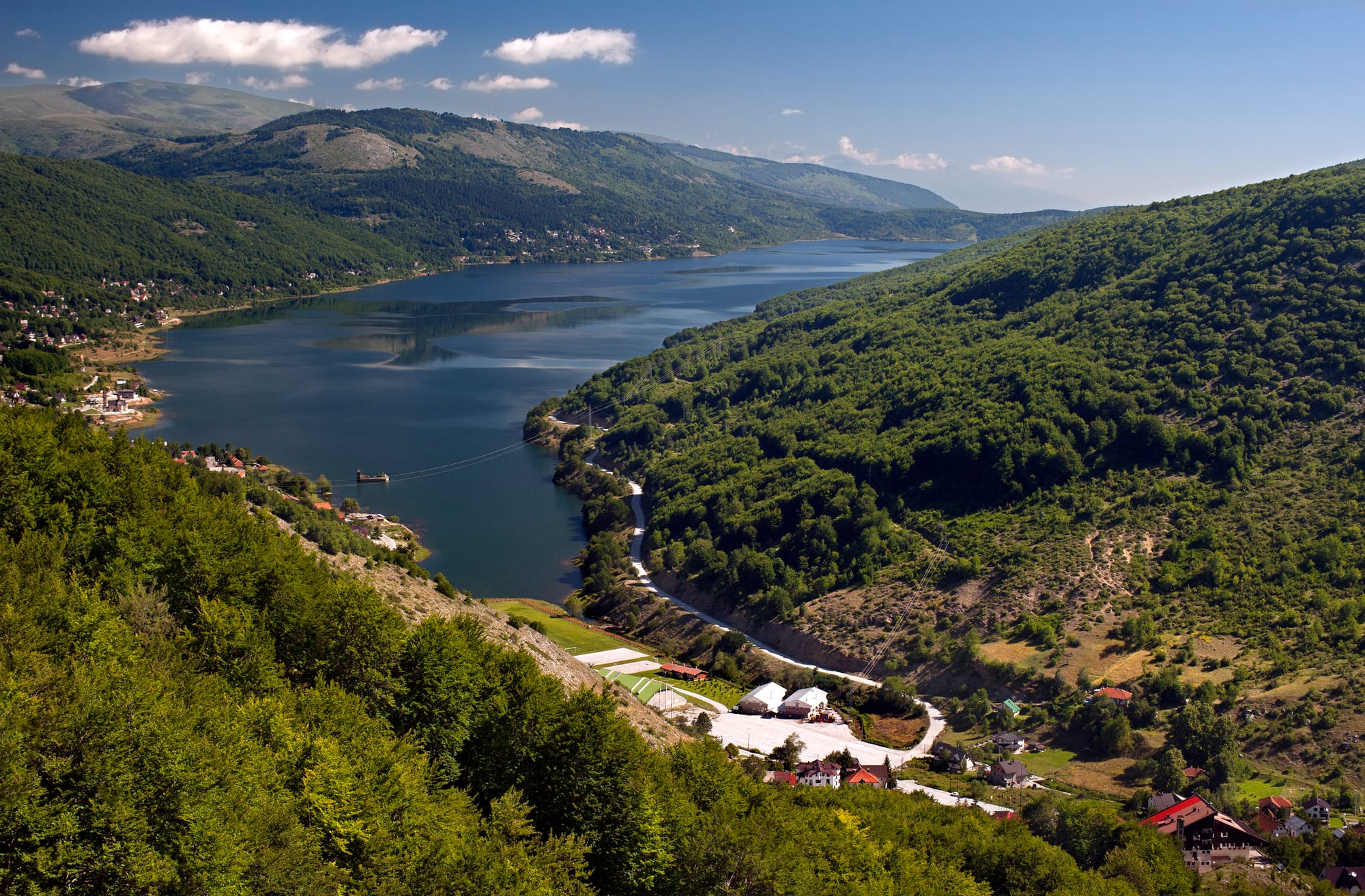
Mavrovo Lake stretching between forested green hills, with houses scattered along the shore under a blue summer sky

North Macedonia

Mavrovo

Mavrovo Lake and the villages on its shore in summer, in Mavrovo National Park. (Ggia / Wikimedia Commons · CC BY 3.0)

A small village and resort in the mountains of western North Macedonia, on the shore of Mavrovo Lake inside the country's largest national park. Its old church of Saint Nicholas was drowned when the reservoir filled in 1953 and now rises out of the water in dry years; the slopes of Mount Bistra above it hold one of the country's main ski resorts.

Neighbourhoods

  • Mavrovo village
    • Skiing
    • Lake views
    • Quiet and residential

    The small village on the lakeshore below Mount Bistra, with the ski slopes rising behind it, the half-submerged old church in the water below and a newer church of Saint Nicholas built above the shore in 2006.

    Open in Maps
  • Mavrovi Anovi and the lakeshore villages
    • Lake swimming
    • Places to eat

    The villages strung around the reservoir, including Mavrovi Anovi, Leunovo and Nikiforovo, with guesthouses, restaurants and access to the water for swimming, boating and fishing in summer.

    Open in Maps

Things to do

The lake and the village

  • Submerged Church of Saint Nicholaslandmark

    The village church built in 1850 and drowned when the lake was filled in 1953; droughts this century have left it largely standing clear of the water, and when the shore dries it can be visited.

    Open in Maps
  • Mavrovo Lakepark

    An artificial lake of 13.7 square kilometres between the Šar Mountains and Mount Bistra, used in summer for swimming, boating and trout fishing.

    Open in Maps
  • Zare Lazarevski Ski Resortattraction

    One of the country's main ski resorts, on Mount Bistra above the lake, with runs from about 1,960 m down to 1,250 m served by chairlifts and drag lifts.

    Open in Maps
  • Church of the Dormition, Leunovolandmark

    The prominent village church on the lakeshore at Leunovo, built in 1840 on a site where a church stood as early as the 14th century, with a stone bell tower beside it.

    Open in Maps

The national park

  • Mavrovo National Parkpark

    The largest national park in the country, about 780 square kilometres of canyons, lakes and forests, established in 1949 and one of the last refuges of the Balkan lynx.

    Open in Maps
  • Radika gorgetrail

    The valley of the Radika river, which has carved a long gorge up to 1 km deep between Korab and Dešat to the west and Bistra to the east.

    Open in Maps

Short trips from the village

  • Galičnikattraction

    One of the two biggest and oldest Mijak villages, with well-preserved traditional architecture and an amphitheatre in the village square, home of the July wedding festival.

    Open in Maps
  • Saint Jovan Bigorski Monasterylandmark

    A monastery on a mountainside above the Debar–Gostivar road, one of the most important spiritual places for Macedonians, famous for its carved wooden iconostasis of 1829–35.

    Open in Maps

Seasonal events

  • Galičnik Wedding Festivalthe weekend nearest 12 July

    A two-day festival in the nearby village of Galičnik, during which a chosen couple marry in the traditional Mijak ceremony, with costume, music and dance.

Eat and drink

Long-standing places and food districts in Mavrovo. Hours, ratings and directions come from your maps app, always current.

Mavrovo classics

  • Restaurants of Mavrovi Anovineighborhood

    Restaurants in the lakeshore village of Mavrovi Anovi, close to the ski slopes.

    Open in Maps
  • Trebište cheesemarket

    The famous cheese of the area, which can be tried at a local dairy near the lake.

    Open in Maps

Experience Mavrovo

History

Mavrovo is an old village. It is recorded in the Ottoman tax register of 1467–68 for the district of Kalkandelen, now Tetovo, with 20 Christian households, and around 1900 it was a substantial mountain village of more than 1,200 people, bilingual in Albanian and Bulgarian according to the ethnographer Vasil Kanchov. In 1850 the church of Saint Nicholas was built in the village.

The great change came in the 20th century. Mavrovo National Park was founded in 1949, and the artificial Mavrovo Lake, part of the park since 1952 and one of the most extensive artificial lakes in the country, was created beside the village. In 1953 the rising water submerged the church of Saint Nicholas, but droughts in the 21st century have left it largely standing clear of the water.

Today Mavrovo is a tourist resort. The Zare Lazarevski ski resort on Mount Bistra, looking down onto the lake, is one of the country's top ski areas, and in 2006 a new church of Saint Nicholas, with a detached bell tower, was built above the shore. The village had 212 residents at the 2021 census, up from 166 in 2002.

Culture & Customs

Mavrovo belongs to the country of the Mijaks, a group of Macedonians from the villages in and around the region, known historically as master builders and craftsmen whose skill shows in the traditional houses and churches of their villages. The great showcase of that culture is the Galičnik Wedding Festival, held over the weekend nearest Saint Peter and Paul's Day, 12 July, in the nearby village of Galičnik, when a chosen couple marries in the traditional ceremony, now a cultural and tourist attraction.

The area's churches are its other inheritance. Beyond the drowned church of Saint Nicholas, the lakeshore village of Leunovo has a large church built in 1840 on a much older site, and the Saint Jovan Bigorski Monastery, founded according to tradition in 1020, is one of the most important spiritual places for Macedonians; its iconostasis, carved by Petre Filipov-Garkata between 1829 and 1835, is a celebrated example of traditional Macedonian woodcarving.

Several Mijak villages in the park, such as Rosoki, are now largely depopulated but come back to life in the summer months and at holidays, when families return.

Daily Life

About 210 people lived in Mavrovo at the 2021 census, almost all of them Macedonians. It lies in the Mavrovo and Rostuše municipality, a large and thinly populated mountain district whose seat is the village of Rostuše, and the whole municipality had only 5,042 residents in 2021. Its villages are spread across valleys and lakeshores that are far apart by road.

Life in the village follows the tourist seasons. In winter the ski resort, with its chairlifts and drag lifts, draws visitors to Mount Bistra; in summer the lake is used for swimming, boating and trout fishing, and walkers come for the national park's peaks, canyons and waterfalls, among them Korab, at 2,764 m the highest mountain in the country.

The park around the village is divided into strict nature reserves, managed reserves and a tourist zone, and it is one of the three remaining habitats of the Balkan lynx.

Food

Mountain food here is built on dairy and meat. The area is known for Trebište cheese, which can be tried at a local dairy near the lake. Selsko meso, beef, pork and lamb with mushrooms, white wine and yellow cheese, usually cooked in a clay pot, is a hearty Macedonian dish, and some restaurants in the park present themselves as ethno restaurants serving traditional food.

The rest of the menu is that of the country. Tavče gravče, made with beans and baked and served in an unglazed earthenware pot, is the national dish; ajvar, a spread of roasted red peppers that can be sweet, piquant or very hot, is eaten on bread or as a side dish; and zelnik, layers of thin dough filled with cheese, eggs, leeks or meat, is a baked pie. Šopska salad is often eaten as a starter with rakija.

To drink, there is rakija, and mastika, considered the national drink, and wines from the country's vineyards, above all the red Vranec, after a day on the slopes.

Planning tools

Budget

Mavrovo is cheap outside the ski season. Guesthouses and mountain lodges around the lake cost little, and food is simple and inexpensive; in winter ski passes and equipment hire are the main extra cost.

Daily Budget Midrange
USD 70–140 (mountain lodge, restaurant meals, a hire car, ski passes in winter)
Daily Budget Shoestring
USD 35–60 (guesthouse room, village restaurants, walking)

There are few shops and services in the village itself, so bring cash and supplies from a larger town.

Best Time to Visit

Winter for skiing on Mount Bistra; summer for swimming, boating and walking in the national park, and for the Galičnik Wedding in July. The old church is most exposed when the lake is low.

Suggested Number of Days

A day or two is enough for the village and the lake. Three or four allow time for the park's villages and monastery, and skiers and walkers often stay a week.

First Visit
1–2 days
With Surroundings
3–4 days

Transportation

A car is the easiest way to get around: the Skopje–Ohrid road crosses the national park, with regional and local roads of varying quality to the villages. A minibus between Skopje and Debar serves the area, but timetables are best checked locally.

Winter driving in the mountains needs winter tyres; check road conditions before setting out in snow.

Airport & Station Connections

Skopje International Airport is the country's main gateway. Most visitors drive along the Skopje–Ohrid road, which crosses the national park, or take the minibus that runs between Skopje and Debar.

Walkability

The village is small and walkable, and paths run along the lakeshore and up into the forests. The ski slopes start just above the village. Mountain walks to the higher peaks need proper boots, maps and a good weather forecast.

Safety

North Macedonia is a safe country for visitors, with low violent crime. In Mavrovo the risks are those of the mountains: winter roads, sudden changes in the weather and remote trails.

Leave word of the planned route before walking in the high mountains, and drive slowly on icy roads in winter. Check current official travel advice before travelling.

Climate

A mountain climate. Summers are the season for the lake and the trails; in winter the lake freezes over and the slopes of Mount Bistra are used for skiing.

Summer
the season for swimming in the lake — for comparison, summer days in Skopje are usually above 31°C and sometimes above 40°C
Winter
cold, with the lake freezing over — for comparison, winter days in Skopje reach roughly 5–10°C, with nights often below 0°C

Local Customs

The village is Macedonian and Orthodox, part of the area of the Mijaks, a group of Macedonians long known for their building and artistic skills. Churches and monasteries are places of worship first.

Dress modestly at the monasteries — at Bigorski, skirts and shawls are provided for women and loose trousers for men.

Common Payment Methods

The currency is the Macedonian denar (MKD). Services in the village are limited, so carry enough cash.