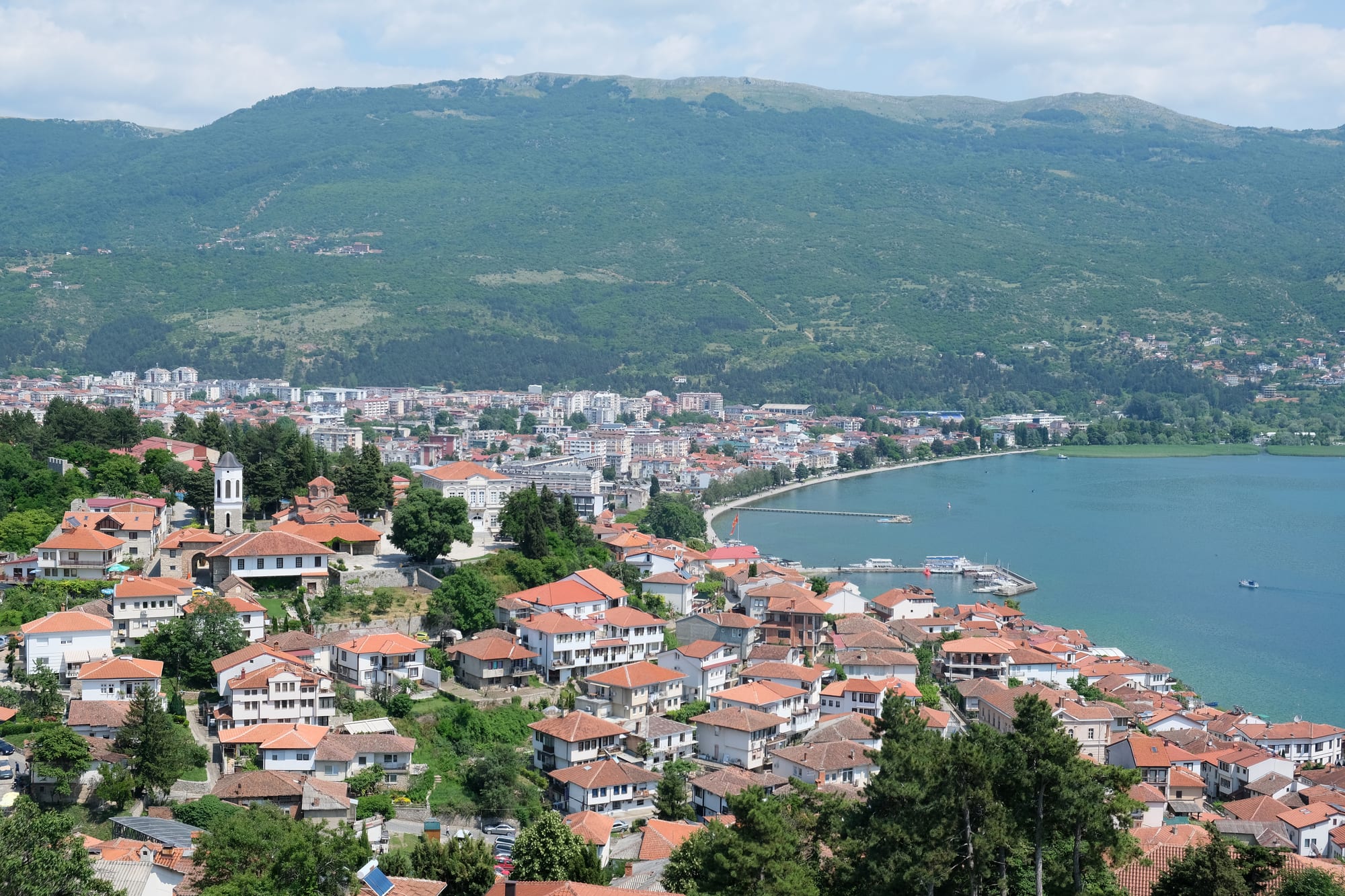
Red-roofed houses of Ohrid's old town falling to the curving lakeshore and harbour, with green mountains behind

North Macedonia

Ohrid

Ohrid on Lake Ohrid, seen from Samuel's Fortress. (kallerna / Wikimedia Commons · CC BY-SA 4.0)

The largest town on Lake Ohrid, in the south-west of North Macedonia, built up a hill crowned by Samuel's Fortress. Ancient Lychnidos, a medieval imperial capital and the seat of a powerful archbishopric, it is famed for its many churches and was listed by UNESCO with its lake; today tourism is its main business.

Neighbourhoods

  • Old Bazaar and the harbour
    • First-time visitors
    • Best for food
    • Close to public transport

    A small bazaar along essentially one street, Saint Clement of Ohrid Street, running from a market at its northern end past a square with an ancient tree to the main square facing the port. It fills with people on summer evenings, and the 15th-century Ali Pasha Mosque stands on the pedestrian street.

    Open in Maps
  • Mesokastro and the upper old town
    • Historic district
    • Views

    The hillside quarter right above the bazaar, between it and the city walls, whose name is explained as the town outside the walls, where the poor once lived. Steep lanes and old family houses such as the Robevi house look over the lake, and Saint Sophia, the ancient theatre, Plaošnik and the fortress are all a short climb away.

    Open in Maps
  • Kaneo
    • Quiet and residential
    • Lake swimming

    The old quarter of the town's poor fishermen, on the shore below the cliff church of Saint John. A small beach busy in summer and a couple of restaurants sit at the water's edge.

    Open in Maps
  • Peštani and the south shore
    • Beaches
    • Quiet and residential

    Down the eastern shore towards Saint Naum. Peštani, once a quiet fishing village, now lives from tourism, with rooms, restaurants and cafés, and Gradište beach nearby is known for its young crowd and music.

    Open in Maps

Things to do

Famous landmarks

  • Samuel's Fortresslandmark

    The walls and towers on the hilltop above the old town, named after Tsar Samuel, whose empire had Ohrid as its capital and stronghold between 990 and 1015; the ramparts look out over the town and lake.

    Open in Maps
  • Church of St. John at Kaneolandmark

    A small church, probably built in the 13th century, on the cliff over Kaneo Beach above the old fishermen's quarter.

    Open in Maps
  • Church of Saint Sophialandmark

    One of the most important monuments in North Macedonia, holding architecture and frescoes from the Middle Ages.

    Open in Maps
  • Church of St. Mary Peribleptoslandmark

    A 13th-century church in the upper old town, also called Saint Clement, which served as the cathedral of the Archbishop of Ohrid from the 15th to the 18th century.

    Open in Maps
  • Ancient Theatrelandmark

    A theatre built around 200 BC, the only Hellenistic-type theatre in the country, used for gladiator fights in Roman times and again as a stage during the Summer Festival.

    Open in Maps

Plaošnik and the old houses

  • Plaošniklandmark

    An archaeological site and holy place 250 metres south of the fortress, where Saint Clement's much-reconstructed church stands on the foundations of an earlier Christian basilica; the site is counted among the oldest centres of learning in Europe.

    Open in Maps
  • Church of Saints Clement and Panteleimonlandmark

    The Byzantine church on Plaošnik attributed to Saint Clement of Ohrid, a disciple of Saints Cyril and Methodius.

    Open in Maps
  • Robevi family housemuseum

    A large town house built in 1863–64 by a master builder from near Debar, now a protected monument belonging to the National Museum, with carved woodwork and views from its top floor.

    Open in Maps

The lake and the bazaar

  • Lake Ohridpark

    The deep lake shared with Albania, listed by UNESCO with the town; boats leave the harbour for Saint Naum and the beaches along the shore.

    Open in Maps
  • Old Bazaarmarket

    The single main street of the bazaar, with a market at its northern end and the main square by the harbour at the other.

    Open in Maps

Short trips from the town

  • Monastery of Saint Naumlandmark

    The monastery founded by the medieval writer Saint Naum on the lakeshore about 29 km south of Ohrid, reached by road or by boat.

    Open in Maps
  • Galičica National Parkpark

    The mountain rising between Lake Ohrid and Lake Prespa, protected as a national park on the Macedonian side, with an exceptional variety of plants.

    Open in Maps
  • Strugaattraction

    The neighbouring lakeside town to the north-west, linked to Ohrid by frequent local buses.

    Open in Maps

Seasonal events

  • Balkan Folklore Festivalearly July

    An annual festival of folk music and dance from across the Balkans.

  • Ohrid Summer Festival12 July to 20 August

    Theatre, classical music and dance, founded in 1961, staged in the churches, squares and ancient theatre of the old town.

  • Ohrid Swimming Marathonsummer

    An international open-water race first held in 1952, swum across the lake from Saint Naum to Ohrid harbour.

  • Ohrid Choir Festivallate August

    An international festival of choirs at the end of the summer season.

Eat and drink

Long-standing places and food districts in Ohrid. Hours, ratings and directions come from your maps app, always current.

Ohrid classics

  • Lakeside fish restaurants in Kaneoneighborhood

    Small restaurants at the water's edge below Saint John's church, in the old fishermen's quarter.

    Open in Maps
  • Fish and grill restaurants in Peštanineighborhood

    Restaurants and cafés in the former fishing village on the road to Saint Naum.

    Open in Maps

Food districts and markets

  • Old Bazaarmarket

    The market at the northern end of Saint Clement of Ohrid Street, the bazaar's single main street, which runs down to the harbour.

    Open in Maps
  • The harbour and main squareneighborhood

    The main square at the lake end of the bazaar, facing the port, at the foot of a street packed on summer evenings.

    Open in Maps

Experience Ohrid

History

The town grew up on the hill above the lake in antiquity as Lychnidos, a name usually explained as "city of light", and it was the capital of the Illyrian Dassaretii and later a Roman town whose bishops attended several ecumenical councils, and by 879 the town was already being called Ohrid. In 886 Clement of Ohrid, a disciple of Saints Cyril and Methodius, founded the Ohrid Literary School here, one of the two great cultural centres of the First Bulgarian Empire, and between 990 and 1015 the town was the capital and stronghold of Tsar Samuel's empire.

After Basil II retook it for Byzantium in 1018, the Bulgarian patriarchate was reduced to the Archbishopric of Ohrid, led almost always by Greek clergy. It remained a powerful church for centuries — at its height in the early 16th century it held sees from Sofia to Moldavia and Italy — until it was abolished in 1767. The Ottomans took the town in 1395 and made it the seat of the Sanjak of Ohrid; Muslim families settled on the flat land by the lake, while the Christian quarter stayed on the hill inside the walls, with the bazaar between them.

Ottoman rule ended on 29 November 1912, when the Serbian army took control of the town during the Balkan Wars, and it later became part of Yugoslavia. UNESCO listed Ohrid and its lake in 1979 and 1980 as a mixed natural and cultural World Heritage Site, and tourism has since become the town's main business.

Culture & Customs

Ohrid is known as the "Jerusalem of the Balkans", and the legend that it once had 365 churches, one for every day of the year, goes back to the 17th-century Ottoman traveller Evliya Çelebi. Its churches, frescoes and the monastery at Plaošnik, linked to Saint Clement and to the beginnings of Slavic literacy, make it a place of pilgrimage for the Macedonian Orthodox Church. The bazaar also keeps an older Muslim heritage, with the 15th-century Ali Pasha Mosque and a tekke of the Bektashi Sufi order.

Summer is the town's festival season. The Ohrid Summer Festival, founded in 1961 and a member of the European Festivals Association since 1994, fills the churches, squares and ancient theatre with theatre, music and dance; early July brings the Balkan Folklore Festival, and the end of August an international choir festival. The Ohrid Swimming Marathon, first swum in 1952, sends competitors 30 km across the lake from Saint Naum to the harbour.

The old houses of the hillside quarters, with their overhanging upper floors, are a local identity of their own — several, such as the Robevi, Uzunov and Prličev family homes, are now museums. The town's handball club, RK Ohrid, plays in the top national league.

Daily Life

About 38,800 people lived in Ohrid at the 2021 census, making it the largest town on the lake and the eighth-largest in the country, and the municipality takes in villages along the eastern shore. Its population is mainly Macedonian, with Albanian, Turkish and Roma communities, and many Macedonian families trace their origins to villages of the surrounding districts.

Tourism dominates the economy. Houses in the old town and in shoreline villages such as Peštani rent rooms, and restaurants, boatmen and guides depend on a summer season that brings large numbers of visitors from across North Macedonia and abroad, some of them on budget flights into the airport outside town. In winter the town is much quieter.

Ordinary life runs around the bazaar, the market at its top end and the lakeside promenade, where people walk in the evening. The lake itself is under pressure, and its endemic trout has declined sharply.

Food

The lake has long defined Ohrid's table. Its best-known fish is the Ohrid trout, ohridska pastrmka, an endemic species of the lake and its rivers that is a speciality of both Macedonian and Albanian cooking, used in soups and other dishes; its numbers have dwindled, and fishing for it was banned from 2004 to 2014. Lakeside restaurants in Kaneo and the shore villages serve fish and grilled meat side by side.

The rest of the menu is that of the country. Tavče gravče, the national dish, is made with beans and baked and served in an unglazed earthenware pot. Ajvar is a spread of roasted red peppers that can be sweet, piquant or very hot; šopska salad is often eaten as a starter with rakija; and zelnik, layers of thin dough filled with white cheese, eggs, leeks or meat, comes from the town's bakeries alongside burek. Selsko meso, beef, pork and lamb with mushrooms, white wine and yellow cheese cooked in a clay pot, is a common main course.

To drink, there is rakija and wine from the country's vineyards, above all the red Vranec. Coffee is taken slowly at the cafés by the harbour.

Planning tools

Budget

Ohrid is inexpensive by European standards for most of the year. Prices climb in July and August, when the Summer Festival and the lake draw the year's biggest crowds; private rooms, bakeries and grill houses keep costs low, and boat trips along the shore are the main extra.

Daily Budget Midrange
USD 70–140 (mid-range hotel, lakeside restaurants, boat trips, museum tickets)
Daily Budget Shoestring
USD 35–60 (private room or hostel, bakeries and grills, local buses)

June and September bring warm weather without the peak-summer crowds.

Best Time to Visit

June to September for the lake, with July and August the busiest and liveliest months, when the Summer Festival fills the old town. May and October are quieter and good for walking the churches and the hills of Galičica. Winters are cool and the town is much quieter.

Suggested Number of Days

Two or three days covers the old town and its churches at an easy pace. Four or five allow time for the south shore, the national park and the neighbouring lakeside town; summer swimming makes many people stay longer.

First Visit
2–3 days
With Surroundings
4–5 days

Transportation

The old town is explored on foot. Local buses and shared taxis run to Struga, suburban buses and boats serve Saint Naum and the villages along the shore, and taxis are easy to find. The bus station is about 2 km from the centre. A hire car is useful for Galičica and the south shore.

Boats from the harbour stop at beaches along the way to Saint Naum in season; check departure times locally.

Airport & Station Connections

Ohrid St. Paul the Apostle Airport lies 9 km north-west of the town, with seasonal and budget flights from many European cities, and taxis into town. Most visitors arrive by bus: services from Skopje run about once an hour, and there are buses from Bitola and from Tirana in Albania.

Walkability

The old town is compact but steep. Cobbled lanes climb from the bazaar to the fortress and Plaošnik, and a path along the shore and cliff leads to Kaneo. The lakeside promenade is flat. Good shoes are needed on the polished stones, which are slippery when wet.

Safety

North Macedonia is a safe country for visitors, with low violent crime. Ohrid is a small, busy resort town; the usual worries are pickpockets in the summer crowds along the bazaar and harbour, and traffic on the narrow lakeshore roads.

Watch bags in the summer evening crowds, take care on the steep cliff path to Kaneo after dark, and swim only where others do. Check current official travel advice before travelling.

Climate

A mild climate moderated by the lake and the town's altitude, between Mediterranean and oceanic. Summers are warm and fairly dry; winters are cool, with January nights just below freezing.

Summer
warm and dry — August, the warmest month, averages highs around 28°C and lows around 14°C
Winter
cool — January averages about 2.5°C, with days around 6°C and nights just below freezing

Local Customs

Ohrid is a centre of the Macedonian Orthodox Church and its churches are working places of worship as well as monuments, and the town also has mosques and a Bektashi tekke in the bazaar. Coffee is taken slowly, and greetings are warm and unhurried.

Cover shoulders and knees in churches and mosques, follow any rules on photographing frescoes, and remove shoes on entering a mosque.

Common Payment Methods

The currency is the Macedonian denar (MKD), issued in coins and in banknotes from 10 to 2,000 denar.