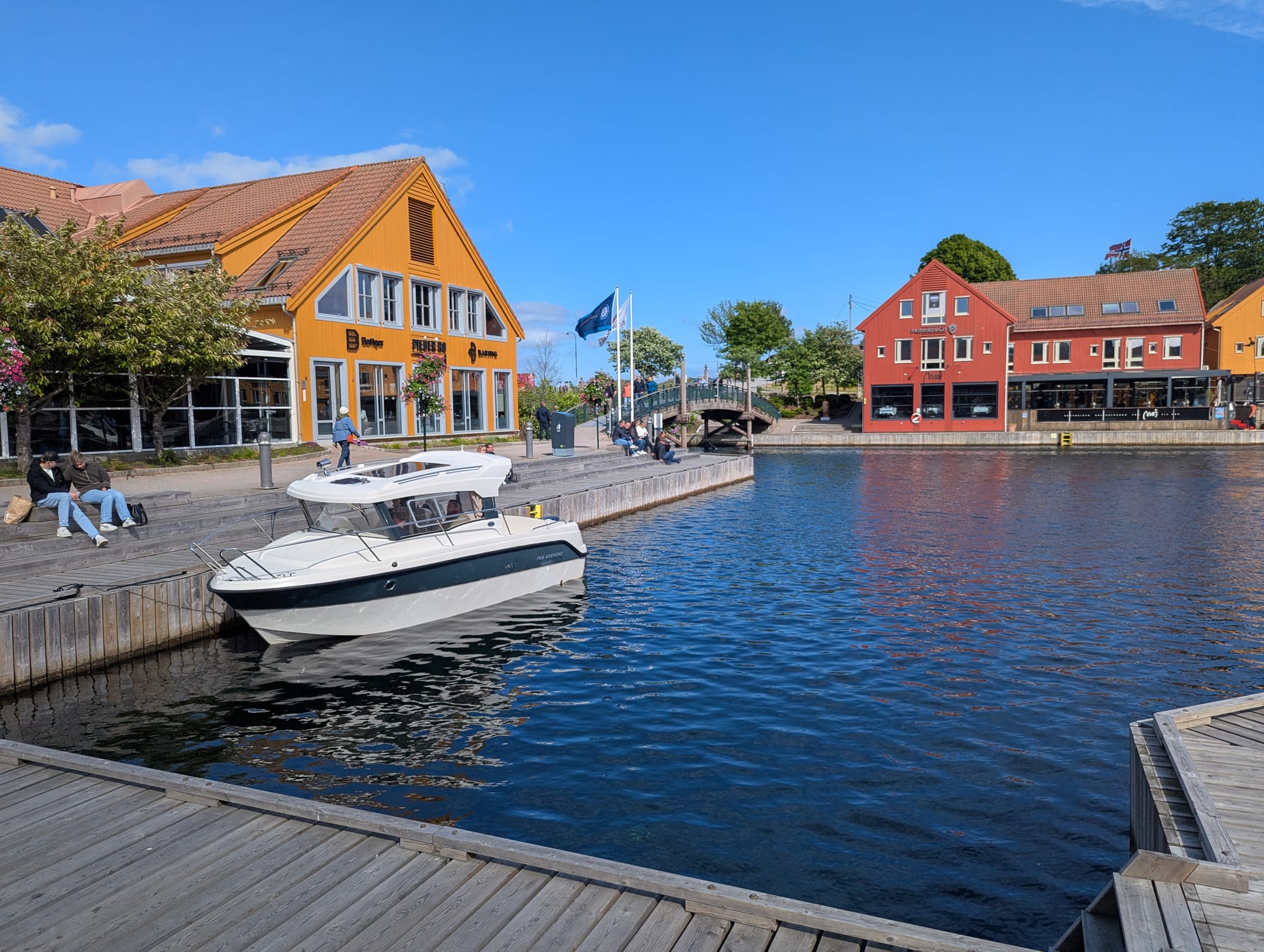
A motorboat moored in a calm canal basin lined by orange and red wooden buildings, with a footbridge behind, under a blue sky

Southern Norway, Norway

Kristiansand

Fiskebrygga, the old fish landing on the Gravane canal in central Kristiansand. (AleWi / Wikimedia Commons · CC BY-SA 4.0)

The largest city of Norway's south coast, on the Skagerrak where the river Otra meets the sea. Founded by Christian IV in 1641 on a strict grid, it grew as a garrison, cathedral and harbour town; today it is the seat of Agder county, with a university, a ferry link to Denmark, white wooden streets, a city beach and Norway's largest zoo.

Neighbourhoods

  • Kvadraturen
    • First-time visitors
    • Close to public transport
    • Shopping

    The city centre, laid out in Renaissance style on a grid of square blocks when the town was founded. The cathedral, the town hall, Markens gate — the main pedestrian street — the station, the bus terminal and the ferry terminal for Denmark are all here, and the seafront walk runs along its southern edge.

    Open in Maps
  • Posebyen
    • Historic district
    • Quiet and residential

    A part of Kvadraturen along the western bank of the Otra, made up mostly of large white wooden houses that survived the great fire of 1892. It forms the largest continuous area of old wooden houses in any city in Northern Europe, and people still live in them.

    Open in Maps
  • Fiskebrygga and Odderøya
    • Best for food
    • Waterfront
    • Arts and culture

    Fiskebrygga, the former fish landing on both sides of the Gravane canal, has wood-fronted buildings with restaurants, shops and a fish market. Across the bridges, Odderøya is a former fortress and quarantine island turned recreation area, with trails, bathing spots, the Kilden concert hall and the Kunstsilo art centre.

    Open in Maps
  • Lund
    • Students
    • Quiet and residential

    The second-largest borough, across the Otra from the centre, with traces of settlement going back to the early Iron Age. It was further built up after the Second World War, and the University of Agder is located here.

    Open in Maps
  • Vågsbygd
    • Local life
    • Quiet and residential

    A large western borough built up in the 1960s and 1970s, with housing, industry, a shopping centre and its own church. It reaches out towards the coast and the Bredalsholmen shipyard, where museum ships are maintained.

    Open in Maps

Things to do

Famous landmarks

  • Kristiansand Cathedrallandmark

    A grey brick Neo-Gothic church of 1885 in the centre, seating about 1,000 people — one of the largest cathedrals in Norway and the fourth church on the site.

    Open in Maps
  • Christiansholm Fortresslandmark

    The fortress completed in 1672 on an islet off the shore, built to defend the young town and now passed by the seafront boardwalk.

    Open in Maps
  • Posebyenneighborhood

    Streets of white-painted wooden houses spared by the 1892 fire, the largest continuous old wooden district of any city in Northern Europe.

    Open in Maps

Museums and the arts

  • Kunstsilomuseum

    An art centre on Odderøya that opened in May 2024, continuing the Southern Norway Art Museum under a new name with a much larger collection, and an emphasis on modernist art.

    Open in Maps
  • Vest-Agder Museum Kristiansandmuseum

    An open-air museum of about 40 old buildings brought from around Agder and from Kvadraturen, with a miniature model of Kvadraturen as it looked in the 1880s and 1890s.

    Open in Maps
  • Natural History Museum and Botanical Gardenmuseum

    The only natural history museum on the southern coast, at Gimle east of the Otra, with displays on the flora, fauna and minerals of southern Norway.

    Open in Maps
  • Kilden Performing Arts Centreattraction

    The theatre and concert hall on Odderøya, opened in 2012, home to the Kristiansand Symphony Orchestra, Kilden Theatre and Kilden Opera.

    Open in Maps

Parks, beaches and the waterfront

  • Odderøyapark

    An island just south of the centre joined by four bridges, used by the navy until 1993 and now a recreation area of forest trails, old cannons, bathing spots and views over the archipelago.

    Open in Maps
  • Bystrandabeach

    The city beach at the edge of Kvadraturen, with beach volleyball, playgrounds and easy access to the water, and the stage for a summer beach festival.

    Open in Maps
  • Baneheiapark

    A recreation area of hills, lakes and forest just north of the centre, given to the townspeople by Christian IV in 1641, with lit ski trails in winter and swimming in summer.

    Open in Maps
  • Ravnedalenpark

    A park in a valley north of the centre, beside Baneheia, laid out by soldiers in 1874–1878 under Colonel Oscar Wergeland.

    Open in Maps
  • Hamresandenbeach

    A three-kilometre sandy beach on the Topdalsfjord at the mouth of the Topdalselva, near the airport, the longest in the municipality.

    Open in Maps

Family days out

  • Kristiansand Zoo and Amusement Parkattraction

    Norway's largest zoo and its second most visited attraction after Holmenkollen, in Sørlandsparken east of the city, with more than a hundred species and the storybook Cardamom Town from Thorbjørn Egner's children's book.

    Open in Maps

Seasonal events

  • Free summer concerts at FiskebryggaTuesdays, late June to early August

    Free live music on the old fish landing on summer Tuesday evenings.

  • Palmesusearly July

    A music festival on the city beach, Bystranda, billed as Scandinavia's largest beach festival.

  • Bragdøya Blues FestivalJune

    A blues festival named after Bragdøya, one of the islands in the archipelago off the city.

  • ProtestfestivalSeptember

    A festival launched in 2000 that mixes political debates, lectures, concerts, performance art and documentaries to challenge apathy about politics.

  • Dark Season FestivalOctober

    An autumn music festival, one of several that run through the year in the city.

Eat and drink

Long-standing places and food districts in Kristiansand. Hours, ratings and directions come from your maps app, always current.

Food districts and markets

  • Fiskebryggamarket

    The refurbished fish landing on the Gravane canal, where a fish market still trades among wood-fronted buildings full of seafood restaurants.

    Open in Maps
  • Markens gateneighborhood

    The main pedestrian street of Kvadraturen, lined with shops, cafés and restaurants.

    Open in Maps
  • Kvadraturen's harbour restaurantsneighborhood

    Restaurants around the central waterfront and the small harbour by the fish market, many of them serving fish and traditional Norwegian dishes.

    Open in Maps

Experience Kristiansand

History

People lived along the lower Otra long before the town existed: grave finds around the church at Lund point to early settlement, and in the 14th and 15th centuries a busy port and a small village stood where the river reaches the sea. On 5 July 1641 Christian IV formally founded Christianssand on the sandy plain across the river. The town was laid out in Renaissance style on a grid — the quarter now called Kvadraturen — and merchants from across Agder were ordered to move there.

Kristiansand became a garrison and cathedral town in 1664, and Christiansholm Fortress was built to guard the harbour in 1672. Fire was the recurring disaster of a wooden town: the first great fire came in 1734, another in 1880 destroyed the cathedral, and in 1892 half the original town burned, though the wooden houses of Posebyen were largely spared. By 1848 the town had about 12,000 people.

In 1940 invading German naval forces met fierce resistance from the coastal artillery on Odderøya, and bombs fell on the centre. After the war Lund and then Vågsbygd were built up. Industry declined in the 1980s, but from the late 1990s marine and offshore equipment makers brought new growth. The University of Agder was established in 2007, Kilden opened in 2012, and in 2020 the municipality absorbed Songdalen and Søgne and the city became the seat of the new Agder county. In May 2024 the Kunstsilo art centre opened on Odderøya.

Culture & Customs

Music is the city's strongest cultural trademark. The Kristiansand Symphony Orchestra plays at Kilden Performing Arts Centre on the harbour, which it shares with Kilden Theatre and Kilden Opera, and the city hosts festivals through the year: the Palmesus beach festival on Bystranda in July, the experimental Punktfestivalen, held every year since 2005, blues, dark-season and children's film festivals, and the Protestfestival, which since 2000 has mixed debate and concerts to challenge political indifference. For several years the Quart festival, founded in 1991, was the largest music festival in Norway, before it went bankrupt.

The visual arts gained a major new home in 2024, when the Southern Norway Art Museum reopened as Kunstsilo on Odderøya with a greatly expanded collection; Kristiansand Kunsthall, founded in 1881 as the Christianssands Kunstforening, is one of the oldest art associations in the country. The zoo, Norway's second most visited attraction after Holmenkollen, recreates Cardamom Town from Thorbjørn Egner's children's book.

The south is known as Norway's Bible Belt, and Christianity is strongest in districts such as Flekkerøy and Søm, though in the rest of the city it plays a smaller part. The old spelling "Christianssand" survives in the names of many businesses and associations. Sport is followed keenly, from football to the handball of Vipers Kristiansand, and summer life centres on the water — boats, swimming from the rocks and evenings on Fiskebrygga.

Daily Life

The city has about 68,000 people (2025), making it the eighth-largest urban area in Norway, and the wider Kristiansand Municipality has over 100,000. It is divided into the boroughs of Kvadraturen, Grim, Lund, Vågsbygd and Oddernes, with the more rural Songdalen and Søgne added in 2020. Most people live in the boroughs rather than in the centre.

The economy mixes old and new industry. Glencore Nikkelverk, founded in 1910 as a nickel refinery, still operates, and makers of marine, offshore and drilling equipment have grown since the late 1990s, alongside Elkem's solar-silicon plant in Vågsbygd. The University of Agder, the county administration, the hospital and retail employ many more; Sørlandsparken, on the eastern edge, holds Norway's largest shopping centre and the zoo, which draws over 900,000 visitors a year.

The year has two speeds. From late June the city fills with Norwegian holidaymakers, boats crowd the harbour, festivals take over the beach and the islands, and many locals head for the archipelago or their summer cabins. The rest of the year follows the routine of commuting, schools and university terms, with the concert season at Kilden and walks and skiing in Baneheia.

Food

Seafood comes first. Fiskebrygga, the old fish landing on the Gravane canal, still has a fish market among its restaurants, and in summer prawns, caught by small trawlers and sold cooked at the quays, are bought by the half-kilo and eaten on the quay. Crabs are caught in pots by amateurs as well as professionals and eaten outdoors with bread, mayonnaise and lemon, and fiskesuppe is a white, milk-based soup with vegetables and various kinds of fish.

The city has long-standing names of its own in food and drink. Dampbageriet, a bakery established in Kristiansand in 1862, still runs shops in the city, and Christianssands Bryggeri has a long history in the city as a producer of beer and soft drinks. Locals are proud of beer from Agder and consider it good manners to start with a local brand in a bar. Beer is the everyday drink; wine and spirits come only from the state Vinmonopolet shops, and the high price of alcohol makes nights out expensive.

Elsewhere the menu is Norwegian home cooking: lapskaus, a stew of meat with potatoes, carrots, swede and onion; lefse, a soft flatbread made with potato, milk or cream and flour; and brunost, the sweet brown cheese of caramelised lactose from goat's milk or a mix of goat's and cow's milk, eaten with bread. Markens gate and the streets of Kvadraturen hold most of the city's cafés and restaurants.

Planning tools

Budget

Prices follow Norway's high national level. July is the costliest month, when Norwegians come south for the beaches and the zoo and the city fills with summer visitors and festival crowds. Outside the summer holidays hotels are easier to find, and many of the best things — Odderøya, Baneheia, the beaches, the seafront walk and Posebyen — cost nothing.

Daily Budget Midrange
USD 210–420 (central hotel, seafood dinners at Fiskebrygga, museum and zoo tickets, a hire car for day trips)
Daily Budget Shoestring
USD 85–140 (hostel or campsite, supermarket food, shrimp from the fish market, local buses)

Beer under 4.75 per cent is sold in supermarkets but not on Sundays; wine and spirits only from the state Vinmonopolet shops.

Best Time to Visit

Late June to mid-August is the main season, when the beaches, the islands, the amusement park and the summer festivals are at their liveliest. June and late August are quieter. Winter is mild and damp on the coast with snow that rarely lasts, but the concert season at Kilden runs through it.

Suggested Number of Days

Two days cover the centre, the waterfront and the main museums. Families who want a full day at the zoo, or visitors who want time on the beaches and the islands of the archipelago, should allow three or four. Summer festival dates fill the city quickly.

First Visit
2 days
With Surroundings
3–4 days

Transportation

The centre is compact and most visitors walk. City buses cover the boroughs, the university and Sørlandsparken with the zoo and the large shopping centre, and the bus terminal sits next to the railway station and the ferry terminal on the western edge of Kvadraturen. Sightseeing boats run into the archipelago, and a car is the easiest way to reach the coast east and west of the city.

Roads around Norway's cities have automatic tolls; for hire cars the rental company receives the toll bill and charges it on afterwards.

Airport & Station Connections

Kristiansand Airport, Kjevik, the only airport in southern Norway with scheduled flights, lies about 16 km by road from the centre, with routes to Norwegian and European cities. The city is the terminus of the railway along the southern edge of the country from Oslo, and car ferries cross the Skagerrak to Hirtshals in Denmark. The E18 arrives from Oslo and Arendal and the E39 from Stavanger and the west.

Walkability

Kvadraturen's flat grid is easy on foot: Fiskebrygga, the cathedral, Posebyen, the city beach and the fortress are all a few minutes apart, and the seafront promenade links the parks along the harbour. Baneheia and Odderøya are each a short walk from Markens gate. The zoo, the airport and Hamresanden need a bus or a car.

Safety

Norway has among the lowest crime rates in the world. Kristiansand is a quiet, safe city; the main risks are on the water — busy summer boat traffic, cold water early in the season and sudden wind on the open Skagerrak.

Wear a life jacket in small boats, keep an eye on the weather before heading into the archipelago, and use the lit, marked trails in Baneheia after dark. Check current official travel advice before travelling.

Climate

A temperate oceanic climate with cool to cold winters and mild summers. Snow generally falls from late December to February and can be heavy, but it rarely stays long on the coast. Summer makes the city an important seaside resort for Norwegians from elsewhere in the country.

Summer
mild — most July days reach 21°C or more, but 30°C is seldom reached
Winter
cool to cold, with snow most likely from late December to February that rarely lasts long on the coast; the airport's record low is −28.2°C

Local Customs

Tipping is not expected — restaurant staff are well paid — but leaving something for good service is never offensive, and rounding up a taxi fare is common. Drinking alcohol in public places is prohibited, though pavement terraces licensed to serve it are fine. Southern Norway has long been part of the country's Bible Belt; Christianity is strongest in a few districts such as Flekkerøy and Søm, and plays a smaller part in the rest of the city.

The age limit is 18 for beer and wine and 20 for spirits; there is no takeaway alcohol on Sundays.

Common Payment Methods

The currency is the Norwegian krone (NOK). Cards, contactless payment and the Vipps app are used almost everywhere, and a contactless Visa or Mastercard works throughout; cash has been a legally required means of payment since 1 October 2024, so a little cash is useful but rarely needed.