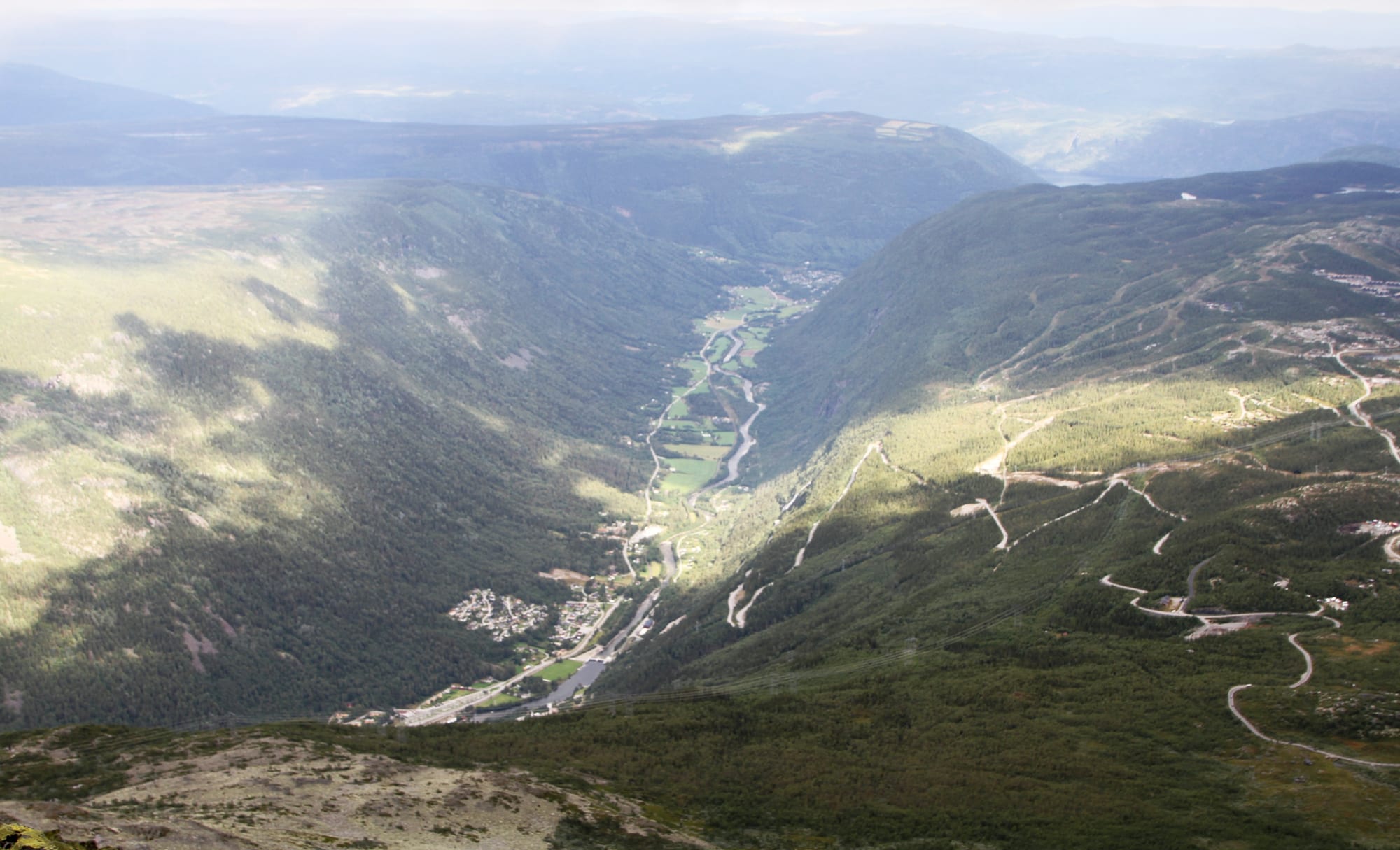
A deep forested valley seen from high above, with a small town along its floor and roads zigzagging up the slope on the right

Southern Norway, Norway

Rjukan

Rjukan on the floor of the Vestfjorddalen valley, seen from the mountainside above. (Bjoertvedt / Wikimedia Commons · CC BY-SA 4.0)

A small industrial town in the deep Vestfjorddalen valley of Telemark, built almost from scratch by Norsk Hydro in the 1910s to make fertiliser with power from the Rjukan Falls. Famous for the wartime heavy-water sabotage at Vemork and for the mirrors that light its winter-shaded square, it is part of a UNESCO World Heritage Site and a base for Gaustatoppen, skiing and ice climbing.

Neighbourhoods

  • The town centre
    • First-time visitors
    • Industrial heritage

    The planned company town strung along the valley floor and the main street, Sam Eydes gate, with workers' housing, the library and tourist office on the square, shops, and the square lit in winter by the sun mirrors on the mountainside above. The lower station of the Krossobanen cable car is on the edge of town.

    Open in Maps
  • Vemork and the west end
    • Museums
    • Wartime history

    West of the town the valley narrows towards the Rjukan Falls. The old Vemork power station, the target of the heavy-water raids, stands at the falls and now houses the Norwegian Industrial Workers Museum.

    Open in Maps
  • Gaustablikk and the Gausta area
    • Skiing
    • Hiking
    • Cabins

    The mountain area below Gaustatoppen, east of the town, with one of the largest ski resorts in Norway, cabins, and the starting points for the summit path and the cable railway inside the mountain.

    Open in Maps

Things to do

Industrial heritage

  • Norwegian Industrial Workers Museummuseum

    A museum founded in 1988 in the Vemork power station — once the world's largest hydro-electric plant — on the industrial society Norsk Hydro created here and on the wartime heavy-water sabotage.

    Open in Maps
  • Sun mirrorsattraction

    Large mirrors installed in 2013 on the mountainside north of the town that track the sun and reflect it onto part of the town square through the sunless winter months.

    Open in Maps
  • Krossobanenattraction

    An aerial tramway built in 1928 as Norsk Hydro's gift to the town so that workers could ride up into the winter sun — the first of its kind in Northern Europe, climbing 498 metres.

    Open in Maps
  • Rjukan Lineattraction

    The railway of 1909 that carried Norsk Hydro's chemicals down the valley to Mæl, where wagons were shipped across Lake Tinnsjø by train ferry; closed in 1991 and kept as a heritage railway.

    Open in Maps

Mountains and waterfalls

  • Gaustatoppenviewpoint

    The 1,883-metre peak south of the town, the highest in Telemark, whose summit views cover about a sixth of mainland Norway; a rocky summer path climbs it, and a cable railway runs up inside the mountain.

    Open in Maps
  • Rjukan Fallsviewpoint

    The 104-metre waterfall on the river Måna about 5 km west of town, a famous sight for 19th-century travellers before it was harnessed for the Vemork plant in 1905.

    Open in Maps

Short trips

  • Hardangervidda National Parkpark

    Norway's largest national park, on the high plateau above the valley, with wild reindeer herds among the largest in the world and a network of mountain huts for hiking and skiing.

    Open in Maps

Seasonal events

  • Solfestenaround mid-March

    The sun festival marking the day, around 12 March, when the returning sun first reaches the factory bridge in town again.

  • Rjukan Ice Festivalannually

    An ice festival held every year since 1995 in a valley counted among Northern Europe's best ice-climbing areas, where the lack of sun keeps the waterfall ice consistent.

Eat and drink

Long-standing places and food districts in Rjukan. Hours, ratings and directions come from your maps app, always current.

Eating in town

  • Rjukan town centreneighborhood

    The town's cafés, restaurants and pub are gathered along the main street through the centre.

    Open in Maps
  • Mountain goat cheesemarket

    Goat cheese made in the traditional way in the surrounding mountains is the local speciality to look for in shops.

    Open in Maps

Experience Rjukan

History

In 1906 the land that became Rjukan was a handful of farmsteads called Saaheim, when Norsk Hydro began planning fertiliser production in the valley with the new Birkeland–Eyde process, which fixed nitrogen from the air using electricity. The company bought the Rjukan Falls, harnessed in 1905, and built the Vemork power station in 1907–1911, then the largest hydro-electric plant in the world. Factories, workers' houses, a station and a town hall followed, the Rjukan Line carried chemicals down the valley to the train ferry on Lake Tinnsjø, and by 1920 the new town had about 8,350 people.

In 1934 Norsk Hydro added a hydrogen plant at Vemork, and its by-product, heavy water, made the site the only regular producer in Europe — and, once Germany occupied Norway in 1940, a target. The Allied operations Grouse, Freshman and Gunnerside, with Norwegian commandos dropped onto the Hardanger Plateau, knocked the plant out of production in early 1943, and in 1944 a ferry carrying heavy water was sunk on Tinnsjø.

After 1960 most of the fertiliser production moved to Herøya in Porsgrunn, and the town shrank. Tinn's council gave Rjukan town status in 1996. On 5 July 2015 the industrial landscape became part of the Rjukan–Notodden Industrial Heritage Site on UNESCO's World Heritage list. Two years earlier the town had finally realised an idea first proposed by Norsk Hydro's founder Sam Eyde about a century before: mirrors on the mountainside that reflect the winter sun onto the square.

Culture & Customs

Rjukan is a company town in its bones. Norsk Hydro built not only the plants but the houses, the institutions and the social life of the valley, and the World Heritage listing recognises the workers' housing and social buildings as much as the turbines. The Norwegian Industrial Workers Museum at Vemork, founded in 1988, tells that story alongside the wartime sabotage, which is a central part of local identity.

Light is the other theme. Gaustatoppen blocks the low sun for roughly half the year, so Norsk Hydro built the Krossobanen cable car in 1928 to carry workers up into the winter sun, and since 2013 the sun mirrors have lit part of the town square. Solfesten celebrates the sun's return around 12 March, when it reaches the factory bridge again.

The valley has drawn travellers for two centuries. In 1811 a royal geologist reported the Rjukan Falls to the king as the tallest waterfall in the world — wrongly — and the falls became a famous sight for the European upper classes; a local resistance veteran later called Rjukan "the cradle of tourism in Norway". Today the town is known among climbers as one of the best ice-climbing areas in Northern Europe, celebrated with an ice festival since 1995, and the Gaustablikk ski area is one of the largest in Norway.

Daily Life

About 3,000 people live in the town (2025), far fewer than the more than 12,000 of its industrial peak. It is the administrative centre of Tinn Municipality, and the long, narrow town follows the valley floor between the lakes Møsvatn and Tinnsjå; its main street, Sam Eydes gate, is 7 km long.

The large fertiliser works left after 1960, and tourism has become a mainstay alongside the municipal administration. Visitors come for the museum at Vemork, for Gaustatoppen and the Hardangervidda plateau in summer, and for skiing at Gaustablikk and ice climbing on the frozen waterfalls in winter.

The year is set by the light. From autumn to March the valley floor lies in the mountain's shadow, and people ride Krossobanen or drive up to the slopes to see the sun, or stand in the patch of reflected light on the square. Spring brings Solfesten, summer the walkers and hikers, and winter the skiers and ice climbers.

Food

Traditional Norwegian country food is the background here. Older dishes include fårikål, the mutton and cabbage stew counted as the national dish; rakfisk, trout salted and fermented for months and eaten without further cooking; flatbrød and lefse, a soft flatbread made with potato, milk or cream and flour; and rømmegrøt, a porridge in which the milk is replaced with sour cream.

Goat cheese made in the traditional way in the surrounding mountains is the local speciality to buy, and brunost, the sweet brown cheese of caramelised lactose from goat's milk or a mix of goat's and cow's milk, is popular with bread. Lapskaus, a stew of meat with potatoes, carrots, swede and onion, is everyday home cooking across Norway.

The town's restaurants, cafés and pub are small and gathered in the centre, and many visitors self-cater in cabins. Beer under 4.75 per cent is sold in supermarkets, while wine and spirits come from the state Vinmonopolet shops. The oddest local purchase is not food at all: tiny ampoules of real heavy water, sold as souvenirs at the museum and the tourist office.

Planning tools

Budget

Inland Telemark is cheaper than the southern coast, with campsites, cabins and mountain lodges, but Norwegian prices still apply. The museum at Vemork, the Gausta cable railway and lift passes are the main extra costs; ski holidays and Easter fill the cabins around Gaustablikk.

Daily Budget Midrange
USD 210–420 (cabin or hotel, restaurant dinners, the Vemork museum and Gausta cable railway, a hire car)
Daily Budget Shoestring
USD 85–140 (campsite, cabin share or hostel, supermarket food, buses)

A small ampoule of real heavy water is sold as a souvenir at the museum and the tourist office.

Best Time to Visit

Summer, roughly June to September, is the season for walking up Gaustatoppen, visiting Vemork and hiking on Hardangervidda. Winter brings skiing at Gaustablikk and some of the best ice climbing in Northern Europe, but the town itself is in shadow from autumn to March; the sun returns to the town in March, when it is celebrated.

Suggested Number of Days

One or two days cover the town and its industrial heritage. Allow three or four for a full mountain day, the plateau, skiing or ice climbing, which depend on the weather and the season.

First Visit
1–2 days
With Surroundings
3–4 days

Transportation

The town is long and narrow but small, and the centre is walkable. A car is the easiest way to reach Vemork, the Gausta area, the falls and the Rjukan Line at Mæl, about 14 km away; buses link the town with Notodden and beyond. Mountain roads in winter need proper tyres and care.

Tyres suited to winter conditions are needed in winter — all-year tyres are not enough — and the roads over the Telemark mountains can be icy.

Airport & Station Connections

There is no passenger railway. By car the usual route from Oslo runs via Drammen and Kongsberg, about 180 km and roughly two and a half hours. Buses from Oslo take about three hours, usually with a change at Notodden, or travellers take the train to Kongsberg and continue by bus.

Walkability

The centre is compact and flat on the valley floor, and the town square, the main street and the Krossobanen station are close together. Vemork, the falls and the Gausta area are several kilometres out and need a car or bus.

Safety

Norway has among the lowest crime rates in the world. Crime is not the concern in Rjukan; the risks are in the mountains, where Gaustatoppen and the Hardangervidda walks demand proper clothing, the south-western side of Gaustatoppen is dangerous, and winter roads can be icy.

Carry warm layers on mountain walks, keep to the marked path on Gaustatoppen, climb ice only with proper equipment or a guide, and drive carefully on winter roads. Check current official travel advice before travelling.

Climate

Inland Telemark has a continental climate: Notodden, the other town of the heritage site, has cold winters and mild summers. Gaustatoppen blocks the low sun, so the town gets no direct sunlight for roughly half the year, which keeps the waterfall ice consistent through the winter.

Summer
mild; in Notodden, the other town of the heritage site, the record high is 33.3°C
Winter
cold, as in Notodden, the other town of the heritage site; the waterfalls freeze below 0°C and the lack of sun keeps the ice consistent

Local Customs

Tipping is not expected — restaurant staff are well paid — but leaving something for good service is never offensive. The town is proud of its workers' history and its wartime story, and the right to roam lets walkers use uncultivated land freely. Drinking alcohol in public places is prohibited.

The age limit is 18 for beer and wine and 20 for spirits; there is no takeaway alcohol on Sundays.

Common Payment Methods

The currency is the Norwegian krone (NOK). Cards, contactless payment and the Vipps app are used almost everywhere, and a contactless Visa or Mastercard works throughout; cash has been a legally required means of payment since 1 October 2024, so a little cash is useful but rarely needed.