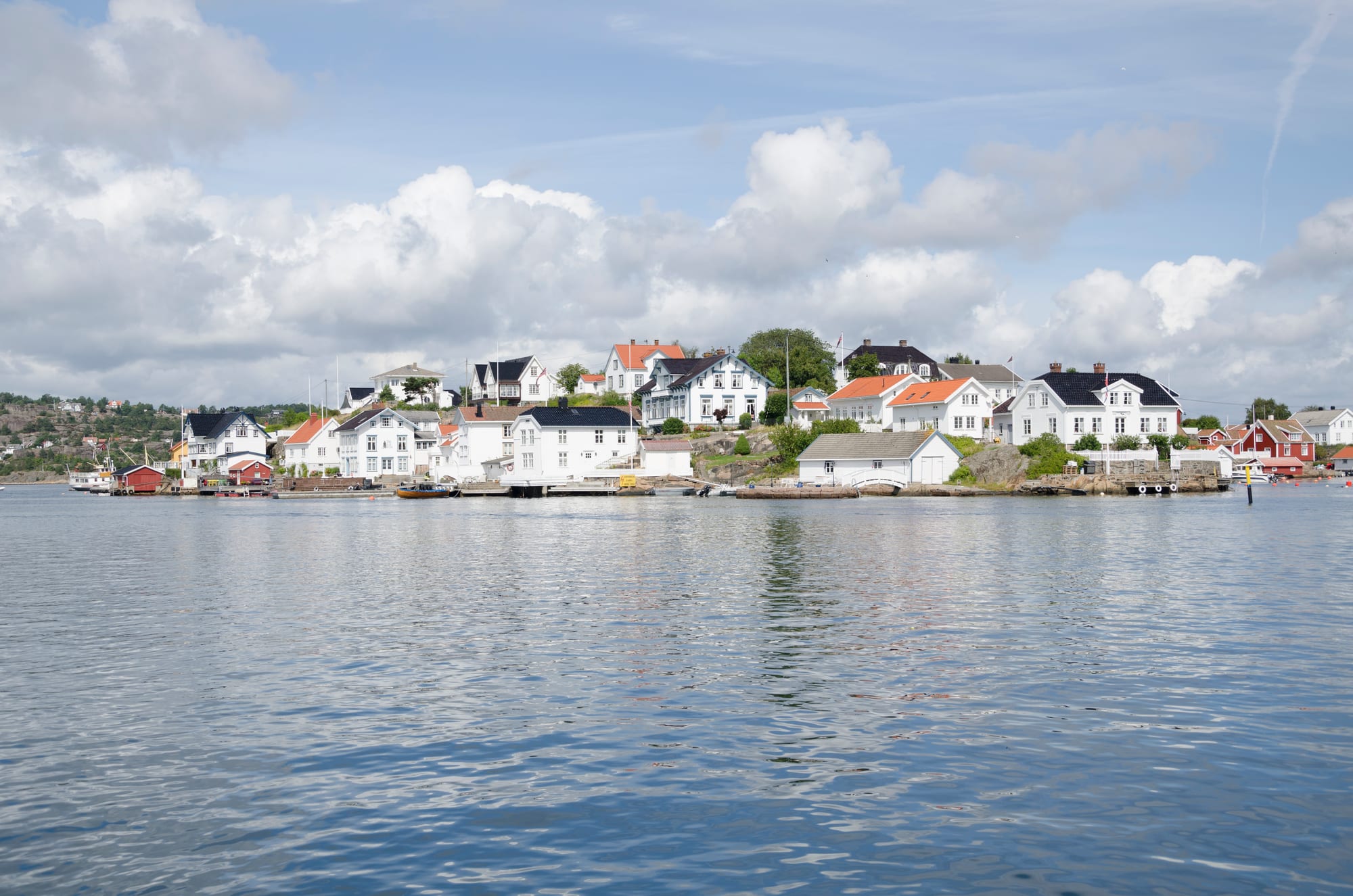
White-painted wooden houses and boathouses along the shore of a small island, seen across calm water under summer clouds

Norway

Southern Norway

White houses at Holmen in Lyngør, an island village off the Agder coast near Tvedestrand. (Peulle / Wikimedia Commons · CC BY-SA 4.0)

The southern tip of Norway, from the Viking burial grounds of Vestfold along the Skagerrak coast of white wooden towns to Lindesnes, and inland through the lakes, valleys and mountains of Telemark and Agder — the country's summer holiday coast and the cradle of modern skiing and its early hydro-electric industry.

Explore Southern Norway

History

Vestfold, on the west side of the Oslofjord, was a seat of power in the Viking Age. The great burial mounds at Borre, Oseberg and Gokstad held royal ship burials, and the Oseberg ship, dug out near Tønsberg in 1904, is among the finest finds of the Viking Age. Tønsberg itself traditionally dates its founding to before 871 and was a medieval royal town and trading port, and the trading site of Kaupang near Larvik was one of Scandinavia's earliest towns.

Under Danish rule the Skagerrak coast grew rich on timber and sailing ships. Christian IV founded Kristiansand in 1641 on a regular grid, and the harbour towns — Arendal, Grimstad, Risør, Lillesand, Mandal, Flekkefjord — built fleets that carried timber and later freight across the world. Their prosperity peaked in the age of sail in the 19th century and collapsed when steam took over, which is why so many white wooden houses of that era survive untouched. Vestfold's Sandefjord and Tønsberg turned to whaling instead and, in the early 20th century, dominated modern whaling in the Antarctic.

Inland Telemark had a different history of remote farming valleys, until waterfalls became power. Norsk Hydro built a hydro-electric plant and fertiliser works at Rjukan and Notodden from the early 1900s, creating an industrial town in a deep valley. During the German occupation the Vemork plant produced heavy water, and Norwegian commandos sabotaged it in 1943 in one of the war's most famous raids. The Rjukan–Notodden industrial landscape became a UNESCO World Heritage Site in 2015.

Culture & Customs

Agder has long been part of Norway's Bible Belt, where Lutheran lay movements, prayer houses and free churches shaped local life and politics. The southern coastal dialects are recognisable across Norway by their throaty, uvular "r", and the coast has its own easy summer image of sailboats, islands and white fences.

Telemark and the Setesdal valley are rich in folk tradition. Telemark gave its name to telemark skiing, pioneered by Sondre Norheim from Morgedal in the 19th century, and the region is known for rosemaling, wood carving, fiddle music on the Hardanger fiddle and kveding, traditional unaccompanied singing. Setesdal keeps a distinctive bunad costume, dialect, folk music and dance, and its own style of old farm buildings.

Literature has deep roots here. Henrik Ibsen was born in Skien in 1828 and worked as an apothecary's apprentice in Grimstad, and Knut Hamsun spent his later years at Nørholm near Grimstad. Summer brings festivals to the coast — Risør's wooden boat festival, jazz and blues in the towns, and the week of political debates in Arendal each summer, when much of the national political class moves south.

Daily Life

Kristiansand, with about 115,000 people after a municipal merger, is the largest city and the centre of Agder, with a university, a port and the Kilden performing arts centre. Vestfold is densely settled, with Sandefjord, Tønsberg and Larvik each home to tens of thousands, and Skien and Porsgrunn form the industrial core of Telemark. Arendal and Grimstad are the other main coastal towns; inland, Rjukan, Notodden, Bø and the Setesdal villages are small.

Work mixes old industry — the Porsgrunn fertiliser and polymer plants, Kristiansand's nickel refinery and offshore-equipment makers — with farming in fertile Vestfold, forestry and hydro power inland, and a large summer tourism and holiday-cabin economy along the coast. Many coastal houses are second homes that stand empty in winter.

Summer changes the rhythm completely. From late June the harbours fill with pleasure boats, the islands with families, and the population of small towns like Lyngør and Risør swells many times over. Out of season the coast is quiet, commuting and school runs set the pace, and local debate turns on building along the shoreline, industrial jobs and the costs of the 2020 county mergers and splits.

Food

The coast lives on seafood. Shrimp, bought boiled from the boats and fish counters, is eaten on white bread with mayonnaise and lemon as the southern summer meal, while crab parties in late summer and the opening of the lobster season in autumn are social occasions. Mackerel is grilled or smoked in summer, and cod, pollock and flatfish are the everyday catch. Kristiansand's fish market and the harbour restaurants of the coastal towns are the places to eat it.

Vestfold is one of Norway's best farming districts, producing grain, potatoes, vegetables, apples and strawberries sold from roadside stalls in July. Inland Telemark and Setesdal keep the older mountain diet of lamb and mutton, cured meats known as spekemat, trout from the lakes, flatbrød and lefse, and rømmegrøt, a sour-cream porridge served with butter, sugar and cinnamon at celebrations.

The south was long the most temperate corner of Norway in the other sense, but microbreweries now operate in several coastal towns, and aquavit and beer accompany the Christmas table as elsewhere. Summer coffee and waffles with brown cheese are served at almost every guest harbour.

Attractions & Natural Wonders

The Sørlandet coast is a long chain of white-painted wooden towns, skerries and small beaches. Kristiansand has the grid-planned wooden quarter of Posebyen, the Christiansholm fortress, the fish market, the Odderøya peninsula and the large zoo and amusement park outside town. East of it lie Lillesand, Grimstad with its Ibsen museum, Arendal's old quarter Tyholmen, the island village of Lyngør and the white town of Risør; west of it are Mandal, with the long sandy beach of Sjøsanden, the Lindesnes lighthouse at mainland Norway's southern tip, and the old Dutch quarter of Flekkefjord. Raet National Park protects islands and sea near Arendal and Grimstad.

Vestfold has Tønsberg, with the ruins of its medieval royal castle on the Slottsfjell hill, the Viking burial mounds of Borre, Sandefjord's whaling museum and the coastal town of Stavern. In Telemark, Ibsen's childhood home stands at Skien, where the Telemark Canal begins. Its locks and lakes, completed in 1892, climb past the flight of locks at Vrangfoss to Dalen, where a wooden dragon-style hotel of 1894 awaits the boats. Nearby stands Heddal stave church, the largest in Norway.

Rjukan lies in a valley so deep that mirrors on the mountainside reflect sunlight into the town square in winter. The Vemork power station houses the Norwegian Industrial Workers Museum and the story of the heavy-water sabotage, and the peak of Gaustatoppen, at about 1,880 metres, looks over much of southern Norway. Setesdal leads north into high moorland around Bykle and Hovden.

Cities in Southern Norway

Planning basics

Budget

Prices follow the national level, but the Sørlandet coast is at its costliest in July, when Norwegian families fill the harbour towns and holiday rentals, hotels and guest harbours book up weeks ahead. Inland Telemark and Setesdal are cheaper, with campsites, cabins and mountain lodges, and outside July the coastal towns are quiet and better value.

Daily Budget Midrange
USD 210–420 (hotel or rented cabin, seafood dinners, a canal boat trip, a hire car)
Daily Budget Shoestring
USD 85–140 (campsite or hostel, supermarket food, regional trains and buses)

Book July accommodation on the coast early; shrimp from the fish counters and a picnic on the rocks is the classic cheap southern lunch.

Safety

The south is among the safest parts of a safe country. The main risks are on the water: busy summer boat traffic, cold water early in the season and sudden wind on the open Skagerrak. Inland, the Gaustatoppen and Hardangervidda walks demand proper clothing, and winter roads over the Telemark mountains can be icy.

Wear a life jacket in small boats, respect weather warnings on the open coast, and carry warm layers on mountain walks. Check current official travel advice before travelling.

Climate

The south coast is the warmest and sunniest part of Norway in summer, with sea temperatures warm enough for swimming in good years, while winters on the coast are mild and damp with little lasting snow. Inland the climate turns continental: the Telemark and Setesdal valleys have warm summers and cold, snowy winters, and the high plateau of Hardangervidda above Rjukan is cold for much of the year.

Summer
warm on the coast, often 20–25°C with long sunny spells; cooler on the Telemark plateau
Winter
mild and wet on the coast, around 0 to 3°C; snowy and well below freezing inland

Transportation

The Vestfold line runs from Oslo to Tønsberg, Sandefjord, Larvik and on to Skien, and the Sørlandet Railway crosses inland Telemark and Agder to Kristiansand. The coastal E18 road links the harbour towns, and Sandefjord Torp and Kristiansand have airports. Car ferries sail from Kristiansand and Larvik to Denmark. Rjukan, Dalen and the Setesdal valley are best reached by car or bus.

A car makes it easy to hop between the coastal towns and inland Telemark; in summer the Telemark Canal can be done one way by boat and the other by bus.

Best Time to Visit

Late June to mid-August is the coastal season, when the islands, beaches and harbour towns come alive and the Telemark Canal boats run. June and late August are quieter and still warm. Winter suits skiing around Gausta and in the Telemark and Setesdal valleys, while the coast is calm and grey from November to March.