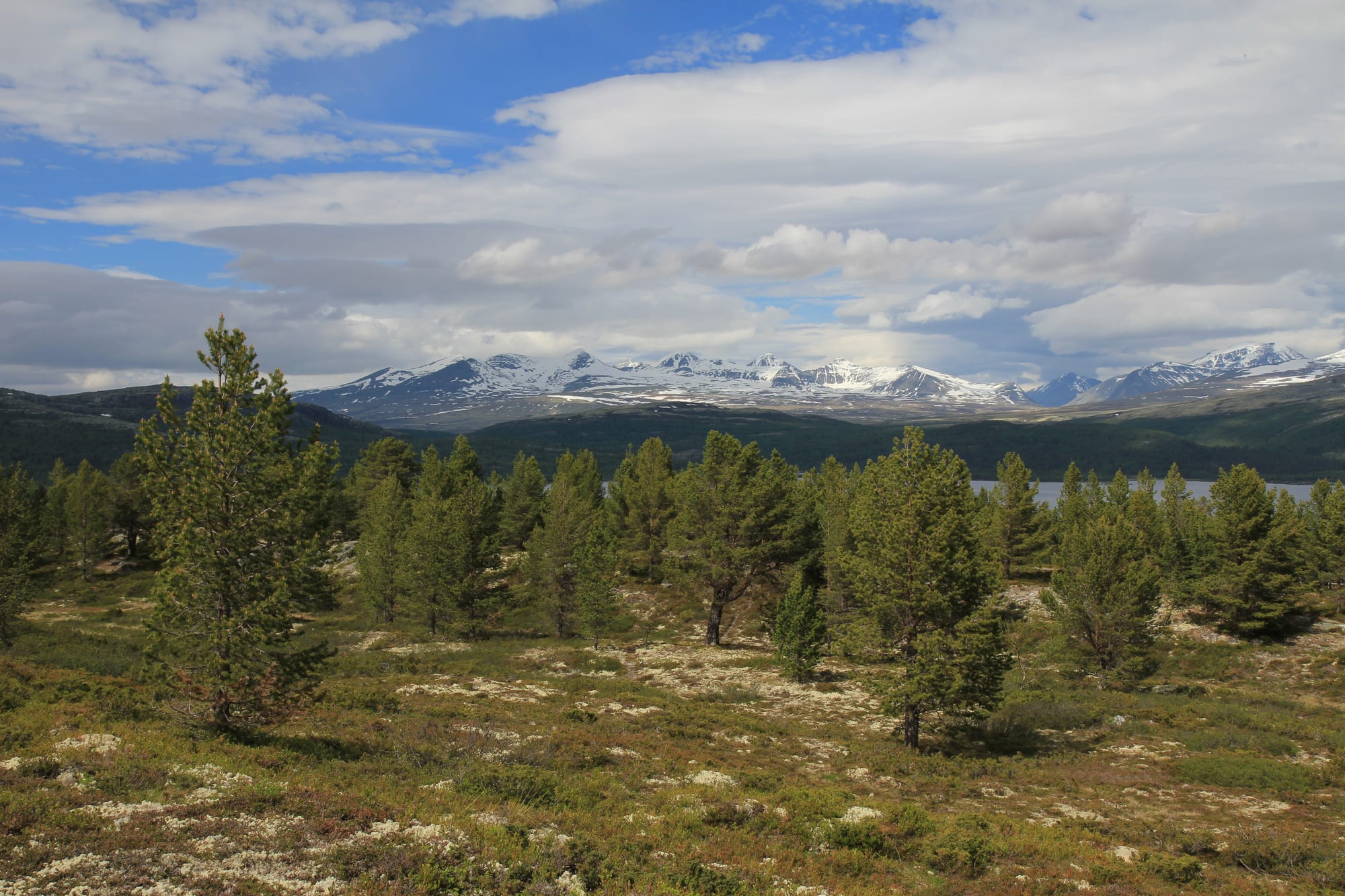
Pine trees on a lichen-covered heath with a lake behind and a line of snow-streaked Rondane peaks under a cloudy sky

Norway

Oslo & Eastern Norway

Pine heath and snow-capped peaks in Rondane, a mountain range in Innlandet county. (Øyvind Holmstad / Wikimedia Commons · CC BY-SA 4.0)

Norway's most populous region, running from the capital and the shores of the Oslofjord north through the farming valleys and forests of the interior to the high plateaus of Rondane and Jotunheimen — the country's political and economic centre, its skiing heartland and the setting of the 1814 constitution.

Explore Oslo & Eastern Norway

History

Eastern Norway's farmland made it a centre of power early. A chieftain was buried in a ship at Tune in Østfold in the Viking Age, and the vessel now belongs to the Viking Ship collection in Oslo. Hamar became a bishopric in the 12th century on the shore of Lake Mjøsa, and Oslo, traditionally founded around the 1040s by Harald Hardrada, became the royal seat under Haakon V, who built Akershus Fortress around 1300.

Under Danish rule the region was the country's commercial core, trading timber down the Glomma and other rivers to the coast. After a fire in 1624 Christian IV moved Oslo to a new grid-planned site below Akershus and named it Christiania. Fredrikstad was fortified in the 17th century against Sweden, and Halden's Fredriksten fortress saw the Swedish king Charles XII killed during a siege in 1718. Silver was mined at Kongsberg from the 1620s.

In 1814 the constitutional assembly met at Eidsvoll, north of the capital, and Christiania grew into a national capital through the 19th century, taking back the name Oslo in 1925. When Germany invaded in April 1940, the parliament met at Hamar and Elverum as the king and government fled north. Since the war the Oslo area has absorbed much of Norway's population growth, while the inland valleys of Innlandet have fought to keep their people. The 1994 Winter Olympics at Lillehammer showed off the region's ski culture to the world, and on 22 July 2011 Oslo's government quarter was bombed before the massacre on the island of Utøya in the Tyrifjord.

Culture & Customs

The east speaks the dialects closest to written Bokmål, and Oslo's speech sets much of the national standard on radio and television, though the valleys keep strong local accents of their own. Rivalry between Oslo and the rest of the country is a national pastime, and within the capital an old divide between the wealthier west side and the working-class east side still shapes politics and football loyalties.

The valleys hold the richest folk traditions in the region. Hallingdal gave its name to the halling, an acrobatic men's dance that ends in kicking a hat from a raised pole, and to a style of rosemaling, the painted floral decoration on chests and cupboards. Gudbrandsdalen is the country of Peer Gynt, the legend Ibsen turned into a play, and of carved log farmhouses, while the Finnskogen forest on the Swedish border keeps the memory of the Forest Finns who settled there from the 17th century. The bunad folk costume, worn on 17 May and at weddings, varies from valley to valley.

Skiing is central. Holmenkollen in Oslo has held ski-jumping and cross-country races since 1892, and the Birkebeinerrennet ski race from Rena to Lillehammer commemorates the flight of the infant king Haakon Haakonsson in 1206. Oslo adds the Munch and Ibsen legacies, a large jazz and pop festival calendar and the Nobel Peace Prize ceremony each December.

Daily Life

Oslo has about 710,000 people, and its wider urban area around 1.1 million, making it by far the largest city in Norway. Around it lie the commuter towns of Akershus such as Bærum and Lillestrøm, and further out Drammen, Fredrikstad, Sarpsborg and Moss. Inland, Hamar, Lillehammer and Gjøvik around Lake Mjøsa are the main towns, each with a few tens of thousands of residents, and the long valleys of Gudbrandsdalen, Østerdalen, Valdres and Hallingdal are thinly settled.

The capital runs on government, finance, shipping, energy companies, media and technology, while Østfold has older industry around the Glomma — timber, paper and chemicals — and Innlandet lives from forestry, grain and dairy farming, tourism and holiday cabins. Many Oslo families own a hytte in the mountains or on the fjord coast, and Friday traffic out of the city is a weekly ritual.

The working day starts early and ends around four, leaving time for skiing in the Nordmarka forest on winter evenings or swimming from the fjord islands in summer. Electric cars fill the streets, and the live issues are house prices, the pressure of growth on the fjord shoreline, and the contrast between the capital's boom and the ageing inland districts.

Food

The inland valleys produce Norway's grain, potatoes and dairy, and their food is built on it. Gudbrandsdalsost, the brown whey cheese named after Gudbrandsdalen, is eaten sliced on bread across the country, and the valleys make flatbrød, a thin crisp bread, and lefse. Valdres is known for rakfisk, trout fermented for months and eaten raw with onion, sour cream and lefse around Christmas, as well as for spekemat, dried and cured meats. Elk, reindeer and wild mushrooms come out of the forests of Hedmark in autumn, and fish from the lakes and rivers — trout, char and whitefish — is smoked or fried.

Oslo eats differently. The city is the centre of Norway's restaurant scene, with New Nordic kitchens alongside the everyday pølse, a sausage in lefse or a bun sold at kiosks, and shrimp bought boiled from the boats on the harbour to be eaten on bread with mayonnaise and lemon. Kjøttkaker, meat cakes in brown gravy, and fårikål in autumn are home cooking everywhere in the region.

To drink, Løiten aquavit takes its name from Løten in Hedmark, and small breweries have spread through the valleys. Summer brings strawberries from Østfold and the Mjøsa farms, ripened in the long summer light.

Attractions & Natural Wonders

Oslo fills several days. Akershus Fortress and the Resistance Museum overlook the harbour; the marble Opera House, whose roof can be walked on, and the Munch Museum stand in the new Bjørvika district; the National Museum holds Munch's "The Scream" and the city hall's murals face the fjord. Frogner Park holds Vigeland's sculptures, the Bygdøy peninsula has the Norwegian Folk Museum with its stave church and the Fram and Kon-Tiki museums, and the Holmenkollen ski jump looks over the whole city.

South-east along the fjord, Fredrikstad's Old Town, Gamlebyen, is one of the best-preserved fortified towns in Scandinavia, with star-shaped ramparts, moats and cobbled streets, and Halden's Fredriksten fortress stands above the Swedish border. North of the capital, Eidsvoll's manor house preserves the room where the constitution was signed, and Hamar has medieval cathedral ruins under a glass roof beside Lake Mjøsa, Norway's largest lake. Lillehammer has the Olympic ski jumps and Maihaugen, an open-air museum of farmhouses and a stave church gathered from Gudbrandsdalen.

The mountains lie beyond. Rondane National Park, created in 1962 as Norway's first, is a range of rounded peaks and wide lichen plateaus with wild reindeer. Jotunheimen holds Norway's highest mountains, including Galdhøpiggen at about 2,470 metres, and the Besseggen ridge walk between the lakes of Gjende and Bessvatnet. Lom and Ringebu have medieval stave churches. To the west the Hallingdal valley runs from Nesbyen past Gol, Ål and Torpo's stave church to the ski resorts of Geilo and Hemsedal.

Cities in Oslo & Eastern Norway

Planning basics

Budget

Oslo is the most expensive place in Norway to sleep and eat, though its museums, parks and public transport pass offer good value, and many sights are outdoors and free. The towns of Østfold and the inland valleys cost a little less, and staffed mountain lodges and campsites in Rondane and Jotunheimen keep a walking trip affordable by Norwegian standards.

Daily Budget Midrange
USD 210–420 (mid-range hotel or mountain lodge, restaurant dinners, museum tickets, a hire car in the valleys)
Daily Budget Shoestring
USD 85–140 (hostel or campsite, supermarket food, local trains and buses)

A multi-day Ruter ticket covers Oslo's metro, trams, buses and harbour ferries; buy picnic food in supermarkets before heading into the mountains.

Safety

Oslo is safe by European standards; pickpocketing around the central station, Karl Johans gate and in summer crowds is the main urban risk, and a few areas have drug dealing late at night. In the mountains the hazards are the usual Norwegian ones: fast-changing weather, snow on high routes, river crossings and long days on exposed ridges such as Besseggen. Moose on inland roads are a real danger at dusk.

Keep bags close in central Oslo, carry warm layers and check the weather before high walks, and drive carefully in the forests at dawn and dusk. Check current official travel advice before travelling.

Climate

The east lies in the rain shadow of the western mountains and is drier and more continental than the coast. Oslo has warm summers and cold, snowy winters; the inland valleys of Innlandet are colder still in winter, with hard frosts in Gudbrandsdalen and Østerdalen, while Rondane is relatively dry. The high peaks of Jotunheimen hold snow well into summer.

Summer
warm and fairly dry, often 20–25°C in Oslo and the lowlands; cooler and changeable in the mountains
Winter
cold and snowy, around −5 to 0°C in Oslo and well below −10°C in the inland valleys

Transportation

Oslo Gardermoen airport is linked to the city by fast trains, and the capital is the hub of the rail network: lines run south-east to Fredrikstad and Halden, north along Lake Mjøsa to Hamar and Lillehammer and up Gudbrandsdalen towards Trondheim, and west through Hallingdal on the Bergen Railway. Buses reach the national-park trailheads in summer, but a car gives the most freedom in the valleys and mountains.

Oslo to Lillehammer takes around two hours by train; mountain roads such as the Sognefjellet road close in winter, so check before driving.

Best Time to Visit

June to September for Oslo's long evenings, the fjord islands and walking in Rondane and Jotunheimen, where most high routes are snow-free from July. Constitution Day on 17 May is celebrated with special ceremony in Oslo, with the children's parade passing the Royal Palace. December to March is the season for cross-country skiing around Lillehammer, Hallingdal and Oslo's own forest, the Nordmarka.