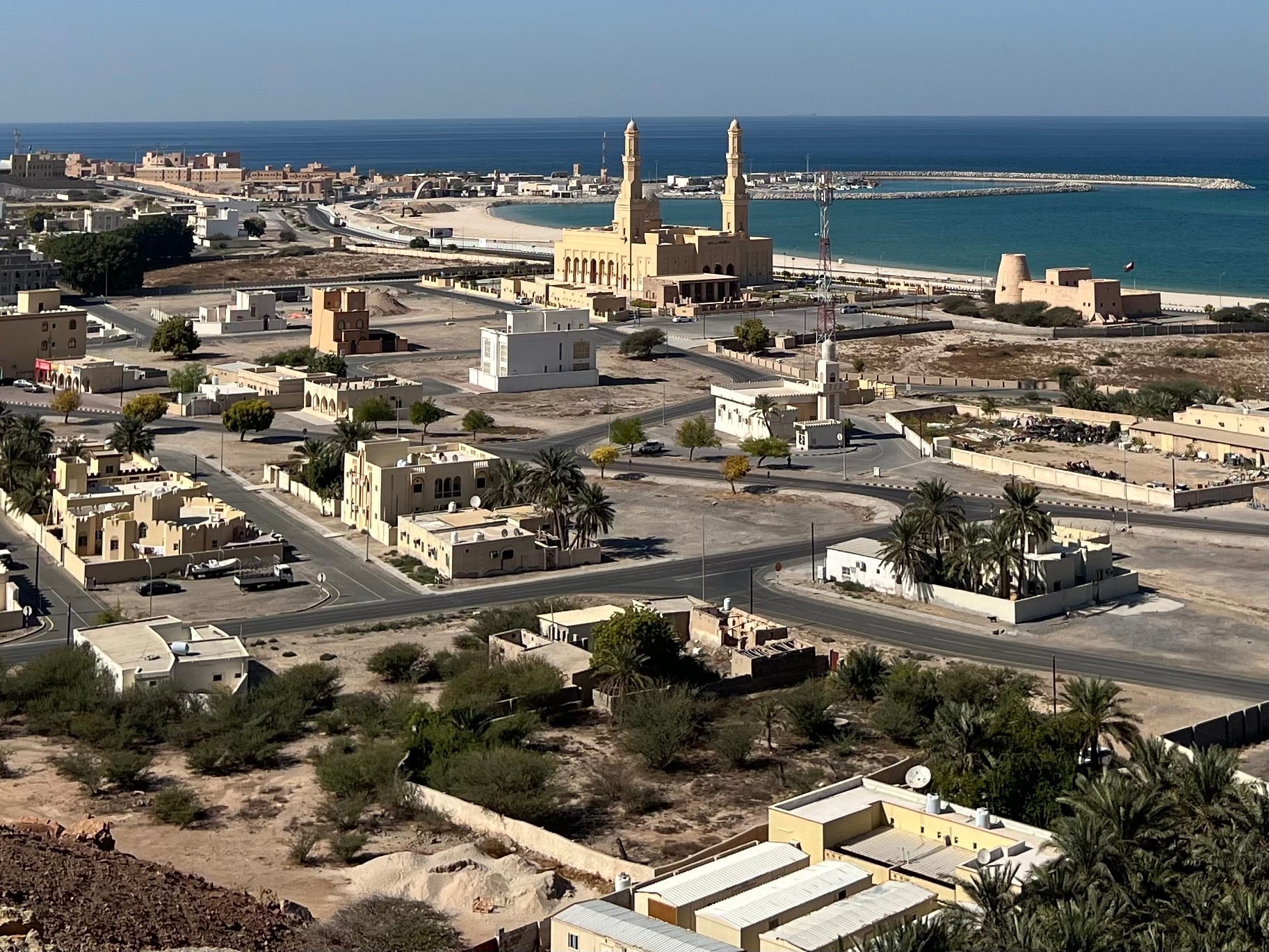
A low coastal village of pale flat-roofed houses and palms, with a twin-minaret mosque and a small fort beside a blue bay

Musandam, Oman

Bukha

Bukha spread along its coastal plain, with the mosque, the shoreline fort and the Gulf beyond. (Sdtrams / Wikimedia Commons · CC BY-SA 4.0)

A coastal village on the west side of Oman's Musandam peninsula, on the road between the United Arab Emirates border and Khasab. Low houses, date gardens and a large mosque spread across a narrow plain between bare mountains and the Gulf, and a restored fort stands beside the shore above a small fishing harbour.

Neighbourhoods

  • The fort and the shore
    • First-time visitors
    • Historic district
    • Sea views

    The old core of the village, where the restored fort stands almost on the beach with a watchtower on the ridge above it. The shoreline beside it is open and stony, and the large modern mosque nearby is the village's most visible landmark.

    Open in Maps
  • The harbour
    • Local life
    • Fishing boats

    A small working harbour behind a breakwater, where the village's launches land kingfish, tuna and sardines in the morning. Nets, ice and boat repairs fill the quay, and the water is clear enough to see fish from the wall.

    Open in Maps
  • The village and the date gardens
    • Quiet and residential
    • Walks

    Inland of the coast road, walled compounds, low concrete houses, small shops and plantations of date palms spread over the plain towards the foot of the mountains. It is residential and unhurried, with the wadi bed running back into the hills.

    Open in Maps
  • The coast road
    • Drives
    • Close to the border

    The highway that carries all traffic between the border and Khasab runs the length of the village, lined with petrol stations, cafeterias and workshops. Its northern and southern stretches run beneath cliffs that fall straight to the sea.

    Open in Maps

Things to do

In the village

  • Bukha Fortlandmark

    A restored fort standing beside the beach in a crescent bay, with a tower at one corner and the mountains rising behind it.

    Open in Maps
  • Bukha harbour and beachattraction

    The village's breakwater, fishing quay and stony shore, the best place to watch the boats come in and to look across the Gulf towards the Iranian coast.

    Open in Maps

Along the peninsula

  • Khasabneighborhood

    The capital of Musandam, a short drive north-east along the coast road, with its own fort, a souk and the harbour from which dhow cruises leave.

    Open in Maps
  • Telegraph Islandlandmark

    A rocky islet in the inlet of Khor ash Sham holding the ruins of a British telegraph repeater station of the 1860s, visited on boat trips from Khasab.

    Open in Maps
  • Jebel Harimviewpoint

    The highest mountain of Musandam at 2,087 metres, reached by a steep graded track from Khasab that passes fossil-bearing rock and highland villages.

    Open in Maps
  • Kumzarneighborhood

    A village near the northern tip of the peninsula, reachable only by boat, whose people speak Kumzari, a language of Iranian origin.

    Open in Maps
  • Khasab Airporttransit hub

    Musandam's small airport, the peninsula's air link with the rest of Oman.

    Open in Maps

Eat and drink

Long-standing places and food districts in Bukha. Hours, ratings and directions come from your maps app, always current.

Eating in the village

  • Cafeterias on the coast roadneighborhood

    A handful of plain roadside places serving grilled fish and chicken, biryani, curries, shawarma and tea to drivers and local families; there is little else in the village after dark.

    Open in Maps
  • Fish landed at the harbourmarket

    Kingfish, tuna, grouper and sardines come off the launches in the morning and are sold at the quay, much of the catch going on to Khasab and across the border.

    Open in Maps

Nearby

  • Khasab's restaurants and soukneighborhood

    The nearest choice of seafood grills, Omani and South Asian kitchens and shops selling dates, coffee, spices and Iranian produce, about half an hour up the coast.

    Open in Maps

Experience Bukha

History

Bukha's plain has one of the few reliable stretches of cultivable ground and fresh water on the west coast of Musandam, and people have lived and fished here for a very long time; graves and stone structures in the surrounding hills point to settlement long before written records. Its position, within sight of the shipping lanes at the mouth of the Gulf, tied it from the start to the sea rather than to the interior.

The fort beside the shore is the village's defining monument. Accounts of its origin differ, crediting it both to a Shihuh sheikh of the medieval centuries and to the period when Portuguese power dominated the Gulf; it guarded the anchorage and the water supply above a crescent beach, and a watchtower on the ridge above watched the approaches by land. Control of this coast was contested for centuries between the Omani sultans, the Qawasim of Ras al Khaimah and the Shihuh tribes of the mountains, and the modern border between Oman and the United Arab Emirates, drawn in the second half of the 20th century, left Bukha a few kilometres inside Oman.

For most of its history the village was reached by boat or by mountain path. That changed with the building of the coastal road, which linked Bukha to the border in one direction and Khasab in the other and made the west coast route the way most people now enter Musandam. Schools, a health centre, mains power and water, a breakwater for the fishing fleet and a large new mosque followed, and the fort was restored as a heritage site.

Culture & Customs

The people of Bukha are largely Shihuh, the mountain and coast dwellers of Musandam, who speak their own dialect of Arabic and who traditionally divided the year between highland villages and the shore, coming down to the date gardens in the hot months. Their stone lock houses in the mountains, the bayt al-qufl, with heavy carved doors securing grain and belongings while families were away, are the best-known expression of that seasonal life. Tribal descent and family connection still order much of village society, and households are linked by marriage across the peninsula and over the border.

Custom here is conservative and unshowy. Men wear the white dishdasha with an embroidered kummah cap or a turban, adding the khanjar, the curved silver dagger, on national and family occasions; women wear covering dress in public, often with the regional face veil among older generations. Hospitality is formal: dates and cardamom coffee are offered to any visitor, and refusing them outright is awkward.

The religious calendar sets the rhythm. Ramadan quietens the day and fills the night, and the two Eids bring visiting, new clothes, gifts for children and large shared meals. Weddings run over several days, with drumming and sung poetry, and the sea supplies the rest of local identity — boat handling, fishing knowledge and the traffic of small craft up and down a coast that faces Iran across a narrow strait.

Daily Life

Bukha is a small place — a few thousand people in the village and the settlements around it, part of a governorate whose whole population was about 49,000 at the 2020 census. It is the seat of its own wilayat, so it has government offices, schools, a health centre, a police and customs presence connected with the nearby border, and a share of the peninsula's military installations.

Work is a mixture of government and security employment, fishing, small trade, construction and services along the through road, with some families commuting to Khasab. The fishing fleet sets the early rhythm: boats go out before dawn, land the catch in the morning, and much of it is trucked north to Khasab or south across the border. Shops open early, close for the hottest hours and open again in the late afternoon, when children play on the shore and men gather outside the mosque or by the harbour wall.

Most people live in walled single-storey compounds among the palms, with air conditioning running for much of the year and rooftop water tanks visible above every house. The village has grown noticeably in recent years, with new housing, the mosque and harbour works spreading along the plain. Distance remains the constant: anything specialist means a drive to Khasab, or a journey through the United Arab Emirates to reach the rest of Oman.

Food

Fish dominates the table. Kingfish, tuna, grouper, snapper and sardines come off the launches each morning and are grilled over charcoal, fried in spiced flour, or cooked in a sauce of tomato, onion, garlic, turmeric and dried lime and eaten with rice. Mashuai, a whole spit-roasted kingfish served with lemon-flavoured rice, is a celebrated Omani seafood dish, and small dried and salted fish are kept for the months when boats cannot go out.

Dates from the village gardens are the other staple, eaten at any hour and always offered with kahwa, the pale coffee scented with cardamom and sometimes rose water, poured in small handleless cups. Halwa, the dense sweet of sugar, ghee, rose water, saffron and nuts stirred for hours in a copper pot, is brought out for guests and celebrations.

Festive cooking follows the Omani pattern: majboos, spiced rice with meat or fish; harees, wheat and meat beaten into a smooth paste; and shuwa, meat marinated in spices, wrapped and buried in an earth oven for Eid. Goats from the mountains provide milk and meat, and thin flat bread baked on a hot plate accompanies most meals. Roadside cafeterias add the biryani, curries and shawarma of the region's South Asian and Levantine kitchens, and Iranian fruit, nuts and sweets reach the shops from across the water.

Planning tools

Budget

Bukha has very little accommodation of its own, and most visitors stay in Khasab or in the United Arab Emirates and pass through. Costs on the peninsula are driven by hotel rooms, which rise at weekends and on UAE holidays, and by boat trips; roadside meals, petrol and the fort itself cost very little.

Daily Budget Midrange
USD 160–360 (mid-range hotel, private or overnight dhow cruise, a 4x4 trip towards Jebel Harim)
Daily Budget Shoestring
USD 50–90 (simple hotel in Khasab or camping, roadside meals, a place on a shared dhow cruise)

Travel on weekdays for quieter roads and cheaper rooms, and fill the fuel tank before leaving the main road, as petrol stations are few on the peninsula.

Best Time to Visit

October to April, when the sea is calm and clear and the coastal drive and mountain tracks are comfortable; winter days are mild and occasional rain greens the wadis. Summer is very hot and humid, though the water is at its warmest. Since late February 2026 the closure of the Strait of Hormuz and attacks on shipping have affected the waters off the peninsula, and current advice should be checked whatever the season.

Suggested Number of Days

The village itself takes an hour or two and is usually seen as a stop on the coastal drive. Two or three days based on the peninsula allow for a boat trip, the mountain roads and the drive in both directions.

First Visit
Half a day
With Surroundings
2–3 days

Transportation

There is no public transport in the village and no taxi rank; a hire car is effectively necessary, and almost all visitors arrive by road between the border and Khasab. The village itself is small enough to walk, while the inlets are reached by boat from Khasab and the mountain tracks require a 4x4. The closure of the Strait of Hormuz since late February 2026 and the attacks on shipping in and near it have affected the waters off the peninsula, so boat trips, ferry links and border arrangements should be checked before travelling.

Check border rules and hire-car insurance valid in Oman before driving up from the United Arab Emirates, and drive the coast road with care in rain, when wadis can cross it.

Airport & Station Connections

Bukha lies on the coastal road a short distance inside Oman from the border crossing with the United Arab Emirates, roughly two hours' drive north from Ras al Khaimah and about half an hour south-west of Khasab, past cliffs that fall straight to the sea. It is the first Omani settlement of any size that drivers reach. Khasab Airport, with its small domestic service, is a short drive to the north-east, and ferry links between Khasab and Muscat have operated at times.

Walkability

The fort, the mosque, the harbour and the shore are within a few minutes of one another on flat ground, and the village lanes behind them are quiet to wander. Shade is scarce and pavements intermittent, so walking is pleasant between October and April and hard going in summer. Anything beyond the village requires a vehicle.

Safety

Bukha is a quiet village where crime affecting visitors is very rare. The hazards are heat and dehydration, fast traffic on the coast road, flash flooding in the wadis after winter rain, and currents and boat traffic at the harbour. The Strait of Hormuz, immediately off this coast, has been largely closed to commercial shipping since 28 February 2026, when Iranian forces declared that passages were not allowed and afterwards mined the strait; ships have repeatedly been attacked in and around it, including a tanker struck north of Khasab in March 2026 and another north of the peninsula in September, and vessels have been hit in Omani territorial waters. Coastal, port and military areas are restricted, and flights across the Gulf have been disrupted.

Carry plenty of water, keep clear of military and coastguard installations and do not photograph them, and use licensed boat operators with life jackets. Check current official travel advice before travelling.

Climate

A hot desert climate on an exposed Gulf coast. Summer is long, humid and severe, with little relief at night; winter is mild and sunnier, with occasional rain and windy spells that raise a swell along the shore. The mountains behind the village are several degrees cooler than the coast.

Summer
very hot and humid, generally 38–45°C by day, with sea temperatures in the 30s°C
Winter
mild, about 18–27°C by day, with cool nights and occasional rain

Local Customs

This is a conservative and devout village, and visitors are expected to dress modestly with shoulders and knees covered; swimwear belongs on boats and hotel beaches, not on the village shore. Greetings are unhurried, the right hand is used for eating and giving, and shoes come off before entering a home. During Ramadan, eating, drinking and smoking in public during daylight are avoided. Ask before photographing people, especially women, and do not photograph military or port installations.

Alcohol is not sold in the village and is served only in licensed hotels elsewhere on the peninsula. Tipping is not obligatory, though rounding up a bill or tipping a boat crew is welcome.

Common Payment Methods

The currency is the Omani rial, divided into 1,000 baisa. Cash is the norm in the village: small shops, cafeterias and fishermen rarely take cards, and banking facilities are limited, so money is best drawn in Khasab or before crossing the border. UAE dirhams are often accepted along this coast because of the cross-border traffic.