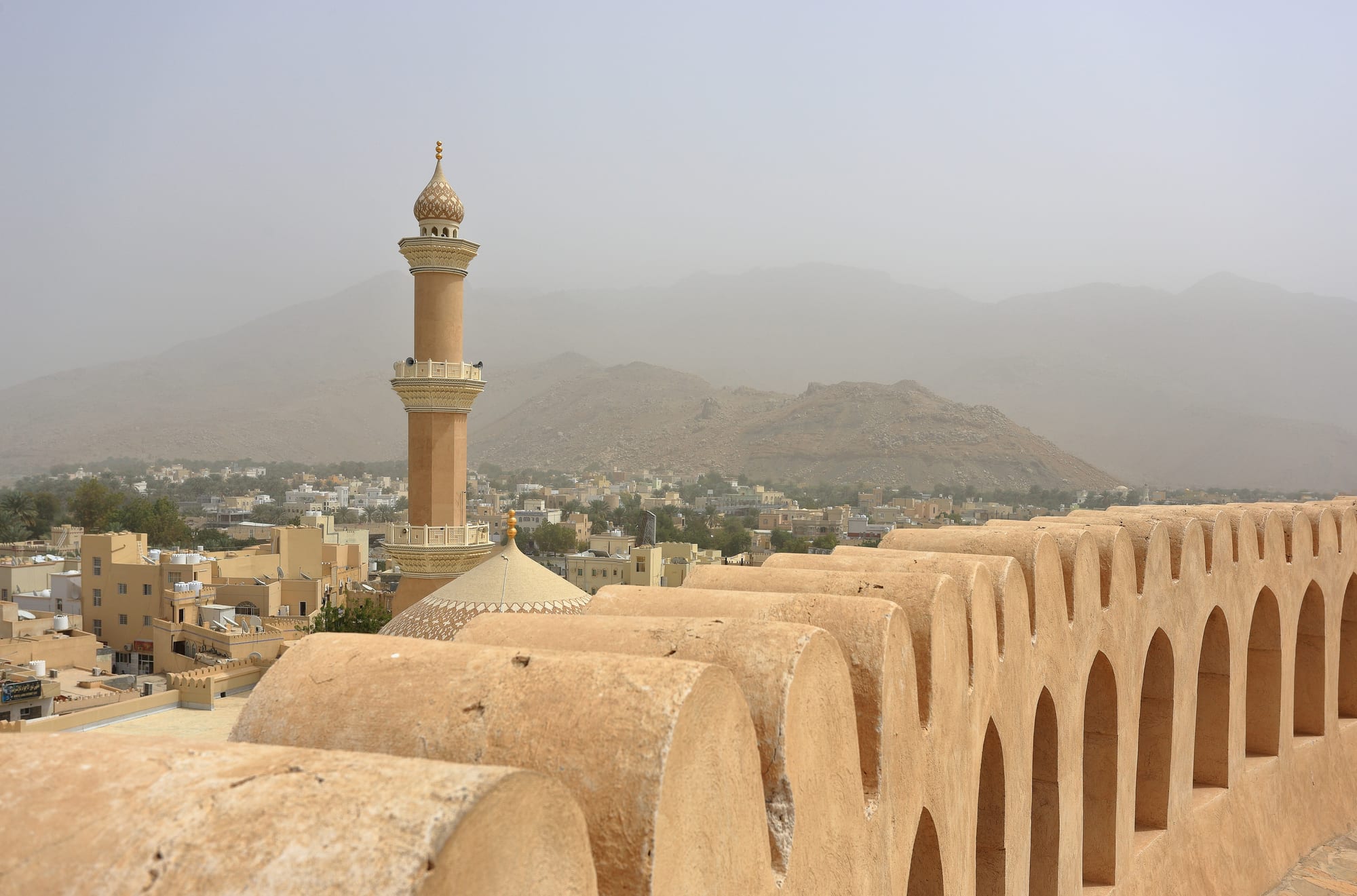
A massive round sandstone fort tower beside a mosque minaret, with a palm oasis and bare mountains behind under a clear sky

Oman

Nizwa Fort, with its great round artillery tower, in the former capital of the interior at the foot of the Hajar mountains. (Martin Falbisoner / Wikimedia Commons · CC BY-SA 4.0)

A sultanate on the southeast corner of Arabia — mountains, desert, and a long Indian Ocean coast — once the seat of a maritime empire that reached Zanzibar, transformed in one 50-year reign from an isolated backwater into a stable, quietly diplomatic modern state.

Explore Oman

History

This coast was ancient Magan, a source of copper for Mesopotamia, and the mountains of Dhofar produced frankincense for the temples and courts of the ancient world, carried out by sea and by camel caravan. Oman took to Islam early and developed its own Ibadi school and an elected imamate. The Portuguese held Muscat and the coastal forts from 1507 until Omani forces drove them out in 1650.

The Al Bu Said dynasty, ruling since 1744, then built a maritime empire that at its height controlled Zanzibar and the East African coast, the port of Gwadar on the Makran coast, and a web of Indian Ocean trade deeply entangled with the slave and clove economies of the region. British influence grew into a "veiled protectorate", the empire split as Zanzibar went its own way in 1856, and the old tension between the coastal Sultanate and the interior Imamate erupted into the Jebel Akhdar War of the 1950s.

Sultan Said bin Taimur kept Oman deliberately isolated and impoverished even after oil was found in the 1960s. In 1970 his British-educated son Qaboos deposed him in a bloodless palace coup, opened the country, ended a Marxist-led rebellion in Dhofar, and spent the next half-century using oil revenue to build roads, schools, and hospitals and to knit coast and interior together. The succession to Sultan Haitham in 2020 was smooth; he has kept Oman's careful neutrality and quiet-mediator role while pushing to diversify the economy for a post-oil future. That neutrality has been tested since 28 February 2026, when the United States and Israel went to war with Iran and its allies: Iran's blockade of the Strait of Hormuz has made the water off Oman's northern tip a conflict zone, while Muscat has stayed out of the fighting and talked to both sides. Its deep-water ports outside the strait at Duqm, Salalah, and Sohar let some shipping bypass the choke point, but Iranian drones and missiles have struck all three, killing 14 people in Oman in all.

  • Oman: The Frankincense Coast and the Indian Ocean Empire — An ancient trading land on the tip of Arabia — an early convert to a distinctive form of Islam, a maritime empire that ran Zanzibar and the East African coast, near-collapse under an isolationist sultan, and a rapid modern transformation

Culture & Customs

Oman is quietly distinctive. Its Ibadi Islam, followed by about half the population and found elsewhere only in small communities in North and East Africa, is associated with moderation and tolerance — dozens of Christian congregations are active in Muscat, alongside Hindu and Sikh communities. National dress is worn with pride: the ankle-length, collarless dishdasha; an embroidered cap or a wrapped turban; and the khanjar, the curved dagger worn on formal occasions and shown on the national flag.

Society is conservative but famously courteous. Cardamom coffee and dates are offered to any visitor, the pace is unhurried, and hospitality and modesty are points of honour. The imperial past lives on in communities with East African, Baloch, and South Asian roots — some Omani families still speak Swahili at home — and Dhofar keeps ancient South Arabian languages found nowhere else.

Camel racing, bull-butting — a bloodless contest between bulls, held nowhere else in the Middle East but Oman and Fujairah — dhow-building, silversmithing, and drumming and dance are living traditions, while the Royal Opera House in Muscat marks a cultivated, outward-looking side.

  • Oman: The Courtesy of the Shaken Cup — A distinctive school of Islam known for tolerance, a majlis where coffee is poured by the right hand and elders are served first, and a living heritage of sung poetry, sword dances and the silver khanjar

Daily Life

Oman's roughly 5.5 million people include a large foreign workforce, mostly from South Asia. Most citizens live along the northern coast — Muscat's low, white sprawl between the mountains and the sea, and the Batinah towns — with the rest in the oasis towns of the Hajar range, the deserts, the fishing coast, and the Dhofar hills.

Life is comfortable by regional standards but less lavish than in Dubai or Doha, and the state has been trimming subsidies, pressing companies to hire Omanis, and preparing for life after oil through logistics ports at Duqm, Sohar, and Salalah, tourism, gas, and large green-hydrogen projects in the southern desert. The war that began in February 2026 has pushed oil prices up, which has helped the state's finances even as the sea lanes around the country have grown dangerous.

Everyday rhythms follow the prayer times and the heat: an early start, a long midday pause in summer, and social life in the cooler evening, in majlis sitting rooms, coffee shops, and the souqs.

  • Oman: A Home Scented Every Day — Three generations sharing one household, a working week that runs Sunday to Thursday, and the smell of frankincense burned each morning as an ordinary household chore rather than an occasion

Food

Omani cooking is mild, fragrant, and shaped by Indian Ocean trade — rice, meat, and spice, with less chilli than the rest of the Gulf. The celebratory dish is shuwa: goat or lamb, marinated and slow-roasted, eaten only on festive occasions such as Eid.

Everyday meals centre on spiced rice with meat, close to biryani; grilled and stewed fish along the coast; harees, a wheat-and-meat porridge; and mashuai, a whole spit-roasted kingfish with lemon rice. Dates are eaten with everything, served alongside kahwa, the cardamom coffee.

Omani halwa — a dense, sticky sweet — is the national confection, served with the coffee and the dates at any welcome. Tea is the national beverage, and laban, a salty buttermilk, and fresh juices are drunk through the day.

  • Oman: Food and the National Dish — Meat marinated overnight and cooked slowly underground for a full day, a genuine feast dish from a country long at the heart of the frankincense trade

Attractions & Natural Wonders

Muscat has the grand Sultan Qaboos Grand Mosque, the Royal Opera House, the Mutrah corniche and its covered souq, and the two Portuguese forts guarding the old harbour. Inland, the Hajar mountains hold the "Grand Canyon of Arabia" at Jebel Shams, the terraced villages of Jebel Akhdar, and a chain of restored mud-brick forts — Nizwa with its huge round tower and its souq, the UNESCO-listed oasis fort of Bahla, and the painted ceilings of Jabrin.

The wadis — Shab, Bani Khalid, Tiwi, Dayqah — are palm-shaded gorges with turquoise pools for swimming, the Wahiba Sands offer dune camps and camel rides, and green turtles nest at Ras al-Jinz on the east coast. The Musandam peninsula in the far north, jutting into the Strait of Hormuz, has fjord-like inlets explored by dhow from Khasab.

In the far south, Salalah and the Dhofar hills turn misty and green in the summer khareef, with frankincense trees, long beaches west of the city, and the Land of Frankincense sites of Sumhuram and Al Baleed.

  • Oman: Seven Attractions and Natural Wonders — A mosque of hand-woven carpet and Swarovski crystal, a canyon locals call the Grand Canyon of Arabia, and turquoise pools hidden inside limestone gorges reached only on foot or by wading

Planning basics

Budget

Oman is mid-to-high priced for the region: cheaper than the UAE or Qatar, but a self-drive trip with a hire car, fuel, and mid-range hotels adds up. Budget options exist — guesthouses, campsites, and camping wild in the desert and mountains, which is legal and common.

Daily Budget Midrange
OMR 50–120 / USD 130–310 (three- or four-star hotel, restaurants, a 4x4, guided wadi and dhow trips)
Daily Budget Shoestring
OMR 15–30 / USD 40–80 (guesthouse or camping, local eateries, a shared hire car)

Splitting a 4x4 and fuel between travellers, and camping in the Wahiba Sands or the Hajar mountains, cuts costs sharply.

Visa Requirements

Citizens of more than a hundred countries, including most Western passports, can enter for up to 14 days without a visa. Longer or repeat stays use the e-visa, applied for online before travel, usually valid for 30 days with single or multiple entry. Rules have changed several times, so check the Royal Oman Police visa portal close to travel.

Typical Validity
Up to 14 days visa-free for citizens of over 100 countries; e-visas usually valid for 30 days

Apply for the e-visa a few days ahead through the official portal, not through third-party sites.

Safety

Oman is one of the safest countries in the Middle East and in the world, with very low crime and a stable, non-confrontational state. The real hazards are natural: flash floods in wadis, extreme summer heat, strong sea currents, and driving risks on fast highways and rough mountain tracks. Dress modestly in towns and the interior, ask before photographing people, and note that alcohol is served only in licensed venues and public drunkenness and drink-driving are treated severely. Since 28 February 2026 the United States and Israel have been at war with Iran and its allies. Oman is not a combatant and has kept to its mediator's role, but Iranian drones and missiles have struck Omani ports and industrial zones, including Duqm, Salalah and Sohar, killing 14 people, and the Strait of Hormuz off its northern tip has been largely blocked by Iran since the war began: merchant ships have been attacked, some of them in Omani waters, mines have been laid in the shipping lanes, and Omani naval and coast guard crews have rescued sailors. Airports and bases elsewhere in the Gulf have been hit by missiles and drones, oil prices have risen steeply, and aviation and tourism across the region have been disrupted. Check your own government's current official travel advice before booking and again before you fly.

Carry plenty of water on any hike or desert trip, check weather before heading into the mountains, and respect conservative dress and photography norms away from beach resorts.

Climate

Hot desert. The north — Muscat, the coast, the interior — is extremely hot in summer (daily averages of 30–40°C, higher inland, and humid on the coast) and mild and pleasant from October to April. Rain is rare and can cause flash floods in the wadis. The exception is Dhofar in the far south, where a summer monsoon (the khareef, roughly late June to late September) brings cool mist and turns the hills around Salalah green.

North Summer
May–September, averaging 30–40°C and hotter inland
North Winter
October–April, 20–30°C by day, cool nights

Transportation

Muscat International Airport is the main gateway, with airports at Salalah, Sohar, and Duqm. There is no passenger railway, though a rail link to the UAE is under construction. Modern highways make self-drive the natural choice: a 2WD covers most sights, a 4x4 is needed for wadis, the Wahiba Sands, and mountain tracks. Intercity buses (Mwasalat) link the main towns, and dhows run the Musandam fjords from Khasab.

Never drive into a flooded wadi crossing or camp in a wadi bed — flash floods drown people every year — and watch for camels on rural roads at night.

Best Time to Visit

October to April for the north — comfortable for forts, hiking, the desert, and diving. July to September for the Salalah khareef, when the south is green, misty, and cool and fills with Gulf visitors. Ramadan reduces daytime dining and opening hours.

Events
Muscat Festival (winter); the Salalah Khareef season (July–September); National Day (20 November); Eid celebrations

Currency

The currency is the Omani rial (OMR), pegged to the US dollar at about USD 2.60 — one of the highest-valued currencies in the world — and divided into 1,000 baisa. Cards are widely accepted in towns and hotels; carry cash for souqs, small restaurants, rural fuel stations, and entry fees.

Symbol
ر.ع.
Currency Code
OMR — Omani rial

Language

Arabic is the official language, in a distinct Omani dialect. English is very widely used in business, tourism, and signage and is taught from early school. Oman's history shows in its other languages: Baluchi on the Batinah coast, Swahili among families with Zanzibari roots, and the ancient, unwritten South Arabian languages of Dhofar such as Jibbali and Mehri.

English
Widely spoken in cities, tourism, and business
Official Language
Arabic