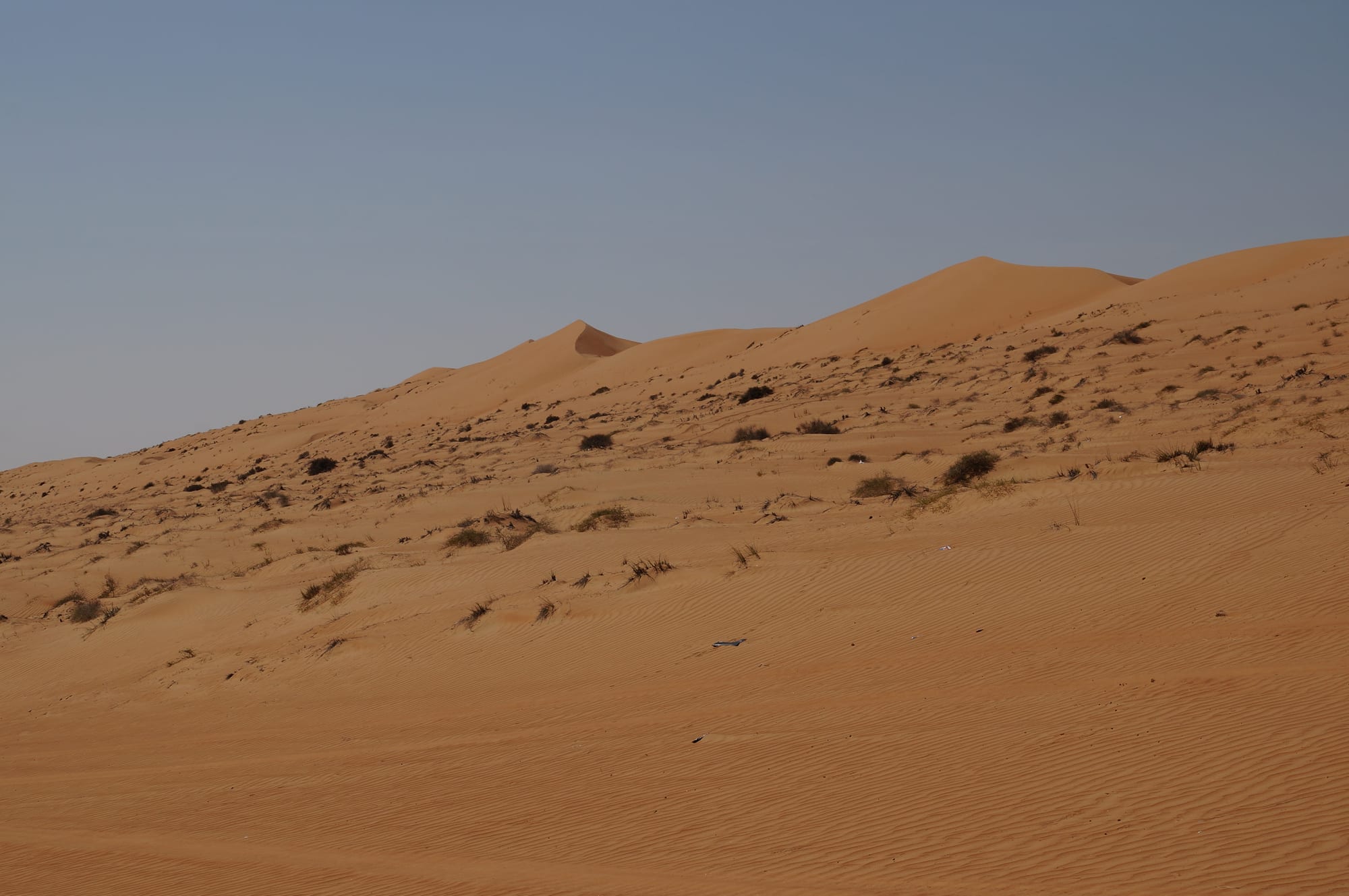
Rippled orange sand rising to a line of high dunes dotted with low desert shrubs under a pale blue sky

Oman

Sur, the Sharqiyah & the Wahiba Sands

Dunes of the Wahiba Sands, the sand desert of the Sharqiyah south of Bidiyah. (albinfo / Wikimedia Commons · CC BY-SA 4.0)

Oman's eastern corner, where the Hajar mountains fall to the dunes of the Wahiba Sands and the coast bends round Ras al Hadd at the tip of Arabia — the dhow-building port of Sur, the turtle beaches of Ras al Jinz, the palm-filled gorge of Wadi Bani Khalid and the long, wind-blown island of Masirah.

Explore Sur, the Sharqiyah & the Wahiba Sands

History

The eastern tip of Arabia was a meeting point with India long before Islam. Excavations at Ras al Jinz have found Bronze Age settlements with objects from the Indus Valley, and fishing communities have lived along this coast for thousands of years. In the Middle Ages the port of Qalhat, north of Sur, was an important stop on the Indian Ocean trade routes; Marco Polo and Ibn Battuta both described it. Earthquakes probably hastened its decline, and it was already fading when the Portuguese captured it in 1507.

Sur took its place. Its shipwrights built the large ocean-going dhows that carried dates, fish and later slaves and ivory between Oman, East Africa, Persia and India, sailing as far as Zanzibar and China. British action against the slave trade in the mid-19th century and the separation of Zanzibar in 1856 brought that era to an end. Inland, the Bani Bu Ali of Jalan clashed with the British in 1820 and 1821, and the tribes of the Sharqiyah long kept their own politics at a distance from Muscat.

After 1970 roads crossed the region for the first time, schools and clinics reached the desert, and in 2000 the Oman LNG plant near Qalhat made Sur an industrial town again. The Wahiba Sands, surveyed by a Royal Geographical Society expedition in the 1980s, became Oman's best known desert.

Culture & Customs

The Sharqiyah is a region of oasis towns, fishing ports and Bedouin, and each keeps its own ways. Ibra, the capital of North Ash Sharqiyah, is known for a souq that keeps a whole day for women, while Sinaw has a Thursday market where Bedouin come to sell livestock and handicrafts. Jalan Bani Bu Ali is known for the Al Hamoda mosque and a mosque roofed with 52 small domes.

The Bedouin of the Wahiba Sands, among them the Al Wahiba tribe that gave the desert its name, still keep camels and goats around the dunes, though most now live in settled homes and many work in the towns or in desert tourism. Camel racing, one of Oman's traditional sports, has a following here too.

Sur keeps a strong maritime identity: shipwrights, sailors' songs and a pride in the town's seafaring past. As elsewhere in Oman, guests are received with kahwa and dates, and conversation begins with a long exchange of greetings and news.

Daily Life

Sur is the region's main city, with a lagoon, a port, a university college and the gas plant down the coast. Ibra, Al Mudaybi, Al Qabil, Bidiyah and Jalan Bani Bu Ali are the market towns of the interior, and small fishing towns such as Al Ashkharah line the Arabian Sea coast. Masirah has about a dozen villages, mainly in the north of the island, and an air force base.

The economy is fishing, date farming, livestock, government jobs, oil and gas and tourism, the last concentrated around the Wahiba camps, the wadis and the turtle beaches. Many families have members working in Muscat.

Life follows the heat and the sea: fishermen land their catches at dawn, souqs are busiest in the morning and life resumes after the late-afternoon prayer. In the desert, Bedouin households water their animals at wells and trucks bring supplies; on the coast, the calendar turns on the fishing seasons and the summer winds.

Food

The coast lives on fish. Kingfish, tuna, grouper and sardines are landed at Sur and Al Ashkharah, and grilled or curried fish with rice is the everyday meal. Mashuai, a whole spit-roasted kingfish served with lemon rice, is a dish of the Omani coast.

Inland, dates and goat meat come first. Majboos, spiced rice with meat, fills the table on festive days, and shuwa, meat marinated in a spiced date paste and roasted in a pit dug in the ground, is kept for festive occasions. Harees, wheat cooked with meat to a thick paste, is served with dates and halwa.

The Bedouin of the Sands offer laban, a salty buttermilk, alongside dates and bread. Kahwa flavoured with cardamom and served with dates is poured for every visitor, and halwa is bought from Sur's shops for guests and weddings.

Attractions & Natural Wonders

Sur's attractions centre on its lagoon. In the dhow yards shipwrights still shape wooden hulls by hand, keeping alive the craft of the ganjah. Across the water the village of Ayjah has an old lighthouse, and the forts of Sunaysilah and Bilad Sur guard the approaches. North of Sur lies ruined Qalhat, a UNESCO World Heritage Site with the tomb of Bibi Maryam, and further north the gorges of Wadi Tiwi and Wadi Shab lead inland from the coast road.

East of Sur, Ras al Jinz marks the easternmost point of the Arabian Peninsula, and its turtle reserve protects a nesting beach of green turtles, as does the beach at nearby Ras al Hadd. Excavations here have also uncovered a Bronze Age harbour with pottery from the Indus Valley.

Inland, Wadi Bani Khalid has green pools, palm groves, springs and caves such as Muqal Cave. Ibra has its watchtowers and its souq, and Jalan Bani Bu Ali its many-domed mosque. The Wahiba Sands, south of Bidiyah and Al Wasil, run for about 180 kilometres of orange and honey-coloured dunes, with desert camps, camel rides and sunset drives. Off the Arabian Sea coast, Masirah island has empty beaches, kitesurfing and important nesting grounds for loggerhead turtles.

Cities in Sur, the Sharqiyah & the Wahiba Sands

Planning basics

Budget

Costs sit below Muscat's. Sur has a few mid-range hotels, while desert camps in the Wahiba Sands range from simple tents to comfortable lodges with dinner included. Masirah has a handful of hotels and guesthouses. Guided desert drives and turtle-watching fees are the main extras; a 4x4 is needed in the dunes.

Daily Budget Midrange
USD 130–310 (Sur hotel or desert camp with half-board, turtle-watching fee, 4x4 hire)
Daily Budget Shoestring
USD 40–80 (guesthouse or wild camping, local restaurants, shared car)

Book a Wahiba camp that includes pick-up from the tarmac at Bidiyah or Al Wasil rather than driving into soft sand without experience.

Safety

The region is very safe. Natural hazards are what matter: getting stuck or lost in the dunes, heat and dehydration, flash floods in Wadi Bani Khalid and other gorges after rain, slippery rocks and deep pools, strong currents off open beaches, and camels on the roads at night.

Travel in the Sands with a guide or a second vehicle, carry extra water, keep to marked paths at Wadi Bani Khalid, and dress modestly when swimming in wadis. Check current official travel advice before travelling.

Climate

Hot desert, with sharp differences between coast and interior. Sur and the east coast are humid, but the summer monsoon winds temper the heat around Ras al Hadd, Al Ashkharah and Masirah, which is windy through the summer. The Wahiba Sands and the Ibra plain are fiercely hot in summer and pleasant in winter, with cold nights in the dunes. Rare storms bring flash floods to the wadis.

Summer
40–47°C inland and in the Sands; about 32–38°C and humid or windy on the coast
Winter
22–30°C by day; nights in the desert can fall near 10°C

Transportation

Two main roads link the region with Muscat: the inland highway through Ibra to Sur, and the coast road via Qurayyat, each about two and a half to three hours. Intercity buses serve Ibra and Sur, but a car is essential for everything else, and a 4x4 with a guide for the dunes. Ras al Jinz is a short drive from Sur. Masirah is reached by car ferry from Shannah on the mainland.

Let tyres down before driving on sand and reinflate afterwards; do not enter the dunes alone or in a 2WD.

Best Time to Visit

October to April for the desert, the wadis and Sur, when desert camps are open and nights in the dunes are clear and cool. The turtle reserve at Ras al Jinz draws visitors in every season. Masirah's steady summer winds draw kitesurfers from about May to September.