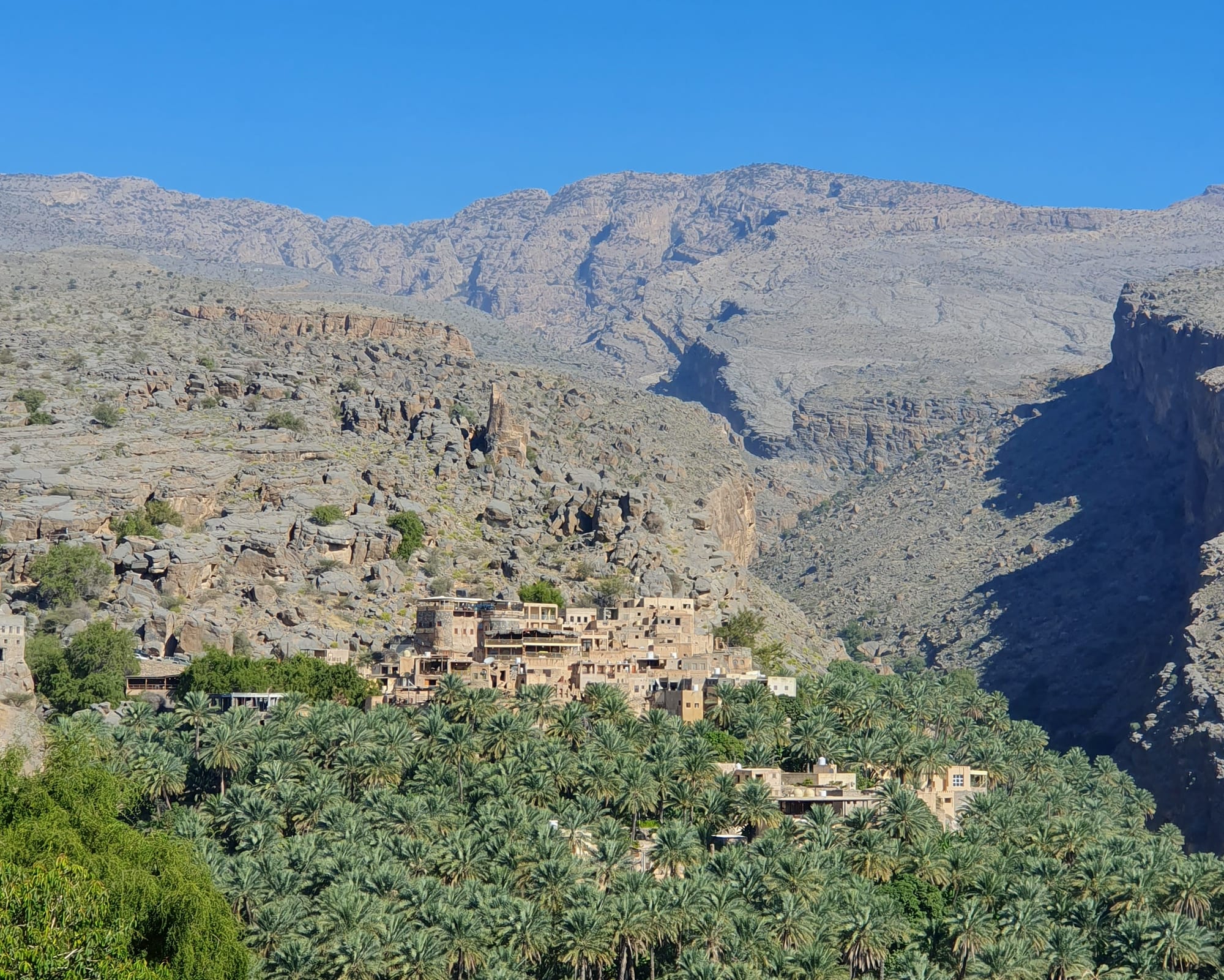
Stone and mud-brick houses of a mountain village above a dense grove of date palms, with bare grey ridges behind

Oman

Nizwa & the Interior

The village of Misfat al Abriyeen above its palm oasis on the lower slopes of the Hajar mountains near Al Hamra. (Broc / Wikimedia Commons · CC0)

The inland heart of northern Oman, stretching from Nizwa and the high Hajar peaks of Jebel Akhdar and Jebel Shams west across the gravel plains of Ibri to the Buraimi oasis on the UAE border — the old land of the Ibadi imams, of mud-brick forts, falaj-watered palm oases and terraced mountain villages.

Explore Nizwa & the Interior

History

Long before Islam, people of the interior built the stone beehive tombs and towers of Bat and Al Ayn in the third millennium BC and began digging the aflaj, the gravity-fed water channels that still water the oases; several interior channels, among them Falaj Daris at Nizwa, are part of a UNESCO World Heritage listing. The interior embraced Ibadi Islam early, and Nizwa became the seat of elected Ibadi imams in the early Islamic centuries, the religious capital of inland Oman.

From the 12th to the 15th century the Nabhani dynasty ruled from Bahla, whose great fort dates largely from their time. The Ya'ariba imams who expelled the Portuguese from the coast in the 17th century built the round tower of Nizwa fort and the palace-castle of Jabrin. The Al Bu Said founder, Ahmad bin Said, came from Adam on the edge of the desert, but his successors ruled from the coast, and the interior tribes kept electing imams of their own.

The 1920 Treaty of Seeb granted the imamate autonomy in the interior while recognising the sultan's sovereignty. In the 1950s the sultan, backed by Britain, took Nizwa, and the imam's supporters held out on Jebel Akhdar until British special forces stormed the plateau in 1959. Buraimi, on the western edge, was contested by Saudi Arabia until 1955 and is now divided between Oman and the UAE city of Al Ain. Roads, schools and restoration of the forts followed after 1970.

Culture & Customs

The interior is Oman's conservative, Ibadi heartland, and its people take pride in it as the country's historic core. Tribal ties and family names still matter, the mosque and the majlis structure daily life, and dress is traditional: white dishdasha and kummah for men, long dresses and headscarves for women. Guests are offered kahwa and dates.

Crafts survive as working trades. Nizwa's silversmiths are known for their jewellery, Bahla is Oman's pottery town and has a long reputation, recorded in local stories, as a place of jinn and sorcery, and other traditional handicrafts are sold in the souqs. On Jebel Akhdar, families still distil rosewater from the plateau's roses.

In the days before each Eid the interior towns hold habta markets, where goats, cattle and camels are auctioned alongside clothes, toys and halwa. Traditional songs and the razha sword-and-chant dance appear at weddings and national celebrations.

Daily Life

Nizwa is the region's main city and the capital of Ad Dakhiliyah, a fast-growing town with a university and new suburbs beyond its old oasis. Other towns strung along the foot of the mountains include Bahla, Al Hamra, Izki, Manah and Adam; Ibri is the main town of Ad Dhahirah and the market centre of the western plains, and Buraimi, capital of its own governorate, is a border town tied closely to Al Ain across the frontier.

The economy mixes government jobs, date farming, livestock, small trade and growing tourism around Nizwa and the mountains, with oil and gas fields further into the desert. Many residents commute or move to Muscat for work, and young Omanis' search for jobs is as pressing here as anywhere.

Days follow the prayer times and the heat. Farmers work the date gardens and maintain the falaj at dawn, the souqs are busiest in the morning, and life slows through the afternoon before evenings of visiting and coffee. On the plateau of Jebel Akhdar, villages grow fruit on terraces watered by their own channels, and the summer brings a stream of Omani families seeking cooler air.

Food

The interior eats from its oases and its herds. Dates are the staple, from everyday varieties to prized khalas, served with kahwa to every guest. Nizwa is a centre of date growing and the market place for the surrounding villages, and falaj-watered orchards ring towns such as Adam. Halwa, the dense sweet served with coffee, is a symbol of Omani hospitality.

Shuwa is the great festive dish: goat, lamb or other meat marinated in a spiced date paste, wrapped in dry leaves and lowered into a pit oven in the ground to cook slowly before the family gathers to eat it. Majboos rice with meat and harees, wheat and meat cooked to a thick paste, fill out the table, along with goat's milk and laban, a salty buttermilk.

Jebel Akhdar gives the region its orchard produce: pomegranates, apricots, peaches, walnuts and grapes grown on terraces, and the rosewater distilled from its roses. The mountain is also a centre of honey-bee breeding for much of Oman.

Attractions & Natural Wonders

Nizwa is the centre of any visit: its fort, finished in the 17th century around a huge round artillery tower, overlooks a restored souq of silver, spices and dates. Birkat al Mawz, just east, has a restored fort, Bait al Redidah, and is the starting point of a road and a walking route up to the Saiq plateau. On the plateau, villages around Saiq cling to terraces above deep gorges, with walking paths between them and viewpoints over the Hajar.

West of Nizwa, Bahla fort, a UNESCO World Heritage Site, rises over the town's oasis and long mud walls, and nearby Jabrin castle has painted ceilings and carved doors. Al Hamra has one of Oman's best preserved mud-brick old towns, and Al Hoota cave lies at the foot of the mountains nearby. Above Al Hamra, Misfat al Abriyeen is a stone village stacked above its palm gardens, crossed by falaj channels and narrow paths.

The road climbs from Al Hamra to Jebel Shams, Oman's highest mountain at about 3,000 metres, where paths follow the rim of the canyon known as Oman's Grand Canyon. Further west, Ibri has old forts and castles, and the Bronze Age tombs of Bat and Al Ayn share a UNESCO listing. On the UAE border, the Buraimi oasis keeps the Al Khandaq fort and palm gardens that run on into Al Ain.

Cities in Nizwa & the Interior

Planning basics

Budget

The interior is cheaper than Muscat. Nizwa has plenty of mid-range hotels and heritage guesthouses in restored mud-brick houses, while mountain resorts on Jebel Akhdar are expensive and Jebel Shams has simpler lodges and camping. Fort entry fees are low. The real cost is a 4x4, which is required on the Jebel Akhdar road and advisable for Jebel Shams.

Daily Budget Midrange
USD 130–310 (heritage guesthouse or hotel in Nizwa, restaurant meals, a 4x4 hire)
Daily Budget Shoestring
USD 40–80 (guesthouse or camping on the plateau, local restaurants, a shared car)

Base in Nizwa or Al Hamra and make day trips; nights in the mountains are cold in winter.

Safety

The interior is very safe and conservative. The main hazards are natural: sheer unfenced drops on the Jebel Shams rim and its canyon paths, heat and dehydration on hikes, steep mountain driving, flash floods in wadis after storms, and camels and goats on rural roads. Modest dress matters more in the interior towns than on the coast.

Start hikes at dawn with plenty of water, keep well back from canyon edges, avoid wadis when rain threatens, and dress modestly in towns and villages. Check current official travel advice before travelling.

Climate

Two climates in one region. The plains and oases around Nizwa, Bahla, Ibri and Buraimi are hot and dry, with less humidity than the coast but summer heat above 40°C. The high plateaux are far cooler: Saiq on Jebel Akhdar stays pleasant in summer, and Jebel Shams can drop near freezing on winter nights. Occasional winter and summer storms send flash floods down the wadis.

Summer
40–46°C on the plains; around 20–30°C on the Jebel Akhdar and Jebel Shams plateaux
Winter
20–28°C by day on the plains, cool nights; near 0°C at night on the high mountains

Transportation

Nizwa is roughly one and a half to two hours by expressway from Muscat, and intercity buses link Muscat with Nizwa, Ibri and Buraimi. Beyond the towns, self-drive is the only practical option. The road up Jebel Akhdar is open only to four-wheel-drive vehicles, and the last stretch to the Jebel Shams rim is rough. Buraimi faces Al Ain across the UAE border.

Hire a 4x4 for the mountains and use low gears on the steep descents; fuel up in Nizwa or Al Hamra before heading up.

Best Time to Visit

October to April for the forts, the oases and the souqs, when days are warm and dry. The mountains are good most of the year: Omanis escape to Jebel Akhdar in summer, and the plateau is known for its roses and rosewater. Winter nights on Jebel Shams call for warm layers.