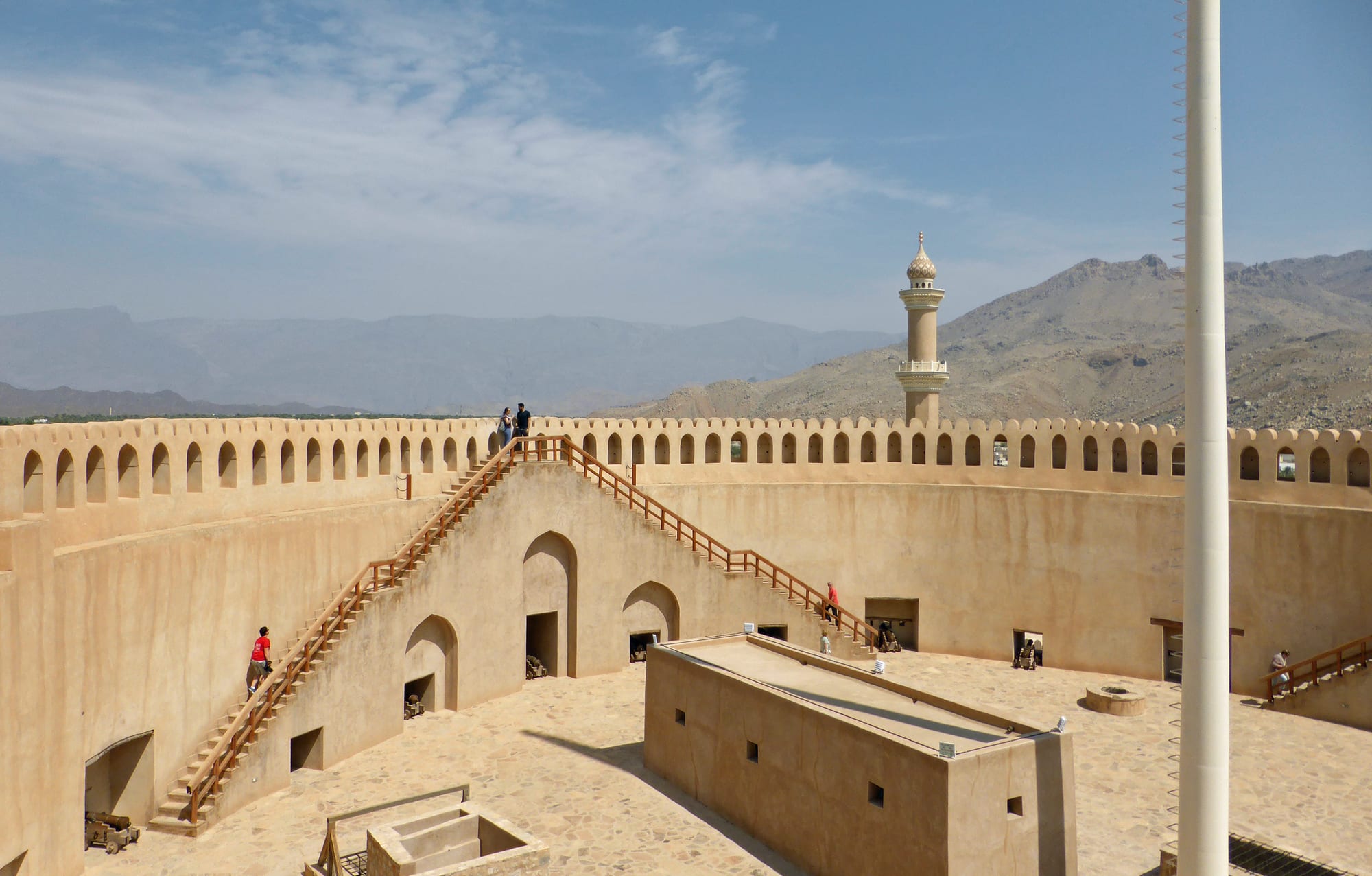
The wide circular top of a sand-coloured fort tower with staircases, a minaret and bare mountains beyond

Nizwa & the Interior, Oman

Nizwa

The gun platform on the round tower of Nizwa Fort, looking towards the Hajar mountains. (Hans Birger Nilsen / Wikimedia Commons · CC BY-SA 2.0)

The main town of the Omani interior, set in a wide oasis of date palms below the Hajar mountains about two hours from Muscat. For centuries it was the seat of elected Ibadi imams and the religious capital of inland Oman, and it is known now for the round drum tower of its fort, a restored souq of silver and pottery, and the livestock market held on Friday mornings.

Neighbourhoods

  • The fort and souq
    • First-time visitors
    • Markets
    • Historic district

    The centre of old Nizwa, where the fort, the Friday mosque and the restored souq buildings stand together beside the date gardens. Silver, pottery, dates and the livestock pens are all within a few minutes' walk, and this is the one part of town made for walking.

    Open in Maps
  • The oasis and the aflaj
    • Walks
    • Quiet and residential
    • Falaj channels

    A dense belt of date palms fed by falaj channels wraps around the old centre, with mud-brick ruins, small mosques and shaded paths between the plantations. Families live along its edges and tend plots inside it.

    Open in Maps
  • The modern town
    • Close to services
    • Hotels

    Along the highway and the roundabouts north and east of the centre: hotels, shops, restaurants, the hospital and the university, spread out and built for driving rather than walking.

    Open in Maps
  • Tanuf and the road to the mountains
    • Mountain scenery
    • Short trips

    West of the town the road runs towards the villages beneath Jebel Shams, past abandoned mud-brick settlements and wadis running out of the mountains. It is the usual approach to the high ground.

    Open in Maps

Things to do

Famous landmarks

  • Nizwa Fortlandmark

    A fort built in the 1650s by the Ya'ariba imam Sultan bin Saif around a drum tower 30 metres high and 36 metres across, on foundations going back to the 12th century.

    Open in Maps
  • Nizwa Souqmarket

    The restored market beside the fort, with halls for silver, pottery, dates, halwa, fruit and vegetables, and separate quarters for meat and fish.

    Open in Maps
  • Friday livestock marketmarket

    Goats, cattle and sheep are paraded before buyers in a ring beside the souq on Friday mornings, in a trade that has run here for generations.

    Open in Maps

Water and gardens

  • Falaj Darisattraction

    The largest falaj in Oman, running through Nizwa's gardens, and one of five aflaj inscribed together as a UNESCO World Heritage Site in 2006.

    Open in Maps
  • The date gardenspark

    Thousands of palms watered by the aflaj surround the old town, with shaded walking paths and views back to the fort tower.

    Open in Maps

Short trips into the mountains

  • Jebel Akhdarviewpoint

    The high limestone plateau above the town, cool in summer, terraced for pomegranates, apricots, walnuts and the roses distilled into rosewater; the access road requires four-wheel drive.

    Open in Maps
  • Jebel Shamsviewpoint

    Oman's highest mountain, north of Al Hamra, whose rim overlooks Al Nakhur Canyon, known as the Grand Canyon of Arabia.

    Open in Maps
  • Al Hoota Caveattraction

    A show cave below Jebel Shams, about five kilometres long and thought to be the longest in Oman, home to Omani blind cave fish and open to visitors since 2006.

    Open in Maps
  • Misfat Al Abriyeenneighborhood

    A stone village perched on a rock above terraced gardens in the wilayah of Al Hamra, with falaj channels running between the houses and guesthouses in restored buildings, named one of the World Tourism Organization's Best Tourism Villages in 2021.

    Open in Maps

Forts and old towns nearby

  • Bahla Fortlandmark

    A vast mud-brick fort and walled oasis west of Nizwa, seat of the Nabhani dynasty and a UNESCO World Heritage Site.

    Open in Maps
  • Jabrin Castlelandmark

    A castle built for the Yaruba imam Bil'arab bin Sultan, who ruled from 1679 to 1692 and was buried there, in a small town a short drive beyond Bahla.

    Open in Maps
  • Al Hamraattraction

    An old town of tall mud-brick houses at the foot of the mountains, with a house museum showing how such buildings were lived in.

    Open in Maps
  • Birkat Al-Mawzattraction

    A palm-shaded village at the entrance to Wadi al-Muaydin, where the road and walking route up Jebel Akhdar begin, with the restored fort of Bait al Redidah.

    Open in Maps

Seasonal events

  • Rose harvest on Jebel Akhdarspring

    Roses grown on the terraces above the town are picked and distilled into rosewater in village stills, a short season that draws Omani visitors up the mountain.

  • Date harvestlate summer

    The oasis is picked through the hottest months, and fresh dates of many varieties fill the souq and roadside stalls.

  • Eid celebrationsvaries with the Islamic calendar

    Both Eids bring shuwa pits, traditional dress, drumming and displays of sword dancing to the town and the surrounding villages.

Eat and drink

Long-standing places and food districts in Nizwa. Hours, ratings and directions come from your maps app, always current.

Nizwa classics

  • The souq food hallsmarket

    Dates, Omani halwa, honey, dried limes, nuts and fresh produce are sold in and around the market buildings beside the fort.

    Open in Maps
  • Omani rice and grill housesrestaurant

    Restaurants in the town serve majboos, spiced rice with meat, grilled lamb and chicken, and at festivals the pit-cooked shuwa.

    Open in Maps

Everyday eating

  • Coffee houses and halwa shopscafe

    Kahwa, the light cardamom-scented Omani coffee, is served with dates and halwa in shops around the souq and along the main roads.

    Open in Maps
  • South Asian cafésneighborhood

    Inexpensive kitchens serve paratha, biryani, curries and karak tea from early morning to late at night.

    Open in Maps

Experience Nizwa

History

Nizwa grew where several wadis draining the Hajar mountains meet, giving enough water to support one of the largest date oases in Oman. Falaj channels, some of them very old, spread that water through the gardens, and the town that grew around them became the natural centre of the interior. The tribes of the interior adopted Ibadi Islam in the early Islamic centuries, and Nizwa became the seat of imams elected by scholars and tribal leaders — the religious and political capital of inland Oman, known for its jurists and libraries.

Power shifted repeatedly between the coast and the interior. The Nabhani dynasty ruled from Bahla, a short distance west, from the 12th to the 15th century. After the Ya'ariba imams expelled the Portuguese from the coast in 1650 they built on a grand scale inland, and the round drum tower of Nizwa Fort — wide enough to mount cannon in every direction, with a warren of defences at its entrance — dates from that period, raised on an older base.

The interior kept electing imams of its own after the Al Bu Said sultans moved their capital to Muscat. The Treaty of Seeb in 1920 recognised autonomy for the imamate while acknowledging the sultan's sovereignty, an arrangement that broke down in the 1950s, when the sultan's forces, backed by Britain, took Nizwa and the imam's supporters held out on Jebel Akhdar until 1959. After 1970 roads, schools and hospitals reached the interior, the fort, mosque and souq were restored in the 1990s, and Nizwa became one of the country's main destinations for visitors.

Culture & Customs

Nizwa is the heartland of Ibadi Islam, a tradition older than the Sunni-Shia division and known for its emphasis on consultation, sober worship and the election of leaders. That history shows in the town's plain mosques, its reputation for learning, and a social manner that is formal, courteous and reserved. Dress is traditional and expected: the dishdasha with kuma or massar for men, the khanjar at celebrations and on national days, and covered dress for women.

Craft is the other half of the town's identity. Nizwa silver is famous across the Gulf — khanjar daggers, rosewater sprinklers, coffee pots and heavy jewellery — and the souq keeps quarters for silversmiths, potters, weavers and makers of copper coffee pots. Pottery from the nearby village of Bahla and woven goat-hair goods from the mountains are sold in the same halls.

Community life is organised around water and kinship. Falaj shares are allocated by time and managed by village agreement, a system inscribed by UNESCO in its World Heritage list, and disputes and maintenance are still settled collectively. Weddings and Eid bring drumming, lines of dancers, rifle displays and communal shuwa pits. The Friday market is as much a social occasion as a trade: men in their best dishdashas walk goats around a ring while buyers call out bids.

Daily Life

About 84,000 people live in Nizwa and its surrounding villages, making it the largest town of the interior and the administrative centre for the Ad Dakhiliyah region. Government work, education — the town has a university and a hospital — farming, crafts and tourism support most households, and many families also have members working in Muscat or on the coast.

The day begins before sunrise and stops through the middle of the afternoon. Shops reopen in the evening, when the souq, the cafés and the gardens fill. Friday is the pivot of the week: the livestock market at dawn, congregational prayers at midday, and family meals afterwards. Outside the old centre, life is suburban — walled villas, several cars per household, and shopping done at supermarkets on the highway.

Agriculture still shapes the town. Dates dominate, with limes, mangoes and fodder grown under the palms and fields of alfalfa watered by the aflaj, while the terraces above on Jebel Akhdar produce pomegranates, apricots, walnuts and roses. Falling groundwater, the cost of maintaining the channels and the pull of the capital on young people are the long-running concerns, and tourism has brought guesthouses into restored mud-brick houses in the villages nearby.

Food

The interior's cooking is slow and communal. Shuwa is its emblem: goat, lamb or camel meat rubbed with a paste of spices, wrapped in palm leaves and buried for many hours in an earth oven lined with embers, then unearthed for the Eid meal and eaten with rice by the extended family. Majboos, rice cooked with meat and spices including dried lime, is the everyday equivalent, and harees, wheat and meat cooked to a thick paste and served with ghee, is eaten at Ramadan meals.

Bread is spread paper-thin over a hot dome and torn up to eat with honey, eggs or curry. Mountain honey from the wadis, thick date syrup and dried limes, loomi, sharpen much of what is cooked here. The date harvest sets the year: dozens of varieties are eaten fresh in late summer, dried for the rest of the year and always offered with kahwa, coffee poured light and scented with cardamom, often with rosewater from the Jebel Akhdar stills.

Omani halwa, a sticky preserve of sugar, rosewater, saffron and nuts stirred for hours in a copper pan, is served warm from a shared dish with coffee, and the souq sells it by the tub. Pomegranates, apricots, walnuts and figs come down from the mountain terraces in season. As across Oman, the town's South Asian cafés add biryani, curries, paratha and karak tea to the daily range.

Planning tools

Budget

Nizwa is cheaper than Muscat, with a good range of mid-range hotels and heritage guesthouses in restored mud-brick houses. Fort entry fees are low, the souq is free to wander, and meals cost little. The real expense is a vehicle: a four-wheel-drive is required for the Jebel Akhdar road and advisable for Jebel Shams.

Daily Budget Midrange
USD 130–310 (heritage guesthouse or hotel, restaurant meals, a four-wheel-drive hire)
Daily Budget Shoestring
USD 45–85 (guesthouse or camping, local restaurants, shared transport)

Basing in Nizwa is cheaper than staying on the mountains, and fuel, cash and supplies are easier to find here than anywhere above the town.

Best Time to Visit

October to April, when the oasis, forts and souq are warm rather than fierce and the mountain roads are comfortable. The mountains are good for most of the year, and Omanis go up to Jebel Akhdar in summer for the cool air and, in spring, for the rose harvest. Winter nights on the high ground are cold. Air travel and events across the region have been disrupted by the war since late February 2026.

Suggested Number of Days

A day or two covers the town, with a Friday morning worth building a stay around. Three or four allow the forts, old towns and mountain plateaux nearby, where the roads are slow and the distances take longer than they look.

First Visit
1–2 days
With Surroundings
3–4 days

Transportation

The old centre is compact, but everything else needs a vehicle. Nizwa is about one and a half to two hours by expressway from Muscat, and intercity buses run between the capital, Nizwa, Ibri and Buraimi. Beyond the towns, self-drive is the only practical option: the Jebel Akhdar road is open only to four-wheel-drive vehicles, and the last stretch to the Jebel Shams rim is rough.

Hire a four-wheel-drive for the mountains, use low gears on the descents, and fill the tank in Nizwa before heading up.

Airport & Station Connections

Nizwa lies inland from Muscat on a fast expressway, roughly one and a half to two hours by car, with intercity buses on the same route. The nearest airport is Muscat International, where air travel across the region has been disrupted by the war since late February 2026. Most visitors drive, either in a hire car or on a day trip from the capital.

Walkability

The fort, souq, mosque and the edge of the date gardens are all within a short walk of each other, and the shaded falaj paths through the plantations are pleasant on foot in the cooler months. The modern town spreads along wide roads where walking is uncomfortable, and summer heat restricts walking to early morning and evening.

Safety

Nizwa is very safe and conservative, with almost no street crime. The hazards are natural: heat and dehydration, flash floods in the wadis after storms, steep mountain driving, sheer unfenced drops on the canyon rims above the town, and camels and goats on rural roads. A war in the region since late February 2026 has closed the Strait of Hormuz to commercial shipping and disrupted air travel across the Gulf.

Start hikes at dawn with plenty of water, keep well back from canyon edges, avoid wadis when rain threatens, and dress modestly in the town and villages. Check current official travel advice before travelling.

Climate

Hot and dry on the plain, with far less humidity than the coast and much cooler conditions on the plateaux above. Rain is rare and falls in winter and occasional summer storms that send floods down the wadis.

Summer
very hot — 40–46°C by day on the plain, around 20–30°C on the Jebel Akhdar plateau
Winter
warm days of 20–28°C on the plain with cool nights; near freezing at night on the high mountains

Local Customs

The interior is the most conservative part of Oman and Nizwa is its religious centre. Modest dress covering shoulders and knees is expected of everyone, and more care is taken here than in Muscat. Mosques are generally not open to non-Muslim visitors. Bathing in falaj channels and wadi pools is done clothed. Greetings are long and coffee with dates is a standard welcome, and alcohol is not part of public life.

Ask before photographing people, especially women and traders at the livestock market, and treat falaj channels and private gardens as property rather than public space.

Common Payment Methods

The currency is the Omani rial, divided into 1,000 baisa. Hotels, petrol stations and larger shops take cards and there are ATMs in the town, but the souq, the livestock market and mountain villages work in cash, so it is worth carrying notes before leaving town.