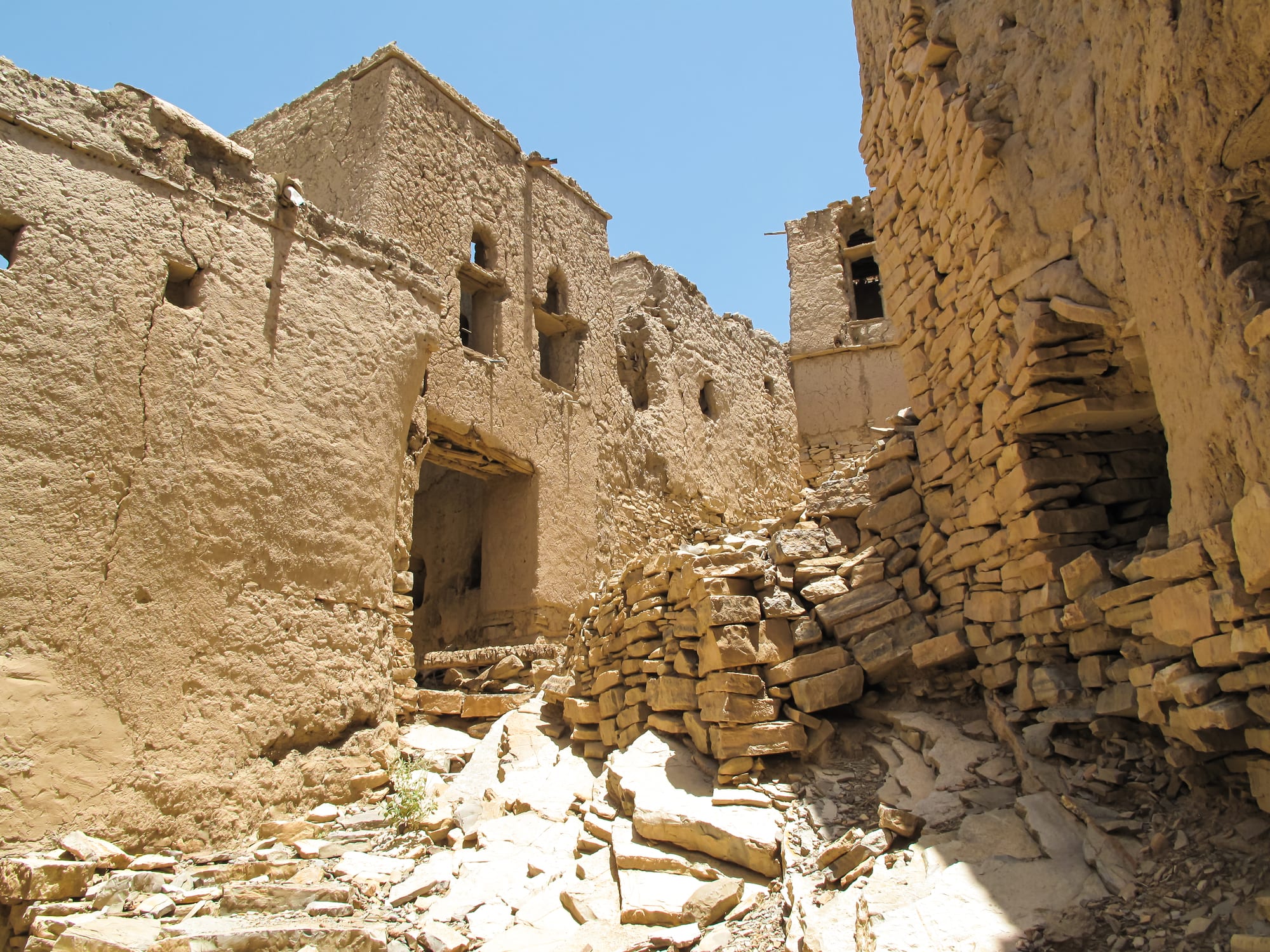
A lane between collapsing mud-brick and stone houses with empty window openings under a hard blue sky

Nizwa & the Interior, Oman

Birkat Al-Mawz

The abandoned quarter of mud-brick houses at Birkat Al-Mawz. (Francisco Anzola / Wikimedia Commons · CC BY 2.0)

A village in the Omani interior at the mouth of Wadi Muaydin, where the road up Jebel Akhdar begins. Its name means 'pool of bananas', for the gardens of bananas and date palms watered by Falaj Al Khatmeen, one of the channels in Oman's UNESCO-listed aflaj. A mud-brick fort and an abandoned quarter of collapsing houses stand at the edge of the plantations.

Neighbourhoods

  • The old quarter
    • Historic district
    • Photography
    • Walks

    A dense warren of abandoned mud-brick and stone houses on the slope above the gardens, left when families moved into modern homes. Lanes run between crumbling walls and roof beams, with the fort at the lower edge and the plantations below.

    Open in Maps
  • The gardens and the falaj
    • Walks
    • Quiet and shaded
    • Falaj channels

    Terraces of date palms, bananas, limes and mangoes fed by Falaj Al Khatmeen, with narrow paths and water running in stone-lined channels. It is cool here even at midday and the water is used for drinking and washing as well as irrigation.

    Open in Maps
  • The modern village
    • Quiet and residential
    • Close to the highway

    Newer houses, shops, a petrol station and small cafés spread along the road towards Nizwa and the expressway. This is where most residents live, and where vehicles for the mountain are checked and fuelled.

    Open in Maps
  • The Jebel Akhdar road
    • Mountain scenery
    • Four-wheel drive trips

    The climb to the plateau starts at the edge of the village, where a checkpoint allows only four-wheel-drive vehicles onto the steep switchbacks. The first bends give a view back over the oasis and the plain.

    Open in Maps

Things to do

In the village

  • Bait Al Redidahlandmark

    A restored mud-brick fort and house at the foot of the old quarter, built to guard the falaj and the gardens and open to visitors as a heritage building.

    Open in Maps
  • Falaj Al Khatmeenattraction

    The village's main irrigation channel, running from the wadi through the gardens in stone-lined courses; several Omani aflaj are inscribed together as a UNESCO World Heritage Site.

    Open in Maps
  • The abandoned quarterneighborhood

    Lanes of collapsing mud-brick houses, some several storeys high, left behind when the village rebuilt on flatter ground.

    Open in Maps
  • The banana and date gardenspark

    Terraced plantations of bananas, date palms, limes and mangoes watered by the falaj, shaded and cool even in the middle of the day.

    Open in Maps

The mountains and nearby towns

  • Jebel Akhdarviewpoint

    The high limestone plateau above the village, terraced for pomegranates, apricots and roses and cool in summer, reached by a steep four-wheel-drive road.

    Open in Maps
  • Wadi Muaydintrail

    The wadi behind the village, a steep gorge cutting into the mountain that supplies the falaj and carries floodwater after storms.

    Open in Maps
  • Nizwaattraction

    The old capital of the interior, with its round-tower fort and its restored souq, known for silver, dates and spices, a short drive to the west.

    Open in Maps

Seasonal events

  • Rose harvest on Jebel Akhdarspring

    Damask roses grown on the terraces above the village are picked and distilled into rosewater, a short season that fills the mountain road with Omani visitors.

  • Date and banana harvestsummer

    The plantations are picked through the hot months, and fruit is sold from stalls along the road to Nizwa.

Eat and drink

Long-standing places and food districts in Birkat Al-Mawz. Hours, ratings and directions come from your maps app, always current.

Village eating

  • Roadside caféscafe

    Small places along the main road serve paratha, eggs, curries and karak tea from early morning, mostly to drivers heading up the mountain.

    Open in Maps
  • Fruit stallsmarket

    Dates, bananas, limes and, in season, pomegranates and apricots brought down from the mountain terraces are sold beside the road.

    Open in Maps

Eating in Nizwa

  • Nizwa's restaurants and souqneighborhood

    The nearest wide choice of food is in Nizwa, where Omani rice and grill houses, coffee shops and the souq's date and halwa stalls are grouped around the fort.

    Open in Maps

Experience Birkat Al-Mawz

History

Birkat Al-Mawz owes its existence to water. Falaj Al Khatmeen draws from Wadi Muaydin, the gorge that cuts into the mountain behind the village, and carries it in stone-lined channels through terraced gardens on the slope below. The system belongs to the tradition of aflaj engineering that has watered the Omani interior since about AD 500, using only gravity, and the channel is one of five Omani aflaj inscribed together by UNESCO as a World Heritage Site in 2006. The village name, 'pool of bananas', records what that water grew.

The settlement was a stronghold of the Bani Riyam, one of the powerful tribes of the interior, and its position at the only practicable route onto Jebel Akhdar gave it strategic weight far beyond its size. Bait Al Redidah, the mud-brick fort at the foot of the old quarter, was built to control the falaj and the entrance to the mountain, and the tight lanes of tall houses above it were planned for defence as much as for shade.

In the 1950s the imamate of the interior and the sultan's government came into open conflict, and the rebellion's last stand was made on Jebel Akhdar, directly above the village; British special forces stormed the plateau in 1959 by climbing from the wadis. From the 1970s families moved out of the old quarter into concrete houses on flatter ground, leaving the mud-brick village to collapse, and the fort was restored as a heritage site as tourism reached the interior.

Culture & Customs

Village life here follows the pattern of the Omani interior, where Ibadi Islam, tribal affiliation and the management of water organise the community. The falaj is the clearest example: shares of the flow are measured in time rather than volume, allocated by agreements that predate living memory, and administered by a warden who keeps the roster and collects contributions for repairs. Drinking water is taken from the head of the channel, washing is done further down, and gardens are irrigated last.

Dress and manners are traditional and reserved. Men wear the white dishdasha with a kuma cap or wrapped massar, and the khanjar at Eid and on the national day; women cover their hair and dress modestly, and visitors are expected to do the same. Greetings are exchanged at length before anything else; a stranger walking through the gardens will usually be greeted and, often enough, invited for coffee.

The village sits at the boundary between two worlds. Below is the plain, with its date palms and market towns; above is Jebel Akhdar, where terraced villages grow pomegranates, walnuts, apricots and the roses distilled into rosewater in family stills each spring. Many households in Birkat Al-Mawz have relatives on the mountain, and the two economies have always been linked by the same path that now carries four-wheel-drive traffic.

Daily Life

Most residents of the village and the smaller settlements around it live in modern houses spread along the road rather than in the old quarter. Incomes come from government work, jobs in Nizwa and Muscat, farming, and a growing amount of tourism: guesthouses in restored buildings, guides, and the trade in fuel, food and vehicle checks for everyone heading up the mountain.

The day is shaped by heat and prayer. Work in the gardens is done early and late, with the middle of the day spent indoors or under the palms, and Friday is given to prayers and family. The falaj sets its own timetable, with irrigation turns falling at fixed hours of the day and night regardless of convenience. Maintaining the channels — clearing silt, repairing walls, sharing costs — is a recurring collective task.

The crops are dates above all, with bananas, limes, mangoes and fodder grown beneath the palms, sold at stalls along the road and in Nizwa's souq. Falling groundwater, the cost of maintaining old channels and the loss of the mud-brick quarter to weather are the standing concerns of the village, along with the traffic that the mountain road now brings through it.

Food

Cooking here is that of the Omani interior, built on rice, slow-cooked meat and the produce of the gardens. Majboos — rice cooked with chicken, mutton or goat, onion, dried lime and a mix of spices — is the dish of any substantial meal. Shuwa, meat rubbed with spice paste, wrapped and buried for a day or more in an earth oven, is made communally for Eid, and harees, wheat and meat beaten to a smooth porridge, belongs to Ramadan.

The gardens supply the rest. Dates of many varieties are eaten fresh in late summer, dried for the rest of the year and pressed for syrup; bananas grown under the palms are small and sweet; limes are dried into loomi for cooking, and mangoes ripen in the heat. From the terraces above come pomegranates, apricots, walnuts and figs, and rosewater from the spring distillation, which is used in sweets and sprinkled on guests at celebrations.

Hospitality is fixed in form: kahwa, coffee poured light and scented with cardamom and sometimes rosewater, served in small cups with dates and with Omani halwa, a sticky preserve of sugar, saffron, rosewater and nuts, eaten from a shared dish. Bread is rukhal, spread thin over a hot dome and eaten with honey from the mountain hives, eggs or curry. Anything more elaborate is eaten in Nizwa, where the choice of restaurants and market stalls is far wider.

Planning tools

Budget

The village itself costs very little: the heritage building charges a small entry fee, the gardens and the old quarter are free, and there is almost nothing to buy. Accommodation is limited to a few guesthouses, with most visitors staying in Nizwa below or at the expensive resorts on the plateau above. The main cost is a four-wheel-drive vehicle.

Daily Budget Midrange
USD 130–310 (hotel in Nizwa or a mountain lodge, restaurant meals, a four-wheel-drive hire)
Daily Budget Shoestring
USD 40–80 (guesthouse in the village or Nizwa, local cafés, a shared car)

Fuel and cash are easier to arrange here or in Nizwa than anywhere on the plateau above, so sort both out before the climb.

Best Time to Visit

October to April, when the oasis and the paths through the gardens are warm rather than fierce. Spring brings the rose harvest on the plateau above, and Omani families come up the mountain through the summer for the cool air while the village below is very hot. Air travel and events across the region have been disrupted by the war since late February 2026.

Suggested Number of Days

A few hours cover the village itself. Two or three days suit a stay that takes in the wider area, where the mountain roads are slow and the high ground is worth an overnight.

First Visit
half a day
With Surroundings
2–3 days

Transportation

A vehicle is needed. The village sits just off the Nizwa expressway, about twenty kilometres from Nizwa, and the lanes within it are narrow and partly unpaved. The road up Jebel Akhdar begins at the edge of the village at a checkpoint that admits only four-wheel-drive vehicles; there is no public transport up the mountain.

Check brakes and tyres before the climb, use low gears on the descent, and never drive into the wadi when rain is falling on the mountain.

Airport & Station Connections

Birkat Al-Mawz lies on the road between the Muscat expressway and Nizwa, roughly one and a half to two hours from the capital by car and about twenty minutes from Nizwa. Most people arrive by hire car or on a tour on the way up to Jebel Akhdar. The nearest airport is Muscat International, where air travel has been disrupted by the war in the region since late February 2026.

Walkability

The village is the rare place in the interior that is best seen on foot: the fort, the falaj, the ruined quarter and the gardens are all within a short walk of one another, on uneven ground and loose stone. Sturdy shoes help, and the ruins are fragile and partly unstable. Everything beyond the village needs a vehicle.

Safety

The village is very safe and quiet. The hazards are the collapsing buildings of the old quarter, where walls and roof beams give way without warning, heat and dehydration in the gardens and the wadi, flash floods after storms, and the steep mountain road above, which demands a four-wheel-drive and careful driving. A war in the region since late February 2026 has closed the Strait of Hormuz to commercial shipping and disrupted air travel across the Gulf.

Keep out of unstable ruins and off the roofs, carry water, avoid the wadi when rain threatens, and dress modestly in the village. Check current official travel advice before travelling.

Climate

Hot and dry, though the shade of the plantations and the running water make the gardens noticeably cooler than the open plain. Rain is rare, falling in winter and occasional summer storms that send floods down the wadi behind the village.

Summer
very hot — 40–46°C by day on the plain, around 20–30°C on the plateau above
Winter
warm days of 20–28°C with cool nights; near freezing at night on the high mountains

Local Customs

This is a conservative village in the most traditional part of Oman. Modest dress covering shoulders and knees matters more here than in the cities, and swimming or wading in the falaj is not acceptable: the water is used for drinking and washing, and channels are allocated by long- standing agreements between families. Greetings are unhurried, and coffee and dates may be offered to visitors who stop.

Ask before photographing people or entering gardens and houses, which are private property, and do not put hands, feet or bottles into the falaj channels.

Common Payment Methods

The currency is the Omani rial, divided into 1,000 baisa. There is little to spend money on in the village and few card machines; the nearest banks and reliable ATMs are in Nizwa, so carry cash for entry fees, fuel and roadside stalls.