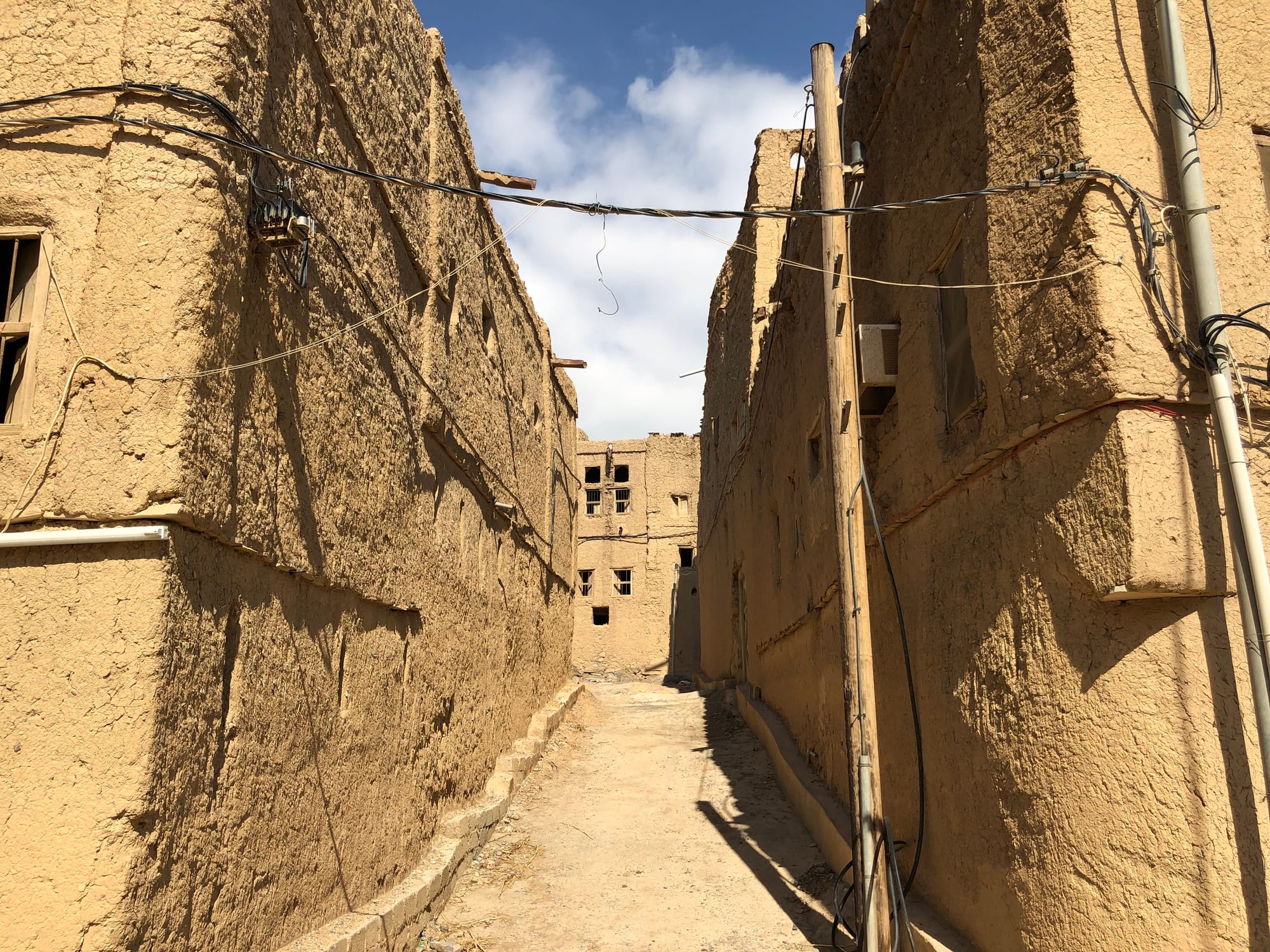
A narrow dirt lane between tall mud-brick houses with wooden window frames in an old Omani town under a blue sky

Nizwa & the Interior, Oman

Al Hamra

A lane through the mud-brick old town of Al Hamra in Oman's interior. (Davide Mauro / Wikimedia Commons · CC BY-SA 4.0)

An old oasis town at the foot of the western Hajar mountains in Oman's Ad Dakhiliyah governorate, about forty kilometres west of Nizwa. Al Hamra keeps a large quarter of mud-brick houses of two, three and even four storeys, watered by a falaj channel, and sits at the bottom of the road that climbs to Jebel Shams and beside the terraced hill village of Misfat al Abriyeen.

Neighbourhoods

  • The old town
    • First-time visitors
    • Historic district
    • Walks

    The core of Al Hamra is a dense quarter of mud-brick houses, some of them three storeys high, standing along lanes above the palm gardens. Many are empty and slowly eroding, while others have been repaired; a restored house in the quarter is open as a small heritage museum.

    Open in Maps
  • The modern town
    • Everyday services
    • Close to the highway

    North and east of the old quarter the newer town spreads along the road, with concrete villas, a souq, small supermarkets, cafés, a hospital and the petrol stations that drivers use before heading into the mountains. It is where almost everyone actually lives.

    Open in Maps
  • Misfat al Abriyeen
    • Views
    • Guesthouses
    • Walks

    A stone village stacked on a rock shelf a few kilometres above the town, with paths running between the houses and down into a falaj-fed grove of date palms, bananas and limes. Several old houses there have been converted into guesthouses, and the village was named one of the World Tourism Organization's Best Tourism Villages in 2021.

    Open in Maps
  • The palm gardens and the falaj
    • Quiet and residential
    • Walks

    Below the old houses the town's date gardens are laid out in plots divided by a falaj, the gravity channel that brings water from the mountain. Narrow walkways follow the water between walled orchards, shaded and noticeably cooler than the streets above.

    Open in Maps

Things to do

In and above the town

  • Al Hamra old townneighborhood

    A large surviving quarter of Yemeni-style mud-brick houses, settled in the late 17th century by the Al Abri tribe and laid out above the falaj and the date gardens.

    Open in Maps
  • Misfat al Abriyeenneighborhood

    A terraced stone village above its palm oasis on the slopes of the Hajar, crossed by irrigation channels and footpaths.

    Open in Maps
  • Al Hoota Caveattraction

    A show cave about five kilometres long, believed to be Oman's longest, home to blind cave fish and opened to visitors in 2006; buggies carry them in from the entrance.

    Open in Maps
  • Jebel Shamsviewpoint

    Oman's highest mountain, at about 3,000 metres, whose rim looks down the sheer walls of Wadi Nakhr, the canyon known as the Grand Canyon of Arabia.

    Open in Maps

Short trips from the town

  • Bahla Fortlandmark

    A vast mud-brick fortress above the oasis town of Bahla, inscribed as a UNESCO World Heritage Site in 1987.

    Open in Maps
  • Bahlaattraction

    An oasis town a short drive south, long known for its pottery workshops and for the remains of the twelve-kilometre wall that rings the town and its fort.

    Open in Maps
  • Nizwa Fortlandmark

    The 17th-century fort of the old Ibadi capital, built around an enormous round artillery tower above the town's souq.

    Open in Maps
  • Nizwaattraction

    The main city of the interior, with a restored souq known for its silver, dates and spices, about forty kilometres east.

    Open in Maps

Seasonal events

  • Ramadanvaries with the lunar calendar

    The fasting month reshapes the day across the interior, with quiet streets in the afternoon and busy evenings after the iftar meal.

  • Eid al-Fitr and Eid al-Adhavaries with the lunar calendar

    The two Eids bring family visiting, new clothes, shuwa cooked in pit ovens and, in the days beforehand, the habta markets held in interior towns.

  • Date harvestsummer

    The hottest months are when the palms are picked and the gardens below the old town are at their busiest.

Eat and drink

Long-standing places and food districts in Al Hamra. Hours, ratings and directions come from your maps app, always current.

Where to eat in town

  • Al Hamra town centreneighborhood

    The modern main road holds the town's small restaurants and coffee shops, most of them serving grilled chicken, rice dishes, Indian curries and shawarma rather than anything formal.

    Open in Maps
  • Misfat al Abriyeen guesthousesneighborhood

    The converted houses in the hill village above the town cook Omani home food for their guests, which is the most reliable way to eat a local meal here.

    Open in Maps

Markets and produce

  • Nizwa Souqmarket

    The restored market below Nizwa fort, forty kilometres east, sells dates, halwa, limes, honey, silver and pottery.

    Open in Maps
  • Local date gardens and roadside stallsmarket

    Dates in many varieties, dried limes and local honey are sold from small shops in town, and the surrounding oases supply much of it.

    Open in Maps

Experience Al Hamra

History

Al Hamra grew where the water comes out of the mountain. A falaj fed by the wadis of the western Hajar made cultivation possible at the foot of Jebel Shams, and a settlement of date gardens and mud-brick houses developed on the slope above the plots. The town was settled in the late 17th century by the Al Abri tribe, under the Yaruba imams who drove the Portuguese from the Omani coast and rebuilt the forts and towns of the interior. The town belonged to the world of the Ibadi imamate centred on Nizwa, governed through tribal leaders and the sheikhs of the Abriyeen, whose name the hill village above the town still carries.

Al Hamra was never a fortress town on the scale of Bahla or Nizwa, and it has no great castle. Its wealth was agricultural — dates above all, with limes, bananas and fodder grown under the palms — and its position on the routes between the interior oases and the mountain villages gave it a modest trading role.

In the 20th century the interior's politics reached the town along with everyone else's: the imamate's autonomy under the 1920 Treaty of Seeb, the fighting of the 1950s and the storming of the Jebel Akhdar plateau in 1959. After 1970 tarmac roads, schools, electricity and piped water arrived, and families moved out of the old houses into concrete villas on the edge of town. The mud-brick quarter was left to erode, and parts of it have since been repaired as heritage buildings, while Misfat al Abriyeen has become one of the most visited villages in Oman.

Culture & Customs

Al Hamra belongs to Oman's Ibadi interior, and the rhythms of that world are plain here: the call to prayer over the gardens, majlis rooms where men receive guests, and a social life built around family, neighbours and the mosque. Men wear the white dishdasha with an embroidered kummah cap or a wrapped massar, and women wear long dresses with a headscarf. Hospitality is formal and unhurried — kahwa scented with cardamom, dates and halwa offered before any business is discussed.

The falaj is a cultural institution as much as an engineering one. Water rights are shared in timed turns among the families who own plots, an arrangement overseen by a local administrator and recorded in long-standing custom, and the channels are cleaned and repaired collectively. Ownership of the water can be distinct from ownership of the land, which is why the gardens below the old town are divided as finely as they are.

Traditional crafts and performance survive around the town's festivals. Omani sword-and-chant dances such as the razha accompany weddings and national holidays, and the two Eids are the year's social high points, preceded by the habta markets of the interior where livestock, clothes and halwa are sold. Visitors are generally welcomed with curiosity and courtesy; the expectation in return is modest dress and quiet behaviour in residential lanes, and patience with a town that is not organised around tourism.

Daily Life

Al Hamra is a small place, and most of its people live in the newer streets rather than the old quarter. Almost nobody lives in the mud-brick houses now — the last families left them in the decades after 1970 — and daily life happens along the main road, in the schools, the hospital, the small souq and the government offices of the wilayat.

Work divides between government employment, the date gardens and small businesses, with a growing share in tourism: guesthouse keeping in Misfat al Abriyeen, guiding on the mountain and running the vehicles that carry visitors up the Jebel Shams road. A great many families also have members working in Muscat or Nizwa and returning at weekends, a pattern common throughout the interior.

The day is shaped by heat and prayer. Farmers open their falaj turns and work the gardens early, shops and offices run through the morning, the middle of the day empties the streets in summer, and the town revives after the late afternoon prayer, with visiting, coffee and children playing outside into the evening. The pressures people talk about are those of small interior towns everywhere in Oman: jobs for young people, the cost of keeping old houses standing, and the balance between the visitors the hill village now attracts and the ordinary life of the families who live there.

Food

Eating in Al Hamra means Omani home cooking or the straightforward food of small roadside restaurants. Dates come first: the gardens below the town grow several varieties, khalas among them, and a dish of them with kahwa — coffee brewed pale and flavoured with cardamom, sometimes with rosewater — is the standard greeting in any house. Halwa, the dense sweet paste of sugar, starch, ghee, rosewater and nuts, is served alongside it and bought for weddings and Eid.

The festive dish of the interior is shuwa: goat or lamb rubbed with a spice paste, wrapped and buried in a pit oven to cook for a day or more before families gather to open it. Majboos, spiced rice cooked with meat, and harees, wheat pounded with meat into a thick paste, appear at Eid and at weddings. Everyday meals are simpler — rice with chicken or fish brought up from the coast, Indian curries and breads in the town's restaurants, grilled meat, and laban, a salty buttermilk, drunk with it.

Produce from the mountain above the town reaches the local markets in season: pomegranates, apricots, peaches, walnuts and grapes from the terraced villages of the Hajar, along with local honey and the dried limes, loomi, that give Omani rice and soups their sour note. Bananas and limes grown in the shade of the palms below the old quarter are sold in the same shops as the dates.

Planning tools

Budget

Al Hamra is inexpensive by Omani standards. Most visitors stay in a converted heritage house in Misfat al Abriyeen or in a hotel in Nizwa and come here for the day. Fort and cave entry fees are low, meals in town cost little, and the largest single expense is a hire car — a four-wheel drive if the Jebel Shams road is part of the plan.

Daily Budget Midrange
USD 130–310 (heritage guesthouse or a hotel in Nizwa, restaurant meals, a 4x4 hire)
Daily Budget Shoestring
USD 40–80 (simple guesthouse or camping, local restaurants, a shared car)

Guesthouses in Misfat al Abriyeen are limited in number and fill up in the cool months, so arrange a room in advance.

Best Time to Visit

October to April, when days on the plain are warm and dry and walking through the old town and the gardens is comfortable. Summer brings heat above 40°C, though the mountain above is far cooler and Omani families go up to escape it. Winter nights on the Jebel Shams plateau fall close to freezing. Air travel and events across the region have been disrupted by the war since late February 2026.

Suggested Number of Days

Half a day to a day covers the town itself for most visitors. Two or three days suit anyone adding the mountain road and the oases nearby, or staying overnight in the hills; heat, a hire car and an early start all change the number.

First Visit
Half a day to a day
With Surroundings
2–3 days

Transportation

There is no useful public transport within the town or up the mountain, so almost everyone drives. The tarmac road from Nizwa reaches Al Hamra and continues to the foot of the mountain; the last climb to the Jebel Shams rim and the tracks into the wadis need four-wheel drive. Taxis can be arranged locally, and guesthouses in Misfat al Abriyeen will often collect guests from the village car park, since vehicles cannot enter the old lanes.

Fill the tank in Al Hamra or Nizwa before heading into the mountains, and use low gears on the steep descents.

Airport & Station Connections

Muscat International Airport is the gateway, roughly two and a half hours away by road. The drive runs on the expressway to Nizwa, then west on the road towards Bahla and Ibri before turning off for Al Hamra. Intercity buses from Muscat serve Nizwa, from where a taxi or hire car covers the last forty kilometres; most visitors arrive in their own vehicle as part of a loop through the interior.

Walkability

The old quarter is walked rather than driven: its lanes are narrow, uneven and partly blocked by collapsed walls, and the paths down into the palm gardens are shaded and level. Misfat al Abriyeen is walked too, on steps and ledges that are steep in places. Between the old town, the modern centre and the hill village, however, distances and heat make a vehicle the practical choice.

Safety

The interior is very safe, and crime touching visitors is rare. The hazards here are physical: abandoned mud-brick buildings that can give way underfoot, unfenced drops on the Jebel Shams rim, heat and dehydration on walks, steep mountain driving, flash floods in the wadis after storms and animals on rural roads at night. A war in the region since late February 2026 has closed the Strait of Hormuz to commercial shipping and disrupted air travel across the Gulf.

Do not climb inside ruined houses, start walks early with plenty of water, keep well back from canyon edges, avoid wadi beds when rain threatens, and dress modestly in town. Check current official travel advice before travelling.

Climate

Hot desert climate at the foot of the mountains, dry through most of the year, with far cooler air a short drive above the town. Rain is scarce and usually arrives in short winter or summer storms that can fill the wadis within minutes.

Summer
very hot and dry — 40–46°C by day on the plain, with warm nights; about 20–30°C on the Jebel Shams plateau
Winter
warm days of about 20–28°C with cool nights; near 0°C at night high on the mountain

Local Customs

This is a conservative interior town. Modest dress is expected of both men and women, covering shoulders and knees, and a headscarf is useful for women visiting a mosque or a village. The old town and Misfat al Abriyeen are lived-in places, not open-air museums: people's doorways, courtyards and falaj channels deserve the same care as anywhere else. Guests are offered kahwa and dates, and refusing outright is awkward — taking a little is the polite answer.

Ask before photographing people, especially women; do not wade or wash in the falaj channels, which supply drinking and irrigation water; alcohol is not sold in the town.

Common Payment Methods

The currency is the Omani rial, divided into 1,000 baisa. Hotels, guesthouses and larger shops take cards, but small restaurants, market stalls and cave or fort entry are easier with cash. ATMs are in the modern town centre and more numerous in Nizwa, so it is worth drawing money before heading into the mountains.