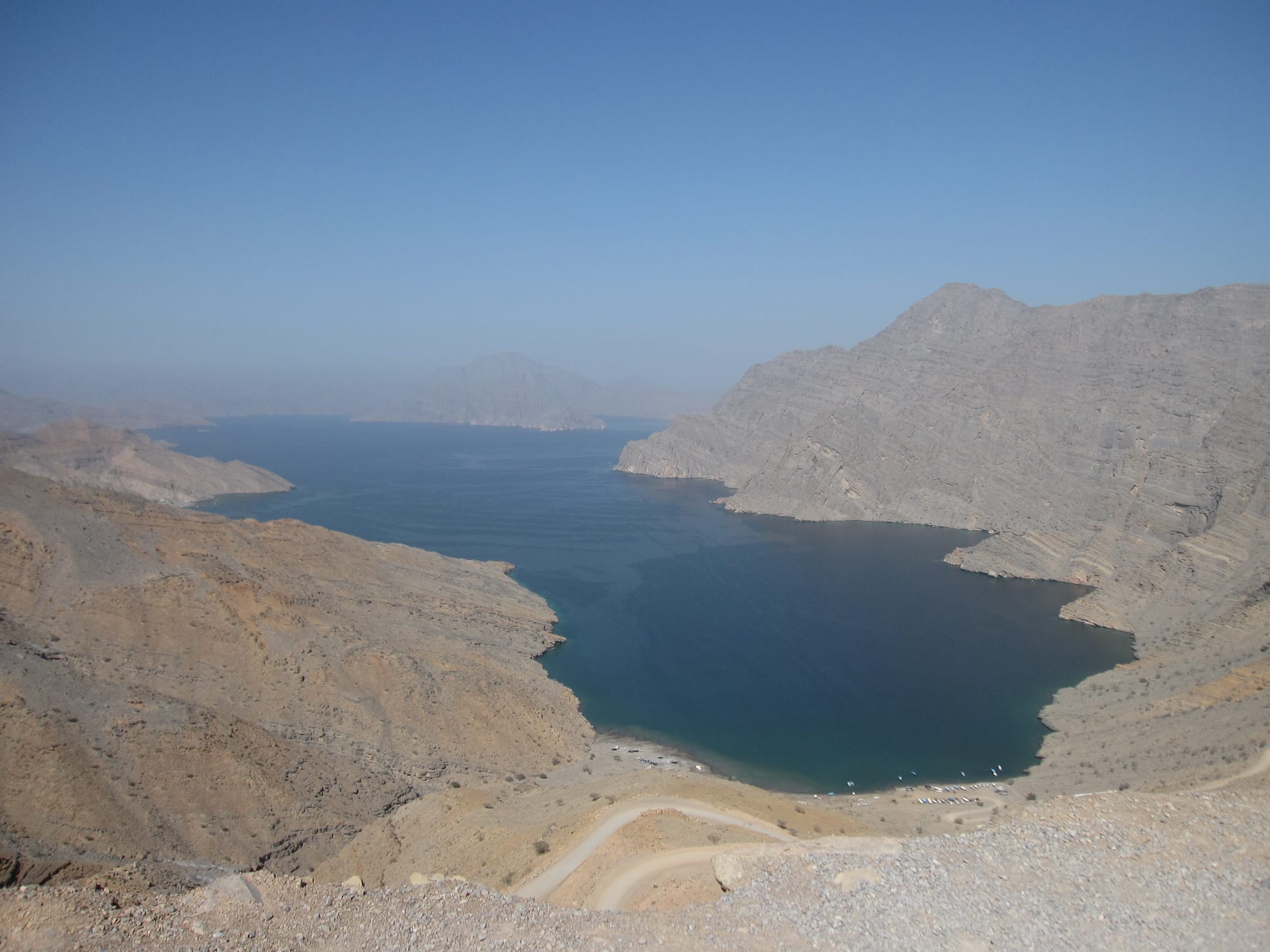
A deep blue inlet between steep, bare grey mountain slopes, seen from a hillside road above a small beach

Oman

Musandam

Khor Najd, one of the fjord-like inlets of the Musandam peninsula, seen from the mountain road above. (Jc8136 / Wikimedia Commons · CC BY-SA 3.0)

Oman's northern exclave, a mountainous peninsula separated from the rest of the country by the United Arab Emirates and jutting into the Strait of Hormuz — a land of bare limestone ridges plunging into fjord-like inlets, reached by dhow from the small port of Khasab, with the heights of Jebel Harim above and a scattering of isolated fishing villages below.

Explore Musandam

History

People have lived in Musandam's valleys and coves for thousands of years, and rock carvings of animals and riders near Khasab record an ancient past. The peninsula's position on the Strait of Hormuz, the gateway to the Gulf, made it strategically important, and in the early Islamic period the plain inland of Dibba, just beyond its southern edge in what is now the UAE, was the scene of a battle of the ridda wars after the death of the Prophet.

In the 16th and 17th centuries the Portuguese controlled much of this coast and built the fort at Khasab. After their expulsion, local tribes, the Omani sultans and the Qawasim of Ras al Khaimah competed for influence, and Britain arrived in the 19th century to police the Gulf. In 1864 the British built a telegraph repeater station on a small island in Khor ash Sham, part of the cable linking Britain and India, but abandoned it in the mid-1870s.

After Omani and British forces ended local tribal rule in 1970–71 and the United Arab Emirates took shape, border talks confirmed Musandam as Omani territory separated from the rest of the country, with the small enclave of Madha also part of the governorate. Since then roads, schools, a hospital and an airport have reached the peninsula, and its strategic position has kept a strong military presence in the area.

Culture & Customs

Musandam's traditional population are the Shihuh, a mountain people speaking their own dialect of Arabic, who once moved between highland villages and the coast with the seasons, going down to tend date gardens in summer. Their villages include bayt al-qufl, the "lock houses", half-buried stone storehouses with heavy doors used to secure grain and belongings while families were away.

In Kumzar, near the northern tip of the peninsula, people speak Kumzari, an Iranian language also spoken on Larak Island across the strait and marked by borrowings from many other languages. Most families keep a second house in Khasab and move there from May to September, when Kumzar is too hot.

The peninsula is conservative and devout, and family and tribal ties are strong. Men wear the dishdasha, and older men of the mountains sometimes carry the jerz, the Shihuh's long-handled axe with a small head. Fishing, dhow sailing and traditional songs are part of local identity, and trade with Iran, including the well-known speedboat traffic in goods across the strait, has long been part of life in Khasab.

Daily Life

Musandam is small in population: a few tens of thousands of people, most living in Khasab, the capital, and in Bukha, Dibba al-Bayah and the enclave of Madha. Many smaller villages lie at the end of inlets that are still reached most easily by boat, and some are occupied only for part of the year.

The economy relies on fishing, government and military employment, trade with Iran and tourism from the UAE and abroad, focused on dhow cruises, diving and mountain drives. Khasab's harbour is busiest in the morning, when fishermen unload, and in the late afternoon, when speedboats load goods for the crossing.

Daily life is shaped by the heat and the sea. Schools and offices start early, and families gather in the evening on the waterfront or in the date gardens. Water and power supply have improved greatly, but distance from Muscat remains a practical issue for everything from health care to shopping.

Food

The sea provides most of Musandam's food. Kingfish, tuna, grouper and sardines are grilled, fried or cooked in spiced sauces with rice. Mashuai, a whole spit-roasted kingfish served with lemon rice, is an Omani favourite, and rice remains the staple alongside chicken and lamb.

Dates are grown in the gardens of Khasab and Bukha and eaten with every meal, often with kahwa, the cardamom-scented coffee. In the mountains, goats provide milk and meat, and simple flat bread is baked at home.

Festive dishes such as majboos, shuwa and harees are prepared for Eid and family occasions, while halwa is bought for weddings and guests. The ties across the strait show in the markets of Khasab, where Iranian goods and fruit are often on sale.

Attractions & Natural Wonders

Khasab is the gateway to the peninsula, with a restored Portuguese-era fort whose tower houses a museum of crafts and antiquities, a busy harbour and an old souk area. From the harbour, dhow cruises head into Khor ash Sham, the best known of the inlets, where steep bare mountains drop straight into the sea, dolphins often follow the boats, and passengers can swim and snorkel near Telegraph Island and past fishing villages that have no roads.

The khors, as the inlets are known, give Musandam its nickname, the "Norway of Arabia". Khor Najd, one of the largest, can be reached by a 4x4 mountain road with a panoramic view from some 420 metres above, while boat trips go on to Kumzar near the tip of the peninsula, where dolphins and sea life are common.

Inland, a steep 4x4 track climbs from Khasab towards Jebel Harim, at 2,087 metres the highest mountain in Musandam, though the summit itself is a closed military site. On the west coast, Bukha has a fort built by the Portuguese in the 16th century, and in the south Dibba al-Bayah has beaches and a harbour on the Gulf of Oman shore.

Cities in Musandam

Planning basics

Budget

Musandam is relatively expensive for its size. Khasab has only a small number of hotels, from simple to mid-range, and a couple of resort-style properties, so prices rise at weekends and on UAE holidays. Dhow cruises and diving trips are the main expense, though shared day cruises are good value. Food in Khasab's local restaurants is inexpensive.

Daily Budget Midrange
USD 160–360 (mid-range hotel, private or overnight dhow cruise, 4x4 trip to Jebel Harim)
Daily Budget Shoestring
USD 50–90 (simple hotel or camping, local restaurants, a shared dhow cruise)

Visit on weekdays to avoid the crowds from the UAE, and book a shared half-day or full-day dhow cruise rather than a private boat.

Safety

Musandam is very safe for visitors. The hazards are heat and dehydration, steep mountain tracks with sheer drops, strong currents at the mouths of the inlets, and busy boat traffic around Khasab harbour. The Strait of Hormuz is a sensitive waterway, and some coastal and military areas are restricted.

Use licensed boat operators with life jackets, carry plenty of water, drive the Jebel Harim track only in a 4x4, and do not photograph military sites. Check current official travel advice before travelling.

Climate

Hot and humid in summer, with sea temperatures in the 30s°C and heavy, airless heat in the enclosed inlets. Winters are mild and more changeable than in the rest of northern Oman, with occasional rain and wind. The heights of Jebel Harim are cooler and can be cold on winter nights.

Summer
hot and humid, 38–45°C on the coast; somewhat cooler on the high ground
Winter
mild, 18–27°C by day, with occasional rain; cold on Jebel Harim at night

Transportation

Because Musandam is cut off from the rest of Oman, most visitors arrive by road from Ras al Khaimah in the UAE, crossing the border on the west coast and following the coastal road through Bukha to Khasab, or by air to Khasab's small airport. Ferry links with Muscat have operated at times. The UAE crossing requires the correct visas and, for hire cars, insurance valid in Oman. Within the peninsula, boats are the key transport to the inlets, and the road to Jebel Harim needs a 4x4.

Check border rules and car insurance before driving from the UAE, and book dhow cruises through established Khasab operators.

Best Time to Visit

October to April, when the sea is calm and clear for cruising, snorkelling and diving and the mountain track is comfortable. Dolphins are common in the waters around the peninsula. Summer is very hot and humid, but the water is at its warmest.