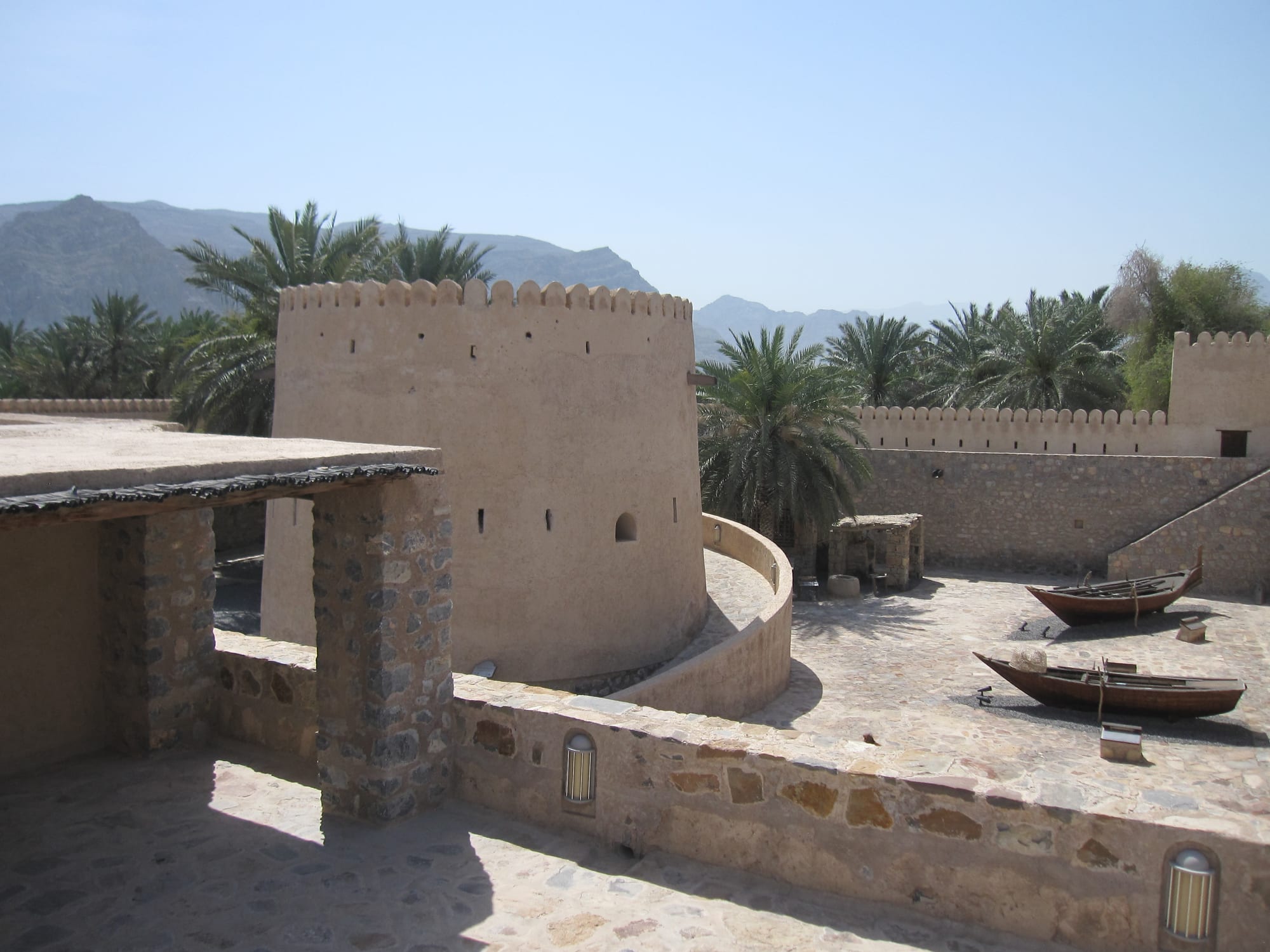
A view from the walls of Khasab Fort over the town below, with date palms and bare mountain ridges behind it

Musandam, Oman

Khasab

The town and mountains of Musandam seen from Khasab Fort, Oman. (Jc8136 / Wikimedia Commons · CC BY-SA 3.0)

The main town and port of Musandam, Oman's mountainous exclave on the Strait of Hormuz, set on a small coastal plain of date gardens between bare limestone ridges and the sea. A Portuguese-built fort stands above the shore, dhows and speedboats fill the harbour, and boat trips run from it into the fjord-like inlets that cut into the peninsula.

Neighbourhoods

  • The harbour and waterfront
    • First-time visitors
    • Boat trips
    • Local life

    The working heart of the town, where dhows tie up alongside fishing launches and the speedboats that trade across the strait. Cruises into the inlets leave from here, and the quays are busiest early in the morning and again in the late afternoon.

    Open in Maps
  • Around the fort and the souk
    • Historic district
    • Shops and markets

    The old centre beside the shore, gathered around the restored fort and the low shops of the souk area, where household goods, fish and Iranian produce are sold. Most of the town's cafés and simple restaurants are within a short walk.

    Open in Maps
  • The date gardens and wadi
    • Quiet and residential
    • Walks

    Behind the town the plain opens into walled date gardens and the gravel bed of the wadi, with houses, mosques and small farms between the palms. It is shaded, quiet and the coolest part of Khasab on a hot afternoon.

    Open in Maps
  • The coast road and the hotels
    • Hotels
    • Sea views

    The road running out of town towards the airport and the west coast passes most of Khasab's hotels and resort-style properties, some on their own stretches of shore with the mountains rising directly behind them.

    Open in Maps

Things to do

Landmarks in the town

  • Khasab Fortlandmark

    A fort by the shore, built early in the 17th century in the Portuguese period as a supply point of dates and water for ships passing through the strait, and later held by the Omani sultans; it is restored and open to visitors, with a round tower in its courtyard.

    Open in Maps
  • Khasab Airporttransit hub

    The peninsula's small airport a short drive west of town, and its air link to Muscat.

    Open in Maps

The inlets and the sea

  • Telegraph Islandlandmark

    A bare rock in Khor ash Sham holding the ruins of a British telegraph repeater station of the 1860s, the usual swimming and snorkelling stop on dhow cruises out of Khasab.

    Open in Maps
  • Kumzarneighborhood

    A village near the northern tip of the peninsula, reached only by boat, whose people speak Kumzari, a language of Iranian origin found almost nowhere else.

    Open in Maps

Mountains and short trips

  • Jebel Harimviewpoint

    The highest mountain in Musandam, at 2,087 metres, reached by a steep graded track that climbs past fossil-bearing rock and highland villages to just below its military-held summit.

    Open in Maps
  • Bukhaneighborhood

    A coastal village on the west side of the peninsula, on the road towards the border, with a restored fort standing beside the shore.

    Open in Maps
  • Dibba Al-Bayaneighborhood

    The Omani town at the southern end of Musandam, on the Gulf of Oman side, with beaches, a harbour and its own dhow trips.

    Open in Maps

Eat and drink

Long-standing places and food districts in Khasab. Hours, ratings and directions come from your maps app, always current.

Khasab classics

  • Seafood grills in the town centreneighborhood

    Small family-run places around the souk area and the main road grill the kingfish, tuna and grouper landed at the harbour, usually served with spiced rice, salad and flat bread.

    Open in Maps
  • Omani and Indian eating housesneighborhood

    Plain, inexpensive cafeterias serving biryani, curries, grilled chicken and Omani rice dishes, reflecting the large South Asian workforce in the town.

    Open in Maps

Markets

  • Khasab fish marketmarket

    The morning landing point for the town's catch, where fishermen sell straight from the boats and buyers pick over kingfish, tuna and sardines.

    Open in Maps
  • Khasab soukmarket

    A modest cluster of shops near the fort selling dates, coffee, spices, household goods and produce, much of it brought across the strait from Iran.

    Open in Maps

Experience Khasab

History

People have lived on this small coastal plain for a very long time, drawn by fresh water in the wadi, date palms and a sheltered anchorage. Its gardens and wells made it the natural capital of a peninsula where flat ground is scarce, and it is now the capital of the Musandam Governorate.

Its position at the mouth of the Strait of Hormuz mattered far more than its size. Passing fleets needed water, dates and shelter: the Portuguese took the town early in the 16th century and, at the height of their naval presence in the region, built the fort by the shore at the beginning of the 17th century, not on high ground as a stronghold but as a supply point of dates and water for their ships. Afterwards the peninsula was contested among Omani rulers, powers on the Gulf coast and the Shihuh tribes of the mountains, and by the early 20th century the Sultan of Oman claimed Musandam and kept a representative in Khasab. In 1864 the British placed a telegraph repeater station on an island in the inlet of Khor ash Sham, part of the cable link between Britain and India, and abandoned it little more than a decade later.

Khasab remained isolated well into the 20th century, supplied by sea and reached overland only with difficulty. Roads, a hospital, schools, a harbour and an airport arrived after 1970, along with a permanent military presence, and the coastal road from the United Arab Emirates opened the town to visitors. Trade across the water with Iran, long a part of its economy, made the harbour busier still.

Culture & Customs

Khasab is the meeting point of two distinct communities. The Shihuh, the mountain people of Musandam, speak their own dialect and traditionally moved with the seasons between highland villages and the coast, coming down to tend the date gardens in summer; their half-buried stone storehouses, the bayt al-qufl or lock houses, kept grain and possessions safe while families were away, and older men of the mountains sometimes still carry the jerz, a long-handled axe with a small head. From Kumzar, near the northern tip, come speakers of Kumzari, a language of Iranian origin full of borrowings from Arabic and beyond; many Kumzari families keep a second house in Khasab and move into the town for the hottest months.

Life is conservative, and family and tribal ties count for a great deal. Men wear the dishdasha with an embroidered cap or turban, and the khanjar, the curved dagger, appears at weddings and on national occasions. Islam shapes the calendar, with Ramadan slowing the daytime and filling the evenings, and the two Eids bringing visiting, gifts and long shared meals.

The sea runs through everything: boatbuilding, fishing songs, races and the handling of dhows are all part of local identity, and the traffic of small fast boats across the strait, carrying goods and passengers to and from Iran, has shaped the town's outlook for generations.

Daily Life

Khasab is the largest town on a thinly peopled peninsula — Musandam as a whole had about 49,000 people at the 2020 census — and functions as the governorate's administrative centre: the hospital, the main schools, government offices and the airport are all here. Because the peninsula is cut off from the rest of Oman by land, supplies arrive by sea, by air or by road through the United Arab Emirates, and prices reflect that distance.

Work is mostly in government service, the armed forces and coastguard, fishing, small trade and tourism. The harbour sets the rhythm of the day: boats land fish in the early morning, the souk and offices open before the heat builds, business pauses through the middle of the day, and activity returns in the late afternoon, when goods are loaded for the crossing to Iran and families come out to the waterfront. Weekends bring a rush of visitors driving up from the UAE, which fills the hotels and the cruise boats and then empties the town again.

Most residents live in low concrete houses among the date gardens or along the roads leading out of the centre, with a growing fringe of newer building on the plain. Summer heat and humidity dominate half the year, and air conditioning, water supply and the long drive to Muscat for anything specialist remain the practical facts of life. Events in the strait beyond the harbour affect the town directly, through fishing, shipping and the cross-border trade.

Food

Fish is the foundation of eating in Khasab. Kingfish, tuna, grouper, snapper and sardines come off the boats each morning and are grilled over charcoal, fried, or simmered in sauces of tomato, onion, garlic, turmeric and dried lime. Mashuai, a whole spit-roasted kingfish served with lemon-flavoured rice, is the best-known Omani seafood dish, and rice with fish or chicken is the everyday meal in most households.

The date gardens behind the town supply the other staple. Dates are eaten at any hour and pressed on every visitor with kahwa, the pale, cardamom-scented coffee poured in small handleless cups; refusing outright is awkward, and two or three cups followed by a gentle shake of the cup is the usual way to finish. Halwa, the dense rose-and-saffron sweet worked with ghee and nuts, appears at weddings, Eid and any occasion with guests.

Festive cooking follows the Omani pattern: majboos, spiced rice with meat; harees, wheat and meat beaten to a smooth paste; and shuwa, meat marinated in spices, wrapped and cooked for many hours in an earth oven for Eid. Goat from the mountains, home-baked flat bread and yoghurt fill out the highland diet. Everyday restaurants in the town reflect its mixed workforce, serving biryani, curries and grilled chicken, while the shops sell Iranian fruit, nuts and sweets brought across the strait.

Planning tools

Budget

Khasab has only a small number of hotels, from simple guesthouses to a few resort-style properties, and prices rise at weekends and on UAE holidays when visitors drive up from Ras al Khaimah and Dubai. The boat trips are the main expense: a place on a shared dhow cruise is good value, while private boats and overnight trips cost several times as much. Meals in the town's local restaurants are inexpensive.

Daily Budget Midrange
USD 160–360 (mid-range hotel, private or overnight dhow cruise, a 4x4 trip towards Jebel Harim)
Daily Budget Shoestring
USD 50–90 (simple hotel or camping, local restaurants, a place on a shared dhow cruise)

Weekdays are quieter and cheaper than weekends, and a shared half-day or full-day cruise gives most of what a private boat does for a fraction of the cost.

Best Time to Visit

October to April, when the sea is calm and clear for cruising, snorkelling and diving and the mountain track is comfortable; dolphins are common in the waters around the peninsula. Summer is very hot and humid, though the water is at its warmest. Since late February 2026 the closure of the Strait of Hormuz and attacks on shipping have affected the waters off the peninsula, and current advice should be checked whatever the season.

Suggested Number of Days

A day or two covers the town and one boat trip. Three or four allow a longer cruise, time in the mountains and the drive down the west coast. Sea conditions and the state of the mountain tracks change how much fits into a stay.

First Visit
1–2 days
With Surroundings
3–4 days

Transportation

Khasab is small enough to cross on foot in the cooler months, but almost everything else needs a vehicle or a boat. Most visitors arrive with a hire car or join tours arranged through their hotel; taxis are few and mostly informal, and there is no urban bus network. Boats are the practical transport to the inlets and to villages such as Kumzar, and the track towards Jebel Harim requires a 4x4. The closure of the Strait of Hormuz since late February 2026 and the attacks on shipping in and near it have affected the waters off the peninsula, so boat trips, ferry links and border arrangements should be checked before travelling.

Book dhow cruises through established Khasab operators, and check border rules and car insurance before driving up from the United Arab Emirates.

Airport & Station Connections

Because Musandam is separated from the rest of Oman by the United Arab Emirates, most visitors drive north from Ras al Khaimah, cross the border on the west coast and follow the coastal road through Bukha to Khasab, a route of roughly two hours from the border area with the mountains on one side and the Gulf on the other. Khasab Airport, a few kilometres west of town, handles a small domestic service, and ferry links with Muscat have operated at times. The correct visas for both countries, and hire-car insurance valid in Oman, are needed for the land crossing.

Walkability

The centre is flat and compact: the fort, the souk area and the harbour are within a few minutes of one another, and the date gardens begin just behind them. Pavements are patchy and shade is limited, so walking is pleasant from October to April and uncomfortable in the middle of a summer day. The hotels along the coast road are too far out to reach on foot in the heat.

Safety

Khasab is a quiet and very safe town, and crime affecting visitors is rare. The practical hazards are heat and dehydration, steep mountain tracks with sheer drops, strong currents at the mouths of the inlets and busy boat traffic in the harbour. The Strait of Hormuz, immediately off the peninsula, has been largely closed to commercial shipping since 28 February 2026, when Iranian forces declared that passages were not allowed and afterwards mined the strait; ships have repeatedly been attacked in and around it, including a tanker struck north of Khasab in March 2026 and another north of the peninsula in September, and vessels have been hit in Omani territorial waters. Some coastal and military areas are restricted, and flights across the Gulf have been disrupted.

Use licensed boat operators with life jackets, carry plenty of water, drive the mountain tracks only in a 4x4, and do not photograph military sites or naval vessels. Check current official travel advice before travelling.

Climate

A desert climate made heavier by the sea. Summer is long, hot and humid, and the air is especially still and airless inside the enclosed inlets. Winter is mild, brighter and more changeable than in the rest of northern Oman, with occasional rain and wind; the heights above the town are several degrees cooler and can be cold at night.

Summer
hot and humid, generally 38–45°C by day on the coast, with warm nights and sea temperatures in the 30s°C
Winter
mild and pleasant, about 18–27°C by day, with occasional rain and windy spells at sea

Local Customs

Musandam is conservative and devout. Modest dress is expected in the town and the souk — shoulders and knees covered for both men and women — and swimwear belongs on the boats and hotel beaches rather than in the streets. Greetings are unhurried, with the right hand used for eating and giving. During Ramadan, eating, drinking and smoking in public during daylight are avoided. Photographing people, and particularly women, calls for permission first, and military and port installations should not be photographed at all.

Alcohol is served only in licensed hotel restaurants and bars and is not sold publicly; public drunkenness is an offence. Tipping is not obligatory, though rounding up a restaurant bill or giving a few rials to a boat crew is welcome.

Common Payment Methods

The currency is the Omani rial, divided into 1,000 baisa, and it is one of the world's higher-valued currencies. Hotels, tour operators and the larger shops take cards, but smaller restaurants, market stalls and boat crews work in cash. There are banks and ATMs in the town centre, though they are few, so it is worth drawing money before heading into the mountains or out to the villages. UAE dirhams are widely accepted in Khasab because of the cross-border traffic.