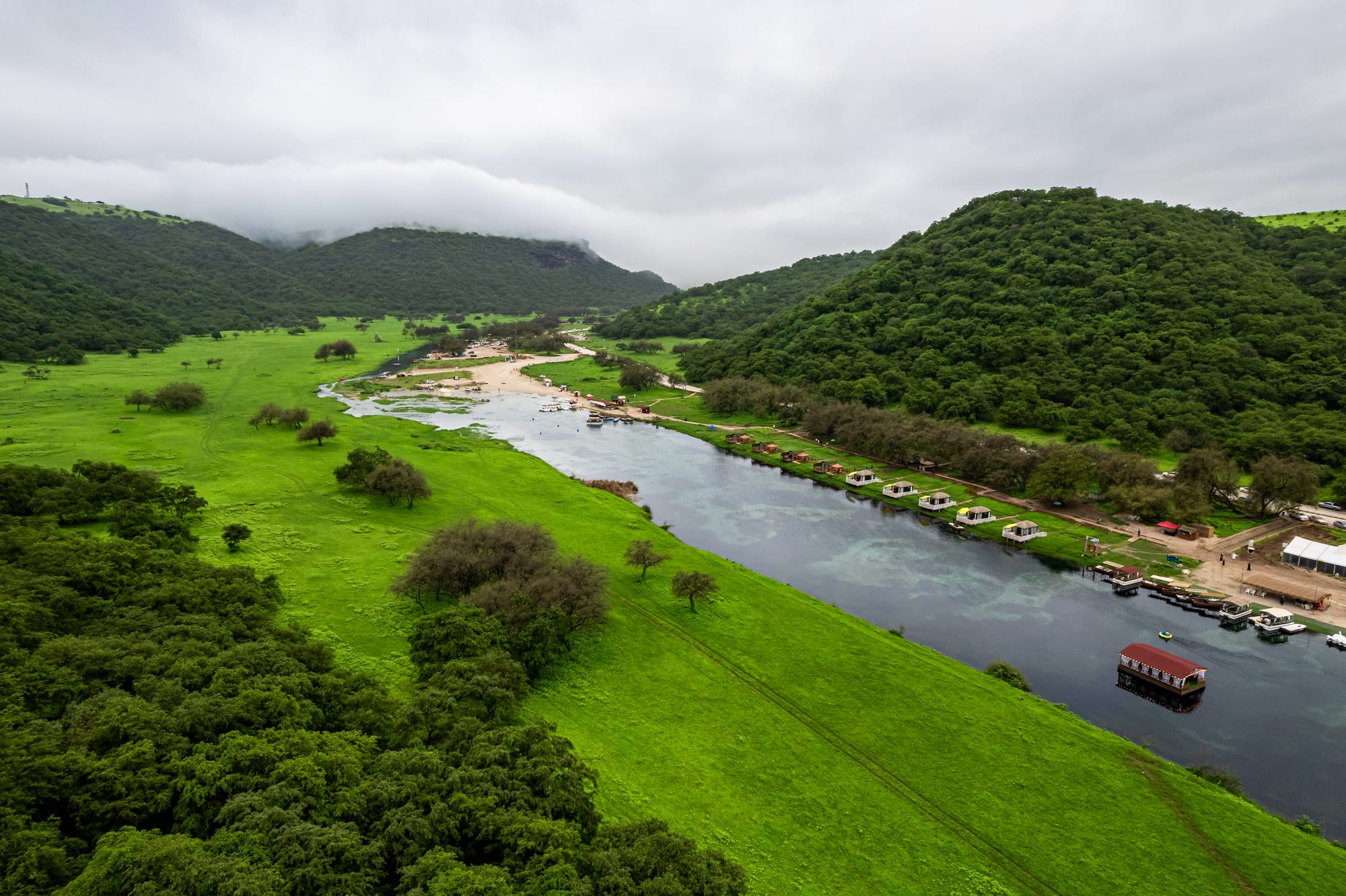
Aerial view of a calm river winding through bright green meadows and wooded hills under low monsoon cloud

Oman

Salalah & Dhofar

Wadi Darbat in the khareef season, when the monsoon turns the hills of Dhofar green, east of Salalah. (Muiad123 / Wikimedia Commons · CC BY-SA 4.0)

Oman's far south and its empty centre — the Dhofar mountains and the coastal plain of Salalah, turned green each summer by the khareef monsoon, and the flat desert and long Arabian Sea shore of Al Wusta — the ancient home of the frankincense trade, of South Arabian languages and of a region that long stood apart from northern Oman.

Explore Salalah & Dhofar

History

Dhofar's wealth came from a tree. Frankincense, the resin of Boswellia sacra, grew in the dry valleys behind the mountains and was shipped from harbours such as Sumhuram at Khor Rori, founded by the Hadramawt kingdom of southern Arabia in the last centuries BC, and carried by caravan to Egypt, Mesopotamia and the Mediterranean. The caravan oasis at Shisr, identified by some in the 1990s with the legendary lost city of Ubar, and the medieval port of Al Baleed, the city of Zafar visited by Marco Polo and Ibn Battuta, belong to the same story, and four of these sites are listed together as the Land of Frankincense, a UNESCO World Heritage Site.

Dhofar came under the Al Bu Said sultans only in the 19th century, and for long afterwards the sultan treated it more as a private estate than a province. Sultan Said bin Taimur lived in Salalah, and his son Qaboos was born there in 1940. Neglect and isolation fed a rebellion in the Dhofar mountains from 1965, later led by Marxist fighters backed by South Yemen. After the 1970 coup, Qaboos combined British, Iranian and Jordanian military help with amnesty and development, and the rebellion was declared defeated in January 1976.

Salalah then grew into a modern city with a large container port at Raysut, while Al Wusta, almost uninhabited desert, gained the new port and industrial zone of Duqm from the 2010s.

Culture & Customs

Dhofar feels different from northern Oman. The mountains are home to speakers of Jibbali, also called Shehri, and Mehri is also spoken, with smaller South Arabian languages such as Harsusi on the Jiddat al Harasis and Bathari on the coast facing the Khuriya Muriya Islands; none has a written tradition of its own. Mountain families have long kept cattle and camels, grazing them on the monsoon pastures, and many Dhofaris share kinship ties with eastern Yemen.

Frankincense is part of everyday life: it is burned in homes to scent rooms and clothes, and sold by grade in the Al Husn souk in Salalah. Al-Bar'ah, a song and dance of Dhofar, is inscribed as UNESCO intangible heritage, and wedding songs and poetry in the local languages remain strong.

The khareef is the social season, when Omani and Gulf families arrive to picnic on the wet hills, and the Salalah Khareef Festival fills the summer with markets, concerts and folk performances. Salalah's coconut groves, banana plantations and Indian-influenced market streets give the city a tropical look unusual in Arabia.

Daily Life

Salalah is Oman's third-largest city, a spread of low-rise districts between the mountains and the sea, with a university, a large port and a busy seafront. Smaller towns along the coast include Taqah and Mirbat to the east and Rakhyut to the west, while Thumrait sits on the desert plateau north of the mountains. Al Wusta is thinly populated, its people spread between Haima, the governorate capital, the fishing villages of the coast and the new town of Duqm.

The economy combines government jobs, the port at Raysut and the free zone, livestock, fishing, farming on the Salalah plain, oil and gas fields in the desert and a tourist trade that peaks in the khareef. Duqm's refinery, port and planned industries are the state's great bet for the centre of the country, and hydrogen made with renewable power is part of Oman's plans for the future.

Days start early in the heat of the dry season and slow down at midday; in the khareef evenings are spent outdoors. Coconut sellers line the roads, and fishing communities work the sea between monsoon closures.

Food

Dhofar's food reflects its tropical plain and its cattle. Roadside stalls in Salalah sell fresh coconuts to drink and bananas from the plain's groves. Mountain families make ghee and drink fresh cow's and camel's milk, and meat, usually goat, camel or beef, is grilled or cooked slowly for guests. Mashuai, spit-roasted kingfish with lemon rice, and grilled fish of all kinds are standard on the coast.

The Arabian Sea off Dhofar yields abalone as well as sardines, tuna and lobster. In the markets, frankincense of several grades is sold alongside spices and dates.

Majboos rice, harees and shuwa appear on festive days as elsewhere in Oman, while Salalah's Indian, Yemeni and Kerala-style restaurants reflect long ties across the Arabian Sea. Kahwa and dates are offered to every guest.

Attractions & Natural Wonders

Salalah itself has Al Baleed, the ruins of medieval Zafar in a seafront park with the Museum of the Land of Frankincense, the Al Husn souk, and the tomb of the Prophet Ayub (Job). In the khareef, the hills and plain around Salalah turn green, springs such as Ain Razat and Ain Hamran flow, and Wadi Darbat fills with pools and a waterfall.

East along the Dhofar coast, Taqah has a fort, Khor Rori holds the ruins of Sumhuram above a lagoon, and Mirbat keeps the mausoleum of Bin Ali and a fort recalling the 1972 battle of the Dhofar war. Inland, Tawi Atayr lies in the green mountain belt above Mirbat, and the Jebel Samhan nature reserve is one of the last refuges of the Arabian leopard. West of Salalah, Mughsayl has a long white beach, the Marneef cave and blowholes, and the road climbs in hairpin bends towards Rakhyut. North of the mountains, Wadi Dawkah protects wild frankincense trees and Shisr has the ruins of its caravan fort, both within the Land of Frankincense listing.

Beyond, the Al Wusta shore runs for hundreds of kilometres of empty beaches and fishing camps. Duqm has its port and a rock garden of wind-eroded formations, the coastal wetlands of Barr al Hikman opposite Masirah shelter wildlife, and the stony Jiddat al Harasis inland holds the Al Wusta Wildlife Reserve, formerly the Arabian Oryx Sanctuary.

Cities in Salalah & Dhofar

Planning basics

Budget

Salalah has everything from simple apartments to beach resorts, and prices rise sharply in the khareef, when Gulf families fill the hotels. Outside the monsoon season rooms are often cheaper than in Muscat. Food is good value, especially roadside coconut and fruit stalls and Salalah's Indian and Yemeni restaurants. Al Wusta has few places to stay beyond Duqm, and long distances make fuel a real cost.

Daily Budget Midrange
USD 130–340 (beach hotel, restaurants, hire car; more in the khareef)
Daily Budget Shoestring
USD 40–80 (apartment or guesthouse, local restaurants, a shared car)

Book khareef-season rooms well ahead, or visit from October to April when Salalah is quiet and cheaper.

Safety

Salalah and Dhofar are very safe for visitors. The hazards are natural and specific to the south: dangerous surf and rip currents during the khareef, when the sea is too rough for swimming, dense fog on mountain roads, slippery rocks at waterfalls, cliffs at the Mughsayl blowholes, camels and cattle on the roads, and long empty desert drives. Areas near the Yemeni border are best avoided.

Stay out of the sea during the monsoon, keep well back from the blowholes and cliff edges, and avoid the border area with Yemen. Check current official travel advice before travelling.

Climate

Unlike anywhere else in Oman. The Salalah plain and the seaward slopes of the Dhofar mountains catch the southwest monsoon, the khareef, from about June to early September, bringing fog, drizzle and temperatures in the 20s°C while the rest of Arabia bakes. The rest of the year is warm and sunny. North of the mountains and across Al Wusta the climate is hot, dry desert, with a humid, windy coast in summer.

Summer
khareef mist and drizzle on the Salalah coast, 22–28°C; 40°C and above in the desert behind the mountains and inland Al Wusta
Winter
warm and dry in Salalah, 25–32°C by day; mild nights and hot days in the desert

Transportation

Salalah airport has flights from Muscat and some Gulf cities; the drive from Muscat is long, most of a day, through the desert via Haima on the Nizwa–Salalah road, and overnight buses make the same journey. Duqm has its own airport. Around Salalah a hire car is needed to reach the coast, the mountains and the frankincense sites; a 2WD covers the main roads, while tracks into the mountains and the Al Wusta coast call for a 4x4.

Drive the mountain roads slowly in khareef fog with headlights on, and fill the tank at every opportunity on the long Al Wusta stretches.

Best Time to Visit

Two seasons appeal for different reasons. The khareef, roughly July to early September, brings green hills, waterfalls and the Salalah Khareef Festival, but also crowds, fog and rough seas. From October to April the weather is sunny and warm, the beaches are open and calm, and the frankincense sites and the Al Wusta coast are comfortable to explore.