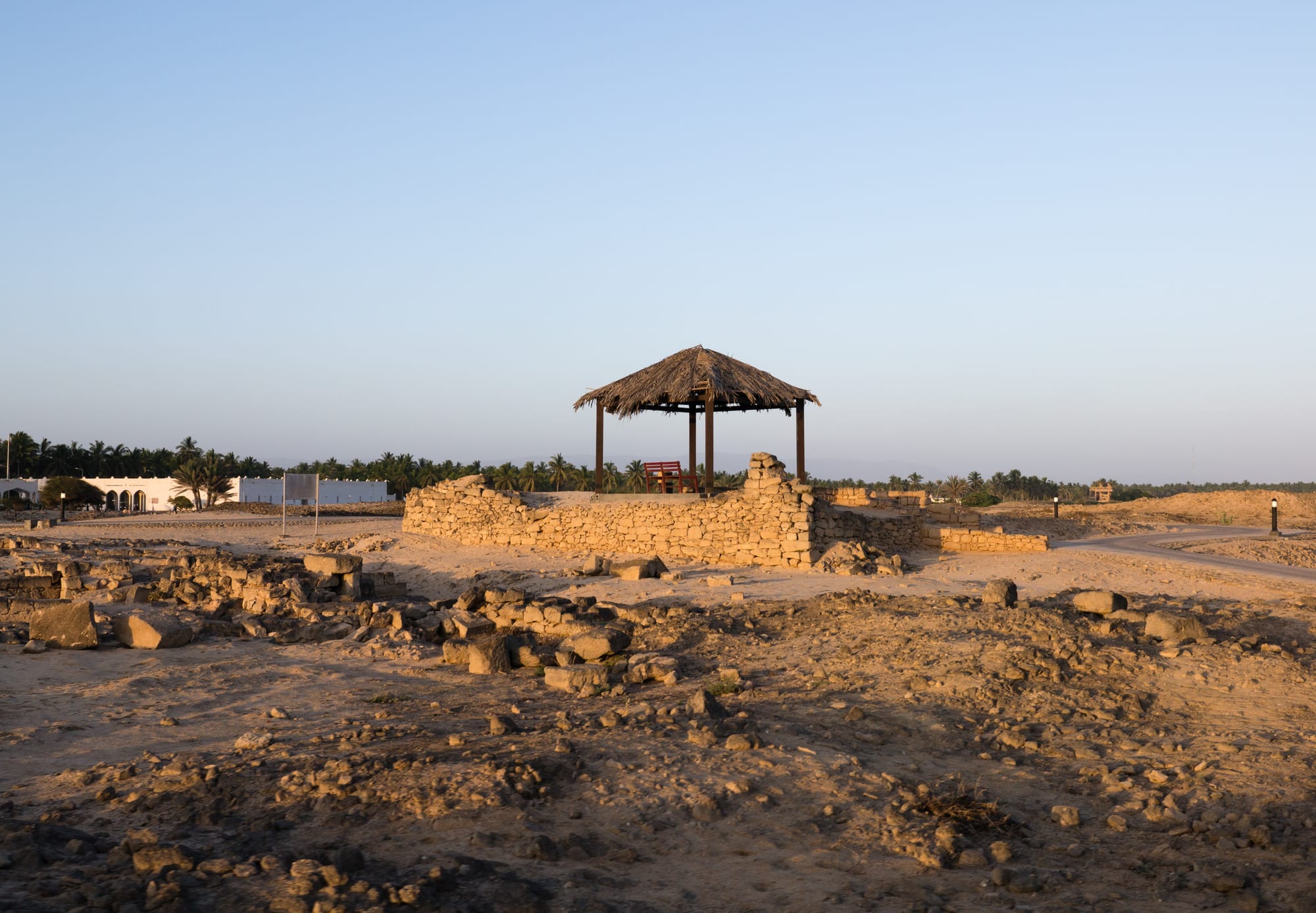
Low stone ruins and a thatched shelter on sandy ground at dusk, with a line of palm trees and hills behind

Salalah & Dhofar, Oman

Salalah

The ruins of the medieval port of Al Baleed on the seafront at Salalah. (Juozas Šalna / Wikimedia Commons · CC BY 2.0)

The capital of Dhofar and Oman's southern city, spread along a coastal plain of coconut groves and banana farms between the Arabian Sea and the Dhofar mountains. It grew rich on frankincense in antiquity, remained a world apart from northern Oman for centuries, and now combines a container port, a low-rise modern city and hills that turn green each summer under the khareef monsoon.

Neighbourhoods

  • Al Haffa
    • First-time visitors
    • Markets
    • Historic district

    The old quarter beside the sea east of the centre, with a souq known for frankincense, incense burners and perfume, low whitewashed houses and a long beach. The ruins of Al Baleed lie at its western edge, and much of what visitors come into the city for is within walking distance.

    Open in Maps
  • Ad Dahariz
    • Beaches
    • Hotels
    • Best for food

    A seafront district of villas, hotels and restaurants on the eastern side of the city, backed by coconut plantations. The beach here is wide and shelving, and the road along it fills with families in the evening once the heat has gone.

    Open in Maps
  • Central Salalah
    • Shopping
    • Local life
    • Close to transport

    The commercial heart around As Salam Street and the central market, where the banks, offices, malls and bus stations are. It is a workaday grid of low buildings rather than a historic centre, and it is busiest in the morning and again after sunset.

    Open in Maps
  • Ittin and the foot of the mountains
    • Views
    • Khareef greenery
    • Quiet and residential

    Newer residential areas spreading north of the city towards the escarpment. The mountains rise directly behind, and in the monsoon season the slopes here turn green and draw picnickers to the viewpoints above the plain.

    Open in Maps
  • Raysut
    • Port and industry
    • Beaches west of the city

    The industrial west, built around the container port and free zone that handle much of Oman's shipping. It is not a sightseeing district, but the road through it leads to the beaches and blowholes of the western coast.

    Open in Maps

Things to do

Frankincense and archaeology

  • Al Baleedlandmark

    The excavated ruins of the medieval port of Zafar, spread across a seafront park beside a lagoon, part of the UNESCO-listed Land of Frankincense.

    Open in Maps
  • Museum of the Land of Frankincensemuseum

    The museum inside the Al Baleed park, with halls on Dhofar's maritime trade and on the history of Oman.

    Open in Maps
  • Sumhuram and Khor Rorilandmark

    The stone ruins of an ancient South Arabian port above a lagoon east of the city, from which frankincense was shipped across the Indian Ocean.

    Open in Maps

Souqs and city sights

  • Al Haffa Souqmarket

    The city's best-known market, where frankincense is sold by grade beside incense burners, perfumes, spices and cloth.

    Open in Maps
  • Salalah Central Marketmarket

    The main produce market, piled with bananas, papayas, coconuts and vegetables from the plain, and busy with fish from the coast in the early morning.

    Open in Maps
  • Ad Dahariz beachbeach

    A long stretch of pale sand along the city's eastern seafront, lined with coconut palms and used for evening walks and football rather than sunbathing.

    Open in Maps
  • Port of Salalahtransit hub

    The container port and cruise terminal at Raysut, one of the busiest transhipment harbours on the Arabian Sea.

    Open in Maps

Springs, wadis and viewpoints

  • Ain Razatpark

    A spring in a small gardened valley below the escarpment north-east of the city, where water runs year-round and flows strongly after the monsoon.

    Open in Maps
  • Wadi Darbatattraction

    A valley of pools, meadows and a seasonal waterfall in the mountains east of Salalah, at its greenest and fullest at the end of the khareef.

    Open in Maps
  • Tawi Atayrviewpoint

    A deep sinkhole in the limestone of the mountains above the eastern coast, reached by a short walk from the road through monsoon-fed woodland.

    Open in Maps
  • Jabal Samhanviewpoint

    The high plateau and escarpment east of Salalah, a nature reserve and one of the last refuges of the Arabian leopard, with long views down to the sea.

    Open in Maps

The western coast

  • Mughsaylbeach

    A wide white beach west of the city below steep cliffs, with blowholes that spout seawater through holes in the rock when the swell is high.

    Open in Maps
  • Marneef Cavelandmark

    A shallow cave under an overhanging cliff at the end of Mughsayl beach, looking out over the sea and the blowholes.

    Open in Maps

Short trips from the city

  • Taqahneighborhood

    A small fishing town east of Salalah with a restored castle, close to the ruins at Khor Rori.

    Open in Maps
  • Mirbatneighborhood

    An old trading and fishing port further east, with merchant houses, a fort and the mausoleum of Bin Ali on its edge.

    Open in Maps

Seasonal events

  • Salalah Khareef FestivalJuly to early September

    The city's monsoon-season festival, with markets, concerts, funfairs and folk performances that draw Omani and Gulf families through the summer.

  • The khareef itselfroughly June to early September

    The southwest monsoon brings mist and drizzle, turning the plain and mountains green and filling the wadis and springs; it is Salalah's busiest season.

  • Ramadan and the two Eidsdates move each year with the Islamic calendar

    Daytime life slows sharply through Ramadan and the city comes alive after dark; the Eid holidays fill beaches, parks and family homes.

  • Oman National DayNovember

    Flags, lights and decorated buildings across the city for the national holiday, with public events and a festive mood on the seafront.

Eat and drink

Long-standing places and food districts in Salalah. Hours, ratings and directions come from your maps app, always current.

Salalah classics

  • Coconut and fruit stallsmarket

    Roadside stalls on the plain sell chilled coconuts to drink, small sweet bananas and papayas grown in the surrounding groves.

    Open in Maps
  • Grilled fish and mashuairestaurant

    Kingfish, tuna and lobster come in from the Dhofari coast; mashuai, a whole spit-roasted kingfish with lemon rice, is the dish kept for guests.

    Open in Maps

Food districts and markets

  • Al Haffa Souqmarket

    Frankincense of several grades, dates, halwa and spices, sold in the old quarter beside the sea.

    Open in Maps
  • Salalah Central Marketmarket

    Fruit, vegetables and fish from the plain and the coast, at their best early in the morning.

    Open in Maps
  • Indian and Kerala restaurantsneighborhood

    Long ties across the Arabian Sea show in the city's many South Indian kitchens, serving biryani, parotta, fish curry and karak tea.

    Open in Maps
  • Yemeni grillsneighborhood

    Dhofar's kinship with eastern Yemen is on the table too, in mandi and haneeth — rice and slow-cooked lamb or chicken shared from a single tray.

    Open in Maps

Experience Salalah

History

Salalah's importance began with frankincense. The resin of Boswellia sacra, which grows in the dry valleys behind the Dhofar mountains, was carried down to the coast and shipped to Egypt, Mesopotamia and the Mediterranean from ports on this plain — Sumhuram at Khor Rori, founded by the Hadramawt kingdom of southern Arabia in the 3rd century BC, and later Zafar, whose ruins at Al Baleed lie in the middle of the modern city. Medieval Zafar traded horses and incense across the Indian Ocean and was visited by Marco Polo, Ibn Battuta and Zheng He; its ruins are part of the Land of Frankincense, inscribed as a World Heritage Site in 2000.

Dhofar came under the rule of the Al Bu Said sultans of Muscat only in the 19th century, and for a long time it was treated almost as a separate possession. Sultan Said bin Taimur made Salalah his home and governed the country from here for much of his reign, and his son Qaboos was born in the city in 1940. Poverty and isolation helped fuel a rebellion in the mountains from 1965, which drew in Marxist fighters backed by South Yemen and was declared defeated in January 1976, after the 1970 change of ruler combined military campaigns with amnesty and development.

What followed changed the city completely: roads, schools, a hospital, an airport, a university and, from 1998, a deep-water container port at Raysut that made Salalah a transhipment hub between Asia, Africa and Europe. The city spread across the plain, khareef tourism grew into a season of its own, and the frankincense sites were excavated, protected and opened to visitors.

Culture & Customs

Salalah looks and sounds different from the rest of Oman. Coconut palms, banana plantations and papaya groves give it a tropical appearance, and Arabic here shares the plain with Jibbali, also called Shehri, spoken in the mountains behind the city, and with Mehri further west — South Arabian languages unrelated to Arabic and with no written tradition of their own. Many Dhofari families have kin in eastern Yemen and along the East African coast, and the city's shops and kitchens are full of Indian, Pakistani and Bangladeshi workers and long-settled families.

Frankincense is part of daily life rather than a souvenir: burned in homes, offices and shops to scent rooms and clothes, passed around after meals, given to guests, and sold by grade and colour in the Al Haffa souq. Al-Bar'ah, a sword-carrying song and dance of Dhofar performed to drums and sung poetry, is still danced at weddings and festivals, and wedding songs in the mountain languages remain strong.

The khareef is the great social season. Families from across Oman and the Gulf arrive to picnic on wet green hillsides, sit in the drizzle and watch waterfalls that flow for only a few weeks, and the festival programme runs through the summer nights. Manners are those of Oman generally — unhurried greetings, coffee before business, modest dress, a reluctance to refuse directly — held to a little more firmly in Dhofar than in Muscat.

Daily Life

About 330,000 people live in Salalah and the surrounding plain, making it the third-largest city in Oman and much the largest in the south. It is low-rise and spread out, a grid of villa districts, shopping streets and plantations stretching perhaps twenty kilometres between the mountains and the sea, so almost every errand involves a car.

The economy rests on the port and free zone at Raysut, government employment, the university and health service, fishing, farming on the irrigated plain — coconuts, bananas, papayas, fodder and cattle — and a tourist season that peaks in the monsoon. A large share of the workforce comes from South Asia, and many Dhofari families also have members working in Muscat or the Gulf.

Days begin early. Fish is landed and sold soon after dawn, offices and schools start in the cool of the morning, and the middle of the day empties the streets outside the khareef. Life resumes after the late-afternoon prayer, when the seafront fills with walkers, football games and families eating on the grass. Water for the plain comes from springs and wells beneath the mountains, and falling groundwater, summer crowding and the growth of the city on to farmland are steady local concerns.

Food

Dhofari cooking starts with the sea and the plantations. Kingfish, tuna, grouper, sardines, lobster and abalone are landed along the coast; the everyday meal is grilled or fried fish with rice, and mashuai — a whole kingfish spit-roasted and served on lemon rice — is the dish brought out for guests. Coconuts are cut open and drunk at roadside stalls, and the plain's small sweet bananas and papayas are sold by the box.

Meat is for occasions. Machboos, spiced rice cooked with goat, camel, beef or fish, is the festive standard, while shuwa — meat rubbed with spices, wrapped and cooked for a day or more in a covered pit — belongs to Eid. Harees, wheat beaten with meat into a thick paste, appears in Ramadan. Mountain families make ghee and drink fresh cow's and camel's milk, and camel meat is more common here than in much of the Gulf.

The city's restaurants tell its trade history. South Indian and Kerala kitchens serve biryani, parotta and fish curry with karak tea; Yemeni houses serve mandi and haneeth, lamb or chicken cooked in a pit oven over rice and shared from one tray. Kahwa, coffee with cardamom and often rosewater, is poured in small cups with dates and halwa, the dense saffron-and-rosewater sweet eaten with the fingers, and frankincense is burned at the end of a meal.

Planning tools

Budget

Salalah is good value outside the monsoon. Apartments, mid-range hotels and beach resorts all exist, and prices climb steeply in the khareef, when Gulf families fill the city and rooms are scarce. Food is cheap, above all in Indian and Yemeni restaurants and at fruit stalls, and the main extras are a hire car and fuel for the drives east and west along the coast.

Daily Budget Midrange
USD 130–340 (beach hotel, restaurants, hire car; more in the khareef)
Daily Budget Shoestring
USD 40–80 (apartment or guesthouse, local restaurants, shared transport)

Book khareef rooms months ahead or come between October and April, when the city is quiet, the sea is calm and rates are much lower.

Best Time to Visit

October to April brings warm sunny days, calm sea and the easiest conditions for the beaches and the frankincense sites. The khareef, roughly July to early September, is the opposite: cool, grey, wet and green, with waterfalls, crowds, festival programmes and a rough sea that is unsafe for swimming. Air travel and events across the region have been disrupted by the war since late February 2026.

Suggested Number of Days

Two or three days cover the city and the nearest sites. Four to six allow the coast east and west, the mountains and the desert edge. The khareef slows everything down, as roads are busy and fog limits driving in the hills, so allow more time in the monsoon months.

First Visit
2–3 days
With Surroundings
4–6 days

Transportation

The city spreads for many kilometres along the plain and was built for driving. A hire car is the usual choice and is needed for the springs, the mountains and the coastal towns; a 2WD covers the main roads, while mountain tracks call for a 4x4. Taxis and shared minibuses work inside the city, and app-based rides are available. Buses connect Salalah with Muscat and with the larger Dhofari towns.

Fuel is cheap but stations thin out quickly on the roads west and north, so fill the tank before leaving the plain, and watch for camels and cattle at dusk.

Airport & Station Connections

Salalah International Airport sits within the city, a few kilometres north of the centre, with flights from Muscat and a number of Gulf and regional cities and extra services in the khareef. The drive from Muscat is about a thousand kilometres across the desert, most of a day, and overnight coaches cover the same route. Cruise ships and cargo call at Raysut, west of the centre.

Walkability

Individual districts walk well — Al Haffa's souq and beach, the seafront at Ad Dahariz, the central market area — but the city as a whole does not. Distances between districts run to several kilometres along wide roads, pavements are patchy, and heat outside the monsoon makes long walks uncomfortable between mid-morning and late afternoon.

Safety

Salalah is very safe for visitors and serious crime is rare. The risks are natural and specific: dangerous surf and rip currents in the khareef, when the sea is closed to swimmers, fog on the mountain roads, slippery rocks at the springs and waterfalls, cliffs at the Mughsayl blowholes, and camels and cattle wandering onto roads at night. Areas near the Yemeni border are best avoided. In March 2026, during the war in the region, drones struck Duqm and Salalah, damaging a fuel storage tank at Duqm; both ports have been busy since with shipping diverted from the Strait of Hormuz, closed to commercial traffic since late February 2026.

Stay out of the sea during the monsoon, keep well back from the blowholes and cliff edges, and avoid the border area with Yemen. Check current official travel advice before travelling.

Climate

Unlike anywhere else in Arabia. The southwest monsoon reaches the Dhofar coast from about June to early September and covers the plain in mist and drizzle, keeping temperatures in the 20s°C while the rest of the country bakes. The rest of the year is warm, dry and sunny, with humid nights.

Summer
khareef mist and drizzle, about 22–28°C, grey and damp, with a rough sea
Winter
warm and dry, about 25–32°C by day with mild nights

Local Customs

Dhofar is conservative. Modest dress is expected in the city, the souqs and the mountains — shoulders and knees covered for both men and women — and swimwear belongs on hotel beaches only. Greetings are long and unhurried, guests are given kahwa, dates and often halwa, and the right hand is used for eating and giving. Frankincense is burned in homes and shops and offered to visitors.

Ask before photographing people, especially women, and avoid photographing the port and military sites; alcohol is served only in licensed hotels and should not be carried in public. During Ramadan do not eat, drink or smoke outdoors in daylight.

Common Payment Methods

The currency is the Omani rial, a high-value note worth more than a US dollar or a euro, so small change matters. Hotels, malls, supermarkets and petrol stations take cards, but souq stalls, fruit sellers, small restaurants and taxis prefer cash. ATMs are common in the centre and scarce in the mountains and along the coast.