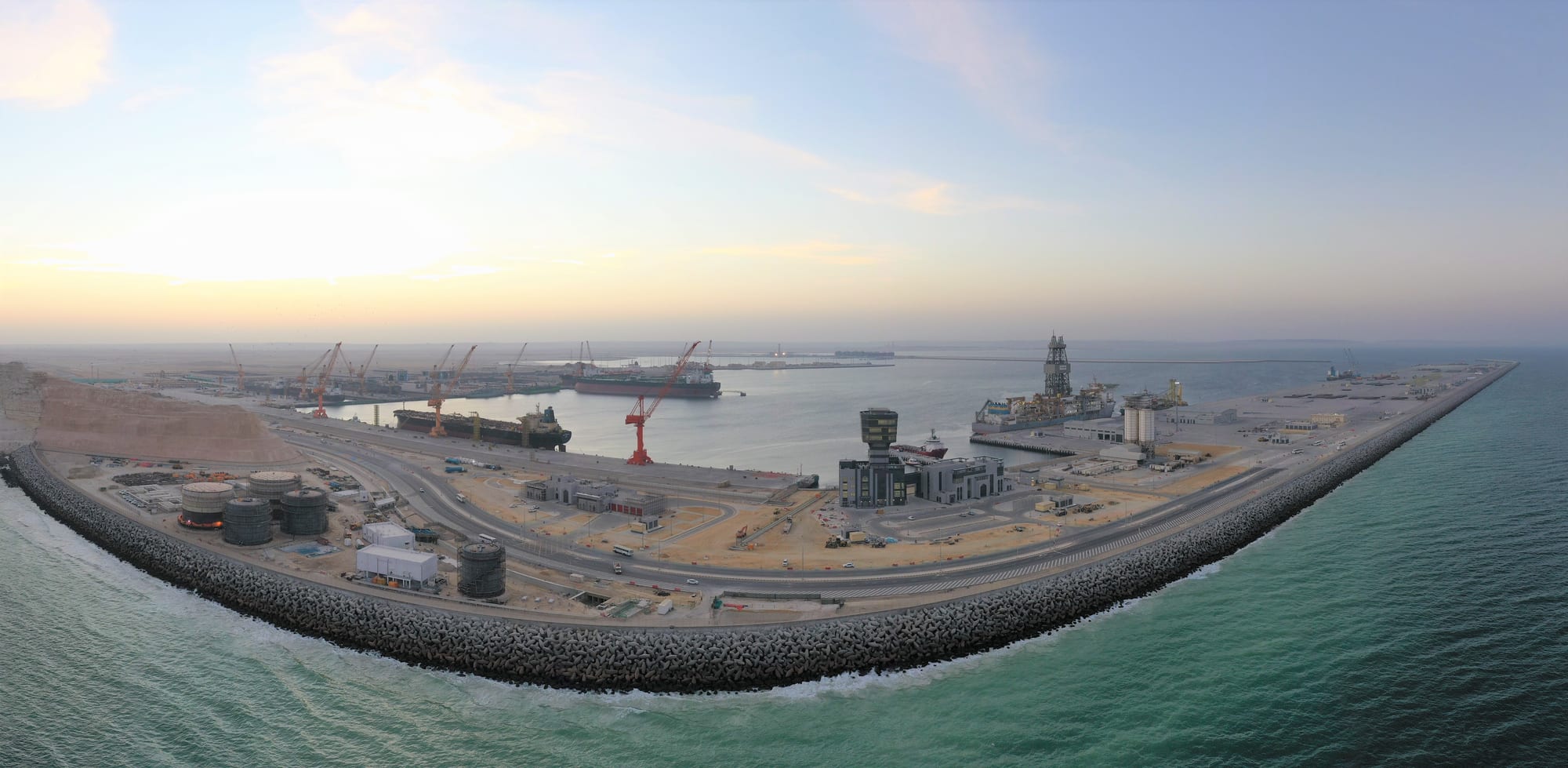
Wide view of a curving stone breakwater enclosing a harbour with cranes and ships, the desert coast stretching behind at dusk

Salalah & Dhofar, Oman

Duqm

The deep-water port of Duqm on the Arabian Sea coast of Oman. (AbdullahAlMaani / Wikimedia Commons · CC BY-SA 4.0)

A planned port town on the empty Arabian Sea coast of central Oman, built out from a small fishing settlement since 2011 around a deep-water harbour, a dry dock and a special economic zone. Wide new roads, hotels and industrial estates sit beside long beaches, wind-carved rock formations and hundreds of kilometres of desert shore.

Neighbourhoods

  • The town centre
    • First-time visitors
    • Shops and services
    • Hotels

    The planned commercial core inland from the shore, laid out on broad straight roads with shops, banks, offices, restaurants and most of the hotels. It is new, low-rise and widely spaced, built for a population much larger than the one it has.

    Open in Maps
  • The seafront and beaches
    • Beaches
    • Quiet
    • Walks

    A long stretch of pale sand and low rock north and south of the town, with resort hotels set back from the water and stretches of shore where nobody goes at all. Swimming is calm for much of the year and the sunsets draw families in the evening.

    Open in Maps
  • The port and economic zone
    • Industry and shipping

    The harbour, dry dock, fishing port and industrial estates spread over a very large area south and east of the town. Access is restricted in places, and this is a working district rather than a sight, though the scale of it is what Duqm is known for.

    Open in Maps
  • The old fishing quarter
    • Local life
    • Boats

    What is left of the settlement that existed before the new town, where fishing families still keep boats and nets and land their catch. It is small and plain, and the everyday life of the place is easiest to see here.

    Open in Maps

Things to do

In and around the town

  • Duqm Rock Gardenpark

    A public park a short drive north of the town where wind and sand have eroded limestone into arches, mushrooms and pillars, floodlit after dark.

    Open in Maps
  • Duqm's beachesbeach

    Kilometres of empty sand along the bay, with shells, birds and warm water for most of the year, and almost no development on long stretches of it.

    Open in Maps
  • The fishing harbourattraction

    Boats land kingfish, tuna and sardines at the fishing port inside the economic zone, the largest multi-purpose fishing port in Oman, where the catch is sorted and iced in the morning.

    Open in Maps
  • Port of Duqmtransit hub

    The deep-water commercial harbour, sheltered by a main breakwater more than four kilometres long and equipped with a dry dock and ship-repair yard; it has been working since 2012 and was formally opened in 2022, and it is the reason the town exists.

    Open in Maps

The desert coast

  • The Al Wusta shorebeach

    North and south of the town the coast runs for hundreds of kilometres of beach, cliff and fishing camp with no settlements in between, a landscape of sand, gravel and sea.

    Open in Maps
  • The Jiddat al Harasisattraction

    The stony desert plateau inland, grazed by camels and home to Arabian oryx and gazelle, crossed by the road north towards Haima.

    Open in Maps
  • Ras Madrakahbeach

    A headland of dark rock and pale sand about eighty kilometres south of Duqm, known for the contrast between the two and used for camping, fishing and birdwatching.

    Open in Maps

Seasonal events

  • The summer windroughly June to September

    The southwest monsoon brings weeks of strong wind, haze and a rough sea to this coast, keeping temperatures below those of the interior and making the water unsuitable for swimming.

  • Turtle nesting on the Al Wusta coastmainly the warmer months

    Turtles come ashore to nest on beaches along this shore, which is little developed and largely empty of people.

  • Ramadan and the two Eidsdates move each year with the Islamic calendar

    Working hours shorten through Ramadan and life moves to the evening; at Eid the beaches and rock garden fill with families from the town and the surrounding desert.

Eat and drink

Long-standing places and food districts in Duqm. Hours, ratings and directions come from your maps app, always current.

Where people eat

  • The town's restaurantsneighborhood

    Simple Indian, Pakistani and Bangladeshi kitchens serve biryani, curries, grilled chicken and fresh bread to the workforce, alongside a few Arabic grills and the hotel dining rooms.

    Open in Maps
  • Fish from the harbourmarket

    Kingfish, tuna, emperor and sardines come straight from the boats, and grilled fish with rice is the local dish worth seeking out.

    Open in Maps
  • Coffee shops and groceriesneighborhood

    Supermarkets and small cafés along the main roads sell dates, halwa and cold drinks and pour kahwa and karak-style milky tea through the day.

    Open in Maps

Experience Duqm

History

Duqm was, until recently, a fishing settlement on one of the emptiest coasts in Arabia. The Jiddat al Harasis behind it is a stony desert grazed by the Harasis people, whose own South Arabian language, Harsusi, is still spoken, and the shore supported small groups of fishermen who worked the Arabian Sea and traded inland by camel. Nothing about the place suggested a city: there was no river, no oasis, no old port and almost no rainfall.

What changed matters was geography. Duqm lies on the open Arabian Sea, outside the Strait of Hormuz, on a bay deep enough for large ships and with unlimited flat land behind it. In 2011 the Omani government set out to build there: a deep-water commercial port with a dry dock and ship-repair yard, a fishing harbour, an airport, roads and housing, and a special economic zone covering a very large area, intended to attract refining, petrochemicals, logistics and manufacturing. Foreign investment, much of it from Asia and the Gulf, followed, and Duqm became the centre of Oman's plan to build an economy less dependent on oil revenue and less exposed to the strait.

The town grew accordingly, from a village to a planned settlement of wide avenues, hotels, schools and industrial estates. Since the closure of the Strait of Hormuz to commercial traffic in late February 2026, Duqm and Salalah, which lie outside it, have handled much of the shipping diverted from the strait. Since March 2026, during the war in the region, drones have been launched at both ports; at Duqm one struck a workers' housing unit and injured a worker, and a fuel tank at the port was hit two days later.

Culture & Customs

Duqm has no old quarter, no fort and no long civic tradition, and its culture is that of a new town: Omani in its manners and its institutions, and made up in practice of people from somewhere else. Omanis from Al Wusta, the Sharqiyah and the north work in the port, the government offices and the services, while a large share of the workforce comes from India, Pakistan, Bangladesh and the Philippines, which shows in the shops, the food and the languages heard on the street.

The older culture of the area belongs to the desert behind it. The Harasis and other Bedouin groups keep camels and goats on the Jiddat al Harasis, and their knowledge of the plateau made possible the conservation programme that returned Arabian oryx to the wild there. Camel racing and camel keeping remain part of local life, and families from the interior come into Duqm to shop and to use its clinics and schools.

Omani custom holds all the same. Guests are given kahwa and dates before anything is discussed, greetings are long, the dishdasha and the kummah or turban are ordinary daily dress, and the working rhythm pauses for prayer. The weekend belongs to families, who drive out to the beaches and the rock formations with mats, thermoses and grills. It is a town where almost everyone has arrived within the last twenty years, and conversation turns quickly to where people are from and what brought them.

Daily Life

Duqm's resident population is small for the space it occupies — around twelve thousand at the 2017 count, besides the workforce in the economic zone — and the town is built to grow. Wide roads with roundabouts connect blocks of housing, shops, schools, a hospital and government offices, with large gaps still waiting to be filled.

Work is dominated by the port and the zone: container and bulk handling, the dry dock and ship repair, refining and petrochemicals, logistics, construction and the fisheries complex that processes the catch landed on this coast. Fishing itself continues on a small scale as it always has, and government service, the airport and the hotels provide much of the remaining employment. Oman's plans for green hydrogen and renewable power place a good deal of weight on this coast.

Life is practical rather than picturesque. Shifts and office hours set the day, the middle of it is spent indoors out of the heat, and the evening brings people to the supermarkets, cafés and beach. Everything except fish has to be trucked in across hundreds of kilometres of desert, water is desalinated, and a strong summer wind coats the town in salt and dust. Many workers live here without their families and remit most of what they earn, and for Omani households the question is whether the promised city will eventually arrive.

Food

Duqm's food is that of the sea and of the workforce that has come to build the town. Boats land kingfish, tuna, emperor, sardines and lobster, and the best eating is the simplest: whole fish grilled over charcoal and served with rice, a spiced tomato sauce and flat khubz bread. Mashuai, a spit-roasted kingfish on lemon rice, is the Omani coast's dish for guests, and dried sardines are still a feature of this shore.

Most restaurants in the town are South Asian, and their menus are the everyday food of the place: chicken and mutton biryani, fish curry, dal, parotta and freshly baked bread, eaten quickly and cheaply. Arabic grills serve shawarma, mixed grills and mandi — rice and meat cooked together in a pit oven — and the supermarkets stock dates, halwa and the packaged goods trucked down from Muscat.

The Omani table appears for occasions. Majboos, rice spiced and cooked with goat, camel or fish, is the festive standard, and shuwa, meat rubbed with spices and cooked for a day in a covered pit, belongs to Eid. Camel meat and camel milk come in from the desert. Kahwa with cardamom, poured in small cups and served with dates and halwa, is offered to every visitor, and karak-style milky tea and fresh juices are the usual drinks in the cafés.

Planning tools

Budget

Duqm's hotels were built for business travellers and contractors, so rooms range from plain guesthouses to a few large beach hotels and prices are steady rather than seasonal. Food is cheap in the workers' restaurants, and the largest cost for a visitor is a hire car and the fuel for very long drives.

Daily Budget Midrange
USD 130–340 (beach or business hotel, restaurants, hire car and fuel)
Daily Budget Shoestring
USD 40–80 (guesthouse, local restaurants, shared transport)

Carry cash for small restaurants and fuel stops outside the town, and fill the tank wherever possible, as stations are very far apart on the Al Wusta roads.

Best Time to Visit

October to April is the comfortable season, with warm sun, calm sea and easy driving. From June to September the monsoon wind makes the coast hazy, rough and gritty, though it keeps temperatures below those of the interior. Air travel and events across the region have been disrupted by the war since late February 2026.

Suggested Number of Days

A day covers the town, the shore and the rock formations nearby. Two or three days suit those breaking the long drive between north and south, or exploring the desert coast, where distances rather than sights decide the length of a stay.

First Visit
1 day
With Surroundings
2–3 days

Transportation

Duqm is built for driving and everything is spread out; there is no public transport within the town, and distances between the centre, the port and the beaches run to several kilometres. Taxis are limited, so a hire car is close to essential, and intercity coaches connect the town with Muscat and Salalah. A 4x4 is needed for tracks along the coast.

Watch for camels on the highways at night, keep water and a spare tyre in the car, and remember that mobile coverage fails on long stretches of the desert roads.

Airport & Station Connections

Duqm has its own airport about twenty kilometres south of the town, open since 2014, with domestic flights from Muscat. By road it is roughly a day's drive from either Muscat or Salalah — about five to six hours from Muscat on the highway through Sinaw or the coast route, and a similar distance south — and long-distance coaches run on both routes. The port handles cargo rather than passengers.

Walkability

Not a walking town. Blocks are large, the roads are wide, distances between the centre, the hotels and the beach are measured in kilometres, and shade is almost non-existent. The beaches and the rock garden are pleasant on foot once a vehicle has reached them, and the fishing quarter is small enough to walk around.

Safety

Duqm is very safe and crime is rare. The hazards are natural and practical: heat and dehydration, long empty roads with camels on them after dark, strong currents and a rough sea in the monsoon months, construction traffic around the industrial areas, and restricted access to port and military sites. Since March 2026, during the war in the region, drones have been launched at the ports of Duqm and Salalah: at Duqm one struck a workers' housing unit and injured a worker, another was intercepted, and a fuel tank at the port was hit two days later. Both ports have been busy with shipping diverted from the Strait of Hormuz, closed to commercial traffic since late February 2026.

Do not photograph the port, the dry dock or military facilities, carry plenty of water on desert drives, and avoid swimming when the summer wind is up. Check current official travel advice before travelling.

Climate

Hot desert on a humid coast, cooled and roughened by the southwest monsoon. Rain is rare and irregular, sea fog and haze are common in summer, and cyclones occasionally cross this part of the Arabian Sea between May and November.

Summer
about 30–38°C, humid and very windy from about June to September
Winter
about 22–28°C by day with cool nights and light winds

Local Customs

A conservative Omani town with a large migrant workforce. Modest dress is expected away from hotel beaches — shoulders and knees covered for both men and women — and swimwear belongs at the hotels rather than on the public shore. Greetings are unhurried, coffee and dates are offered to guests, and the working day pauses around prayer times.

Ask before photographing people, and never photograph the port, industrial plants or military sites; alcohol is served only in licensed hotels. During Ramadan do not eat, drink or smoke in public in daylight.

Common Payment Methods

The currency is the Omani rial. The town has banks, ATMs and supermarkets where cards are accepted, but small restaurants, fishing boats and anything bought outside the town generally want cash, and there are no ATMs on the long desert roads either side.