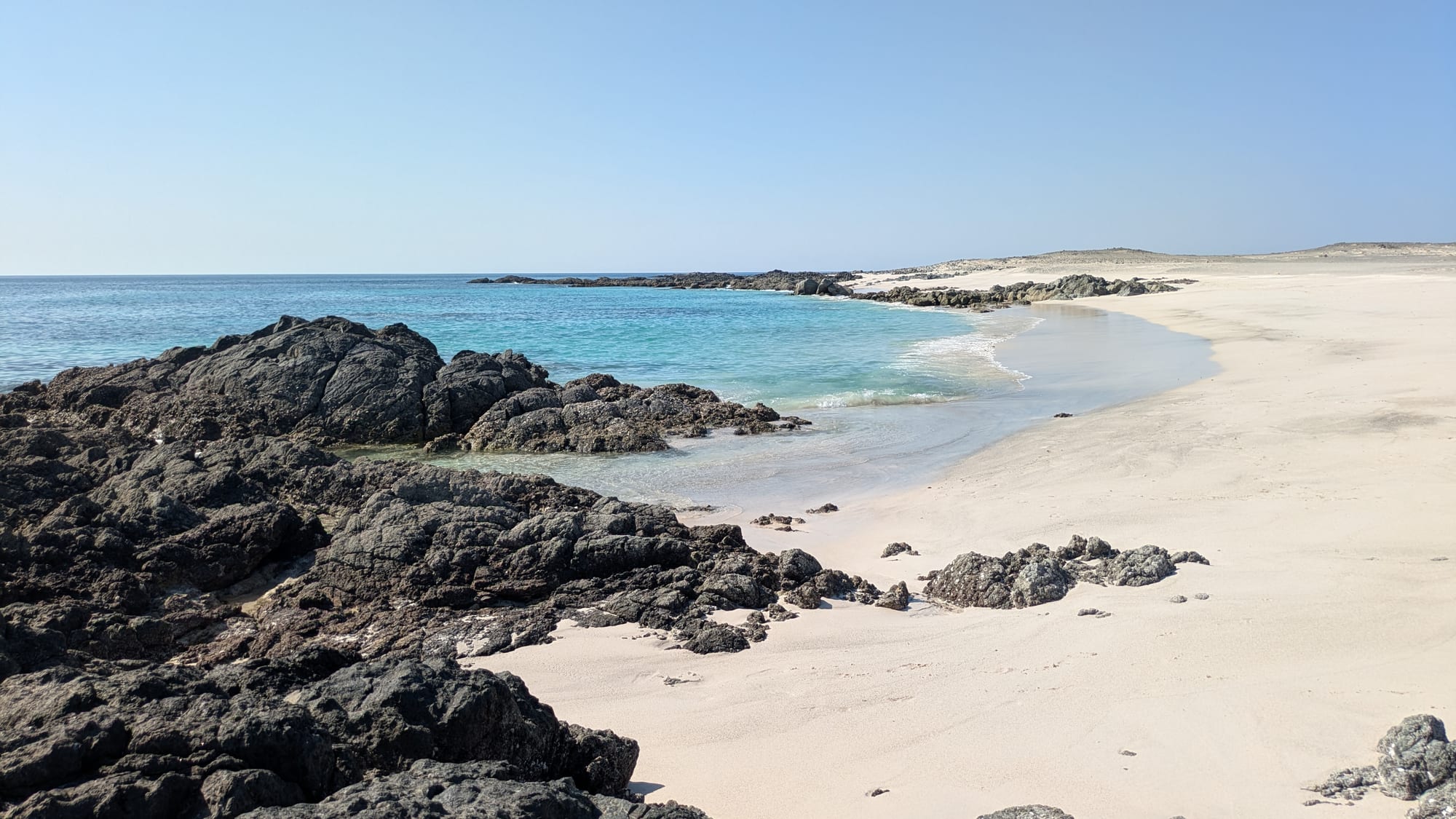
Black volcanic rocks on a pale sand beach beside clear turquoise water, with low dunes running to the horizon

Sur, the Sharqiyah & the Wahiba Sands, Oman

Masirah Island

A beach on the southern part of Masirah Island, Oman. (Cappo80 / Wikimedia Commons · CC0)

A long, dry island in the Arabian Sea off Oman's east coast, reached by car ferry from Shannah and settled mainly at its northern end around the town of Hilf. Fishing and an air base sustain it; nesting loggerhead turtles, wrecked dhows, empty sand and a steady summer wind that draws kitesurfers define the rest.

Neighbourhoods

  • Hilf
    • First-time visitors
    • Hotels and shops
    • Ferry port

    The island's main town, at the northern tip, where the ferry from the mainland arrives. Almost all the shops, petrol stations, banks, restaurants and the small stock of hotels and guesthouses are here, along with the fish landing and the harbour.

    Open in Maps
  • The north-east coast
    • Kitesurfing
    • Beaches

    The shore facing the open Arabian Sea north of the airfield, where the summer monsoon wind blows hardest and the surf is strongest. Kitesurfing camps set up along this side, and the sand runs for kilometres between low rocky headlands.

    Open in Maps
  • The west coast and the villages
    • Local life
    • Quiet and residential
    • Calm water

    The sheltered side facing the mainland, where many of the island's dozen or so villages lie among fishing boats, drying racks and date palms. The water is calmer here and the lagoons and mudflats draw large numbers of wading birds.

    Open in Maps
  • The southern end
    • Empty beaches
    • Camping

    Beyond the last villages the road narrows and the island empties out into a long, bare landscape of sand, gravel and low hills. Turtles nest on these beaches, wrecked wooden boats sit above the tideline, and visitors who camp usually do so here.

    Open in Maps

Things to do

Beaches and the coast

  • Masirah's turtle beachesbeach

    The island's sand is one of the most important nesting grounds in the world for the loggerhead turtle, with females coming ashore at night through much of the year; Oman has the second largest nesting population of loggerheads in the world.

    Open in Maps
  • Wrecked dhows on the shorelandmark

    Wooden hulls left high on the beaches, weathered to bare timber, are a reminder of the island's boatbuilding and fishing past and a favourite subject for photographers.

    Open in Maps
  • Kitesurfing on the east coastbeach

    From roughly May to September the southwest monsoon sends a steady, strong wind across the island, and the east-facing beaches are among Oman's best known places to kitesurf.

    Open in Maps

Harbour and town

  • Hilf harbour and fish landingattraction

    Boats come in through the morning at the island's northern port, where the day's catch is sorted on the quay beside the ferry berths.

    Open in Maps
  • Masirah Island Ferrytransit hub

    The roll-on roll-off ferries that cross from Shannah on the mainland are the island's lifeline and the way almost every visitor arrives.

    Open in Maps

Short trips from the island

  • Barr Al Hikmanattraction

    The mostly uninhabited peninsula of sandflats, mudflats and lagoons facing Masirah across the channel, whose coastal wetlands were listed as a Ramsar site in 2023 and shelter large numbers of waterbirds.

    Open in Maps

Seasonal events

  • Loggerhead nesting seasonpeaks in the northern summer

    Turtles come ashore to lay through much of the year, with the greatest numbers in the hot months; hatchlings emerge on the same beaches weeks later.

  • The kitesurfing windroughly May to September

    The southwest monsoon brings weeks of hard, reliable wind, and the island's few camps fill with kitesurfers.

  • Eid al-Fitr and Eid al-Adhadates move each year with the Islamic calendar

    The two Eids empty the shops and fill the villages, as families return to the island and visit one another over several days.

Eat and drink

Long-standing places and food districts in Masirah Island. Hours, ratings and directions come from your maps app, always current.

Where people eat

  • Hilf's restaurantsneighborhood

    The town's small, plain eating houses are mostly Indian- and Pakistani-run, serving biryani, curries, grilled fish and fresh bread; the hotels have the only other kitchens on the island.

    Open in Maps
  • Hilf fish marketmarket

    Kingfish, tuna, sardines and lobster come straight off the boats, and much of what the island eats is bought here in the morning.

    Open in Maps
  • Island groceries and coffee shopsneighborhood

    Small general stores in Hilf and the larger villages sell dates, rice, tinned goods and cold drinks, and the roadside coffee shops pour kahwa and sweet tea.

    Open in Maps

Experience Masirah Island

History

Masirah has been inhabited for thousands of years, and the sea rather than the land has always decided its fortunes. Its people fished, dived for shells and built wooden boats, and the island lay on the sailing routes between Arabia, East Africa and India; the strong summer winds that draw kitesurfers today made it a difficult and dangerous shore for sailing ships, and wrecks along the beaches were a source of timber for generations.

Its modern history is largely aviation history. The Royal Air Force established a staging post on the island before the Second World War and kept an airfield here for decades afterwards as a link on the route between Britain, the Gulf and Asia, with the installation handed over to Oman in the second half of the 1970s. The airfield remains in use as a Royal Air Force of Oman base, and military employment sits alongside fishing as a mainstay of the island.

Since 1970 the island has been connected to the rest of Oman in ways it never was before: a ferry service for vehicles from Shannah, sealed roads down both coasts, electricity and desalinated water, schools and a hospital. Cyclones crossing the Arabian Sea have caused serious damage, Cyclone Gonu in 2007 above all, when some 7,000 islanders had to leave their homes because of storm waves, and rebuilding after such storms has shaped much of what stands in the villages today. Conservation has become part of the island's identity too, as its beaches are recognised internationally for the turtles that nest on them.

Culture & Customs

Island life here is Omani and Arabic-speaking, shaped by the sea and by a long habit of self-reliance. Families are large and closely related, most trace their living to fishing, and the rhythms of boats, tides and the monsoon still organise the week. Traditional skills — net mending, boatbuilding, navigation by wind and star — were until recently everyday knowledge, and older men in the villages remember when almost everything arrived by dhow.

The island's old craft reputation was in weaving and in the making of wooden vessels, and the household arts of the Omani coast — coffee served from a long-spouted dallah, incense burned for guests, dates offered before anything else is discussed — are kept up more strictly here than in the cities. Hospitality to strangers is a point of pride, and visitors who stop in a village are often invited to sit and drink kahwa.

Religious observance is visible: mosques in every village, the call to prayer carrying over the water, and a quiet island during Ramadan, when working hours shorten and the evenings come alive after the fast is broken. The two Eids are the great family occasions, when relatives working on the mainland come home. Dress is conservative, and visitors who match it are treated warmly; it is also a community where news travels fast, and courtesy counts for more than anywhere a traveller has just come from.

Daily Life

Roughly twelve to fifteen thousand people live on Masirah, most of them in Hilf at the northern tip and in a string of smaller villages down the western shore; the southern half of the island is largely empty. The island runs about ninety-five kilometres from north to south and is twelve to fourteen kilometres wide, so nowhere is far from the sea.

Fishing is the backbone of the economy. Small fibreglass boats go out for kingfish, tuna, sardines and lobster, and much of the catch is trucked to the mainland on the ferry; sardines are also dried on the shore for feed and fertiliser. The air force base, government service, schools, the hospital, the ferry and a small tourist trade in kitesurfing and turtle watching provide most of the remaining work, and many families have members employed in Muscat or Sur.

The day starts early, before the heat, with boats returning to the landing and the fish sold by mid-morning; shops shut in the early afternoon and open again towards evening. Everything else — building materials, most food, spare parts — comes over on the ferry, which makes the crossing the island's central fact of life. Fresh water is desalinated, wind and salt are hard on vehicles and buildings, and the seasonal monsoon, which can interrupt sailings for days, still sets the limits of island life.

Food

Fish dominates the table. Kingfish, tuna, grouper, sardines and lobster are landed daily, and the ordinary meal is grilled or fried fish with rice, a tomato-based sauce and Omani flatbread. Mashuai, a whole kingfish spit-roasted and served with lemon rice, is the coastal dish kept for guests and celebrations, while salted and sun-dried fish is a long-standing way of keeping a catch in a hot climate.

Beyond the sea, the food is that of Oman generally, with a strong Indian influence brought by long trade across the Arabian Sea and by the shopkeepers and cooks who run most of the island's restaurants. Machboos — spiced rice cooked with meat or fish — is the standard festive dish, biryani and curries are everyday fare in Hilf, and shuwa, meat marinated in spices and cooked slowly in a covered pit, appears at Eid. Dates, camel or goat meat and thin rounds of khubz complete the picture.

Drinking is a ritual of its own. Kahwa, coffee flavoured with cardamom and often rosewater, is poured in small cups for every visitor, with dates alongside and frequently halwa, Oman's dense rosewater-and-saffron sweet. Fresh lime juice and karak-style milky tea are the usual cold and hot drinks in the town.

Planning tools

Budget

Masirah is inexpensive once the cost of getting there is met. There are only a handful of hotels and guesthouses, nearly all in or near Hilf, and kitesurf camps sell packages that include meals and equipment. The ferry carries vehicles for a modest charge, food in the town is cheap, and camping on the empty beaches costs nothing.

Daily Budget Midrange
USD 130–310 (island hotel or kitesurf camp with meals, hire car brought over on the ferry, fuel and the crossing)
Daily Budget Shoestring
USD 40–80 (guesthouse room or camping, local restaurants, shared transport)

Bring cash, and fill the fuel tank on the mainland before the crossing; the island's stock of rooms is small, so arrive with one booked in the windy season.

Best Time to Visit

October to April is the easier season, with warm sunny days, calm water on the sheltered side and comfortable nights for camping. Kitesurfers come instead from about May to September, when the monsoon wind is at its strongest and the sea on the east coast is rough. Air travel and events across the region have been disrupted by the war since late February 2026.

Suggested Number of Days

A night or two is enough to circle the island and see its beaches. Longer suits kitesurfers, birdwatchers and anyone combining Masirah with the mainland coast; the ferry timetable and the sailing conditions often decide how long a stay actually lasts.

First Visit
1–2 days
With Surroundings
3–4 days

Transportation

A vehicle is close to essential. A single sealed road runs down each side of the island, and the distances between villages are long with no public transport and little shade. Most visitors bring a car across on the ferry; some hotels and camps arrange transfers and a few pick-ups are available locally. Tracks to the remoter beaches need a 4x4.

Check the ferry's sailing conditions before planning a departure, as crossings can be delayed by wind, and carry water and a spare tyre when driving south.

Airport & Station Connections

Masirah is reached by roll-on roll-off car ferry from Shannah, on the mainland coast south-east of Mahout, a crossing of an hour or two depending on the vessel and the sea. Shannah is a long drive from Muscat, most of a day by road, and the national ferry company runs several sailings a day, with smaller private boats alongside it. The island's airfield is a Royal Air Force of Oman base, which also takes a weekly scheduled flight.

Walkability

Hilf itself is small enough to walk around, and its harbour, shops and restaurants are within a few minutes of each other. The rest of the island is not walkable: settlements are kilometres apart along open road, with no pavements and little shelter from the sun or the wind. Beaches are best explored on foot once a vehicle has reached them.

Safety

The island is very safe and crime is rare. The hazards are natural: strong currents and heavy surf on the exposed east coast, especially in the monsoon months, heat and dehydration on long empty stretches of road, soft sand off the tarmac, and tropical cyclones, which occasionally cross this part of the Arabian Sea between May and November. Merchant ships have been attacked in the Gulf of Oman during the war in the region, and the Strait of Hormuz has been largely closed to commercial shipping since late February 2026.

Swim only on the sheltered western side when the monsoon is blowing, keep clear of nesting turtles and never shine a light on them, and carry water and fuel for the length of the island. Check current official travel advice before travelling.

Climate

Hot desert, tempered by the sea and by wind. Rain is scarce and irregular, humidity is high, and the summer monsoon keeps the island cooler and far windier than the interior of Oman. Cyclones are rare but have struck the island.

Summer
about 30–38°C, humid and very windy from about June to September
Winter
about 22–28°C by day with mild nights and lighter winds

Local Customs

Masirah is a conservative, close-knit Muslim community, more so than Muscat. Modest dress is expected away from a hotel beach: shoulders and knees covered for both men and women, and swimwear kept to the water's edge. Greetings are unhurried, guests are offered kahwa and dates, and the working day pauses around prayer times. Alcohol is sold in Oman only in licensed venues, of which the island has very few.

Ask before photographing people, particularly women, and before photographing homes or boats; during Ramadan do not eat, drink or smoke in public in daylight.

Common Payment Methods

The currency is the Omani rial. Hilf has banks and ATMs, and hotels and the larger shops take cards, but small shops, the fish market, the ferry and anything bought in a village generally want cash, so notes should be drawn before leaving the town.