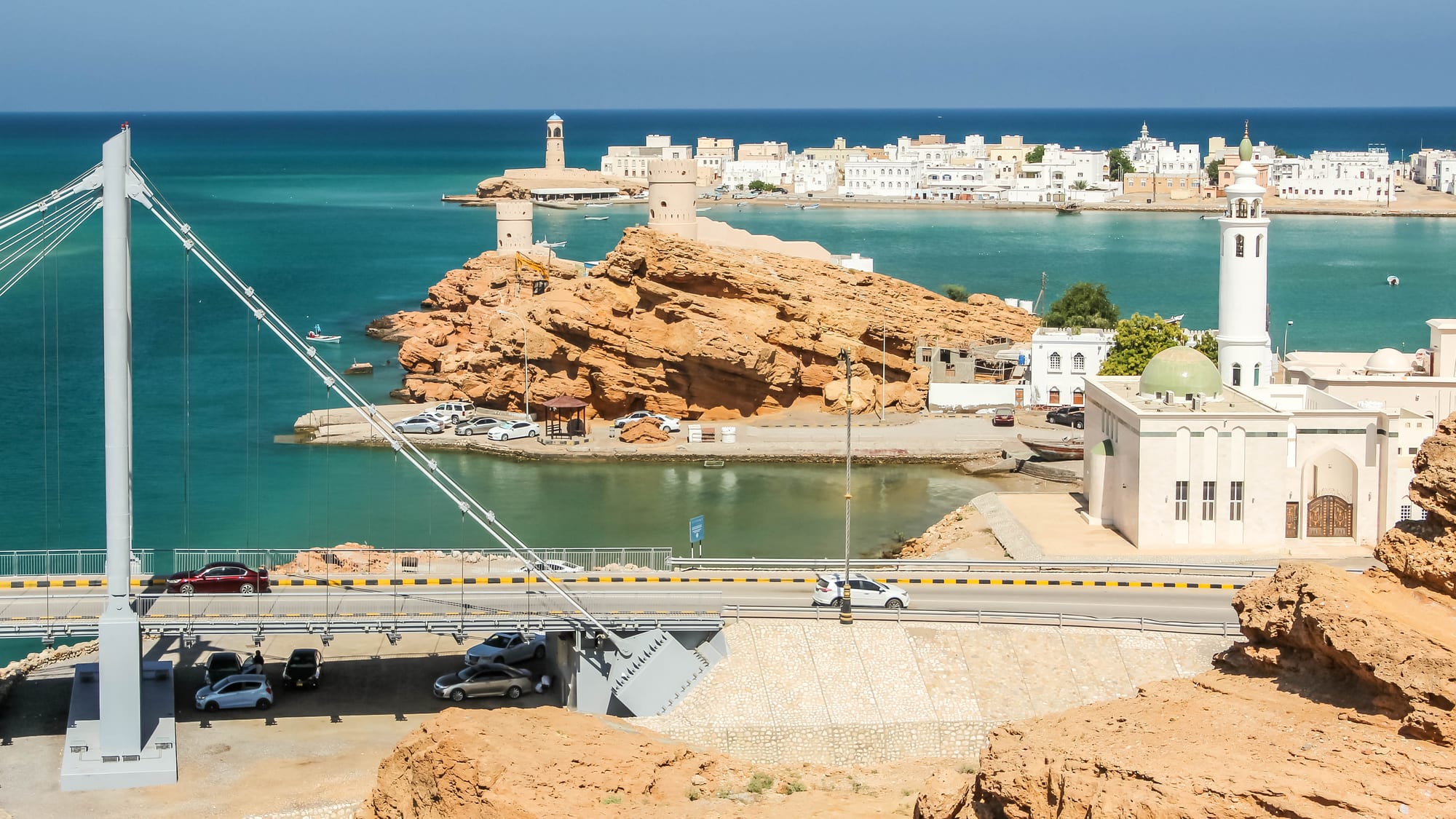
A white suspension bridge over a turquoise creek, with a rocky headland, watchtowers and a white village of flat-roofed houses beyond

Sur, the Sharqiyah & the Wahiba Sands, Oman

Sur

The creek at Sur, with the bridge to the village of Al Ayjah and its watchtowers across the water. (Dr. Thomas Liptak / Wikimedia Commons · CC BY-SA 4.0)

A port city on Oman's east coast where the Gulf of Oman meets the Arabian Sea, about three hours by road from Muscat. Sur made its name and fortune from the sea, sending wooden dhows to East Africa, Persia and India, and shipwrights still shape hulls by hand beside its lagoon. Forts, a lighthouse village across the water and turtle beaches nearby define it today.

Neighbourhoods

  • The corniche and the lagoon
    • First-time visitors
    • Walks
    • Waterfront

    The seafront road follows the lagoon past moored boats, the dhow yards and the maritime museum, with views across the water to Al Ayjah. It is the part of Sur most visitors see, busiest in the evening when families walk and fish are landed nearby.

    Open in Maps
  • Al Ayjah
    • Historic district
    • Views
    • Photography

    The old fishing village on the far side of the creek, reached by a suspension bridge or a small ferry boat. Whitewashed houses with carved doors, watchtowers on the ridge and a lighthouse at the point face the city across the entrance to the lagoon.

    Open in Maps
  • The old town and the souq
    • Markets
    • Local life

    Inland from the water, the older quarters hold the market, mosques, carved doorways and a fort. Shops sell halwa, dates, fish and household goods, and the area is the everyday centre of Sur rather than a museum piece.

    Open in Maps
  • Bilad Sur
    • Historic district
    • Quiet and residential

    The inland district behind the city, guarded by a fort built to protect it from the interior tribes. Palm gardens, walled houses and quiet residential streets make up most of it.

    Open in Maps
  • The modern city and the corniche road south
    • Everyday services
    • Beaches

    South and west of the centre, newer neighbourhoods spread along the coast road with hotels, supermarkets, schools, the university college and open beaches, running on towards the industrial area and the gas plant.

    Open in Maps

Things to do

Landmarks and the old town

  • Sunaysilah Castlelandmark

    A square fort with round corner towers on a rise above the city, built to watch the approaches to the harbour.

    Open in Maps
  • Bilad Sur Castlelandmark

    A fort inland from the centre, built to defend Sur from raids out of the interior, with towers set on rock.

    Open in Maps
  • Al Ayjahneighborhood

    The village across the creek, with white houses, carved doors, watchtowers and a lighthouse marking the harbour mouth.

    Open in Maps
  • Al Ayjah lighthouselandmark

    The tower at the tip of the headland opposite the city, a landmark for boats entering the lagoon.

    Open in Maps
  • Khor Al Batah bridgelandmark

    The white suspension bridge over the creek linking the city with Al Ayjah, and the best viewpoint over the lagoon.

    Open in Maps

Dhows and the sea

  • Sur dhow yardsattraction

    Open yards beside the lagoon where shipwrights build and repair wooden dhows by hand, working largely without plans.

    Open in Maps
  • Sur corniche and lagoonattraction

    The waterfront walk along the lagoon, lined with moored fishing boats and looking across to the village opposite.

    Open in Maps

Coast and beaches

  • Ras al Haddbeach

    A fishing village and bay at the entrance to the Gulf of Oman, about an hour away, with a turtle nesting beach close to the eastern tip of Arabia.

    Open in Maps
  • Ras al Jinzattraction

    A protected beach and turtle reserve where green turtles come ashore at night to nest, with a visitor centre and guided walks.

    Open in Maps

Short trips from the city

  • Qalhatattraction

    The ruined medieval port north of Sur, once described by Marco Polo and Ibn Battuta, with the tomb of Bibi Maryam and a UNESCO World Heritage listing.

    Open in Maps
  • Wadi Shabtrail

    A gorge on the coast road towards Muscat, walked between cliffs to a chain of green pools.

    Open in Maps
  • Wadi Tiwitrail

    A narrow palm-filled valley beside Wadi Shab, with villages, terraces and pools along its floor.

    Open in Maps
  • Wadi Bani Khalidtrail

    One of Oman's best known wadis, inland from Sur, with year-round pools, palm groves and a cave above the valley.

    Open in Maps

Seasonal events

  • Turtle nesting seasonyear-round, with most nesting in the summer months

    Green turtles nest on the beaches east of the city all year, with the greatest numbers coming ashore in summer.

  • Ramadanvaries with the lunar calendar

    The fasting month quietens the city by day and fills the corniche, restaurants and mosques after sunset.

  • Eid al-Fitr and Eid al-Adhavaries with the lunar calendar

    The two Eids bring family visiting, new clothes, pit-roasted shuwa and busy beaches and parks.

  • National DayNovember

    Oman's national holiday fills the corniche and public buildings with flags, lights and celebrations.

Eat and drink

Long-standing places and food districts in Sur. Hours, ratings and directions come from your maps app, always current.

Sur classics

  • Fish restaurants on the cornicheneighborhood

    Grilled kingfish, tuna, shark and prawns with rice, salad and lime are the everyday meal along the waterfront, cooked simply and served in plain family restaurants.

    Open in Maps
  • Sur's halwa shopsneighborhood

    Sur is known across Oman for halwa, the dense sweet of sugar, ghee, starch, rosewater, saffron and nuts, stirred for hours in a copper pot and sold by weight for weddings and Eid.

    Open in Maps

Markets and food streets

  • Sur fish marketmarket

    The morning landing and sale of the night's catch — kingfish, tuna, grouper, sardines and squid — beside the harbour.

    Open in Maps
  • Sur souqmarket

    The old market in the town centre sells dates, dried limes, spices, halwa, coffee and household goods.

    Open in Maps
  • Restaurants of the town centreneighborhood

    Away from the water, small restaurants run by Indian, Pakistani and Bangladeshi cooks serve curries, biryani, roti and shawarma alongside Omani rice dishes.

    Open in Maps

Experience Sur

History

Sur's history is a history of the sea. Its sheltered lagoon, set where the coast turns south towards the Arabian Sea, made a natural harbour on the sailing routes between Arabia, Persia, India and East Africa, and the town's shipwrights became the best known in Oman. They built ocean-going dhows — the ganjah and the baghlah among them — that carried dates, dried fish, timber and, in the 18th and 19th centuries, slaves and ivory, with Zanzibar and the Swahili coast at the other end of the run. Sur families settled in East Africa, and Swahili words and kin networks came back with them.

The city grew as the medieval port of Qalhat to the north faded, a place Marco Polo and Ibn Battuta had both described and which was already losing its trade to Muscat — earthquakes on the Qalhat fault are one suggested cause — when the Portuguese took it in 1507. Sur's own fortunes turned in the 19th century: Britain's campaign against the slave trade, the separation of Zanzibar from Oman in 1856, and then steamships and the Suez Canal cut away the trade that had sustained the fleet. Many families emigrated, and the population fell.

Modern Sur dates from the 1970s, when roads, schools, hospitals and a deepwater port arrived. In 2000 a liquefied natural gas plant opened down the coast near Qalhat, giving the city an industrial base, and a university college and government offices followed as it became the seat of the South Ash Sharqiyah governorate. A few yards still build wooden dhows, now mostly for museums, collectors and tourism rather than for cargo.

Culture & Customs

Sur's identity is maritime and it is worn openly: ship models in shop windows, a dhow on the city's emblems, and families who trace their names to voyages to Zanzibar, Basra or the Malabar coast. The craft of building in wood — shaping planks by eye, fastening them with cord or nails, caulking the seams — is passed on in the yards rather than in schools, and the shipwrights are respected accordingly. The seafaring past also left sung work songs, drumming and dance forms with rhythms shared with the Swahili coast.

Socially the city is conservative and Muslim, with both Ibadi and Sunni communities, and daily life turns on family, the mosque and the majlis. Hospitality follows the Omani pattern: long greetings, kahwa poured from a dallah, dates and halwa before business. Men wear the dishdasha with a kummah or massar, women long dresses with a headscarf; dress in public is modest, and visitors are expected to match it.

The year's high points are religious — Ramadan evenings on the corniche, the two Eids, weddings with drumming and the razha sword dance — and national, with Oman's National Day in November. Sur is also known nationally for its halwa, and a box of it is the standard gift carried away by Omani visitors.

Daily Life

Around 110,000 people live in the wilayat of Sur, the seat of the Ash Sharqiyah South governorate. Work divides between the port and fishing fleet, government offices and schools, the liquefied natural gas plant and its contractors down the coast, small trade and a steady flow of tourism to the turtle beaches and the wadis. A large share of the labour force is South Asian, as elsewhere in the Gulf, and Indian, Pakistani and Bangladeshi shops and restaurants are part of the ordinary street.

Most residents live in the newer districts spread along the coast road rather than in the old quarters, in concrete villas with walled yards. Al Ayjah keeps a fishing community across the water, and inland Bilad Sur has palm gardens and older houses. The university college brings students in from across the region.

The day begins at sea: boats come in early and the catch is sold at the fish market in the morning, while shops and offices work through to midday. The afternoon is quiet in the heat, and the corniche fills again in the evening with families, fishermen and men sitting out. Concerns are those of a small coastal city — jobs for young Omanis, the decline of the traditional boatbuilding trade, and the effects of the industrial plant and the port on a place that still thinks of itself as a sailors' town.

Food

Fish rules the table. Kingfish, known locally as kanad, tuna, grouper, sardines, prawns and squid come off the boats and are grilled over charcoal, fried or curried and served with rice, lime and salad. Mashuai, a whole kingfish spit-roasted and served with lemon rice, is the coastal dish of ceremony, and dried and salted fish keep their place in the kitchen from the days when there was no refrigeration. Fish machboos — spiced rice cooked with fish — is everyday food.

Sur's other claim is halwa. The city is famous throughout Oman for it: sugar, starch, ghee, rosewater, saffron, cardamom and nuts stirred for hours in a copper pot over a wood fire until dark and elastic, then sold by weight and served in a shallow dish with kahwa. Refusing the coffee and halwa offered to a guest is close to impossible and not worth attempting.

From the interior come the dishes of the wider Sharqiyah: shuwa, meat rubbed with a date and spice paste and cooked in a pit oven for the Eids; machboos, spiced rice with goat or chicken; and harees, wheat pounded with meat into a thick paste. Dates and dried limes, loomi, are staples, laban, a salty buttermilk, is drunk with meals, and the migrant kitchens of the city add biryani, curries and roti to the everyday choice.

Planning tools

Budget

Sur is cheaper than Muscat. The city has a modest range of hotels along the coast, meals in fish restaurants cost little, and the fixed extras are the turtle reserve fee at Ras al Jinz and a hire car, which is close to essential. Desert camps in the Wahiba Sands, often combined with a visit here, cost considerably more per night.

Daily Budget Midrange
USD 130–310 (Sur hotel or desert camp with half-board, turtle-watching fee, 4x4 hire)
Daily Budget Shoestring
USD 40–80 (guesthouse or camping, local restaurants, a shared car)

Turtle-watching places at the reserve are limited and are arranged in advance, so plan that part of a trip before arriving.

Best Time to Visit

October to April, when the coast is warm rather than punishing and the wadis and the desert inland are comfortable. Summer is hot and humid, though sea breezes temper it near the water and turtle numbers on the beaches are at their highest. Air travel and events across the region have been disrupted by the war since late February 2026.

Suggested Number of Days

One or two days cover the city itself. Three or four allow the coast east of it, the wadis on the road back towards Muscat and a night in the desert inland. Driving times, the heat and an overnight turtle visit are what change the number.

First Visit
1–2 days
With Surroundings
3–4 days

Transportation

Sur is spread along the coast, and a car is the practical way to get around; taxis and shared taxis work within the city, and intercity buses connect it with Muscat and Ibra. A small boat crosses the creek to Al Ayjah, which is otherwise a long way round by the suspension bridge. Reaching the turtle beaches, the wadis and the dunes inland needs a vehicle, and soft sand needs four-wheel drive with a guide.

Drive the coast road in daylight where possible: camels and goats stray onto rural roads after dark.

Airport & Station Connections

Muscat International Airport is the main gateway, about two and a half to three hours away by road. Two routes lead here: the coast road via Qurayyat, Wadi Shab and Tiwi, which is the scenic one, and the inland highway through Ibra. Intercity buses run from Muscat, and most visitors arrive by hire car as part of a circuit through the Sharqiyah.

Walkability

The corniche, the lagoon, the dhow yards and the old souq form a walkable strip, and Al Ayjah is small enough to explore on foot once across the water. The rest of the city stretches for kilometres along the coast with wide roads, patchy pavements and little shade, so most journeys are driven, particularly in summer humidity.

Safety

Sur is a safe city with very little crime affecting visitors. The hazards are natural and practical: strong currents and few lifeguards on open beaches, heat and humidity, flash floods in the wadis after rain, rough ground at ruined sites and animals on the roads at night. Merchant ships have been attacked in the Gulf of Oman during the war in the region, and the Strait of Hormuz has been largely closed to commercial shipping since late February 2026.

Swim where local families swim, carry water on wadi walks and leave when rain threatens, follow the guides' instructions on turtle beaches and use no flash or torches there, and dress modestly away from hotel beaches. Check current official travel advice before travelling.

Climate

Hot desert climate on the coast, humid for much of the year and tempered by sea breezes. Rain is rare and falls mainly in winter or during occasional tropical systems in the Arabian Sea, which can bring heavy downpours and wadi floods.

Summer
hot and humid — usually 32–38°C by day, with high humidity and warm nights
Winter
warm and pleasant — about 22–30°C by day, cooler after dark

Local Customs

Sur is a conservative port city, more used to outsiders than the interior towns but still modest in dress and manner. Shoulders and knees should be covered away from hotel pools and beaches, and swimwear is for the beach only. Greetings are unhurried, guests are given kahwa and dates, and the right hand is used for eating and passing things. Friday midday prayers close shops for a while.

Ask before photographing people, the dhow yards' workers or fishermen; do not disturb nesting turtles or use lights on the beaches; and note that alcohol is sold only in licensed hotel venues.

Common Payment Methods

The currency is the Omani rial, divided into 1,000 baisa. Hotels, supermarkets and petrol stations take cards, while the souq, fish market, small restaurants and boatmen expect cash. ATMs are easy to find in the city centre and along the main road, but not on the coast east of it.