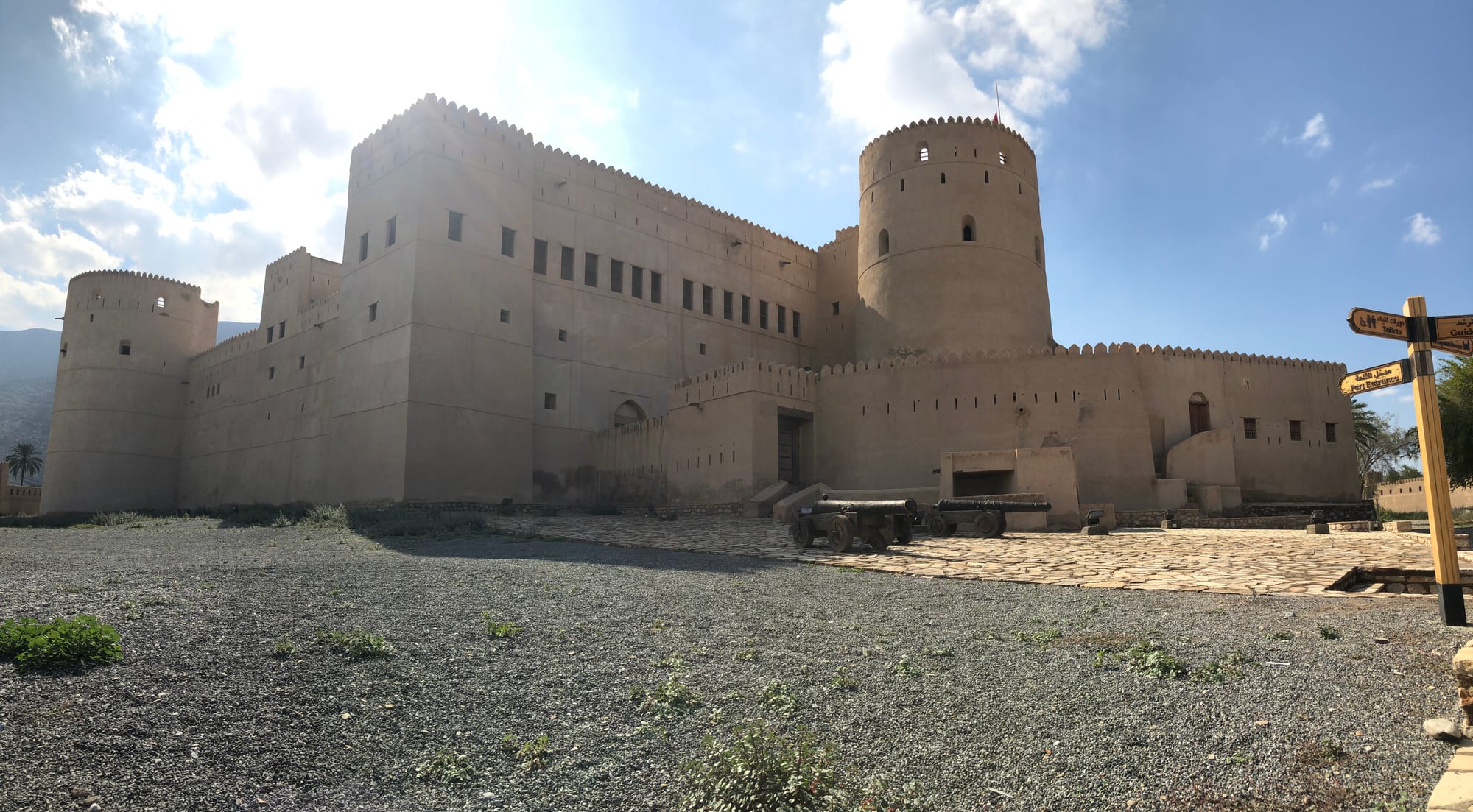
A large mud-coloured fort with a tall round tower and crenellated walls standing above open stony ground

Muscat & the Batinah Coast, Oman

Rustaq

Rustaq Fort, built below the Hajar mountains in northern Oman. (Davide Mauro / Wikimedia Commons · CC BY-SA 4.0)

An inland town in northern Oman, set among date gardens where the Batinah plain meets the wall of the Hajar mountains. Its great fort was the seat of the Ya'ariba imams in the 17th century and briefly the capital of the country, and the town is known today for hot springs, honey and the rough mountain route that climbs through Wadi Bani Awf.

Neighbourhoods

  • The fort and old quarter
    • First-time visitors
    • Historic district

    The centre of the old town, where the fort rises above the falaj channels and date gardens that supplied it. Lanes of older houses, a souq and mosques stand below the walls, and the hot spring is a short distance away.

    Open in Maps
  • The modern town centre
    • Markets
    • Close to services

    Shops, banks, restaurants and government offices along the main roads, with the produce and livestock markets that draw people in from the mountain villages. It is busiest in the morning and again after sunset.

    Open in Maps
  • The date gardens and villages
    • Quiet and residential
    • Walks
    • Falaj channels

    Palm gardens fed by falaj water spread around the town, with small villages, old watchtowers and farm tracks between them. This is where much of Rustaq's population lives and where the town feels rural.

    Open in Maps
  • The mountain road
    • Mountain scenery
    • Four-wheel drive trips

    South-east of the town the ground rises quickly into the Hajar, and the tracks and graded roads into the wadis begin. Villages are scattered up the valleys, and a four-wheel-drive vehicle is needed beyond the asphalt.

    Open in Maps

Things to do

Landmarks

  • Rustaq Fortlandmark

    A large fort on three levels with four towers, the tallest over 18 metres, rebuilt by the first Ya'ariba imams between 1624 and 1649 and used as their seat of government.

    Open in Maps
  • Ain al-Kasfah hot springattraction

    The best known of Rustaq's warm springs, its water around 45°C, channelled into bathing pools and into the falaj that waters the date gardens.

    Open in Maps
  • The old souqmarket

    The town market, known across Oman for honey from the mountain hives, dates, limes and locally made silver and knives.

    Open in Maps

Forts nearby

  • Al Hazm Castlelandmark

    A fortified palace north of Rustaq, built in 1708 by Imam Sultan bin Saif II as his residence, with heavy stone walls, fortified towers and a carved wooden gate.

    Open in Maps
  • Nakhal Fortlandmark

    A fort built on a rock outcrop east of Rustaq at the foot of the mountains, with hot springs and date gardens in the wadi below.

    Open in Maps

The mountains

  • Wadi Bani Awftrail

    A deep valley cutting into the western Hajar above Rustaq, with terraced villages, pools and a narrow gorge, reached by a rough four-wheel-drive road.

    Open in Maps
  • Wadi Bani Kharustrail

    A valley 26 kilometres long running into the mountains from Al Awabi, east of Rustaq, known for its exposed rock formations and its string of old villages.

    Open in Maps

Seasonal events

  • Date harvestlate summer

    The palm gardens around the town are picked through the hottest months, and fresh dates fill the souq and roadside stalls.

  • Eid celebrationsvaries with the Islamic calendar

    Both Eids bring shuwa pits, family gatherings and displays of traditional dress and dancing in the town and surrounding villages.

Eat and drink

Long-standing places and food districts in Rustaq. Hours, ratings and directions come from your maps app, always current.

Rustaq classics

  • Honey and dates in the souqmarket

    Mountain honey from the wadis above the town is Rustaq's best-known product, sold in combs and jars beside dates, dried limes and nuts.

    Open in Maps
  • Omani grills and rice housesneighborhood

    Simple restaurants serve majboos, spiced rice with chicken or mutton, grilled meat, and at festivals the pit-cooked shuwa.

    Open in Maps

Everyday eating

  • South Asian cafésneighborhood

    Small kitchens serve paratha, biryani, curries and karak tea from early morning, feeding workers and travellers heading into the mountains.

    Open in Maps

Experience Rustaq

History

Rustaq sits where mountain water reaches the plain, and that water made it. Falaj channels cut from the wadis above the town have irrigated date gardens here for many centuries, and a settlement around the spring is older than any written record of it. The castle is said to have been raised on Persian ruins, and later rulers enlarged it into the fort that still dominates the town, whose tallest tower stands over 18 metres high.

Its moment came in the 17th century. In 1624 Nasir bin Murshid was elected imam at Rustaq, founding the Ya'ariba dynasty that unified much of Oman and drove the Portuguese from Muscat in 1650. Rustaq served as the capital, and the wealth of the new maritime state was spent on forts, aflaj and mosques across the interior. Al Hazm, a short distance away, was built as a fortified palace by Imam Sultan bin Saif II in 1708, shortly before the dynasty fell into civil war.

In the 1740s Ahmad bin Said, governor of Sohar, expelled Persian forces and founded the Al Bu Said dynasty; he ruled from Rustaq, and his successors later moved the capital to Muscat, leaving the town as a provincial centre of farming, trade and religious learning. Modern roads reached it after 1970, the fort was restored in the following decades, and Rustaq became a stop on the route between the coast and the mountains rather than a place people passed through only on foot or by donkey.

Culture & Customs

Rustaq belongs to the conservative, tribal world of the Omani interior, where Ibadi Islam, a tradition distinct from both Sunni and Shia Islam, has shaped religious and civic life for more than a thousand years. The town was a seat of imams and of religious scholarship, and its mosques and libraries mattered in the history of Omani law. Dress is traditional: the white dishdasha with kuma or massar for men, the khanjar dagger at celebrations, and covered, often colourful dress for women in the villages.

Water is a communal institution as much as a resource. The aflaj are managed by agreements that allocate shares of flow by time, administered by village elders, and a family's standing can be tied to its water rights. Several Omani aflaj are inscribed by UNESCO as World Heritage, and the same system waters the gardens here.

Craft traditions survive in the wadis: beekeeping in the mountains above the town, silverwork, and the weaving and leatherwork associated with the interior. Weddings and national holidays bring drumming, lines of dancers and displays of swords and rifles, and the pit-cooked shuwa is prepared communally at Eid. Visitors are treated with courtesy and some reserve; an invitation to coffee is routine, and refusing it outright is impolite.

Daily Life

Tens of thousands of people live in the wilayat of Rustaq, most of them in villages spread through the date gardens and up the wadis rather than in a single dense town. Government employment, farming, small business and work on the coast provide most incomes, and many families have members commuting to Muscat, Barka or Sohar, or working abroad in the Gulf.

The day starts before sunrise, pauses through the worst of the heat and resumes in the late afternoon, when the souq and the cafés fill and children play in the lanes. Friday is the quiet day, given to prayers and to family meals. Weddings, funerals and Eid gather extended families from across the region, and the mountain villages empty towards the town for school and shopping.

Agriculture still shapes the landscape: dates above all, with limes, mangoes, bananas and fodder crops under the palms, all fed by falaj water whose maintenance is a constant, shared task. Groundwater levels and the cost of keeping the channels running are live concerns, as is the drift of young people towards the capital. Tourism has grown modestly, bringing four-wheel-drive traffic through the wadis and a handful of guesthouses to the villages.

Food

Rustaq's name is attached above all to honey. Hives in the mountain wadis produce dark, strong honey from sidr and acacia flowers, sold in the souq at prices that surprise visitors and given as a gift of respect. It is eaten with bread, stirred into drinks, and poured over thin bread baked over a hot dome.

The staples are those of the Omani interior. Majboos, rice cooked with meat and spices including dried lime, appears at most meals of substance; harees, wheat and meat cooked to a thick paste and served with ghee, is eaten at Ramadan meals; and shuwa, meat rubbed with spice paste, wrapped and cooked for many hours in an earth oven, is the dish of Eid, prepared by families together. Grilled meat, salads and flatbread fill the everyday menus.

Dates are everywhere: dozens of varieties, eaten fresh in late summer and dried the rest of the year, always served with kahwa, the light cardamom-scented coffee poured in small cups. Omani halwa, a dense sticky preserve of sugar, rosewater, saffron and nuts, is shared from a common dish. The gardens also supply limes, dried into loomi for cooking, bananas and mangoes, and the town's South Asian cafés add biryani, curries and karak tea to the range.

Planning tools

Budget

Rustaq is inexpensive. Accommodation is limited to a few small hotels and guesthouses, and many visitors come as a day trip from Muscat or stay in the mountains instead. Food costs little, fort entry fees are low, and the real expense is the vehicle: a four-wheel-drive is needed for the wadi routes above the town.

Daily Budget Midrange
USD 110–240 (small hotel or mountain lodge, restaurant meals, a four-wheel-drive hire)
Daily Budget Shoestring
USD 40–75 (guesthouse or camping, local restaurants, a shared car)

Fuel, water and cash are easier to get in Rustaq than anywhere in the mountains above it, so stock up before heading up the wadis.

Best Time to Visit

October to April, when the town is warm rather than fierce and the wadis and mountain roads are comfortable. Winter days are ideal for walking, and the high ground above the town is cool. Summer is very hot on the plain. Air travel and events across the region have been disrupted by the war since late February 2026.

Suggested Number of Days

A day is enough for the town itself. Two or three suit a wider trip through the wadis and forts of the western Hajar, where the roads are slow and distances take longer than the map suggests.

First Visit
1 day
With Surroundings
2–3 days

Transportation

A car is essential. The town is spread among date gardens and villages, and the wadi routes above it are unpaved. Asphalt roads link Rustaq with the Batinah coast and with Nakhal and the Muscat highway; beyond that, the road over the mountains through Wadi Bani Awf towards the Nizwa side is rough, steep and for four-wheel-drive vehicles only.

Use low gears on the mountain descents, carry water, and never enter a wadi bed when rain is falling anywhere upstream.

Airport & Station Connections

Rustaq lies inland from the Batinah coast, roughly one and a half to two hours by road from Muscat and about an hour from the coastal highway at Barka. Most people drive or come on an organised day trip; minibuses and shared taxis serve the town from the coast. The nearest airport is Muscat International, where air travel has been disrupted by the war in the region since late February 2026.

Walkability

The fort, the spring and the souq are close enough together to walk between in the cooler months, and the paths through the date gardens are pleasant on foot. The rest of the wilayat is a scatter of villages across many kilometres, so walking is a pleasure locally and impractical for getting around.

Safety

Rustaq is very safe, with almost no street crime, and the conservative atmosphere of the interior. The hazards are natural and on the road: heat and dehydration, flash floods that fill the wadis after storms, steep unfenced mountain tracks, and goats and camels on rural roads after dark.

Start walks early with plenty of water, avoid wadis when rain threatens, and dress modestly in the town and villages. Check current official travel advice before travelling.

Climate

Hot and dry, drier than the coast but no cooler in summer, with more comfortable winters. Rain falls rarely, in winter and occasional summer storms, and can send flash floods down the wadis from the mountains behind the town.

Summer
very hot — 40–45°C by day on the plain, a little cooler in the high wadis
Winter
warm days around 20–28°C, cool nights, and cold nights in the mountains above

Local Customs

The interior is more conservative than Muscat. Modest dress covering shoulders and knees is expected of everyone, and swimwear is not appropriate at the hot spring or in the wadi pools, where people bathe clothed. Greetings are unhurried, and coffee with dates is offered readily. Alcohol is not part of public life here.

Ask before photographing people, especially women, and before entering village gardens and falaj channels, which are private property.

Common Payment Methods

The currency is the Omani rial, divided into 1,000 baisa. There are ATMs and card machines in the town centre, but the souq, roadside honey and date stalls and small cafés run on cash, and there is nowhere to withdraw money once the mountain roads begin.