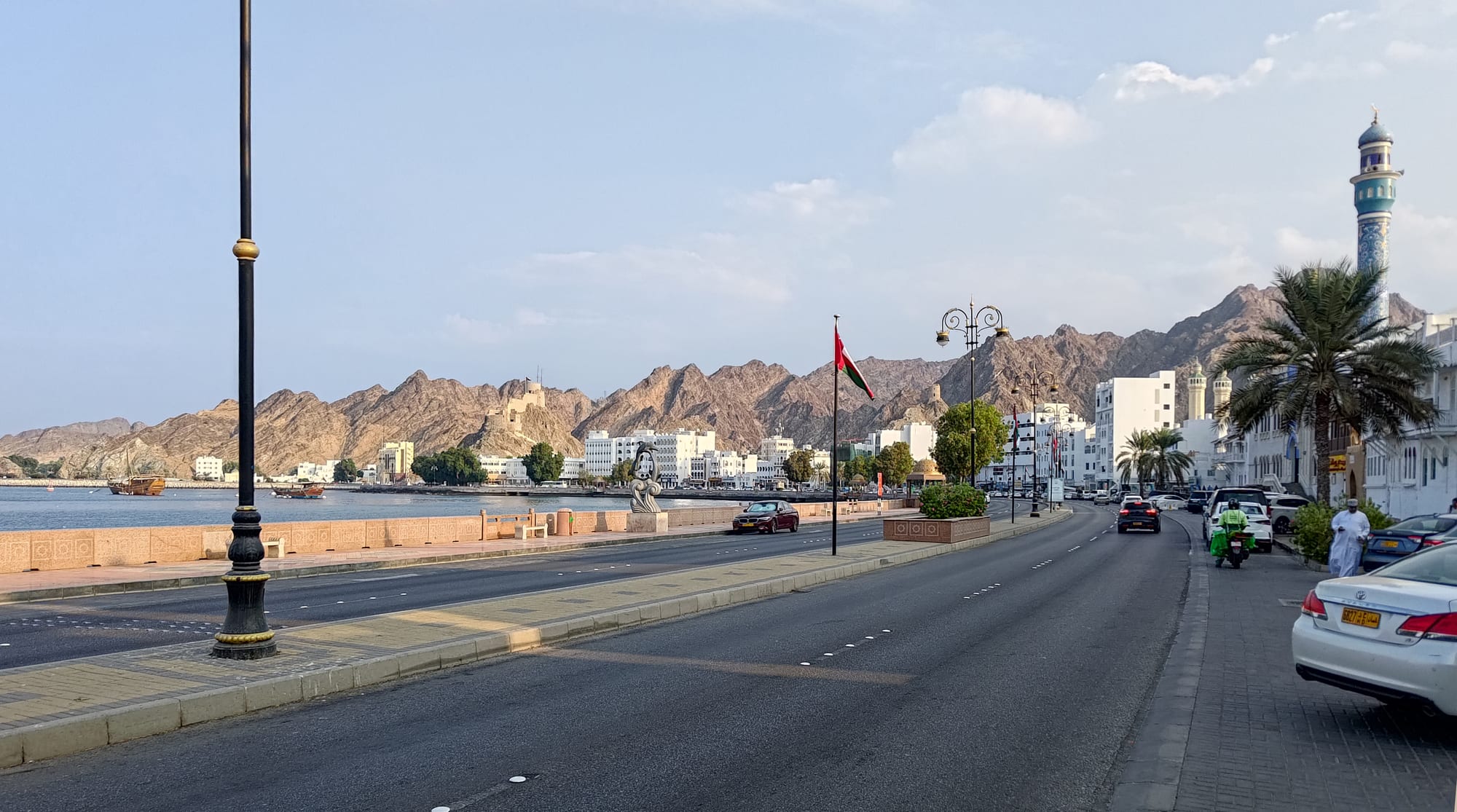
A seafront road curving past a white mosque minaret towards a harbour backed by bare rocky mountains

Muscat & the Batinah Coast, Oman

Muscat

The Corniche at Mutrah, on the harbour below Muscat's mountains. (Francesco Bini / Wikimedia Commons · CC BY-SA 4.0)

Oman's capital, a low-rise city strung for tens of kilometres along the Gulf of Oman between bare brown mountains and the sea. A Portuguese-held harbour in the 16th century and later the seat of a sultanate that reached Zanzibar, it keeps a building code of white walls and Omani arches, and is known for the Sultan Qaboos Grand Mosque, the Mutrah souq and the Royal Opera House.

Neighbourhoods

  • Mutrah
    • First-time visitors
    • Markets
    • Historic district

    The old trading harbour, with a curving corniche of white merchant houses, a fort on the headland and the covered souq running back from the water. Dhows and cruise ships tie up here, at one of the largest seaports of the region. It is the most walkable part of the city.

    Open in Maps
  • Old Muscat
    • Historic district
    • Palaces and forts

    The original walled town in a rocky cove east of Mutrah, hemmed in by cliffs and guarded by two Portuguese forts. The Al Alam Palace stands at its centre, with museums in restored houses nearby and gates still marking the old entrances.

    Open in Maps
  • Ruwi
    • Best for food
    • Budget hotels
    • Local life

    The busy commercial quarter inland from Mutrah, home to banks, the bus station and much of the city's South Asian community. Its streets hold the cheapest hotels and the Indian, Pakistani and Bangladeshi cafés that feed working Muscat.

    Open in Maps
  • Qurum and Shatti Al-Qurum
    • Beaches
    • Restaurants
    • Parks

    The city's beach district, with a long sandy shore, a large park around a creek and lagoon, embassies, malls and a concentration of restaurants and cafés. The Royal Opera House stands on Sultan Qaboos Street at the Shatti end, and many of the mid-range and upper hotels are along this stretch.

    Open in Maps
  • Al Khuwair and Bausher
    • Museums
    • Close to services
    • Quiet and residential

    The ministries district and the residential suburbs behind it, spread along the expressway. The Sultan Qaboos Grand Mosque stands in this part of the city, along with shopping centres and mid-range hotels.

    Open in Maps
  • Seeb and Al Mouj
    • Close to the airport
    • Beaches
    • Newer developments

    The western end of the city, around the old fishing town of Seeb and the marina and golf development at Al Mouj. The airport is here, along with long beaches and a fish market on the shore.

    Open in Maps
  • Al Bustan and Sidab
    • Quiet and residential
    • Coastal views

    A cove south-east of Old Muscat below steep hills, with a large resort hotel, a fishing village at Sidab and the coast road that climbs towards Yiti and the eastern bays.

    Open in Maps

Things to do

Famous landmarks

  • Sultan Qaboos Grand Mosquelandmark

    Oman's main mosque, completed in 2001, with a vast Persian carpet and chandelier in the prayer hall and courtyards open to non-Muslim visitors outside prayer times.

    Open in Maps
  • Royal Opera House Muscatlandmark

    Oman's main venue for the performing arts, opened in 2011, in Omani stone and woodwork, staging opera, ballet and concerts through the cooler months.

    Open in Maps
  • Al Alam Palacelandmark

    The sultan's ceremonial palace in Old Muscat, with blue and gold flared columns, seen from the gates at the end of its avenue.

    Open in Maps
  • Al Jalali Fortlandmark

    One of two Portuguese forts of the late 16th century guarding the entrance to Muscat's cove, built on the rock above the water.

    Open in Maps
  • Al Mirani Fortlandmark

    A fort rebuilt by the Portuguese in 1587 on an older stronghold, facing Al Jalali across the cove beside the palace.

    Open in Maps
  • Mutrah Fortlandmark

    A fort on a rocky spur above the Mutrah corniche, looking down on the harbour and the souq.

    Open in Maps

Museums

  • National Museum of Omanmuseum

    The country's main museum, opened in 2016 opposite the palace in Old Muscat, covering Omani history from prehistory to the maritime empire and modern state.

    Open in Maps
  • Bait Al Zubairmuseum

    A family collection in a restored Old Muscat house, showing khanjar daggers and other weapons, dress and household objects, with a scale-model Omani village in the garden.

    Open in Maps
  • Bait Al Barandamuseum

    A museum on the Mutrah corniche tracing the geology and history of the Muscat area.

    Open in Maps

Markets and the waterfront

  • Mutrah Souqmarket

    A covered market of narrow lanes behind the corniche, selling frankincense, silver, textiles, spices and household goods, one of the oldest markets in the country.

    Open in Maps
  • Mutrah Cornicheattraction

    The seafront promenade along the old harbour, lined with gazebos and white buildings, busiest in the evening when the heat drops.

    Open in Maps

Beaches and parks

  • Qurum Beachbeach

    The city's main sandy beach, several kilometres long, with cafés at the Shatti end and joggers and walkers out at either end of the day.

    Open in Maps
  • Qurum Natural Parkpark

    A large park around a creek and lagoon in the middle of the city, with gardens, a boating lake and views over the bay.

    Open in Maps
  • Riyam Parkpark

    A hillside park above the sea between Mutrah and Old Muscat, in the village of Riyam, with a path over the ridge to the Mutrah corniche.

    Open in Maps

Short trips from the city

  • Daymaniyat Islandsattraction

    A nature reserve of nine small islands off the Batinah coast, protected for coral reefs, turtles and seabirds, reached by boat.

    Open in Maps
  • Bimmah Sinkholeattraction

    A limestone sinkhole of clear blue-green water in a park beside the coast road south-east of the capital, reached by steps.

    Open in Maps
  • Nakhal Fortlandmark

    A fort built on a rock outcrop at the foot of the Hajar mountains, with hot springs and date gardens below it.

    Open in Maps

Seasonal events

  • Muscat FestivalJanuary to February

    The city's winter festival, with craft displays, food, music and family events staged in parks and public spaces.

  • Royal Opera House seasonAutumn to spring

    The opera, ballet and concert programme runs through the cooler half of the year, drawing touring companies and orchestras.

  • National DayNovember

    Oman's national holiday is marked with flags, lights and decorated buildings across the capital, and a public holiday on 20 November.

Eat and drink

Long-standing places and food districts in Muscat. Hours, ratings and directions come from your maps app, always current.

Muscat classics

  • Mutrah Souq food stallsmarket

    Halwa, dates, nuts, Omani coffee and spices are sold through the covered lanes, and small cafés at the edges serve tea and sweets.

    Open in Maps
  • Shuwa and Omani grillsneighborhood

    Restaurants around the city serve Omani dishes such as shuwa, meat marinated in spices and cooked slowly in an underground oven, and grilled fish with rice.

    Open in Maps

Food districts

  • Ruwi's South Asian cafésneighborhood

    Inexpensive Indian, Pakistani and Bangladeshi kitchens serve biryani, thali, paratha and karak tea to the workers who fill this district.

    Open in Maps
  • Shatti Al-Qurum restaurantsneighborhood

    The beach district holds much of the city's international dining, from Lebanese and Indian to Italian, along with cafés facing the sea.

    Open in Maps
  • Seeb shoreneighborhood

    The old fishing town at the western end of the city, where boats land their catch on the shore and cafés and stalls line the beach road.

    Open in Maps

Experience Muscat

History

Muscat's cove, ringed by cliffs and easy to defend, has been a harbour for at least two thousand years; Greek and Arab geographers knew it as a watering place on the route between the Gulf and India. The Portuguese seized the town in 1507 under Afonso de Albuquerque and held it for most of the following century and a half, fortifying the entrance with the forts of Jalali and Mirani and leaving the cove's defensive shape unchanged to this day.

In 1650 the Ya'ariba imams, ruling from Rustaq in the interior, drove the Portuguese out. Under the Al Bu Said dynasty, founded in the 1740s by Ahmad bin Said of Sohar, the capital moved to Muscat, and from this harbour the sultans built a maritime power that traded across the western Indian Ocean and ruled Zanzibar and part of the East African coast for much of the 19th century. After the empire was divided in 1856, and as steamships and European power reshaped the Indian Ocean, the town declined into a quiet walled port with a few thousand inhabitants.

Oil revenue and the accession of Sultan Qaboos in 1970 transformed it. Roads, a port at Mutrah, an airport at Seeb, ministries at Al Khuwair and housing along the coast turned a walled town and its neighbouring harbour into a city stretching tens of kilometres westward. A building code has kept it low and white throughout, and the Grand Mosque in 2001 and the Royal Opera House in 2011 gave the modern capital its landmarks. Cyclone Gonu flooded parts of the city in 2007.

Culture & Customs

Muscat is a capital that has deliberately avoided the skyline of its Gulf neighbours. Buildings are kept low, faced in white or sand-coloured render and finished with Omani arches, carved doors and crenellations, and the result is a city that reads as a series of villages along a coast rather than a single downtown. The national dress is worn widely: men in the ankle-length dishdasha with an embroidered kuma cap or a wrapped massar, and on formal occasions the curved khanjar dagger that appears on the national emblem.

The population is strongly mixed. Omani families with roots in Zanzibar and East Africa brought Swahili into daily speech, Baluchi communities have long been part of the coast, and Indian merchant families, some settled for generations, run businesses in Mutrah and Ruwi alongside a large migrant workforce from South Asia and the Philippines. Ibadi Islam, distinct from both Sunni and Shia traditions, shapes the country's religious life and its reputation for moderation, and Sunni and Shia Omanis, Hindus and Christians worship in the city as well.

Manners matter. Greetings are long, voices are kept low, and public displays of anger are considered shameful. Frankincense burns in homes and shops, and guests are offered kahwa, cardamom-scented coffee, with dates and halwa. The Royal Opera House, the Royal Oman Symphony Orchestra and the city's galleries sit alongside traditional music and the sea shanties of the old sailing trade.

Daily Life

About 1.7 million people live in the Muscat governorate, roughly a quarter of them in the outer province of Seeb, and a large share of the population are foreign residents working in construction, retail, domestic work and the professions. Government employment, the port and free zone, banking, and an expanding tourism industry provide most of the local work, and the state has pushed for years to move Omanis into private-sector jobs.

The day starts early and pauses in the middle. Offices and shops open soon after dawn, empty in the heat of the afternoon, and reopen in the evening, when families come out to the corniche, the beaches and the parks. Friday morning is quiet before congregational prayers, and weekends fall on Friday and Saturday. Most households drive; traffic on the single expressway spine is the standing complaint of the capital.

Districts are distinct: Mutrah and Ruwi are dense, older and largely South Asian in daily feel; Qurum and Shatti Al-Qurum hold the beach, the malls and the embassies; and newer suburbs spread inland around Bausher, Al Amerat and towards Seeb, where most of the city's housing has been built. Water comes from desalination, summer power demand is enormous, and the cost of housing in the capital is a common concern for young Omanis.

Food

Omani cooking is mild, fragrant and rice-based, closer to the Indian Ocean than to the rest of Arabia. The celebratory dish is shuwa, meat rubbed with a spice paste, wrapped and cooked for many hours in a covered pit and eaten at Eid and other festive occasions. Everyday meals lean on majboos, spiced rice with chicken, mutton or fish; mashuai, a whole spit-roasted kingfish served with lemon rice, is a coastal favourite, and harees, wheat and meat cooked to a thick paste, is served with ghee.

Fish is the city's strength: kingfish, tuna, hammour, prawns and lobster landed at Mutrah and Seeb and grilled simply. Bread comes as paper-thin rounds baked over a hot dome and often eaten with honey or with Omani curry. Sweets end everything: Omani halwa, a dense, sticky preserve of sugar, rosewater, saffron and nuts, is served warm in a shared dish with kahwa, coffee scented with cardamom and sometimes rosewater.

Muscat also eats the food of its communities. Ruwi's cafés serve biryani, thali and paratha with karak tea; Lebanese grills and Zanzibari-influenced dishes appear across the city; and dates, limes dried into loomi, and frankincense are sold by the sack in the souq. Alcohol is confined to licensed hotels and restaurants, so evenings out are built around coffee, juice and shisha.

Planning tools

Budget

Muscat is the most expensive part of Oman for a bed, with beach resorts at Shatti Al-Qurum and Al Bustan at one end and plain hotels in Ruwi and Mutrah at the other. Food is cheap if eaten where residents eat. The biggest variable cost is transport: the city is long and thin, so a hire car or frequent taxis add up quickly.

Daily Budget Midrange
USD 170–340 (four-star hotel, restaurant dinners, a hire car and fuel)
Daily Budget Shoestring
USD 55–95 (simple hotel in Ruwi or Mutrah, café meals, buses and shared taxis)

Rooms in Mutrah and Ruwi cost a fraction of the beach hotels, and many of the best things in the city — the corniche, the souq, the mosque grounds, the beaches — are free.

Best Time to Visit

November to March, when days are warm rather than punishing and the corniche, souq and forts can be enjoyed at any hour; the Muscat Festival usually falls in these months and the opera season is running. October and April are hot but workable early and late. From May to September the heat and humidity confine sightseeing to mornings and evenings, though hotel prices drop sharply. Since late February 2026 the war in the region has disrupted air travel and events, so dates should be confirmed before booking.

Suggested Number of Days

Two or three days suit the capital itself, which is spread over a long coastline and takes time to cross. Four to six allow the coast and the mountains within reach of the city. Summer heat shortens what can be done in a day.

First Visit
2–3 days
With Surroundings
4–6 days

Transportation

The city is a ribbon along one expressway, so distances are long and taxis, ride-hailing apps or a hire car are needed to move between districts. Mwasalat buses run the main corridor between Ruwi, the ministries area and Seeb, and intercity services leave from Ruwi for Sohar, Nizwa, Salalah and the UAE. Driving is straightforward, with good roads and fuel that is cheap by international standards.

Use metered or app-booked taxis and agree a fare in advance with older unmetered cabs; a two-wheel-drive car is enough for everything in and around the city.

Airport & Station Connections

Muscat International Airport is at Seeb on the western side of the city, about 30 kilometres from Mutrah and Old Muscat, half an hour or more by taxi depending on traffic. It is the hub of Oman Air and is served by Gulf, European and Asian carriers, though air travel across the region has been disrupted by the war since late February 2026. Long-distance buses connect Muscat with the rest of Oman and with the UAE, and cruise ships dock at Mutrah.

Walkability

Individual districts are walkable — the Mutrah corniche and souq, Old Muscat, the Qurum beachfront — but the city as a whole is not: neighbouring districts are separated by kilometres of expressway and rocky hills, with few pavements between them. Walking is comfortable in winter and unpleasant in the summer heat and humidity.

Safety

Muscat is a very safe capital with little street crime. The real hazards are heat and humidity in summer, fast traffic on the expressway, rip currents off the open beaches, and flash floods in wadis after the rare heavy rain, which can also close roads in the city. The Strait of Hormuz, north of this coast, has been largely closed to commercial shipping since late February 2026, and merchant ships have been struck in the Gulf of Oman.

Swim at sheltered or supervised beaches, keep out of wadi beds when rain is forecast, and dress modestly in the souq and at the Grand Mosque. Check current official travel advice before travelling.

Climate

Hot desert climate with high humidity from the sea. Rain is scarce and usually falls in short winter downpours that flood wadis; cyclones from the Arabian Sea occasionally reach this coast, as Gonu did in 2007 and Shaheen in 2021.

Summer
hot and very humid — 38–45°C by day, with nights near 30°C
Winter
warm and pleasant — 20–28°C by day, cooler at night, with occasional rain

Local Customs

Oman is conservative but relaxed in manner. Modest dress covering shoulders and knees is expected in public, and women must cover hair, arms and legs to enter the Grand Mosque. Greetings are unhurried, and coffee with dates is a standard welcome. Alcohol is served in hotels and licensed restaurants but not sold openly elsewhere, and drinking in public is not allowed. Friday is the main prayer day and mornings are quiet.

Ask before photographing people, especially women, and avoid photographing military and government buildings. Tipping is not required but small amounts are appreciated.

Common Payment Methods

The currency is the Omani rial, one of the highest-valued currencies in the world, divided into 1,000 baisa. Cards work in hotels, malls and larger restaurants and ATMs are widespread, but the souq, taxis and small cafés run on cash, so small notes are useful.