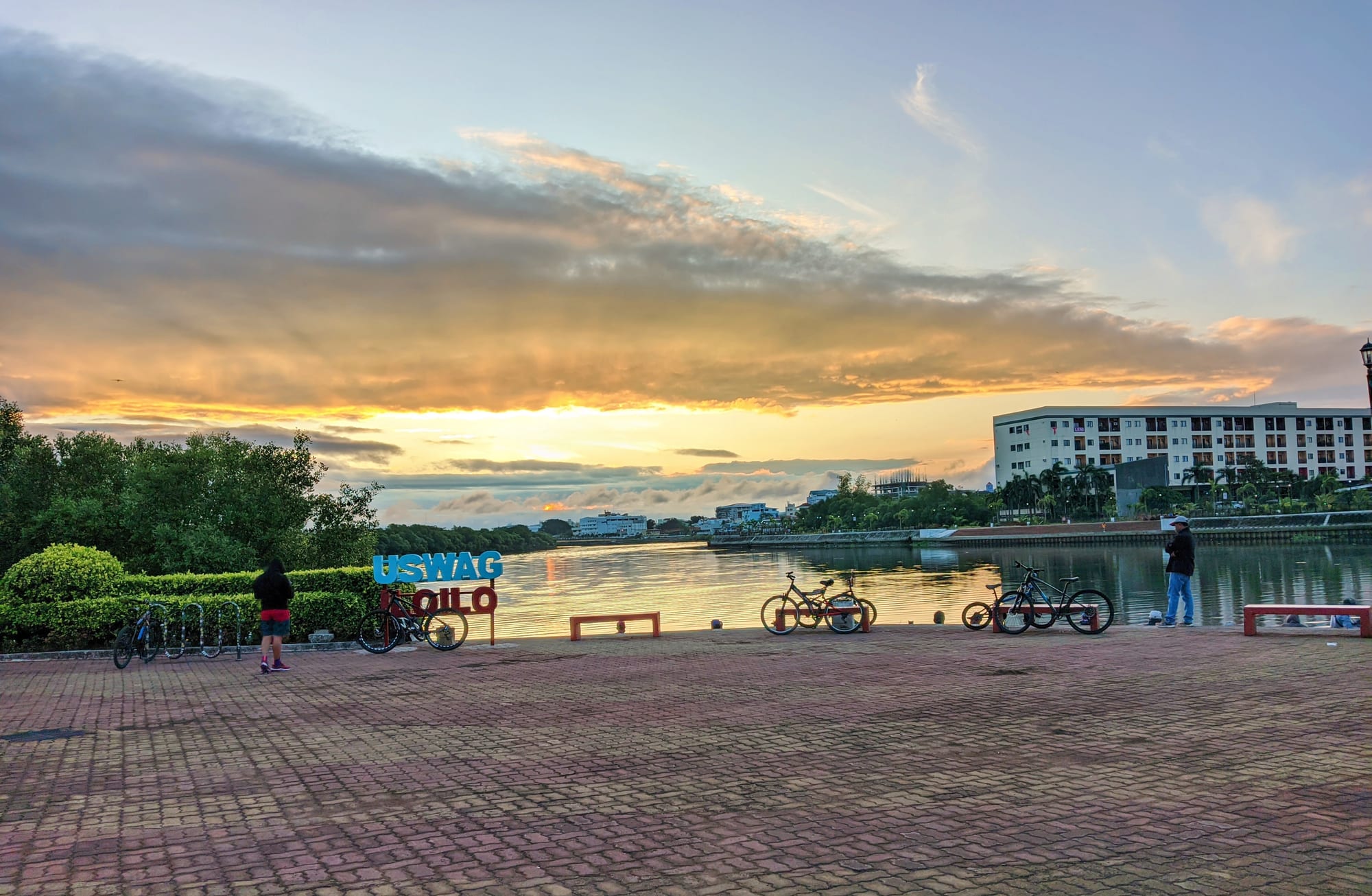
A paved riverside promenade with bicycles and walkers at sunrise, mangroves on one bank and low buildings on the other

The Visayas, Philippines

Iloilo City

Sunrise on the Iloilo River Esplanade, the promenade that runs along the river through the city. (Johngaje92 / Wikimedia Commons · CC BY-SA 4.0)

The main port and capital of Iloilo province on the south-east coast of Panay, facing Guimaras across a narrow strait. Sugar and textile wealth in the 19th century left it with grand churches, commercial arcades and ancestral mansions, and after decades of quiet it has grown again around a riverside promenade and a new business district. It is known nationally for food and for the Dinagyang festival.

Neighbourhoods

  • City Proper
    • First-time visitors
    • Historic district
    • Close to public transport

    The old commercial core around Calle Real and Plaza Libertad, near the port and the river mouth. Spanish and American-era arcades, banks and department stores line the streets, with the fort, the old market and most of the budget hotels within walking distance of each other.

    Open in Maps
  • Jaro
    • Historic homes
    • Churches
    • Local life

    A district north of the centre that was a separate town until 1937, built around a large plaza, its cathedral and a free-standing belfry. The surrounding streets hold many of the ancestral mansions built by sugar families, and the February fiesta is the city's biggest religious event.

    Open in Maps
  • Molo
    • Historic district
    • Best for food
    • Churches

    The old Chinese-mestizo quarter west of the centre, known for its white Gothic-style church, its plaza and the dumpling soup named after it. Quiet streets of old houses and bakeries give it a residential feel close to the centre.

    Open in Maps
  • Mandurriao
    • Modern hotels
    • Shopping and nightlife
    • Business district

    The city's newer business district, built on former airport land beside the river. Malls, towers, convention space, hotels and the contemporary art museum stand here, and the Esplanade runs along the water below.

    Open in Maps
  • La Paz
    • Best for food
    • Markets
    • Students

    A district north-east of the centre built around a plaza and its market, and the birthplace of la paz batchoy. Universities and student housing make the surrounding streets busy and inexpensive.

    Open in Maps
  • Villa Arevalo
    • Quiet and residential
    • Beaches and sunsets
    • Flowers and crafts

    The westernmost district, once a separate town, known for its flower growers and for a shoreline where families gather in the late afternoon. It is calmer and more suburban than the rest of the city.

    Open in Maps

Things to do

Churches and landmarks

  • Jaro Cathedrallandmark

    The seat of the Archdiocese of Jaro, rebuilt after earthquakes, with a shrine to Our Lady of the Candles above its entrance and a belfry standing separately across the plaza.

    Open in Maps
  • Molo Churchlandmark

    A neo-Gothic church completed in 1888, known as the women's church for its two rows of sixteen female saints, and the only Gothic church in the country outside Metro Manila.

    Open in Maps
  • Calle Reallandmark

    The old commercial street, now J.M. Basa Street, lined with early 20th-century arcaded buildings that made it the city's business heart.

    Open in Maps
  • Iloilo Provincial Capitollandmark

    The columned seat of the provincial government on Bonifacio Drive in the City Proper, beside the Casa Real, its Spanish-era predecessor.

    Open in Maps
  • Plaza Libertadpark

    The square in front of the city hall where Spanish forces formally surrendered on 25 December 1898, ending Spanish rule in what was their last capital in Asia.

    Open in Maps

Museums and mansions

  • Museo Iloilomuseum

    The provincial museum, the first government-sponsored museum outside Metro Manila, covering Panay's prehistory, burial goods, colonial trade and religious art.

    Open in Maps
  • Iloilo Museum of Contemporary Artmuseum

    The first museum in the Visayas and Mindanao devoted to modern art, housed in the Casa de Emperador at the Iloilo Business Park in Mandurriao.

    Open in Maps
  • Nelly Gardenlandmark

    A 1928 mansion in Jaro built for the Lopez family, among the grandest of the sugar-era houses that fill the district.

    Open in Maps

The river and the waterfront

  • Iloilo River Esplanadetrail

    A landscaped promenade of some nine kilometres along the Iloilo River, opened in 2012 and used for walking, running and cycling from dawn.

    Open in Maps
  • Iloilo Riverattraction

    The tidal channel that separates the city's districts, lined with mangroves in places and crossed by several bridges.

    Open in Maps

Short trips from the city

  • Miagao Churchlandmark

    A fortress-like coral-stone church begun in 1787 and finished ten years later, with a carved façade showing Saint Christopher among coconut and papaya trees, one of the UNESCO-listed Baroque Churches of the Philippines, about forty kilometres south-west.

    Open in Maps
  • Guimarasattraction

    The island province across the strait, reached by small ferries from the city in fifteen to twenty minutes, known for its mangoes, beaches and quiet roads.

    Open in Maps
  • Santa Barbaraattraction

    A town north of the city with a large church and convent complex, where the Revolutionary Government of the Visayas was inaugurated in November 1898.

    Open in Maps
  • Otonattraction

    A coastal town west of the city, an early Spanish settlement, now known for its shoreline and its seafood eateries.

    Open in Maps

Seasonal events

  • Dinagyangfourth weekend of January

    The city's largest festival, honouring the Santo Niño with tribal-style street dancing, drums and costumed contingents performing at judging areas around the centre.

  • Jaro Fiesta and the Feast of Our Lady of the Candles2 February

    The patronal feast of Jaro, with a procession, a fair around the plaza and open houses across the district.

  • Paraw Regattathird weekend of February

    A sailing race of traditional outrigger paraws with coloured sails, starting from Villa Beach in Arevalo and crossing the strait towards Guimaras.

  • Chinese New YearJanuary or February

    Lion dances, fireworks and street food in the old commercial district, marking the city's long-established Chinese community.

Eat and drink

Long-standing places and food districts in Iloilo City. Hours, ratings and directions come from your maps app, always current.

Iloilo classics

  • La paz batchoyrestaurant

    The city's most famous dish — egg noodles in a pork and offal broth topped with crushed chicharon, spring onion and garlic — is served at stalls and canteens around the La Paz market where it was created.

    Open in Maps
  • Pancit molorestaurant

    A soup of pork-filled wontons in clear chicken broth, named after the Molo district and cooked in its restaurants and homes.

    Open in Maps

Food districts and markets

  • La Paz Public Marketmarket

    A large working market north-east of the centre, with produce, fish and meat halls and a cluster of long-running batchoy counters.

    Open in Maps
  • Iloilo Central Marketmarket

    The old covered market in the City Proper, rebuilt in the American period, selling dried fish, spices, sweets and household goods, with cooked-food stalls inside.

    Open in Maps
  • Villa Arevalo shoreline eateriesneighborhood

    Grilled-seafood places along the western shore, where families come for fish, squid and oysters in the late afternoon.

    Open in Maps
  • Smallville and the Mandurriao stripneighborhood

    The newer district's cluster of restaurants, cafés and bars, the city's main area for eating out after dark.

    Open in Maps

Experience Iloilo City

History

The Spanish moved their Panay settlement to the mouth of the Iloilo River in the 1600s, fortifying it against raids from the southern seas. For two centuries it remained a modest port in a province known for weaving: Iloilo's hand-loomed textiles, including cloth of pineapple and abaca fibre, supplied the colony and gave the area the name of the textile capital of the Philippines.

Everything changed when the port was opened to foreign trade in 1855. The British vice-consul Nicholas Loney promoted sugar cultivation on Negros across the strait and financed mills and shipping, while cheap imported cloth ruined the weaving trade. Sugar money built the warehouses along the river, the commercial arcades of Calle Real, and the mansions of Jaro. Iloilo became the second city of the colony and was given the title La Muy Leal y Noble Ciudad. In 1898 the revolution reached Panay; Spanish forces made their last formal surrender in the islands at Plaza Libertad in December of that year.

The 20th century was harder. The sugar trade moved its centre to Bacolod and Manila, the port declined, a long dock strike and labour unrest in the 1950s drove business away, and Iloilo slipped into decades as a provincial city living on its past. Its districts — Jaro, Molo, La Paz, Mandurriao and Arevalo, each once a town of its own — were merged into the city in 1937. Revival came late: the old airport closed in 2007 and its land became the Mandurriao business district, the river was cleaned and lined with an esplanade, and the city has grown again on outsourcing, education, retail and conventions while restoring parts of its heritage core.

Culture & Customs

Iloilo is the heartland of Hiligaynon, or Ilonggo, a language whose gentle cadence is a national stereotype and a local point of pride. Ilonggos are thought of as soft-spoken, courteous and slow to confront, and conversation works by hint and politeness rather than bluntness; the same mildness carries into an unhurried city manner that surprises visitors arriving from Cebu or Manila.

The religious calendar is the cultural one. Dinagyang, held on the fourth weekend of January, honours the Santo Niño with drummed street dancing by contingents in tribal-style costume, performing at judging points around the city centre, and it draws crowds from across the country. The Jaro fiesta in early February, centred on the image of Our Lady of the Candles in the cathedral, fills the district with processions, a fair and open houses. The paraw regatta sends traditional sailing outriggers with coloured sails across the strait, reviving a boat-building tradition older than the city.

Heritage is taken seriously here. The old houses of Jaro and Molo, Calle Real's arcades, and the province's coral-stone churches have their own preservation campaigns, and the sugar-era families remain socially prominent. The city has a long-established Chinese-mestizo community, strongest historically in Molo, whose influence shows in business, surnames and food. Universities give the centre a student population, and basketball, karaoke, choirs and beauty pageants fill the social calendar the church does not.

Daily Life

About 474,000 people live in the city itself, with a larger metropolitan area spreading into the neighbouring towns of Iloilo province. The economy rests on government and services, the port, retail and malls, several large universities and hospitals, and a substantial business-process outsourcing sector whose night-shift workers keep parts of Mandurriao awake at unusual hours. Remittances from Ilonggos working abroad support many households, and agriculture and fishing continue in the surrounding province.

The day starts early. The Esplanade and the plazas fill with walkers, runners and cyclists at first light, markets are busiest by seven, and the schools and universities set the traffic rhythm twice a day. Heat flattens the middle of the day; the evening brings the malls, the food strips and the riverside benches. Sunday Mass and family meals structure the week, and fiestas structure the year.

Cycling has a visible place here that is rare in Philippine cities, helped by lanes along the main roads and the flat terrain. The city's own concerns are familiar ones: traffic and flooding after heavy rain in the low-lying districts, pressure on the river and its mangroves, the cost of housing near the new district, and whether the old buildings of Calle Real and the ancestral houses can be kept as the downtown redevelops.

Food

Iloilo has a reputation for food that outruns its size, and in 2023 it became the country's first Unesco Creative City of Gastronomy. La paz batchoy, created in the La Paz district, is the emblem: fine egg noodles in a broth of pork and offal, topped with crushed chicharon, garlic, spring onion and sometimes a raw egg, eaten at market counters at any hour. Pancit molo, from the Molo district, is not a noodle dish at all but a clear chicken soup of pork-filled wontons. KBL — kadios, baboy, langka — is a sour stew of pigeon peas, pork and unripe jackfruit, and chicken inasal, grilled over coals after a marinade of calamansi, vinegar, pepper and annatto, is eaten here as much as in Bacolod across the water.

Seafood defines the coast: oysters from the mangrove flats, grilled squid and fish, and shellfish sold along the Arevalo shore. Guimaras mangoes, prized across the country, come over on the morning boats, and the markets sell them beside dried fish, coconut and the vegetables of Panay's interior.

Sweets and merienda are a serious business. Biscocho, twice-baked bread brushed with butter and sugar, and barquillos, rolled wafer sticks, are the standard gifts taken home from the city; butterscotch bars, piaya and muscovado sweets come from the same bakeries. Pinasugbo, banana fried in caramelised sugar, and the ube and coconut sweets of the markets round it out, with fresh calamansi juice and buko, young coconut, to drink in the heat.

Planning tools

Budget

Iloilo is one of the better-value cities in the Visayas: hotel rooms cost less than in Cebu or Manila, eating is cheap even in restaurants, and jeepney fares are small. Prices rise and rooms sell out for Dinagyang in January and the Jaro fiesta in February. The new district's hotels and bars are the most expensive part of town.

Daily Budget Midrange
USD 70–160 (city hotel, restaurants, taxis or ride-hailing, day trips to Guimaras or the church towns)
Daily Budget Shoestring
USD 25–45 (guesthouse or dorm, market and canteen meals, jeepneys)

Book months ahead for the January festival weekend, when rates across the city rise sharply and many rooms are taken by returning families.

Best Time to Visit

December to May are the drier months on this side of Panay, and January and February hold the festivals — Dinagyang, the Jaro fiesta and the paraw regatta — when the city is at its busiest and liveliest. March to May are the hottest months. June to November is wetter and is the typhoon season as the region gives it.

Suggested Number of Days

Two or three days cover the districts, the churches and the riverside at an even pace. Four or five allow the church towns of the province and the island across the strait as well. Festival visits need an extra day for the crowds and the road closures.

First Visit
2–3 days
With Surroundings
4–5 days

Transportation

Jeepneys are the backbone of city transport, running set routes between the districts for a few pesos, and are supplemented by taxis, ride-hailing and tricycles for short hops. The city has invested in cycle lanes along the main roads and the Esplanade, and bicycles are a realistic way to move between districts. Buses and vans to the provincial towns leave from terminals on the edge of the city.

Traffic thickens sharply at the start and end of the school day and around the malls at weekends; allow extra time to reach the port or the airport.

Airport & Station Connections

Iloilo International Airport is at Cabatuan, about twenty-five kilometres north-west of the centre, with flights from Manila, Cebu and elsewhere. Fast ferries cross to Bacolod on Negros, small boats run to Guimaras in fifteen to twenty minutes, and larger vessels serve Manila and other islands. Buses link the city with Caticlan for Boracay and with towns across Panay.

Walkability

The City Proper is flat and walkable, with Calle Real, the plaza, the market and the fort area within a few blocks. Beyond it the districts are spread out — Jaro, Molo and Mandurriao are each a few kilometres from the centre — and the heat and traffic make a jeepney the sensible choice. The Esplanade is the pleasant long walk, shaded in parts and busy at dawn and dusk.

Safety

Iloilo has a reputation as one of the calmer major cities in the country, and violent crime rarely touches visitors. The usual urban care applies: pickpocketing in crowded markets and jeepneys, and caution with valuables during festival crowds. Traffic is the everyday hazard, and flooding follows heavy rain in low-lying districts. Typhoons, earthquakes and dengue are regional concerns.

Keep bags in front of the body in festival crowds and on packed jeepneys, and avoid walking on unlit riverside stretches late at night. Monitor PAGASA for storms, keep away from volcanic danger zones, take dengue precautions year-round, and do not travel to the Sulu provinces or the Zamboanga peninsula. Check current official travel advice before travelling.

Climate

Tropical, hot and humid throughout the year, with a fairly clear dry season from about December to May and a wetter stretch from June to October or November. The hottest weeks come before the rains break, and the wet season brings heavy but usually short downpours.

Summer
hot and humid, about 28–34°C, driest from March to May
Winter
warm, about 24–31°C, generally dry with cooler nights around December and January

Local Customs

The language is Hiligaynon, usually called Ilonggo, known across the country for its soft, lilting tone, and English and Filipino are widely used. Ilonggos have a reputation for gentleness and indirect speech, and raised voices are badly received. Catholic practice shapes the calendar, so modest dress is expected in churches and at fiestas. Hospitality is emphatic: refusing food outright can offend, and taking a small amount is the polite middle way.

Tipping is not obligatory but small change is appreciated; ask before photographing worshippers, festival performers in costume or people in their homes.

Common Payment Methods

The currency is the Philippine peso. Malls, hotels and larger restaurants take cards, and mobile wallets are widely used, but jeepneys, tricycles, markets and small eateries run on cash. Cash machines are common in the centre and the malls, with low withdrawal limits and per-transaction fees.