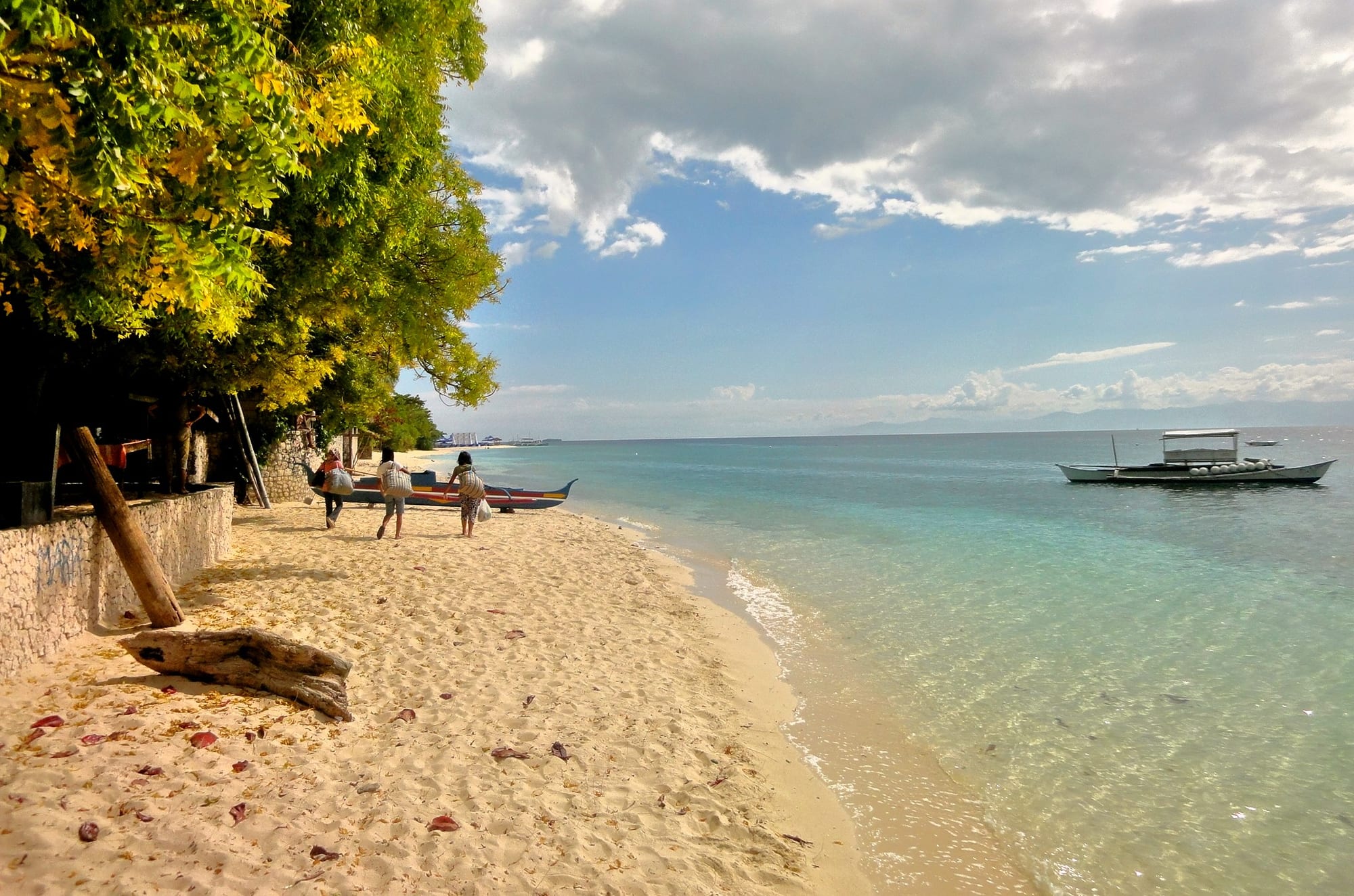
A curving strip of pale sand under leafy trees, with an outrigger boat moored in turquoise shallows and clouds over the sea

The Visayas, Philippines

Moalboal

White Beach on the coast of Moalboal, looking south along the Tañon Strait. (Lindstrm / Wikimedia Commons · CC BY-SA 3.0)

A coastal town on the west side of Cebu island, facing Negros across the Tañon Strait. Farming and fishing supported it until divers arrived in the 1970s and 1980s and turned the hamlet of Panagsama into one of the country's best-known dive bases. It is now a small resort town of dive shops, beach guesthouses and day boats, with reef a few metres from the shore.

Neighbourhoods

  • Panagsama Beach
    • Diving and snorkelling
    • Bars and restaurants
    • First-time visitors

    The diving village, a narrow strip of dive shops, guesthouses, bars and restaurants along a low seawall a few kilometres from the town centre. There is little sand left in front of it, but the reef wall begins within swimming distance of the steps, which is why most visitors stay here.

    Open in Maps
  • White Beach and Saavedra
    • Beaches
    • Families
    • Quiet stays

    A sandy shore a short tricycle ride north of Panagsama, with shallow turquoise water, moored outrigger boats and a line of resorts and small eateries behind the trees. It is the swimming and sunset side of Moalboal, and quieter after dark than the dive strip.

    Open in Maps
  • Poblacion
    • Local life
    • Markets
    • Transport

    The working town centre inland on the main coastal highway, with the market, the church, banks, the bus stop and rows of carinderia eateries. Few visitors sleep here, but it is where buses from Cebu City set down and where prices are local.

    Open in Maps

Things to do

The sea and the reef

  • Pescador Islandattraction

    A small limestone island offshore, ringed by a steep reef wall and a short boat ride from Panagsama, long the best-known dive site on this coast.

    Open in Maps

Short trips from the town

  • Kawasan Fallsattraction

    Turquoise pools beneath limestone falls on the Kawasan River in neighbouring Badian, about twenty kilometres south and reached by a walk upstream.

    Open in Maps
  • Dalagueteattraction

    A town on the other side of the island, known as the vegetable basket of Cebu, whose upland barangay of Mantalongon lies in hills cool enough to be called the province's summer capital.

    Open in Maps
  • Alegriaattraction

    A quiet farming and fishing municipality further south along the coast, and the site of the first onshore oil field in the Philippines.

    Open in Maps
  • Badianattraction

    The coastal municipality south of Moalboal, the starting point for canyoneering trips through river gorges towards Kawasan.

    Open in Maps
  • Oslobattraction

    A town on the far south-east coast where whale sharks are fed close to shore, a practice conservation groups have criticised.

    Open in Maps

Eat and drink

Long-standing places and food districts in Moalboal. Hours, ratings and directions come from your maps app, always current.

Food districts

  • The Panagsama stripneighborhood

    The dive village's single lane holds most of the town's restaurants and bars, mixing Filipino grills with the pizza, curries and breakfasts that long-stay divers ask for.

    Open in Maps
  • Moalboal public marketmarket

    The town's produce and fish market in the poblacion, where mangoes, bananas, coconuts and the morning catch are sold, with carinderia stalls serving cooked dishes alongside.

    Open in Maps
  • Saavedra and White Beach eateriesneighborhood

    Small beachfront kitchens and resort dining rooms behind the sand, strongest on grilled fish, squid and chicken with rice.

    Open in Maps

Experience Moalboal

History

Moalboal grew as an ordinary Cebuano coastal municipality, its people living from maize and coconuts inland and from fishing in the Tañon Strait. One explanation traces its name to the Cebuano word for the bubbling of a spring in the town proper. Like the rest of western Cebu it was organised under Spanish rule around a parish and a poblacion set slightly back from the sea, with fishing hamlets strung along the shore, and it remained obscure through the American period and the first decades after independence.

The change came from the water. Divers began arriving in the 1970s and 1980s, drawn by a reef wall that starts only a few metres offshore at the hamlet of Panagsama, and by the steep drop-offs around Pescador Island. Simple huts became dive shops, and Moalboal established itself early as one of Cebu's cheapest and longest-running places to learn. Typhoon Ruping, among the strongest storms to strike the country in decades, made landfall on Cebu in 1990 and caused heavy damage across the province; Panagsama rebuilt behind a seawall.

Since then the town has grown steadily rather than dramatically. The huge shoal of sardines in the shallows off Panagsama turned snorkelling into a draw in its own right, bringing visitors who never put on a tank, and the canyoneering routes opened in the river gorges of neighbouring Badian added a second reason to stay. Resorts spread north to White Beach in Saavedra, while the poblacion carried on as the market and transport town it had always been, and local government and dive operators have argued ever since about waste, moorings and pressure on the reef.

Culture & Customs

Moalboal is Cebuano in language and Catholic in rhythm, and the parish year sets much of the calendar: Sunday Mass, processions, the long Christmas season that begins months early, and Holy Week, when the town empties into churches and families return from Cebu City and abroad. The town fiesta, like those all over the province, means open houses, a band, basketball and food for anyone who calls in.

Two populations live side by side. One is the farming and fishing municipality of barangays inland and along the coast, where life runs on family obligation, remittances from relatives working overseas, and the barangay basketball court. The other is the small, long-established foreign and Manila-based diving community on the Panagsama strip, some of whom have run shops here for decades. The mix is old enough to be unremarkable, and many businesses are jointly run.

Diving has created its own local customs. Boat crews and guides are usually men from the coastal barangays who learned the reef before they learned the qualifications, and the code around the sardine shoal — no chasing, no touching, no fins near the coral — is enforced by the guides themselves as much as by rules. Music, karaoke and late conversation carry along the strip in the evening, while the poblacion goes quiet early. Visitors are expected to dress modestly away from the beach and to be gentle in manner; open irritation costs more here than it gains.

Daily Life

Nearly 38,000 people live in the municipality, most of them in barangays spread along the coast and up into the hills rather than in the small poblacion. Tourism now provides much of the cash income — dive shops, resorts, boats, tricycles, laundries, shops and construction — but farming and fishing continue beside it, and many households mix the two, with a son driving a tricycle and a father still going out in a bangka.

The day starts early. Boats return with the night's catch before dawn, the market in the poblacion is busiest by seven, and dive boats load at Panagsama in the morning light. The middle of the day is slow and hot; the strip fills again in the late afternoon, when swimmers go in to meet the sardines in softer light. Children in school uniforms fill the roads twice a day, and the evening belongs to basketball, sari-sari shops and television.

The pressures are those of a small place growing quickly. Water supply, drainage and rubbish collection lag behind the building of rooms; the reef and the shoal bring the money and are also what heavy use threatens; and the road between the highway and the beaches carries far more scooters than it was built for. Power cuts happen, storms cut the town off occasionally, and work in tourism is seasonal, which is why so many families still keep a plot of land or a boat.

Food

Eating in Moalboal is Cebuano before it is anything else. Grilled fish, squid and chicken come with rice — often puso, rice boiled in a woven pouch of palm leaf, the standard companion to barbecue across Cebu. Kinilaw, raw fish cured in vinegar with ginger, chilli and onion, is made with whatever the morning boats bring in. Lechon, whole roast pig, is the food of fiestas and of any occasion large enough to justify it, and Cebu's version is well known across the country.

Everyday eating happens at carinderia counters in the poblacion, where a plate of rice with adobo, pork sinigang, or fish stewed in vinegar costs a fraction of what the beach charges. The market sells mangoes and bananas, coconuts for drinking, dried fish and the small catch of the day, and streets stalls outside it fry bananas and grill skewers in the late afternoon. Tuba, coconut wine tapped from the palms, is the old village drink, though beer is more common now.

The Panagsama strip reflects who has stayed there. Alongside Filipino grills and breakfast silog plates — garlic rice, egg and a cured meat — there are pizzas, pastas, curries and western breakfasts that have been on menus for years, a reminder of how long divers have been coming. Fruit shakes, calamansi juice and buko, fresh young coconut, are the drinks of the hot part of the day, and halo-halo, shaved ice with beans, fruit, jelly and purple ube yam, is the standard afternoon sweet.

Planning tools

Budget

Moalboal is one of the cheaper beach destinations in the Visayas. Guesthouse rooms, tricycle rides and carinderia meals cost very little, and the main expenses are diving, boat trips and the transfer from Cebu City. Prices on the Panagsama strip are higher than in the poblacion, and rooms are dearest around Christmas, New Year and Holy Week.

Daily Budget Midrange
USD 70–160 (beach resort or dive-shop room, restaurants, a boat trip or two dives a day)
Daily Budget Shoestring
USD 25–45 (dorm or fan room, carinderia meals, tricycles, snorkelling from the shore)

Bring enough cash for the whole stay; cash machines are few and can be empty in busy periods, and many small resorts and dive shops prefer cash.

Best Time to Visit

March to May brings the calmest seas and the clearest water for diving and island trips, and falls inside western Cebu's drier months of about December to May. Rain is likelier from June to November, which is also the typhoon season as the region gives it, although Cebu is struck less often than islands facing the Pacific. Visibility is generally good year-round.

Suggested Number of Days

Two or three days suit most visitors, and four or five allow for the waterfalls, the hills and the south coast as well. Divers working through a course, or anyone happy to swim from the shore each morning, tend to stay considerably longer.

First Visit
2–3 days
With Surroundings
4–5 days

Transportation

Tricycles are the local transport, running constantly between the poblacion, Panagsama and White Beach for a few pesos a seat. Motorbikes and scooters are widely rented, and habal-habal motorbike taxis reach villages inland. Buses along the coastal highway link the town with Cebu City in one direction and the southern towns in the other, and boats for dive sites and island trips leave from the beaches.

Roads outside town are narrow and unlit at night, and scooter riders should check insurance cover and licence requirements before hiring.

Airport & Station Connections

The nearest airport is Mactan-Cebu International, beyond Cebu City, which is itself about 105 kilometres north-east by road. Buses from Cebu City's south bus terminal take roughly three to four hours to the Moalboal junction on the highway, where tricycles wait for the last few kilometres to the beaches; vans and private transfers are quicker. Ferries between Cebu and Negros, Bohol and Dumaguete make it easy to arrive as part of a longer island route.

Walkability

Panagsama is walkable end to end in a few minutes, and White Beach much the same, but the three parts of town are several kilometres apart along a road with little footpath, so a tricycle or scooter is normal for moving between them. Shoes with grip help on the seawall steps and on the rocky entries to the water.

Safety

Moalboal is a calm small town and serious crime against visitors is rare. The real risks are in the water and on the road: currents along the reef wall, boat traffic near swimmers, canyoneering and waterfall jumping in the gorges inland, and scooter accidents on wet or gravelled roads. Typhoons and earthquakes affect the whole region, and mosquito-borne dengue is present year-round.

Snorkel with a buoy or float where boats pass, treat the reef wall and the currents beyond it with respect, and use licensed operators for canyoneering. Monitor PAGASA for storms, keep away from volcanic danger zones, take dengue precautions year-round, and do not travel to the Sulu provinces or the Zamboanga peninsula. Check current official travel advice before travelling.

Climate

Tropical, hot and humid all year, with western Cebu's drier months running from about December to May and the wetter, stormier stretch from June to November. Rain usually comes as heavy afternoon showers rather than all-day grey, and the sea stays warm enough to dive without a thick wetsuit.

Summer
hot and humid, about 28–34°C, driest and calmest from March to May
Winter
warm, about 24–31°C, generally dry with a breeze off the strait

Local Customs

The language is Cebuano, often called Bisaya, and English is widely understood. This is a Catholic town: shoulders and knees covered in church, and the fiesta and Sunday Mass matter to daily life. Elders are greeted respectfully, and voices are kept low in disagreement. Beachwear belongs on the sand rather than in the market or the church, and reef etiquette is taken seriously — nothing is touched, stood on or collected.

Tipping is not obligatory but small amounts for dive guides, boat crews and housekeeping are appreciated; ask before photographing people or their homes.

Common Payment Methods

The currency is the Philippine peso. Resorts and larger dive shops take cards, but most small guesthouses, tricycles, eateries and market stalls are cash only. Cash machines exist in the poblacion and near the beaches, with low withdrawal limits and fees, so many visitors draw money in Cebu City before coming.