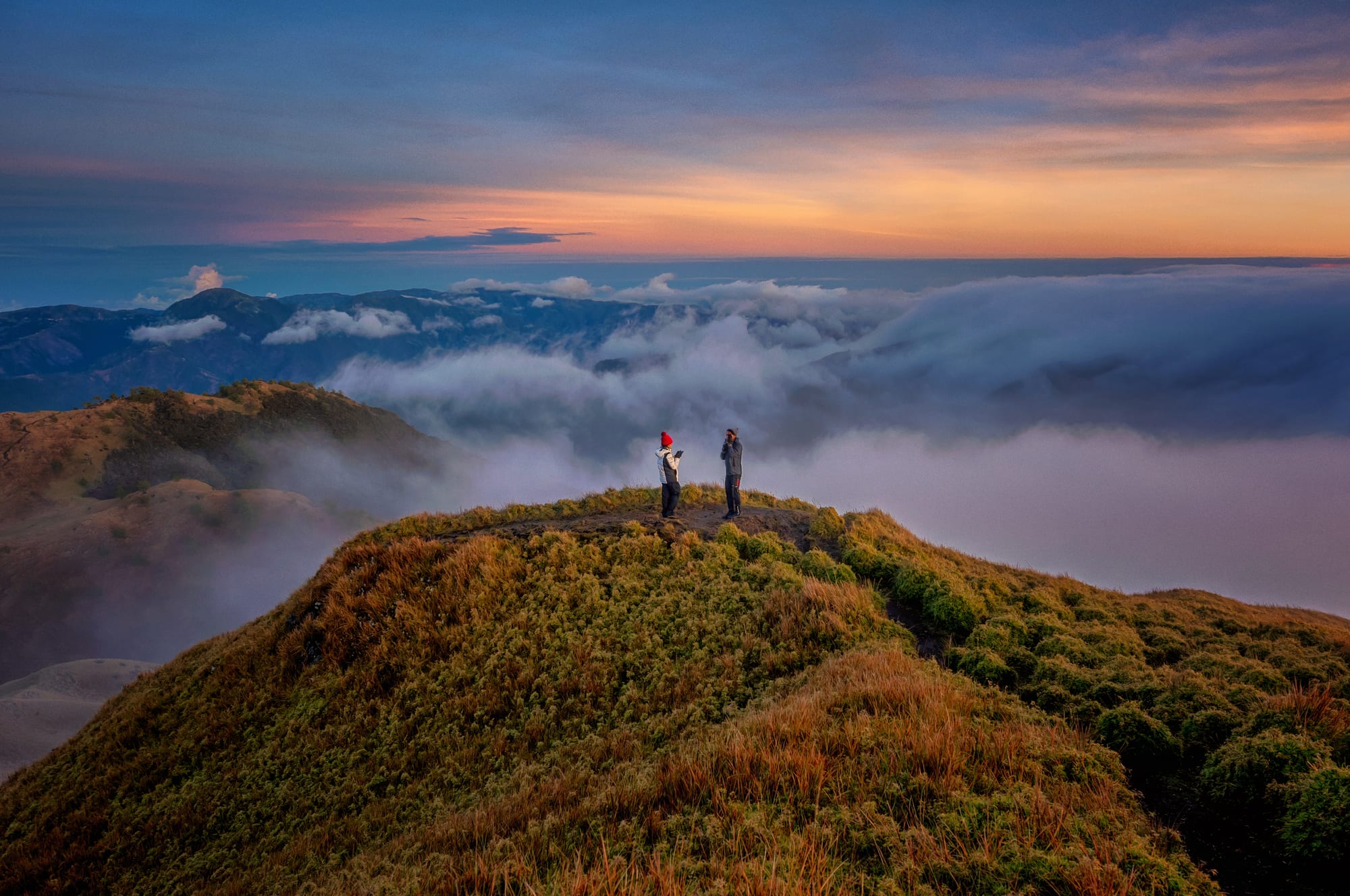
Two hikers stand on a grassy summit ridge above a rolling sea of clouds, with blue mountain ranges behind and an orange and pink sunrise sky

Philippines

Hikers watch the sunrise over a sea of clouds from the grassy summit of Mount Pulag in northern Luzon. (Jeremias Telva / Wikimedia Commons · CC BY-SA 4.0)

An archipelago of more than 7,000 islands in Southeast Asia, on the Pacific typhoon belt and Ring of Fire — Asia's largest Catholic-majority country, shaped by three centuries of Spain and half a century of America, and held together by family, faith, and migration.

Explore Philippines

History

Austronesian settlers built "barangay" communities and, from the fourteenth century in the south, Islamic sultanates. Ferdinand Magellan's Spanish expedition arrived in 1521 — and Magellan was killed by the chief Lapu-Lapu at Mactan — but Spain colonised from 1565 and ruled for 333 years from Manila, converting most of the archipelago to Catholicism and linking Asia and the Americas through the Manila galleon trade.

A revolution against Spain broke out in 1896, and independence was declared in 1898 — but Spain instead ceded the islands to the United States, which crushed the First Philippine Republic in a brutal war and ruled the Philippines as a colony until 1946, leaving behind English-language schooling and American institutions. Japanese occupation in the Second World War, the Bataan Death March, and the catastrophic 1945 Battle of Manila preceded independence.

A patronage-driven republic dominated by landed families gave way to the rule of Ferdinand Marcos, who declared martial law in 1972 and governed as a dictator — cronyism, torture and disappearances, and billions plundered — until the peaceful "People Power" revolution of 1986 ousted him and installed Corazon Aquino. The restored democracy has cycled through reformers and scandal-plagued leaders; Rodrigo Duterte's nationally popular but lethal "war on drugs" killed thousands and led to his arrest in March 2025 and transfer to the International Criminal Court in The Hague. In 2022 Ferdinand "Bongbong" Marcos Jr., the dictator's son, won the presidency in a landslide alongside Duterte's daughter Sara as vice-president — an alliance that has since collapsed. She was impeached by the House of Representatives in February 2025, the first sitting vice-president to be impeached; the Supreme Court voided that case, but the House impeached her again in May 2026, and she remains in office while a Senate trial runs; an impeachment complaint was filed against Marcos himself in January 2026. A scandal over flood-control projects has brought repeated mass anti-corruption protests since September 2025. Marcos has swung foreign policy back toward the United States as territorial disputes in the South China Sea have escalated: the Philippines has claims in the Spratly Islands that overlap with those of China, Malaysia, Taiwan and Vietnam, and it won a 2016 arbitration case that China rejects. In the south, the Bangsamoro Autonomous Region in Muslim Mindanao held its first regular parliamentary election in September 2026, returning a parliament with no majority.

  • The Philippines: The Islands in Between — An archipelago of 7,000 islands — 300 years under Spain and a name from a Spanish king, a revolution cut short by American conquest, a brutal Japanese occupation, and a democracy repeatedly strained by dictatorship and dynasty

Culture & Customs

The Philippines is the outlier of Asia — majority Catholic, heavily influenced by Spain and America, yet unmistakably Southeast Asian and Austronesian underneath. Faith runs through daily life: fiestas for town patron saints, the world's longest Christmas season, Holy Week processions, and the January Feast of the Black Nazarene that draws millions into the Manila streets.

Family is the organising unit — extended, close, and the reason so many Filipinos work abroad — and values of utang na loob (debt of gratitude), hiya (propriety), and pakikisama (getting along) shape social life, alongside a famous warmth, humour, and resilience. Karaoke is a national institution; basketball is played on every barangay court; and boxing produced Manny Pacquiao, a national hero turned senator.

The highland cultures of the Cordillera, the Moro sultanate traditions of Mindanao, and the crafts of the Indigenous lumad peoples add a depth the tourist image often misses.

  • Philippines: Mano, Fiesta and the Dawn Mass — A mostly Catholic nation with deep Muslim and Indigenous traditions, where elders are greeted with a hand pressed to the forehead, guests are never refused food, and Christmas begins with nine Masses before dawn

Daily Life

The Philippines is young, urbanising, and defined by mobility. Metro Manila, one of the densest urban regions on Earth, holds the government, the money, and the traffic; Cebu is the fast-growing second centre; Davao anchors the south.

The economy runs on the young English-speaking workforce — the call-centre and outsourcing industry is a world leader — and on the remittances of millions of overseas Filipino workers, from nurses and seafarers to domestic helpers, which reached a record 37.2 billion US dollars in 2023, about 8.5 per cent of GDP, and sustain millions of households while their absence reshapes families. Around 2.5 million of them work in the Middle East, and the war that began there in February 2026 has reached them: two Filipino crew members were killed in a security incident involving a tanker crossing the Strait of Hormuz in August 2026. Electronics assembly, farming, mining, and tourism fill out the picture, but a few dynastic families dominate business and politics, and poverty is stubborn.

Above all, life is lived under the weather: the Philippines is one of the most disaster-prone countries in the world, hit by around twenty typhoons a year and ringed by volcanoes and fault lines, and communities have deep habits of preparation, mutual aid, and rebuilding.

  • Philippines: The Family That Spans an Ocean — Multigenerational households anchored by grandparents, a school day split into shifts, and a country where remittances from abroad reached a record 35.6 billion US dollars in 2025

Food

Filipino cooking is savoury, tangy, and unfussy, shaped by Malay roots and Chinese, Spanish, and American layers. Adobo — meat braised in vinegar, soy, garlic, and pepper — is the unofficial national dish, in endless regional versions. Sinigang, a sour tamarind broth, and kare-kare, an oxtail-and-peanut stew eaten with shrimp paste, are home classics; lechon, a whole spit-roasted pig, is the centrepiece of every fiesta.

Chinese-derived pancit noodles, siomai, and lumpia spring rolls are everyday food, and the American era left fried chicken, banana-ketchup spaghetti, and a love of tinned meat. Breakfast is silog — garlic rice, fried egg, and a cured meat. Street food runs from balut to grilled skewers of everything.

Sweets and merienda are their own world: halo-halo shaved ice with beans, fruit, jelly, and purple ube yam; bibingka and puto bumbong at Christmas; and ube and pandan in everything. San Miguel beer and coconut lambanog round it out.

Attractions & Natural Wonders

The Philippines is a beach and island country above all. Palawan tops most lists — the karst lagoons and island-hopping of El Nido and Coron, the underground river near Puerto Princesa, and remote Tubbataha for divers — followed by the white sand of Boracay, the surf and lagoons of Siargao, the hills and tarsiers of Bohol, and the diving of Malapascua and Moalboal. Whale sharks are seen at Oslob and, more ethically, at Donsol.

Inland Luzon has the amphitheatre rice terraces of Banaue and Batad, carved by the ancestors of the Ifugao and long said to be 2,000 years old, though researchers dispute the date; the hanging coffins and caves of Sagada; the Spanish colonial streets of Vigan; the near-perfect cone of Mayon volcano; and Taal, a volcanic island in the middle of a lake that fills a vast caldera.

Manila itself has the walled Spanish quarter of Intramuros with Fort Santiago, the old districts and markets, and a strong art and food scene in Makati and Bonifacio Global City. The Cordillera trails, the far-northern Batanes islands with their stone houses, and the war memory of Corregidor and Bataan add range to a country that is hard to see quickly.

  • Philippines: Ten Attractions and Natural Wonders — Over a thousand grass-covered hills that turn chocolate-brown in the dry season, limestone islands scattered across a turquoise bay, centuries-old rice terraces carved largely by hand, and a reef so pristine it can only be reached by liveaboard boat

Planning basics

Budget

The Philippines is affordable, though island-hopping by plane and boat adds up. Guesthouses, carinderia eateries, and jeepneys cost little; Boracay, El Nido, and Manila's business districts run to mid-range and up. Diving and remote-island resorts are the big splurges.

Daily Budget Midrange
USD 70–170 (mid-range hotel or beach resort, restaurants, domestic flights, island-hopping tours and diving)
Daily Budget Shoestring
USD 30–50 (guesthouse or dorm, local eateries, jeepneys and ferries)

Book domestic flights early for the best fares, and build buffer days around inter-island flights and ferries, which weather can cancel.

Visa Requirements

Citizens of the EU, the UK, the US, Canada, Australia, New Zealand, and many other countries can enter visa-free, usually for 30 days, extendable in country up to a much longer stay. A passport valid for six months and an onward ticket are required, and every arrival must register on the free eTravel system within 72 hours before landing.

Typical Stay
30 days visa-free, extendable at the Bureau of Immigration

Safety

The main tourist areas — Manila's business districts, Cebu, Bohol, Boracay, Palawan, Siargao, and the Luzon highlands — are generally safe with normal precautions. Petty theft and tourist scams (drugged drinks, fake taxis, rigged card games) occur in Manila and Cebu. Governments advise against all travel to western and central Mindanao and the Sulu Archipelago because of Islamist militancy, clan feuds, and a history of kidnapping foreigners for ransom, and the UK also advises against all but essential travel to the rest of Mindanao, except the islands of Camiguin, Dinagat and Siargao.

Natural
Around 20 typhoons a year, plus earthquakes, active volcanoes (Taal, Mayon, Kanlaon), and strong rip currents

Monitor PAGASA for storms, keep away from volcanic danger zones, take dengue precautions year-round, and do not travel to the Sulu provinces or the Zamboanga peninsula.

Climate

Tropical, hot and humid year-round. Around Manila and the west there is a hot dry season (March–May), a rainy southwest-monsoon season with typhoons (June–November), and a cool dry season (December–February), the pleasantest. The eastern seaboard and much of Mindanao get rain more evenly. Typhoon season peaks from July to October.

Lowlands
25–34°C year-round
Typhoon Season
July–October, strongest and most frequent storms

Transportation

Manila and Cebu are the main gateways, and domestic flying (Cebu Pacific, Philippine Airlines, AirAsia) is the practical way to island-hop. Ferries and roll-on-roll-off vehicle boats link the islands, with outrigger bangka boats for short hops. On land there are buses, the brightly painted jeepney, tricycles, motorbike taxis, and Grab; Metro Manila has three crowded elevated rail lines.

Traffic in Metro Manila and Cebu is severe — allow far more time than the distance suggests — and use Grab rather than hailing taxis.

Best Time to Visit

December to May, the dry months, are best for the islands, with December to February coolest and March to May hottest and busiest. Avoid the typhoon-prone months, especially August to October, in Luzon and the Visayas. Holy Week sees the country travel en masse and many businesses close.

Events
Sinulog (Cebu, January); Ati-Atihan (Kalibo, January); Panagbenga (Baguio, February); MassKara (Bacolod, October)

Currency

The currency is the peso (PHP). Cards are accepted in cities, malls, and resorts; carry cash for eateries, jeepneys, tricycles, markets, and the islands. ATMs are common but have low withdrawal limits and fees.

Symbol
₱
Currency Code
PHP — Philippine peso

Language

Filipino, based on Tagalog, and English are the official languages, and English is used in government, courts, higher education, and much of business, and it is widely spoken. Everyday Manila speech mixes the two as "Taglish". Some 130 to 195 languages are spoken in all, depending on how they are counted, with Tagalog and Cebuano the most widely spoken native languages and Ilocano, Hiligaynon, Bikol, and Waray all major.

Also Spoken
Cebuano, Ilocano, Hiligaynon; 130 to 195 languages in all
Official Languages
Filipino, English