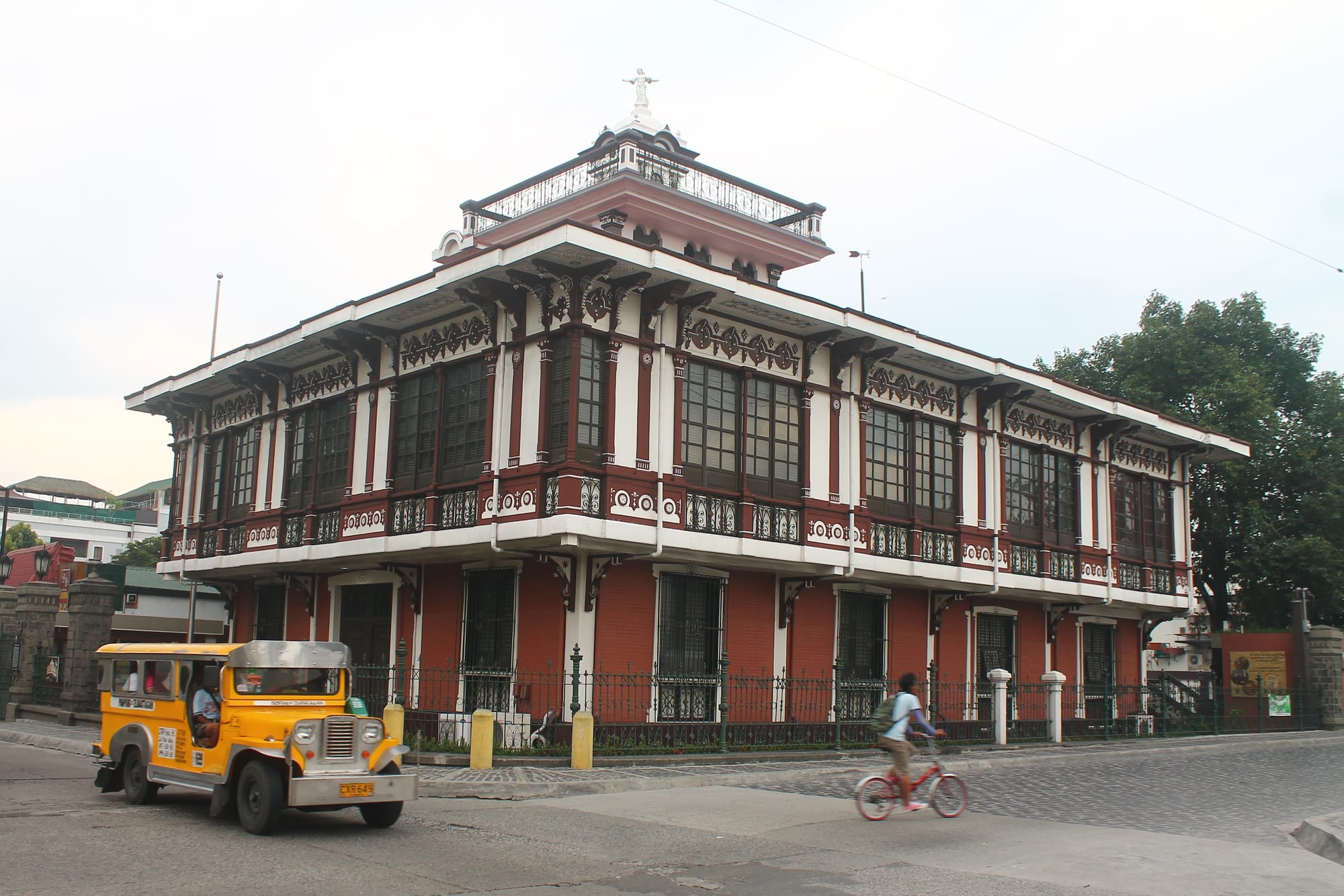
A red and white two-storey colonial mansion with wide shuttered windows on a street corner, with a yellow jeepney passing in front

Manila & Central Luzon, Philippines

Angeles

The Pamintuan Mansion in the old centre of Angeles, with a jeepney on the corner. (Elmer B. Domingo / Wikimedia Commons · CC BY-SA 4.0)

A city in Pampanga, about 80 kilometres north of Manila, that grew up beside the American military base at Clark and now sits next to the freeport and international airport that replaced it. It keeps a small Spanish-era centre of brick churches and ancestral houses, serves as the base for trips to Mount Pinatubo, and is known nationally for Kapampangan cooking.

Neighbourhoods

  • Santo Rosario and the old centre
    • Historic district
    • Walking
    • Local life

    The original town around the brick parish church, with ancestral houses, the old municipal buildings and small museums within a few blocks. It is the quietest and most walkable part of the city and holds most of what survives from the Spanish period.

    Open in Maps
  • Balibago
    • Nightlife
    • Hotels
    • Restaurants

    The district beside the main gate of the former base, built up during the American years and still the city's hotel and entertainment quarter, with bars, restaurants and shops along Fields Avenue and the surrounding streets.

    Open in Maps
  • Clark Freeport Zone
    • Close to the airport
    • Quiet and residential
    • Families

    The former air base, now a freeport of wide avenues, old hangars, hotels, golf courses and duty-free shops, with the international airport at its northern end. It feels nothing like the rest of the city: green, spacious and quiet.

    Open in Maps
  • Nepo and the commercial strip
    • Markets
    • Best for food
    • Close to public transport

    The busy commercial belt around the market and the malls near MacArthur Highway, where jeepneys and buses converge and Kapampangan food is sold cheaply from stalls and canteens.

    Open in Maps

Things to do

The old town

  • Holy Rosary Parish Churchlandmark

    The brick parish church built by forced labour between 1877 and 1896, used as a military hospital during the Philippine–American War and still the centre of the old town.

    Open in Maps
  • Pamintuan Mansionmuseum

    An 1880s house where the First Philippine Republic marked the first anniversary of independence in 1899, later a bank and now a museum of Philippine social history.

    Open in Maps
  • Museo ning Angelesmuseum

    The city museum in the former town hall, built in 1922 and the seat of the town government until 1998, with displays on Kapampangan life, local history and food.

    Open in Maps

Clark and the base

  • Clark Freeport Zoneattraction

    The former Clark Air Base, the largest American military installation overseas until 1991, converted into a freeport of business parks, hotels, parks and duty-free shopping.

    Open in Maps
  • Clark International Airporttransit hub

    The airport inside the freeport, built on the old military runways and now the main alternative gateway to Luzon after Manila.

    Open in Maps
  • Clark Veterans Cemeteryattraction

    A cemetery within the freeport holding the remains of thousands of American veterans and Philippine Scouts, in use since 1900.

    Open in Maps

Volcanoes and country around

  • Mount Pinatuboattraction

    The volcano whose 1991 eruption was one of the largest of the 20th century; four-wheel-drive rides across the lahar fields and a walk reach the crater lake, with Angeles the usual base.

    Open in Maps
  • Mount Arayattrail

    The isolated 1,000-metre peak rising from the Pampanga plain east of the city, a national park with trails to two summits.

    Open in Maps
  • San Fernandoattraction

    The provincial capital about 15 kilometres south, known for its giant parol lanterns at Christmas and for Holy Week penitential rites.

    Open in Maps
  • Candaba Swampattraction

    Seasonal wetlands east of the city that flood in the rainy season, dry out from about November to be farmed, and draw migratory birds in the cooler months.

    Open in Maps

Seasonal events

  • Sisig FestivalDecember

    Street parties, cooking contests and parades in the city that claims sisig as its own, held alongside the December holidays.

  • Tigtigan Terakan keng DalanOctober

    A street festival whose Kapampangan name means music and dancing in the street, closing the roads of the old centre and Balibago for stages and food stalls.

  • Holy Week in PampangaMarch or April

    Processions, chanted passion readings and the penitential rites for which the province is known, some of them discouraged by the church.

  • Giant Lantern FestivalDecember

    In nearby San Fernando, enormous illuminated parol lanterns spun by rotors compete before crowds in the weeks before Christmas.

Eat and drink

Long-standing places and food districts in Angeles. Hours, ratings and directions come from your maps app, always current.

Kapampangan classics

  • Sisigrestaurant

    Chopped grilled pig's face, ears and cheek served sizzling on a hot plate with onion, calamansi and chilli; its modern form was popularised in Angeles and it is now eaten across the country.

    Open in Maps
  • Kapampangan restaurants in the old centreneighborhood

    Long-standing kitchens near the church serve kare-kare, bringhe, tocino and buro, the fermented rice and fish relish that outsiders find hardest and locals prize.

    Open in Maps
  • Balibago's international restaurantsneighborhood

    Decades of American, Korean and Australian residents have left a strip of steakhouses, Korean barbecue, bakeries and bars unusual for a provincial Philippine city.

    Open in Maps

Markets

  • Pampang public marketmarket

    The main market district of the city, in Pampang and San Nicolas, where cured tocino and longganisa sausages, buro, fresh produce and cooked food are sold from early morning.

    Open in Maps
  • Clark's duty-free and food hallsmarket

    Imported groceries and restaurants inside the freeport, a legacy of the base that still draws shoppers from across Central Luzon.

    Open in Maps

Experience Angeles

History

Angeles began in 1796, when Ángel Pantaleón de Miranda and his wife Rosalía de Jesús cleared a settlement in the forest at the edge of San Fernando's territory. It was named Culiat after a vine that grew there and later renamed for the founder and for the town's patrons, the Holy Angels. The brick parish church was built between 1877 and 1896, and a small class of Kapampangan landowners put up the ancestral houses that still stand around it. In 1899, as the First Philippine Republic retreated northwards, Angeles briefly served as its capital, and Emilio Aguinaldo marked the first anniversary of the declaration of independence at the Pamintuan house.

The American period changed everything. In 1903 the United States established a cavalry post on land beside the town that became Clark Field and then Clark Air Base, and the settlement grew around its gates. The Japanese took the base in 1942 and used it until American forces returned in 1945. During the Cold War Clark became the largest American military installation outside the United States, a city of tens of thousands of personnel, and the economy of Angeles — housing, services, bars and restaurants along Fields Avenue — shaped itself entirely around that traffic.

Two events ended the arrangement. The Philippine Senate voted in 1991 not to renew the bases agreement, and in June of the same year Mount Pinatubo, about 25 kilometres to the west, erupted and buried Clark and much of Pampanga under ash and lahar. The Americans withdrew, the local economy collapsed, and lahar flows continued to bury towns for years afterwards. The base was reopened as the Clark Freeport Zone, the runways became a civilian airport, and the city rebuilt around aviation, business-process offices, tourism and its reputation for food.

Culture & Customs

Angeles is thoroughly Kapampangan, and in Pampanga that identity is expressed first through cooking. The province regards itself as the culinary capital of the country, and households judge each other on their kare-kare and their cured meats; a cook of reputation is a person of standing. Food festivals, cooking competitions and the city's own sisig celebration are civic occasions rather than tourist events.

Catholic practice is intense and public. Holy Week brings chanted readings of the passion, called pabasa, in neighbourhood chapels through the night, processions of images owned by particular families, and the penitential rites — self-flagellation and, in a few places nearby, crucifixion — that Pampanga is known for and that the church discourages. December belongs to the parol, the star lantern, which the province turned into an art of rotating lights and which fills the streets from the beginning of Advent.

The long American presence left another layer: baseball and basketball, a strong tradition of live cover bands, bakeries selling hot dogs and pastries beside Kapampangan stalls, and a mixed community of Filipino-Americans, retired servicemen and, more recently, Korean residents and students. Kapampangan, Tagalog, English and Korean are all heard within a few streets, and the city is used to foreigners in a way few provincial cities are.

Daily Life

About 480,000 people live in the city, which is one of the larger urban centres of Central Luzon and effectively continuous with the neighbouring towns of Mabalacat and Porac. Most live away from the freeport in the dense barangays along the highway, while the freeport itself holds offices, hotels and industrial estates rather than much housing.

The economy rests on the freeport and the airport. Clark employs tens of thousands in aviation, logistics, manufacturing, outsourcing offices and casinos, and the government's plans for Central Luzon treat it as a second hub for the capital region. Tourism supplies the rest: the entertainment district, Pinatubo tours, conventions and a steady flow of foreign residents and retirees. Farming and food production continue in the surrounding towns, and remittances from Kapampangans abroad support many households.

The day starts early, with jeepneys full before six and bakeries selling pan de sal at dawn, and slows through the hot afternoon before the evening trade begins. Traffic on MacArthur Highway, flooding when the monsoon is heavy, and the long process of clearing lahar-choked rivers are constant local concerns. The eruption is still a living memory: people date events by it, and the grey sand under the fields west of the city is a reminder of how recent it is.

Food

Pampanga's reputation rests on dishes that take trouble, and Angeles claims the most famous of them. Sisig in its modern form — pig's face and ears boiled, grilled, chopped fine and served sizzling on a cast-iron plate with onion, calamansi and chilli, often topped with an egg — was popularised here in the 1970s by the cook Lucia Cunanan, and has since become one of the country's signature dishes.

The rest of the Kapampangan table is wider than that. Kare-kare, oxtail and vegetables in a thick peanut sauce, is eaten with bagoong shrimp paste. Bringhe is a rice dish cooked with coconut milk and turmeric in a banana leaf, a relative of paella. Tocino, sweet cured pork, and longganisa sausages are provincial specialities sold in every market, and buro, rice fermented with fish or shrimp and served with vegetables and fried fish, is the acquired taste that Kapampangans defend most fiercely. Sinigang, adobo and grilled bangus appear as everywhere, but the seasoning is more careful.

Sweets are a serious business too: turrones de casuy, cashew marzipan wrapped in edible wafer, tibok-tibok, a carabao-milk pudding, and the rice cakes eaten at dawn in December after the Simbang Gabi masses. The American years added steakhouses, bakeries and a taste for breakfasts of eggs and sausage, and Korean restaurants now line parts of Balibago, so a single street can offer buro, barbecue and a bakery within a few doors.

Planning tools

Budget

Angeles is cheaper than Manila for rooms and food, and the range is wide: simple hotels and guesthouses in Balibago cost little, while resorts and business hotels inside the freeport are priced for airline crews and golf. Kapampangan food is good value at every level. The main extra costs are a guided trip to Pinatubo and transport, since the city is spread out.

Daily Budget Midrange
USD 60–140 (mid-range hotel, restaurant meals, taxis or ride-hailing, a Pinatubo day tour)
Daily Budget Shoestring
USD 25–45 (budget hotel or guesthouse, carinderia and market meals, jeepneys and tricycles)

Share a four-wheel-drive to Pinatubo, which is charged per vehicle rather than per person, and expect Balibago rates to rise around Christmas and Chinese New Year.

Best Time to Visit

November to April is the dry season and the practical window, with December bringing the lantern and festival season across Pampanga and the clearest conditions for Pinatubo. March to May is very hot on the plain. The Pinatubo route follows river channels and is often closed in the rainiest months from June to October.

Suggested Number of Days

A day or two covers the old centre and the freeport. Three or four suit anyone adding a volcano trip or using the city as a base for Central Luzon, and the mountain excursion takes a full day on its own.

First Visit
1–2 days
With Surroundings
3–4 days

Transportation

Jeepneys run along MacArthur Highway and the main roads, tricycles cover short distances, and ride-hailing works in the built-up areas. The freeport has its own shuttle buses and is too large to cross on foot. Buses to Manila, Baguio, Subic and the northern provinces leave from terminals on the highway, and the expressway makes the capital a straightforward drive outside peak hours.

Fix tricycle fares before setting off, and allow extra time to cross between Balibago, the old centre and the airport, which are several kilometres apart.

Airport & Station Connections

Clark International Airport sits inside the freeport a short drive from the city, with domestic flights and international services to Asian and Gulf cities, and a bus link to Manila. By road, Angeles is about 80 kilometres north of the capital on the expressway, roughly one and a half to three hours by bus depending on traffic, with frequent departures from several Manila terminals.

Walkability

The old centre around the church is compact and can be walked in an hour, and Balibago's main strip is walkable within itself. Beyond that the city is built for vehicles: highways without crossings, long distances between districts, and a freeport laid out on the scale of an airbase. Heat and humidity make midday walking hard work.

Safety

Angeles is generally calm, but the entertainment district attracts the usual problems of such places — inflated bills, drink spiking, theft from distracted visitors and scams aimed at foreigners — and is best treated with the caution any nightlife area deserves. Traffic is the everyday hazard, and ash-laden channels around Pinatubo can flood violently during heavy rain, which is why trips are run with licensed guides.

Keep valuables out of sight in Balibago at night, agree prices before accepting anything, and book Pinatubo through a licensed operator. Monitor PAGASA for storms, keep away from volcanic danger zones, take dengue precautions year-round, and do not travel to the Sulu provinces or the Zamboanga peninsula. Check current official travel advice before travelling.

Climate

Hot and humid, with the western Luzon pattern of a dry season from November to April and a wet season from about May to October, when the southwest monsoon and typhoons bring heavy rain to the Central Luzon plain. Temperatures usually run between 23 and 35°C, with the highest readings in April and May.

Summer
March–May is the hottest, often 33–36°C in the afternoon with high humidity and little rain
Winter
December–February is the most comfortable, around 23–31°C, dry with cooler nights

Local Customs

Kapampangan is the language of the province, spoken alongside Filipino and English, and Kapampangans are known across the country for taking food and hospitality seriously; refusing an offer of a meal takes some care. Catholic practice is strong, and Holy Week observances here are conspicuous. Decades of foreign residents mean visitors attract little attention, but modest dress and ordinary courtesy are still expected away from the entertainment strip.

Dress modestly in churches and the old town, ask before photographing Holy Week rites or people at work, and accept that meals with locals will be long and generous.

Common Payment Methods

The currency is the Philippine peso. Cards are accepted in freeport hotels, malls and larger restaurants, and cash is needed for tricycles, jeepneys, markets and small eateries. Cash machines are common in the malls and along the commercial strip, with low limits and fees, and money-changing services are easy to find in Balibago.