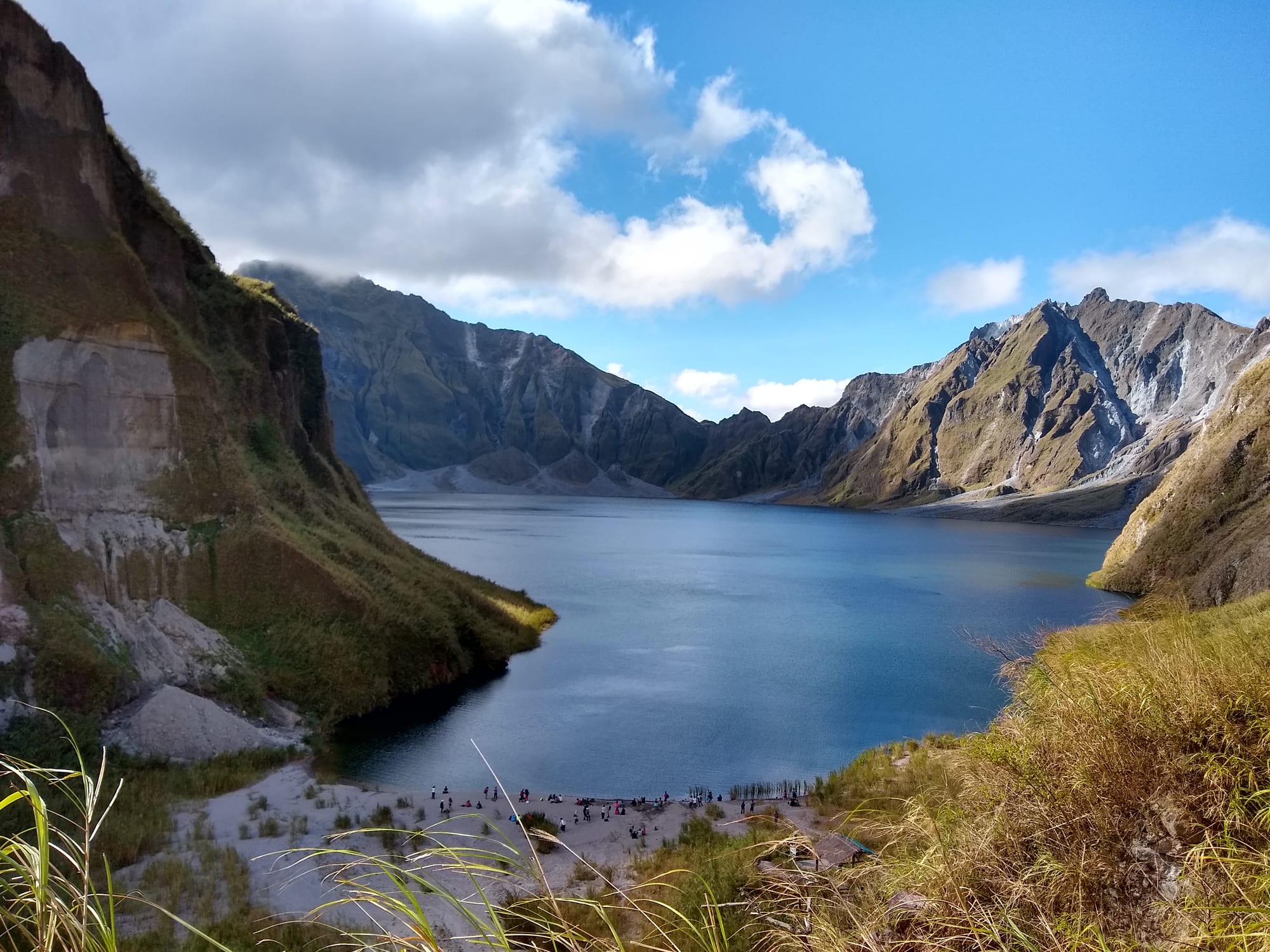
Blue crater lake ringed by steep grey-green volcanic cliffs, with grassy slopes and a pale sandy shore in the foreground

Philippines

Manila & Central Luzon

The crater lake inside the caldera of Mount Pinatubo, formed after the volcano's 1991 eruption. (Lance Vanlewen / Wikimedia Commons · CC BY-SA 4.0)

The crowded heart of Luzon, taking in the capital region, the rice plains and volcanoes of Central Luzon and the industrial, lake-and-volcano country of Calabarzon to the south — the seat of Spanish and American power, the birthplace of the 1898 republic, and home to well over a quarter of all Filipinos.

Explore Manila & Central Luzon

History

Before the Spanish arrived, Maynila was a fortified Muslim settlement on the mouth of the Pasig, trading with Brunei and China, with Tondo across the river. Miguel López de Legazpi took it in 1571 and made it the capital of the Spanish Philippines. Intramuros, the walled city, became the seat of church and government, Chinese traders settled in the Parián and later Binondo, and for 250 years the Manila galleons carried silk and porcelain to Acapulco in exchange for Mexican silver. The British held the city briefly from 1762 to 1764.

The provinces around the capital led the revolution against Spain. José Rizal was born in Calamba, Laguna, in 1861; Emilio Aguinaldo declared independence from his house in Kawit, Cavite, on 12 June 1898; and the Malolos Congress in Bulacan drafted the constitution of the First Philippine Republic. Under American rule Manila grew into a planned colonial capital, and the United States established Clark Air Base and greatly expanded the former Spanish naval base at Subic Bay.

The Second World War struck hardest here. American and Filipino troops held out on Bataan and Corregidor until April and May 1942, and the Bataan Death March followed; in February 1945 the Battle of Manila destroyed most of Intramuros and killed around 100,000 civilians. After independence the Central Luzon plains were the base of the Huk peasant rebellion. The 1986 People Power protests filled EDSA, Metro Manila's main avenue. In June 1991 Mount Pinatubo erupted in one of the largest eruptions of the 20th century, burying towns under lahar and hastening the American withdrawal from Clark and, in 1992, from Subic.

Culture & Customs

The region is the Tagalog heartland — Filipino, the national language, is built on the Tagalog of Manila, Bulacan, Batangas and the southern provinces — but Pampanga speaks Kapampangan and parts of Tarlac and Nueva Ecija speak Ilocano or Pangasinan. Batangueños are known for their emphatic accent and pride, and Kapampangans for taking food more seriously than anyone else in the country. The Aeta, among the Philippines' earliest inhabitants, live on the slopes of Pinatubo.

The festival calendar is dense. Every January the procession of the Black Nazarene draws huge crowds through Quiapo in Manila. In May the town of Lucban in Quezon decorates its houses with rice wafers, fruit and vegetables for the Pahiyas harvest festival, and Obando in Bulacan dances in the streets to pray for children. Holy Week in Pampanga is known for its penitents, some of whom are nailed to crosses in San Fernando, a practice the church discourages. December belongs to San Fernando's giant lanterns, the parol, which turned a village craft into the city's trademark.

Craft towns keep older skills: Paete in Laguna carves wood and papier-mâché, Taal in Batangas makes embroidery and the balisong, a folding knife, and Bulacan is known for its jewellery. Manila itself mixes Chinese-Filipino Binondo, the Catholic crowds of Quiapo and the malls and galleries of Makati and Bonifacio Global City.

Daily Life

Metro Manila, a cluster of sixteen cities and one municipality, has about 14 million people; Quezon City is its largest, with about 3 million, and the City of Manila has around 1.9 million on a small, very dense area. Calabarzon is the most populous region in the country and Metro Manila the second, so commuter towns now spread well into Bulacan, Cavite, Laguna and Rizal.

The economy is the national economy in miniature. Makati and Bonifacio Global City hold banks, head offices and call centres; Cavite, Laguna and Batangas are lined with factory parks making electronics and car parts; Batangas City has refineries and a busy port. Central Luzon grows much of the country's rice, particularly in Nueva Ecija, while Subic and Clark have become freeports and Clark is being developed as a second airport and government centre.

Days start early to beat the traffic, with long commutes by jeepney, bus, train or motorbike, and malls serve as air-conditioned town squares at weekends. Flooding in the rainy season, congestion, housing shortages and informal settlements along the rivers and bay are the recurring issues, alongside land reclamation in Manila Bay and the recovery of towns around Taal after its 2020 eruption.

Food

Pampanga is the region's kitchen. Sisig, chopped pig's face and ears grilled and served sizzling with onion and chilli, was popularised in Angeles; the province also makes sweet cured tocino, longganisa sausages, and buro, fermented rice with fish. Kapampangan tables often feature kare-kare and other stews prepared with extra care, and Pampanga makes turrones de casuy, cashew marzipan wrapped in wafer.

Batangas cooks for cold nights on the ridge: bulalo, a clear beef-shank and bone-marrow soup, is Tagaytay's signature, and lomi is a thick noodle soup eaten at roadside stalls. Kapeng barako, strong coffee from the liberica bean, is grown on the Batangas hills. From Taal Lake comes tawilis, a small freshwater sardine found nowhere else, fried whole.

Laguna produces buko pie, a custard-like pie of young coconut, and espasol, rice-flour rolls, while Lucban in Quezon is known for oregano-flavoured longganisa and pancit habhab, noodles eaten straight from a banana leaf without cutlery. Bulacan makes pastillas de leche, carabao-milk sweets wrapped in paper, and the region's markets sell kakanin rice cakes every morning. In Manila, Binondo's Chinese-Filipino restaurants serve hopia pastries, dumplings and noodles, and the city's food scene runs from carinderias to international restaurants.

Attractions & Natural Wonders

Metro Manila's historic core is Intramuros, with Fort Santiago, where Rizal was held before his execution, and the San Agustin Church, one of the Baroque Churches of the Philippines on the UNESCO World Heritage list. Nearby are Rizal Park, the National Museum complex, Binondo's Chinatown, the Quiapo Church of the Black Nazarene, and sunsets over Manila Bay; Makati and Bonifacio Global City are the modern face of the capital. Ferries from Manila cross to Corregidor, where the Malinta Tunnel, ruined barracks and gun batteries tell the story of 1942.

North of the capital, Bataan has the Mount Samat shrine and the Las Casas Filipinas de Acuzar heritage resort, and Malolos preserves the Barasoain Church. Subic Bay offers forest trails, beaches and a former naval base; Clark has its old airfield and hot-air balloon festival grounds. From Capas in Tarlac, a 4x4 ride across grey lahar fields and a walk lead to Mount Pinatubo's crater lake. Zambales has the pine-fringed coves of Anawangin and Nagsasa, and Aurora's Baler is the region's surf town.

South of Manila, Tagaytay sits on the ridge of an ancient caldera above Taal Lake and Taal Volcano, whose island remains off-limits during periods of unrest; the town of Taal has ancestral houses and a large basilica. The Batangas dive coast centres on Anilao, where reefs on the Verde Island Passage are known for nudibranchs and macro life, with Nasugbu's beaches to the west. Laguna offers Pagsanjan Falls by boat, the hot springs around Mount Makiling, and Rizal's birthplace in Calamba.

Cities in Manila & Central Luzon

Planning basics

Budget

Costs split sharply. Makati, Bonifacio Global City and Tagaytay's weekend hotels are the most expensive places in the Philippines outside the big resorts, while provincial towns in Pampanga, Tarlac, Laguna or Quezon are cheap. Tours to Pinatubo and Corregidor and dive packages in Anilao are the main extra costs, and Manila taxis and ride-hailing add up in traffic.

Daily Budget Midrange
USD 70–160 (mid-range hotel in Makati or Tagaytay, restaurants, Grab rides, a day tour or two dives)
Daily Budget Shoestring
USD 30–50 (hostel or budget hotel, carinderia meals, jeepneys, trains and buses)

Stay near a rail line in Manila to avoid long taxi rides, and visit Tagaytay and Anilao on weekdays, when rates and crowds drop.

Safety

Metro Manila carries most of the country's petty crime: pickpockets on the trains and in Quiapo and Divisoria, drugged-drink and card-game scams, and snatch theft in crowds. The business districts are comfortable. Natural hazards matter more than crime elsewhere: typhoon floods in Manila and the Central Luzon plains, lahar channels around Pinatubo, and Taal Volcano, whose island is a permanent danger zone.

Use ride-hailing apps rather than street taxis, keep phones out of sight in crowds, and follow PHIVOLCS alert levels before going near Taal. Check current official travel advice before travelling.

Climate

Most of the region has the western Luzon pattern: a hot dry season from March to May, a southwest-monsoon wet season from June to October that regularly floods low parts of Metro Manila, and a cooler, drier spell from December to February. Tagaytay, on its ridge, is several degrees cooler than the capital. The Pacific-facing provinces of Aurora and Quezon get rain more evenly through the year and take the first blow from many typhoons.

Summer
hot and humid, 30–36°C in Manila and the plains in April and May; rainy and stormy from June
Winter
dry and comparatively mild, 24–31°C; cooler at night in Tagaytay

Transportation

Manila's airport is the country's main gateway, and Clark International Airport in Pampanga is a growing alternative. Expressways run north to Pampanga, Tarlac and Subic and south to Laguna, Batangas and Tagaytay, with frequent buses in both directions. Within Metro Manila the LRT-1, LRT-2 and MRT-3 lines beat the roads at rush hour, and Grab is safer than street taxis. Ferries to Corregidor leave from Manila, and the port of Batangas City links the region to Mindoro and beyond.

Leave several hours for any cross-city journey in Manila at peak times, and book Pinatubo and Corregidor through licensed tour operators.

Best Time to Visit

December to April is the reliable window: dry weather for the Pinatubo trek, calm seas for Corregidor and the Batangas coast, and the Christmas lantern season in Pampanga. Diving at Anilao continues year-round, but seas are best from about November to May. Holy Week empties Manila and fills every beach, and the Pinatubo trek is often closed in the height of the rainy season.