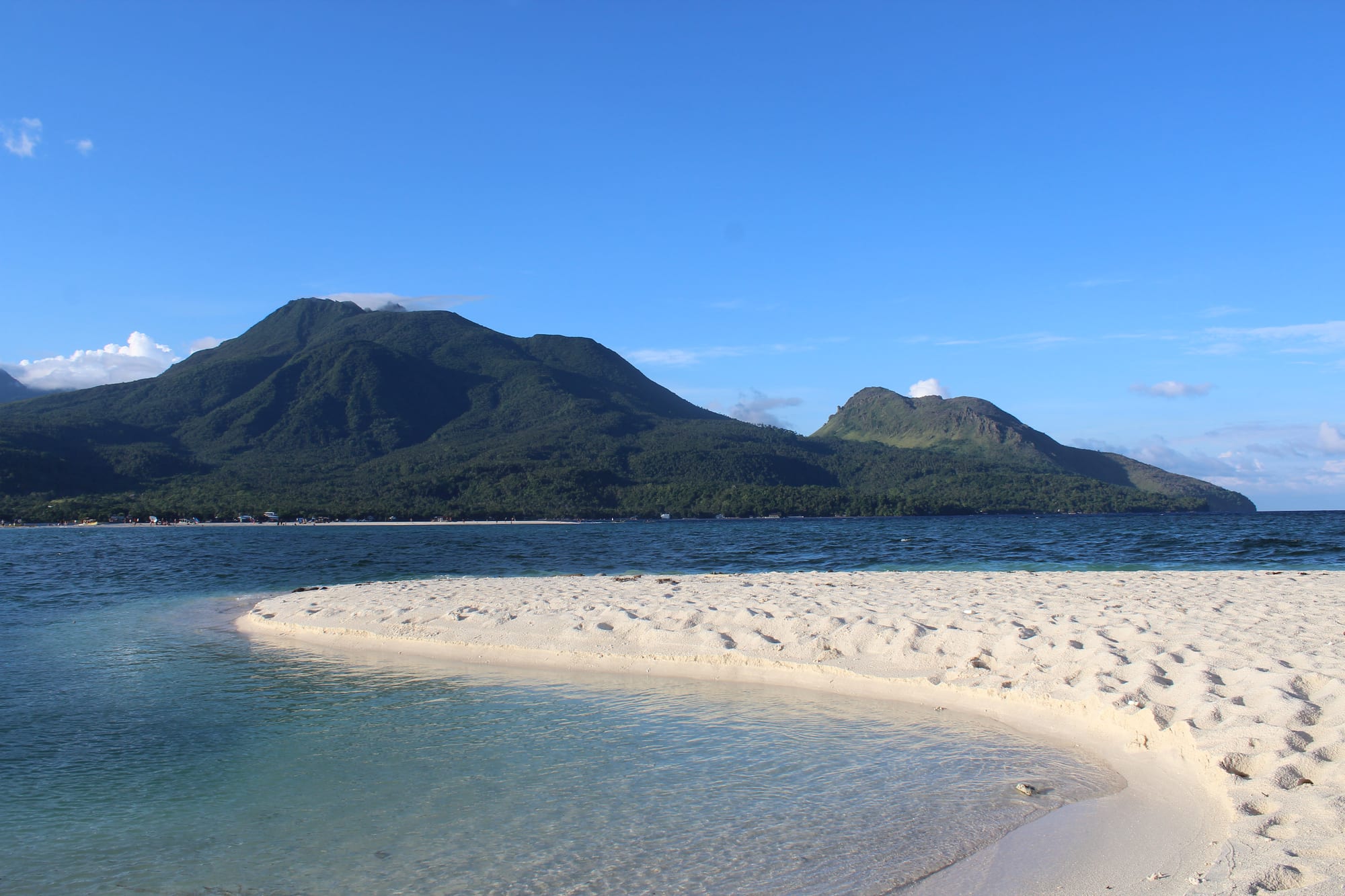
White sandbar and clear blue shallows in front of green forested volcanic peaks on an island under a blue sky

Philippines

Mindanao

Mount Hibok-Hibok and a smaller volcanic peak on Camiguin, seen from the White Island sandbar. (Wolfgang Hägele / Wikimedia Commons · CC BY-SA 4.0)

The large southern island of the Philippines and the archipelagos around it — home to the country's Muslim sultanates and Indigenous lumad peoples as well as generations of Christian settlers, with Davao, Mount Apo, Siargao and Camiguin in the calmer east and north, and a west and southwest shaped by a long conflict and a peace process in the Bangsamoro region.

Explore Mindanao

History

Mindanao's written history begins with trade. Butuan, on the north coast, was a trading port by around the 10th century, and the balangay boats excavated there were the first wooden watercraft excavated in Southeast Asia. Islam arrived through the Sulu islands, where a mosque at Simunul in Tawi-Tawi is traditionally dated to 1380, and the Sultanate of Sulu took shape in the 15th century, followed by the Sultanate of Maguindanao and the Maranao principalities around Lake Lanao. These states traded across the region, dealt with Borneo and the Dutch, and fought Spain for three centuries in the Moro wars; Spain built Fort Pilar in Zamboanga in 1635 but never controlled the Muslim south.

The United States subdued the sultanates by force, including the 1906 assault on Bud Dajo on Jolo, in which hundreds of Moro were killed, and then encouraged Christian settlers from Luzon and the Visayas to move south. Over the 20th century settlement turned Mindanao's population majority Christian and pushed the Moro and lumad peoples off much of their land.

That pressure, and the 1968 killing of Moro army recruits in the Jabidah massacre, fed the rise of the Moro National Liberation Front in the early 1970s and an armed conflict whose death-toll estimates vary widely. Autonomy deals in 1976 and 1996 were followed by the Moro Islamic Liberation Front's peace agreement of 2014 and the creation of the Bangsamoro Autonomous Region in 2019. Violence continued alongside: Abu Sayyaf kidnappings, the 2013 siege of Zamboanga City, and the five-month battle between government forces and Islamic State-affiliated militants for Marawi in 2017, which destroyed much of the city. Davao, meanwhile, became the political base of Rodrigo Duterte, its long-time mayor.

Culture & Customs

Mindanao has three broad communities. Christian settlers' descendants, mostly Cebuano-speaking, are the majority in most provinces. The Moro peoples — Maranao, Maguindanao, Tausug, Sama, Yakan and others — are Muslim and form the majority in Bangsamoro. The lumad, Indigenous non-Muslim groups such as the Manobo, Bagobo, T'boli, B'laan, Subanen and Higaonon, keep their own languages and customs in the uplands.

Moro arts are among the richest in the country: the kulintang gong ensembles, the Maranao singkil dance and the okir carving of scrolls and leaves on the old torogan houses, and the Tausug pangalay dance. Zamboanga City speaks Chavacano, a Spanish-based creole, and its sailboats, the vinta, carry colourful sails. The T'boli of Lake Sebu weave t'nalak, abaca cloth dyed in patterns said to come to weavers in dreams.

Religious life is mixed: mosques and Friday prayers in the Muslim areas, Catholic fiestas elsewhere. Davao's Kadayawan festival in August celebrates the harvest and the region's tribes, Camiguin's Lanzones festival marks the fruit harvest, and Bukidnon's Kaamulan festival brings its tribes together in Malaybalay. Respect for modest dress, halal food and Ramadan matters in the Muslim provinces.

Daily Life

About 27 million people live in Mindanao and its islands. Davao City, with around 1.8 million people across a large territory, is the south's commercial capital; Zamboanga City has around a million, Cagayan de Oro around 750,000, and General Santos, Butuan, Iligan and Cotabato City are the other main centres.

Mindanao is the country's plantation frontier. The Davao region exports bananas and other fruit, Bukidnon grows pineapples and corn on the plateau, General Santos lands much of the country's tuna, and coconut and rubber cover large areas. Siargao and Camiguin live increasingly on tourism.

The divides are sharp. Bangsamoro, long among the poorest parts of the country, is still rebuilding Marawi and demobilising former fighters, and its first parliamentary election, postponed four times, was finally held in September 2026; a 2024 Supreme Court ruling excluded Sulu province from the region. Davao, by contrast, is a large and growing commercial city. Land disputes involving lumad communities, and the displacement caused by conflict and floods, remain national issues.

Food

Mindanao has the widest range of cooking in the country. The Davao Region grows most of the country's durian, and its sinuglaw combines grilled pork belly with kinilaw, raw fish cured in vinegar. General Santos serves fresh tuna in every form, from kinilaw to grilled tuna jaw.

Moro cooking uses spices, coconut and chilli, and no pork. Maranao dishes are seasoned with palapa, a condiment of scallion, ginger, chilli and toasted coconut; the Tausug make tiyula itum, a black soup of beef coloured with burnt coconut, and pyanggang, chicken in a dark burnt-coconut sauce. Pastil, rice topped with shredded chicken or fish and wrapped in banana leaf, is a Maguindanao breakfast now sold across the south.

Zamboanga has satti, grilled meat skewers in a spicy sauce eaten with rice cakes, curacha, the spanner crab, often cooked in a rich Alavar coconut sauce, and knickerbocker, a fruit-and-ice-cream dessert. Camiguin is known for pastel, soft sweet-filled buns, and for its lanzones fruit.

Attractions & Natural Wonders

In the southeast, Davao City has People's Park, its fruit markets and the Philippine Eagle Center, with Samal Island across the gulf. Mount Apo, the highest mountain in the country, is one of its most popular climbs, and Davao Oriental has Mount Hamiguitan's UNESCO-listed forests. Further south, Lake Sebu in South Cotabato offers T'boli villages and weaving centres.

In the northeast, Siargao has Cloud 9's reef break, the islands of Naked, Daku and Guyam and, nearby, Sohoton Cove on Bucas Grande; on the mainland are Surigao del Sur's Enchanted River and Tinuy-an Falls, and Butuan's balangay sites. On the north coast, Cagayan de Oro has whitewater rafting and serves as the gateway to Camiguin — the sunken cemetery, hot springs and White Island — and to Bukidnon's plateau. Iligan has the Maria Cristina Falls.

Parts of the west are covered by foreign travel warnings, and fewer foreign visitors go. Zamboanga City has Fort Pilar, vinta sails and the pink-tinged sand of Great Santa Cruz Island, and Dapitan has the shrine and farm site where José Rizal spent four years in exile. The Bangsamoro region includes Marawi on Lake Lanao, Cotabato City's Grand Mosque, and in Tawi-Tawi the Sheikh Karimul Makhdum mosque.

Cities in Mindanao

Planning basics

Budget

Mindanao is inexpensive in general. Davao, Cagayan de Oro and General Santos have good-value hotels and food, and Camiguin is cheap. Siargao is the exception: its surf-town boom has pushed accommodation and food in General Luna to prices close to Boracay's in the high season.

Daily Budget Midrange
USD 65–140 (hotel or resort, restaurants, island tours, surf lessons or a guided climb)
Daily Budget Shoestring
USD 25–40 (guesthouse or dorm, local eateries, jeepneys, buses and ferries)

Carry cash on Siargao and Camiguin, where cash machines are few and can run out in busy periods.

Safety

Safety varies more across Mindanao than anywhere else in the country. Some foreign governments advise against travel to parts of western and central Mindanao and the Sulu Archipelago because of armed groups and past kidnappings for ransom. The rest of Mindanao, including Davao, Siargao, Camiguin and Cagayan de Oro, is much calmer. Natural hazards include typhoons in the northeast, floods and earthquakes.

Confirm exactly which provinces current warnings cover before going anywhere west of Davao and Cagayan de Oro, including Lake Sebu, the Zamboanga peninsula and the Sulu Archipelago. Check current official travel advice before travelling.

Climate

Most of Mindanao lies south of the main typhoon belt and has rain spread through the year rather than a sharp dry season, though it is not immune: Sendong in 2011, Pablo in 2012 and Odette in 2021 were all deadly. The Pacific coast from Siargao to Davao Oriental is wettest from about November to February. The Bukidnon plateau, Lake Sebu and the slopes of Mount Apo are noticeably cooler than the coast.

Summer
hot and humid, 26–33°C on the coasts, with frequent afternoon showers
Winter
warm, 24–31°C; heavier rain on the northeastern Pacific coast

Transportation

Davao has the main international airport; Laguindingan serves Cagayan de Oro, and Siargao, Camiguin, General Santos, Butuan, Zamboanga and Cotabato have their own airports with flights from Manila or Cebu. Ferries cross from Surigao to Siargao and from Balingoan, about two hours by bus from Cagayan de Oro, to Camiguin. Buses and vans link the cities, with Davao to General Santos a few hours by road and Lake Sebu reached from General Santos or Koronadal.

Fly between distant parts of Mindanao rather than crossing the island by road, which passes through areas covered by travel warnings.

Best Time to Visit

March to May is broadly the driest and calmest time for Siargao's lagoons, Camiguin and the east coast. Siargao's best surf season runs from about August to December. Davao's Kadayawan harvest festival is in August and Camiguin's Lanzones festival in October. Mount Apo is one of the country's most popular climbs; check current trail arrangements before planning.