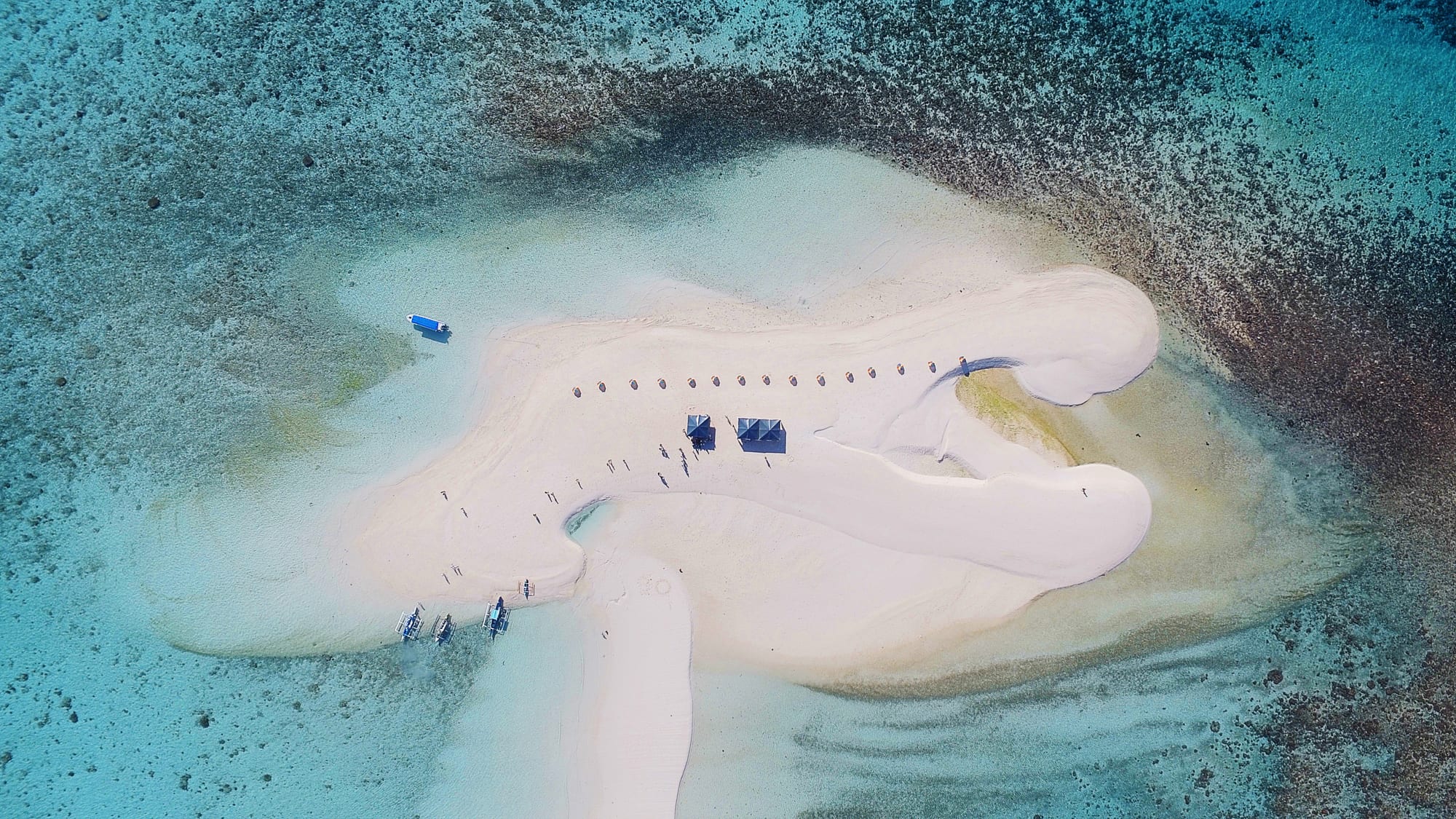
Aerial view of a bare white sandbar shaped like a star, ringed by pale shallows and turquoise water, with small boats and shade tents on the sand

Mindanao, Philippines

Camiguin

The White Island sandbar in the shallows off Camiguin, seen from the air. (Theglennpalacio / Wikimedia Commons · CC BY-SA 4.0)

A small volcanic island province in the Bohol Sea off the north coast of Mindanao, reached by ferry from Balingoan or by air. Volcanic cones rise from an island of about 240 square kilometres, and the eruptions that shaped it left hot and cold springs, a cemetery under the sea and a ring road past waterfalls, old church ruins and the White Island sandbar.

Neighbourhoods

  • Mambajao
    • First-time visitors
    • Transport connections
    • Best for food

    The island's capital and largest town, on the north coast, with the provincial offices, the market, the banks and the airport. Most shops, bakeries and eateries are here, and it is the usual base for anyone without their own transport.

    Open in Maps
  • Yumbing and Agoho
    • Beaches
    • Resorts
    • Diving and boat trips

    The resort strip a few kilometres west of Mambajao town, a line of small hotels and dive shops along a grey-sand shore. Boats to the White Island sandbar leave from here, and the beachfront restaurants are the closest thing the island has to a nightlife.

    Open in Maps
  • Catarman
    • Historic district
    • Quiet and residential
    • Waterfalls

    The south-western town, whose old settlement at Bonbon was destroyed when Mount Vulcan rose in the 1870s. The sunken cemetery, the ruins of the old stone church and a cold spring are all within a few kilometres of the modern town centre.

    Open in Maps
  • Mahinog and Benoni
    • Close to public transport
    • Quiet and residential

    The east-coast municipality where the ferries from the Mindanao mainland dock at Benoni. Boats to the small forested island of Mantigue leave from the same coast, and a lagoon beside the port is used for fish pens.

    Open in Maps
  • Guinsiliban and Sagay
    • Quiet and residential
    • Local life

    The two southern towns, the least visited part of the ring road. Guinsiliban keeps a Spanish-era watchtower above the shore, and the coast road between them runs past rice fields, coconut groves and fishing villages with the Bohol Sea on one side.

    Open in Maps

Things to do

Beaches and the sea

  • White Islandbeach

    An uninhabited horseshoe of white sand in the shallows off Agoho, with no shade or buildings, reached by outrigger boat and partly covered at high tide.

    Open in Maps
  • Mantigue Islandbeach

    A small island off the east coast with a forested interior, a sandbar and a reef wall, run as a nature park and reached by boat from Mahinog.

    Open in Maps

Volcanoes, springs and waterfalls

  • Mount Hibok-Hiboktrail

    The island's only active volcano, 1,332 metres high, whose eruptions between 1948 and 1951 killed thousands of people; the climb from Ardent is steep and usually done with a guide.

    Open in Maps
  • Katibawasan Fallsattraction

    A single ribbon of water falling around 75 metres into a cold pool in the forest above Mambajao, among ferns and orchids.

    Open in Maps
  • Ardent Hibok-Hibok Spring Resortattraction

    Pools of warm volcanic water on the lower slopes of Hibok-Hibok, the best known of the island's several hot springs.

    Open in Maps
  • Santo Niño Cold Springattraction

    A spring-fed swimming pool near Catarman where cold water rises through the sandy floor, shaded by trees and surrounded by picnic huts.

    Open in Maps

Historic sites

  • Sunken Cemeterylandmark

    The graveyard of old Catarman, submerged when the ground subsided during the eruptions of the 1870s, now marked by a large white cross on a platform offshore.

    Open in Maps
  • Old Bonbon Church Ruinslandmark

    The coral-stone walls and columns of the old Catarman church at Bonbon, left roofless by the same eruption and declared a National Cultural Treasure, standing among trees close to the shore.

    Open in Maps
  • Old Spanish watchtower, Guinsilibanlandmark

    A coral-block lookout above the southern coast, built in the Spanish period to watch for raiding boats crossing from the Bohol Sea.

    Open in Maps

Seasonal events

  • Lanzones Festivalthird weekend of October

    The island's harvest festival for the sweet lanzones fruit, with street dancing in costumes made from leaves and fruit in Mambajao.

  • Holy Week pilgrimageHoly Week, March or April

    A Holy Week walk in which people circle the island on the ring road overnight, stopping at churches and stations of the cross.

  • San Juan and town fiestasJune and through the year

    Each municipality keeps its patronal fiesta with Mass, processions, games and food shared in family houses.

Eat and drink

Long-standing places and food districts in Camiguin. Hours, ratings and directions come from your maps app, always current.

Camiguin classics

  • Pastel bakeriescafe

    Soft sweet buns filled with yema, a thick custard of egg yolk and milk, baked in Mambajao and sold boxed as a gift to take home.

    Open in Maps
  • Lanzones and island fruitmarket

    The fruit the island is famous for is sold in bunches in the market and at roadside stalls when the crop comes in around September and October.

    Open in Maps

Food districts and markets

  • Mambajao town centreneighborhood

    Small canteens, bakeries, barbecue stalls and a handful of restaurants around the market and the plaza, where most islanders eat.

    Open in Maps
  • Yumbing beachfrontneighborhood

    The resort strip west of town, where hotel kitchens and beachfront cafés serve grilled fish, kinilaw and Filipino staples alongside pizza and pasta for visitors.

    Open in Maps

Experience Camiguin

History

Camiguin's recorded history begins with Spanish settlement in the late sixteenth century, when missionaries and soldiers established themselves on an island already inhabited by Manobo and Kamigin people and raided from the sea. Small towns grew at Guinsiliban, Sagay, Catarman and later Mambajao around coral-stone churches and watchtowers, living on coconut, abaca and fishing while remaining a remote dependency of Misamis on the Mindanao mainland.

The island's defining events were volcanic. An eruption recorded in 1871 opened a new vent close to the old capital at Catarman: over the following years the mountain now known as Mount Vulcan built itself up, the town was destroyed and abandoned, and part of the coast subsided far enough to take the cemetery below sea level, leaving the church a roofless shell and the graves under the water. Survivors moved inland and along the coast, and Mambajao, on the northern shore, grew into the island's main port and eventually its capital, prosperous enough in the early twentieth century to leave a stock of wooden houses with wide eaves.

Hibok-Hibok erupted repeatedly in the late 1940s and, in December 1951, sent a searing flow down its northern slopes; more than three thousand people were killed in the sequence of eruptions from 1948, and thousands more left the island. An observatory run by the national volcanology institute has watched the mountain since. Camiguin was separated from Misamis Oriental and made a province in its own right in 1966, and tourism has grown steadily since the 1990s alongside farming and fishing.

Culture & Customs

Camiguin is Cebuano-speaking and overwhelmingly Catholic, and the parish calendar sets the rhythm of island life. The best-known expression of this is the Holy Week pilgrimage in which people walk the full circuit of the ring road overnight, praying at stations set along the coast — a devotion that draws returning islanders from Cagayan de Oro, Manila and abroad. Each of the five municipalities also keeps its own patronal fiesta, with a Mass, a procession, brass bands, basketball and tables of food in family houses.

The island's other great communal occasion is the Lanzones Festival in October, a harvest celebration for the small sweet fruit that grows well on volcanic soil. Dancers wear costumes made from leaves and fruit, and contingents from the towns compete in street dancing through Mambajao. Both events reflect a culture that is family-centred and outward-looking at once: many households depend on relatives working in the cities or overseas, and returns for fiesta and Christmas are a fixed part of the year.

Manners follow the wider Philippine pattern — indirect speech, the mano gesture of touching an elder's hand to one's forehead, titles rather than first names for older people, and an assumption that a visitor will be fed. Because the island is small and everyone is known, the informal social controls are strong, and visitors are noticed and greeted rather than ignored.

Daily Life

About 95,000 people live in Camiguin, making it the second-least populous province in the Philippines after Batanes, spread over five municipalities on an island of roughly 240 square kilometres. Mambajao holds the provincial capitol, the hospital, the banks, the schools and about a third of the population; the rest live in coastal barangays along the ring road, with a scatter of inland settlements on the volcanic slopes.

The economy rests on farming, fishing and tourism. Coconut, lanzones and other fruit, rice and vegetables grow on rich volcanic ground, and the lanzones crop is a significant part of the annual household income for many families. Fishermen work the Bohol Sea in outriggers, and the lagoon at Benoni supports fish pens. Tourism, concentrated on the resort strip west of Mambajao and on boat trips to the sandbar and Mantigue, now employs a large share of young islanders as guides, boat crew and resort staff, though it is seasonal and weather-dependent. Many families also live partly on money sent home from Cagayan de Oro, Manila or abroad.

The day starts early, with the market and the school run before the heat. Power and water supply, the reliability of ferry crossings, and pressure on reefs and beaches from growing visitor numbers are the recurring local issues, alongside the permanent business of living beside an active volcano on the Pacific Ring of Fire.

Food

Camiguin eats what the sea and the volcanic soil give it. Fish dominates: grilled over coals, simmered in a sour broth as sinigang, or served raw as kinilaw, cured in vinegar with onion, ginger and chilli. Squid, crab and shellfish appear alongside, and chicken or pork adobo, braised in vinegar, soy and garlic, is the standard alternative. Rice comes with everything, and cheap canteens known as carinderia serve several dishes from trays at the market and along the main road.

A local speciality is pastel, a soft bun filled with yema — a thick custard of egg yolk and condensed milk — baked in Mambajao and sold in boxes to take home. It is the usual gift brought back from the island, and the bakeries make versions with other fillings as well. The other export is lanzones, a small translucent fruit in clusters that is widely held to be sweeter here than elsewhere in the country; the harvest in September and October is celebrated with its own festival.

Sweet and starchy snacks fill the gaps between meals: rice cakes steamed in banana leaf, cassava and coconut puddings, halo-halo shaved ice with beans and fruit, and strong sweet coffee. Tuba, fermented coconut sap, is still drunk in the villages, while the resort strip pours beer and rum.

Planning tools

Budget

Camiguin is one of the cheaper island destinations in the Philippines. Guesthouses, canteen meals and a rented motorbike cost very little; the main variable costs are boat hire to White Island and Mantigue, entrance fees at the springs and falls, and a car or tricycle hired for a circuit of the ring road. Prices rise around the October festival and Holy Week.

Daily Budget Midrange
USD 65–140 (beach resort room, restaurant meals, private boat hire and island tours)
Daily Budget Shoestring
USD 25–40 (guesthouse or dorm, canteen meals, shared boats and a rented motorbike)

Cash machines are few and can run out at weekends and during festivals, so bring enough pesos from Cagayan de Oro or the mainland.

Best Time to Visit

March to May is generally the driest and calmest stretch for boats to the sandbar and for climbing. October brings the lanzones harvest and the festival, and Holy Week brings the island's pilgrimage and its busiest accommodation. Rain falls through much of the year, heaviest around November to February, when sea crossings are more often rough.

Suggested Number of Days

Two or three days cover the island at an easy pace, since the ring road is only about 65 kilometres. Divers, walkers and anyone climbing the volcano need longer, and ferry timings at each end usually absorb part of a day.

First Visit
2–3 days
With Surroundings
4–5 days

Transportation

A single paved road rings the island, and almost everything is on or just off it. Motorcycles with sidecars, called multicabs and tricycles, work as shared transport between the towns, and jeepneys run on the main routes. Most visitors rent a motorbike or hire a vehicle with a driver for the day, which is the simplest way to link the springs, falls and coastal sites.

Roads are narrow, unlit at night and shared with dogs and livestock; helmets and a licence are required for renting a motorbike.

Airport & Station Connections

Ferries cross to Benoni on the east coast from Balingoan in Misamis Oriental, about two hours by bus from Cagayan de Oro, and the crossing takes roughly an hour. Camiguin also has its own airport, near Mambajao, with flights from Manila or Cebu. Citizens of the EU, the UK, the US, Canada, Australia, New Zealand and many other countries enter the Philippines visa-free, usually for 30 days, with a passport valid for six months and an onward ticket; all arriving passengers register online through the government's eTravel form shortly before the flight.

Walkability

Mambajao's town centre, the market and the plaza are easily walked, and the resort strip at Yumbing and Agoho is a flat stroll along the shore. The island as a whole is not walkable: the waterfalls, springs and church ruins are kilometres apart on the ring road, with little shade and no pavement, so some form of transport is needed for everything beyond the immediate neighbourhood.

Safety

Camiguin is among the calmer parts of Mindanao, along with Davao, Siargao and Cagayan de Oro, and crime against visitors is uncommon. The real risks are natural and practical: Hibok-Hibok is an active volcano monitored by PHIVOLCS, the island sits in an earthquake zone, sea crossings are cancelled in bad weather, and most injuries involve rented motorbikes, slippery rocks at the waterfalls and strong currents off the sandbar.

Monitor PAGASA for storms, keep away from volcanic danger zones, take dengue precautions year-round, and do not travel to the Sulu provinces or the Zamboanga peninsula. Check current official travel advice before travelling.

Climate

Tropical, hot and humid all year, with rain spread through the calendar rather than falling in one season. The island lies south of the main path of the strongest typhoons but is not immune to them, and storms further north can still bring heavy rain and rough seas.

Summer
hot and humid, about 26–33°C from March to May, with afternoon showers and the calmest seas
Winter
warm, about 24–31°C from November to February, wetter and windier, with crossings more often cancelled

Local Customs

The island is Catholic and Cebuano-speaking, and Sunday Mass and town fiestas order the week and the year. Dress modestly in churches and cover up away from the beach and resort strip. Greeting people and asking before photographing someone's house, boat or child is expected, and older people are addressed with respect. Tipping is not required, though small amounts are appreciated by boat crews and guides.

Take nothing from the shore at White Island or Mantigue, where sand, shells and coral are protected, and ask permission before flying a drone near villages or the sunken cemetery.

Common Payment Methods

The currency is the Philippine peso. Resorts and a few larger businesses take cards, but most eateries, boatmen, tricycle drivers, market stalls and entrance gates are cash only. Cash machines are concentrated in Mambajao and can be empty in busy periods, so carry enough pesos for the whole stay.