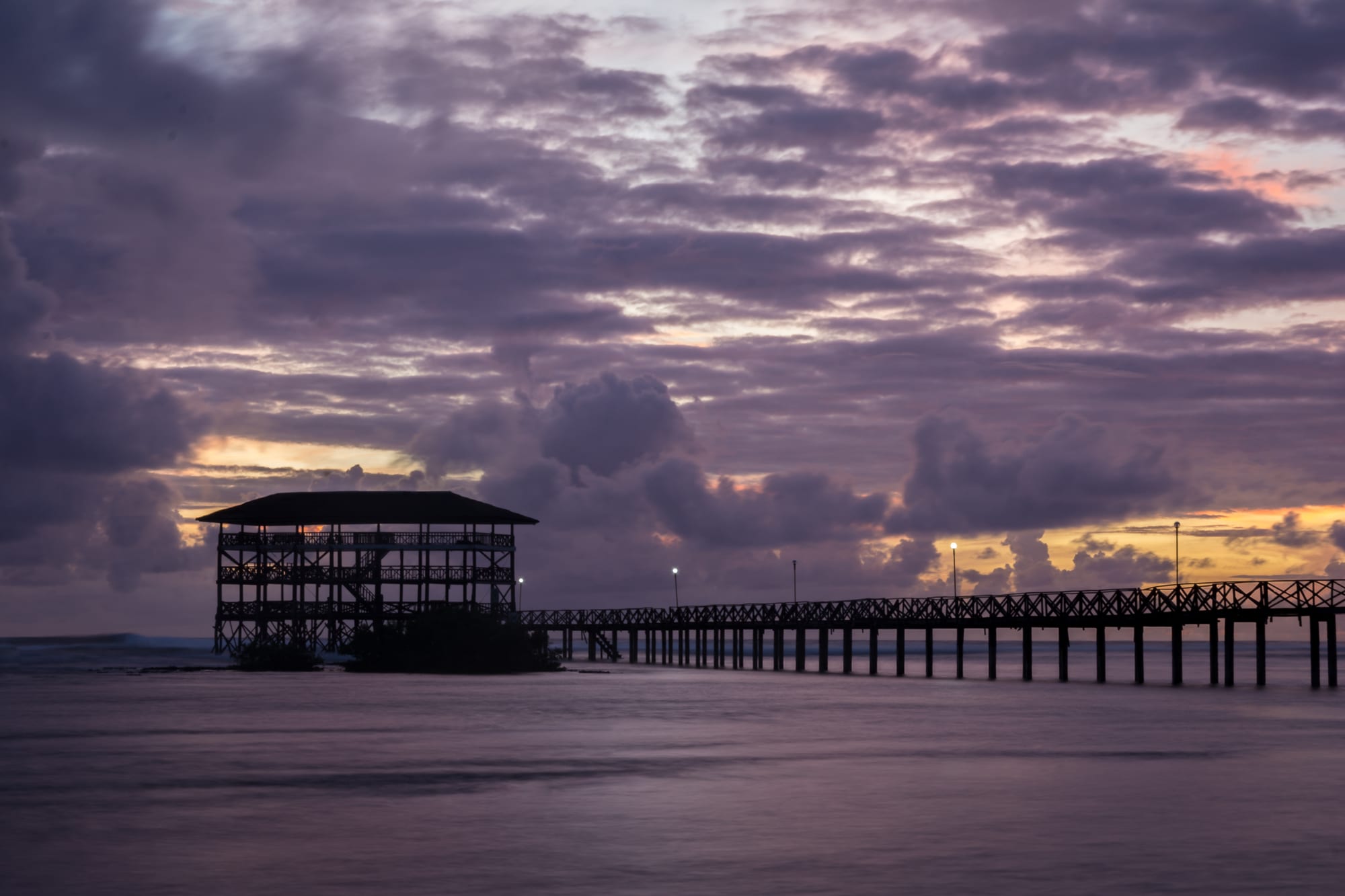
A long wooden boardwalk and tiered viewing tower silhouetted over the sea at dawn under purple and gold clouds

Mindanao, Philippines

Siargao

The boardwalk and viewing tower at the Cloud 9 surf break in General Luna, Siargao, at sunrise. (JupitReyes / Wikimedia Commons · CC BY-SA 4.0)

A low, teardrop-shaped island in Surigao del Norte, at the north-eastern corner of Mindanao where the Philippine Sea meets the archipelago. Coconut plantations cover most of it and mangroves line its west coast, while the reef off General Luna carries the Cloud 9 break that made the island a surfing destination from the 1980s. Fishing and copra still shape life away from the resorts.

Neighbourhoods

  • General Luna
    • First-time visitors
    • Surfing
    • Restaurants and nightlife

    The island's tourist town on the south-east coast, usually shortened to GL. Resorts, hostels, surf schools, restaurants and bars line the road towards Cloud 9 and the beachfront, and boats for the offshore islands leave from the pier here.

    Open in Maps
  • Cloud 9 and the east coast
    • Surfing
    • Sunrises
    • Quiet stays

    A few kilometres north of the town, where the reef break and its boardwalk sit among coconut palms. Accommodation thins out along the coast road towards Catangnan and beyond, with small breaks, quiet beaches and rice fields inland.

    Open in Maps
  • Dapa
    • Arriving by ferry
    • Markets
    • Practicalities

    The island's main port and commercial town, where ferries from Surigao City tie up. Banks, the market, hardware shops and cheap eateries make it the place islanders come to do business rather than a place visitors stay.

    Open in Maps
  • Del Carmen
    • Mangroves
    • Nature trips
    • Airport

    A west-coast municipality fronted by one of the largest mangrove forest reserves in Mindanao, with boardwalks and boat trips through the channels. The island's airport lies within it, at Sayak.

    Open in Maps
  • Pilar and the north
    • Rock pools
    • Away from the crowds
    • Local life

    The quieter northern half of the island, with tidal rock pools on the east coast, small fishing villages and long stretches of palm and rice. Roads are good but services are few, and most people visit for the day.

    Open in Maps

Things to do

Surf and the coast

  • Cloud 9attraction

    The reef break north of General Luna, with a boardwalk and viewing tower over the water, the wave that made the island's name and still its best known.

    Open in Maps
  • General Lunaneighborhood

    The main town, whose beachfront, pier and road to the break hold most of the island's places to stay, eat and learn to surf.

    Open in Maps
  • Pilarattraction

    A northern municipality whose shoreline at Magpupungko holds tidal pools and limestone rock formations, best visited when the water is low.

    Open in Maps

Lagoons, mangroves and islands

  • Del Carmen mangrovespark

    A protected mangrove forest of nearly 4,900 hectares on the west coast, crossed by boardwalks and boat channels and home to saltwater crocodiles.

    Open in Maps
  • San Isidroattraction

    A north-eastern municipality of surf villages and quiet beaches, with breaks that pick up the same swell as the south-east coast.

    Open in Maps
  • Bucas Grandeattraction

    A neighbouring island of limestone cliffs and hidden inlets, reached by boat from Siargao, known for its enclosed lagoons.

    Open in Maps
  • Socorroattraction

    The municipality covering Bucas Grande, whose Sohoton area of caves, lagoons and a tide-dependent rock entrance is the usual reason for the boat trip.

    Open in Maps

Around the island

  • Dapatransit hub

    The port town where ferries from the mainland arrive, with the island's biggest market and the road across to the east coast.

    Open in Maps
  • Santa Monicaattraction

    A northern town of rice fields and fishing villages, a quiet counterpart to the resort coast and a stop on the round-island road.

    Open in Maps

Eat and drink

Long-standing places and food districts in Siargao. Hours, ratings and directions come from your maps app, always current.

Food districts

  • Tourism Road, General Lunaneighborhood

    The strip between the town and Cloud 9 holds most of the island's restaurants, cafés and bars, from Filipino grills and rice plates to bakeries, coffee and international cooking aimed at long-staying surfers.

    Open in Maps
  • General Luna public marketmarket

    The town market, where fish, coconuts, bananas and vegetables are sold in the morning and carinderia stalls serve cooked food at local prices.

    Open in Maps
  • Dapa market and eateriesmarket

    The island's main market beside the port, the cheapest place to eat and the source of much of what the resorts cook.

    Open in Maps

Experience Siargao

History

Siargao was settled by fishing and farming communities long before Spanish administration reached it, and the island's coasts were exposed to the sea raids that shaped much of the region. Under Spain it was organised into small parishes around Dapa and the coastal towns, and for most of its recorded history it lived on copra — dried coconut flesh — with fishing and rice alongside. The plantations that cover the interior date from that trade, and the island remained a remote corner of Surigao del Norte, reached by slow boats from the mainland.

Surfing changed its fortunes. Travelling surfers reached the reef off Catangnan in the late 1980s, and an American photographer named the break Cloud 9 after a chocolate bar. A surfing competition, a boardwalk and viewing tower, and an article in Surfer magazine in 1993 followed, and by the 1990s the island had a modest circuit of surf camps. Sayak Airport opened the island to short flights, and from the 2010s growth accelerated sharply: hostels, resorts, restaurants and property development spread through General Luna, and Siargao became one of the best-known destinations in the country.

Growth brought strain, and so did the weather. In December 2021 Typhoon Odette struck the island directly, destroying much of its buildings, boats and trees and cutting power and communications for weeks; rebuilding took much of the following years. The island's debates since have turned on construction rules, water and waste, and how large a tourist economy a small island can carry without losing what people come for.

Culture & Customs

Two cultures share the island. One is Surigaonon and rural: Catholic, family-based and organised around the fishing calendar, the copra harvest, the barangay basketball court and the town fiesta, with karaoke carrying from houses in the evening and church on Sunday morning. The other is the surf and traveller culture of General Luna, international and young, which has produced its own year-round population of long-stayers, instructors, bar owners and returning visitors.

Surfing is the thread between them. Many of the island's best riders grew up in the coastal barangays and learned on borrowed boards; surf schools and board repair now support a large number of families, and competitions draw riders from across Asia. The etiquette at the reef breaks is taken seriously — locals have priority, and dropping in on another rider is the island's main social offence.

Away from the strip, manners are conservative and quiet. Elders are greeted first, modest dress is expected in villages, and the emphatic hospitality common across the Philippines applies here too: food is offered and refusing outright is awkward. The island is also environmentally self-conscious in a way that is unusual in the country. Bans on some single-use plastics, mangrove protection schemes and beach clean-ups are local causes, driven partly by residents who watched the reef and the shoreline change as the crowds grew.

Daily Life

Well over a hundred thousand people live across the island's municipalities, most of them in fishing and farming barangays rather than in the resort towns. Dapa is the commercial and transport centre, and General Luna, with around 25,000 residents, is where the tourist economy is concentrated. Copra remains the backbone of the rural interior, fishing supports the coasts, and rice is grown on the flat land in the north.

Tourism has reorganised much of the island's working life. Construction, housekeeping, guiding, boat crewing, scooter hire and hospitality now absorb many young people who would once have left for Cebu or Manila, and some have come back from those cities to work at home. It is seasonal, dependent on flights and weather, and its wages are uneven, so most households still keep land, a boat or a market stall.

The day begins before dawn for surfers and fishermen alike. Boats go out early, the markets are busiest by seven, the middle of the day is spent in the shade, and the evening belongs to the beachfront and the town plazas. The island's persistent problems are practical: an electricity supply that fails often, limited fresh water, rubbish collection struggling with the volume visitors bring, and health care that means a boat or a flight for anything serious. Storm preparedness is part of ordinary life since 2021.

Food

Fish is the foundation. Tuna, mackerel, squid and reef fish come in daily and are grilled over coals, fried, or made into kinilaw — raw fish cured in vinegar and calamansi with ginger, onion and chilli, which the region makes as well as anywhere in the country. Crab, prawns and sea urchin appear in season, and the standard accompaniment is rice, with a vinegar and chilli dipping sauce on every table.

Coconut is the other constant, as it is in the plantations that cover the island. Fish and vegetables are stewed in coconut milk, snacks and cakes are made with grated coconut and palm sugar, and buko, the young nut, is cut open and drunk cold in the heat. Tuba, coconut wine tapped from the palm, is the village drink. Across Mindanao sinuglaw — grilled pork belly combined with kinilaw — is a favourite, and it is served here too.

In General Luna the cooking has broadened with the visitors: bakeries, coffee bars, smoothie bowls, pizza and Asian and European menus line the road to Cloud 9, alongside Filipino canteens serving adobo, sinigang and silog breakfasts of garlic rice, egg and cured meat. The markets in Dapa and General Luna are where prices stay local, selling the morning catch, fruit, and the sticky rice and banana-leaf snacks eaten between meals.

Planning tools

Budget

Siargao is the most expensive part of Mindanao. Rooms, meals and drinks in General Luna cost far more than on the mainland and rise steeply in the surf season and over Christmas and New Year, while Dapa and the northern towns stay cheap. Surf lessons, board hire, island boat trips and scooter rental are the other regular costs.

Daily Budget Midrange
USD 65–140 (resort or guesthouse room, restaurants, a boat trip or surf lessons, scooter hire)
Daily Budget Shoestring
USD 30–50 (hostel bed or fan room, carinderia meals, shared scooter, occasional board hire)

Carry cash: machines are few, queues form and they can run out in busy periods, and many small places do not take cards.

Best Time to Visit

The surf season runs from about August to December, when the swell is most consistent and the island is busiest, and March to May is the driest and calmest time for the lagoons, the mangroves and island trips. The north-eastern coast is wettest from about November to February. Beginners often prefer the smaller waves outside the main season.

Suggested Number of Days

Three or four days cover the coast, a boat trip and the north of the island without rushing. Five to seven suit surfers, anyone adding the neighbouring islands, or visitors who want the slow pace the island is known for. Rain and tides can move plans, so a spare day helps.

First Visit
3–4 days
With Surroundings
5–7 days

Transportation

Scooters and motorbikes are how almost everyone moves around; the main roads are paved and the loop around the island is easily ridden in a day. Habal-habal motorbike taxis and tricycles run between Dapa, General Luna and the northern towns, and can be hired by the day with a driver. Boats from the General Luna pier serve the offshore islands and Bucas Grande.

Wet roads, sand on the tarmac and unlit stretches after dark cause frequent scooter injuries; check insurance and licence requirements before hiring, and wear a helmet.

Airport & Station Connections

Sayak Airport at Del Carmen, also known as Siargao Airport, takes domestic flights on small aircraft and is about an hour by road from General Luna. Ferries cross from Surigao City on the Mindanao mainland to Dapa, taking roughly two to three hours depending on the vessel, with vans meeting the boats. Sailings and flights are cancelled in rough weather, so tight onward connections are unwise.

Walkability

General Luna's centre and beachfront are walkable, and the boardwalk area at Cloud 9 is small, but the two are several kilometres apart on a road with no footpath and little light at night. Everything else on the island is far enough apart to need wheels. Walking is for the beaches, the mangrove boardwalks and the rock pools.

Safety

Siargao is calmer than the parts of Mindanao covered by travel warnings, and crime against visitors is mostly opportunistic theft. The real dangers are the reef and the road: shallow coral under the breaks, strong currents and rips, and a high rate of scooter accidents. Saltwater crocodiles live in the mangrove areas. The island lies in a typhoon-exposed corner of the country and was badly damaged by Typhoon Odette in 2021.

Surfers should stay within their level and take local advice about the reef and tides, riders should go slowly and wear a helmet, and local guidance about where not to swim near mangroves is worth following. Monitor PAGASA for storms, keep away from volcanic danger zones, take dengue precautions year-round, and do not travel to the Sulu provinces or the Zamboanga peninsula. Check current official travel advice before travelling.

Climate

Hot and humid all year, with rain spread through the calendar rather than falling in a single wet season. The Pacific-facing coast is wettest from about November to February, and March to May is the driest and calmest stretch. Sea temperatures stay warm enough to surf and swim without a wetsuit.

Summer
hot and humid, about 26–33°C, with frequent short afternoon showers
Winter
warm, about 24–31°C, with the heaviest rain and biggest swell of the year

Local Customs

The language is Surigaonon, close to Cebuano, and English is widely spoken in the tourist towns. The island is Catholic and rural, and beyond General Luna it is conservative: swimwear belongs on the beach, and shoulders and knees are covered in villages and churches. Surf etiquette matters at the breaks, where local riders have priority and dropping in causes real offence.

Permission is asked before photographing people, homes or fishing boats; tipping is not expected but is appreciated by guides, boat crews and drivers; rubbish is best carried out, as the island's waste system is overstretched.

Common Payment Methods

The currency is the Philippine peso. Larger resorts and some restaurants take cards and mobile payments, but most guesthouses, boats, scooter hire, markets and small eateries are cash only. Cash machines are concentrated in Dapa and General Luna, charge fees and have low limits, and many visitors bring pesos from the mainland.