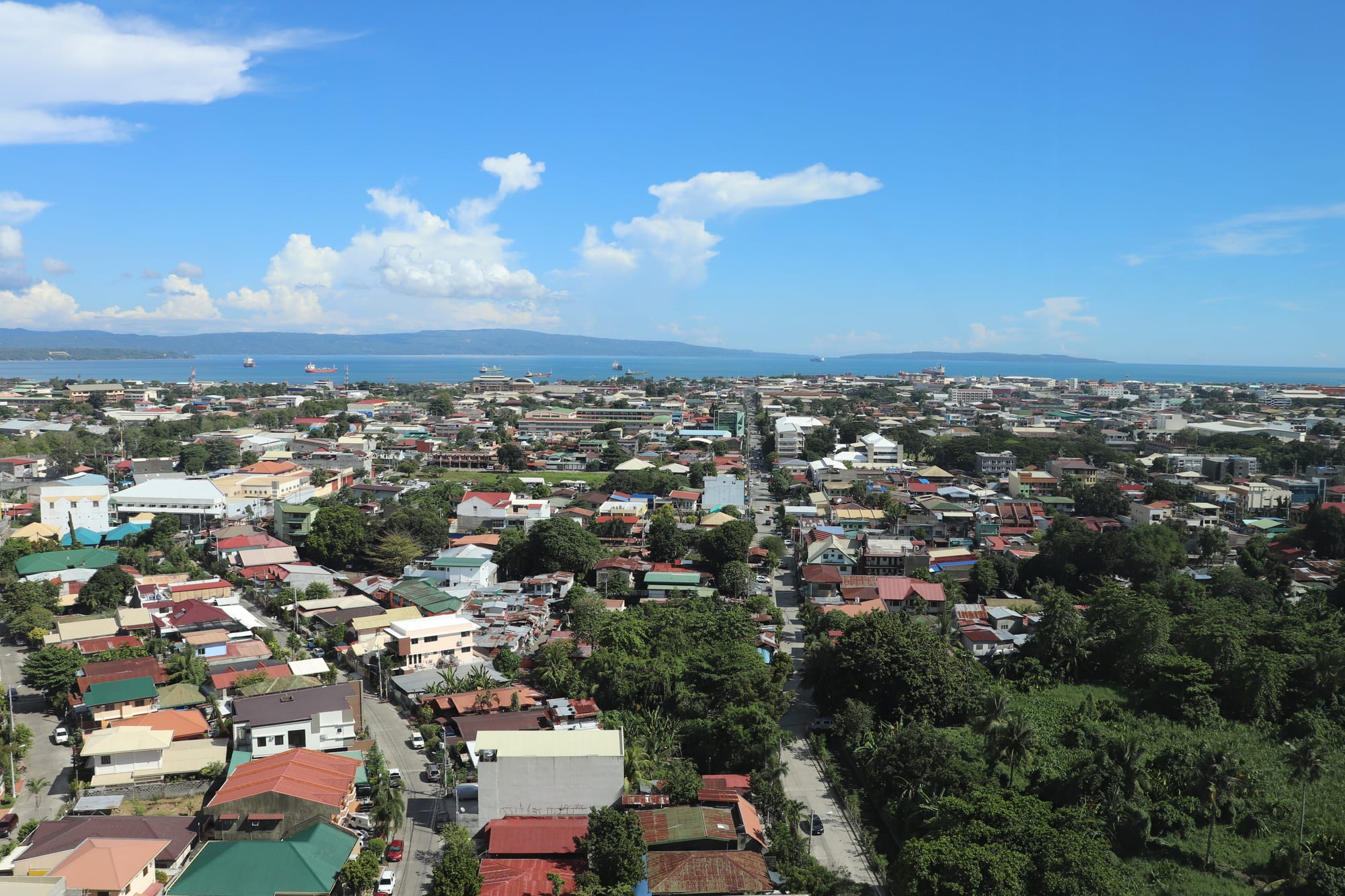
A wide view over low red and green rooftops and palm trees in Davao towards ships on the blue gulf and distant hills

Mindanao, Philippines

Davao City

Davao City looking south-east across the low-rise districts towards the Davao Gulf. (Teemu Väisänen / Wikimedia Commons · CC BY-SA 4.0)

The commercial capital of southern Mindanao, spread over a very large territory on the Davao Gulf beneath Mount Apo, the highest mountain in the Philippines. Settled in the 19th century and developed by planters, it grew into a city of migrants from across the archipelago and now exports bananas and other fruit. It is known nationally for durian, for the Philippine Eagle Center and as the political base of the Duterte family.

Neighbourhoods

  • Poblacion and the downtown
    • First-time visitors
    • Historic district
    • Markets

    The old centre near the port, around San Pedro Street, the cathedral and Magsaysay Park. Government offices, older hotels, department stores, the main market and the durian stalls are here, and it is the busiest and least polished part of the city.

    Open in Maps
  • Lanang
    • Hotels and resorts
    • Waterfront
    • Business travellers

    The coastal strip north of the centre along the highway, with the airport close by, large hotels, a convention centre, malls and the terminal for boats to Samal. Quieter and greener than downtown, and the usual base for conferences.

    Open in Maps
  • Matina
    • Restaurants
    • Mountain views
    • Residential

    A southern district of subdivisions, universities, restaurants and shopping centres, rising towards the hills above the city, which give views over the gulf and out to Mount Apo on clear mornings.

    Open in Maps
  • Agdao and Buhangin
    • Local life
    • Markets
    • Transport

    Dense residential districts north and east of the centre, built around markets and jeepney routes. There is little for visitors beyond everyday city life and food, but this is where much of Davao actually lives.

    Open in Maps
  • Toril and the south
    • Quiet and residential
    • Nature trips
    • Close to Mount Apo

    A large district towards the city's southern edge, part suburban and part agricultural, with fruit farms and the road towards the Mount Apo foothills. Distances here are considerable, roughly fifteen kilometres from downtown.

    Open in Maps
  • Calinan and Baguio districts
    • Nature trips
    • Farms and gardens
    • Day trips

    The upland inland part of the city's territory, cooler and rural, with plantations, orchid and butterfly gardens and the Philippine Eagle Center. It is more than twenty kilometres from downtown but still inside the city limits.

    Open in Maps

Things to do

Wildlife and gardens

  • Philippine Eagle Centerattraction

    A conservation and breeding centre in the uplands of the city, caring for Philippine eagles and other native birds and mammals in forested enclosures.

    Open in Maps
  • Davao Crocodile Parkattraction

    A crocodile farm and wildlife park in the city, with saltwater crocodiles, birds and reptiles, long one of the city's standard family outings.

    Open in Maps
  • Malagos Garden Resortattraction

    A garden and farm estate in the same upland district as the eagle centre, known for its orchids, birds and locally made chocolate.

    Open in Maps

Parks, churches and museums

  • People's Parkpark

    A landscaped park in the centre of the city, with sculptures representing Mindanao's Indigenous peoples, a dancing fountain and shaded walks.

    Open in Maps
  • San Pedro Cathedrallandmark

    The metropolitan cathedral downtown, first built in 1847 and rebuilt since in a plain modern form.

    Open in Maps
  • Magsaysay Parkpark

    A waterfront park near the port, with a promenade along the gulf and the fruit stalls that made the surrounding blocks the city's durian centre.

    Open in Maps
  • Davao Museum of History and Ethnographymuseum

    A museum in Lanang holding textiles, carvings, weapons and instruments of the region's lumad and Moro communities.

    Open in Maps

Markets

  • Bankerohan Public Marketmarket

    The city's principal market beside the Davao River, selling fruit, fish, meat and vegetables in bulk from dawn.

    Open in Maps

Short trips from the city

  • Mount Apotrail

    The highest mountain in the Philippines, about forty kilometres south-west of the centre, climbed over several days from trailheads in the surrounding towns, and climbs have to be arranged well in advance.

    Open in Maps
  • Samalattraction

    The island city across the gulf, reached by a short ferry crossing from the city, with beaches, resorts and a large bat cave.

    Open in Maps
  • Eden Nature Parkpark

    A mountain resort and garden in the city's uplands, cool and pine-planted, with walks and views over the gulf.

    Open in Maps
  • Davao Riverattraction

    The river that runs through the city from the highlands to the gulf, and the source of the city's name.

    Open in Maps

Seasonal events

  • KadayawanAugust

    The city's main festival, a thanksgiving for the harvest and a celebration of Davao's Indigenous peoples, with street dancing, floral floats and fruit displays.

  • Araw ng DabawMarch

    The city's charter anniversary, marked with parades, civic events, sport and concerts through the week around it.

  • Durian seasonroughly August to October

    The peak of the harvest, when durian is piled on stalls along the roadsides and around Magsaysay Park at its cheapest.

  • Christmas seasonDecember

    Lights, lantern displays and late-night shopping across the city, with public New Year celebrations shaped by the city's long-standing restrictions on fireworks.

Eat and drink

Long-standing places and food districts in Davao City. Hours, ratings and directions come from your maps app, always current.

Davao classics

  • Durian stalls near Magsaysay Parkmarket

    Rows of vendors selling fresh durian by the kilo in season, along with dried durian, candy and the city's other fruit — the classic introduction to the city's signature crop.

    Open in Maps
  • Sinuglawrestaurant

    The southern Mindanao combination of grilled pork belly with kinilaw, raw fish cured in vinegar, served in grill houses across the city.

    Open in Maps

Markets and food districts

  • Bankerohan Public Marketmarket

    The main market, where the day's fish, tropical fruit and vegetables arrive from the region and cooked-food stalls feed traders from early morning.

    Open in Maps
  • Roxas Avenue night marketneighborhood

    An evening street market downtown with grilled skewers, seafood, rice meals and cheap goods, one of the city's long-standing night-time gatherings.

    Open in Maps
  • Poblacion restaurants and cafésneighborhood

    A concentration of restaurants, bars and cafés near the centre, covering Filipino, Chinese, Japanese and Korean cooking.

    Open in Maps
  • Seafood grills along the gulfneighborhood

    Grill houses along the coast road and in Lanang serving tuna jaw, prawns, squid and reef fish from the gulf and from General Santos.

    Open in Maps

Experience Davao City

History

The Davao Gulf was home to Indigenous peoples — Bagobo, Mandaya, Manobo, Ata and others, alongside Muslim communities along the coast — long before any town existed. In 1848 an expedition led by José Oyanguren took the settlement of the datu Bago at the river mouth for Spain, and a small Christian town was founded on the site, named Nueva Vergara before reverting to Davao, though Spanish control remained thin.

The American period reshaped it. Plantations of abaca — Manila hemp — drew capital and labour, and by the 1930s Davao held a large Japanese community, thousands strong, that dominated the abaca trade and gave the town the nickname Davaokuo. That community was interned or repatriated after the Second World War, during which Davao was occupied early and bombed heavily before liberation. Migrants then poured in from the Visayas and Luzon, encouraged by government settlement schemes, and Davao became a charter city in 1937.

The later 20th century was violent. Communist insurgency and counter-insurgency made parts of the city dangerous in the 1980s, and vigilante groups formed in response. Rodrigo Duterte, first elected mayor in 1988, held the office for most of the next three decades and built a national reputation on strict local rules and a hard line on crime that human rights groups linked to extrajudicial killings; he was elected president in 2016. A bombing at the Roxas Avenue night market in September 2016 killed more than a dozen people and led to a prolonged state of emergency. Since then the city has grown as Mindanao's commercial hub. In March 2025 Duterte was arrested on an International Criminal Court warrant over killings during the drug war and transferred to The Hague, and thousands marched in Davao in protest.

Culture & Customs

Davao calls itself a city of many peoples, and the claim is grounded. Cebuano is the common language, but its neighbourhoods hold families from every region of the country, alongside eleven Indigenous groups — lumad and Moro — recognised by the city, each with a seat in local governance arrangements. Kadayawan, held every August, is the expression of this: a harvest thanksgiving that has become a celebration of those communities, with street dancing in tribal dress, floral floats and fruit displays filling the centre.

Life here is more ordered than in most Philippine cities, a legacy of decades of strict local ordinances: no smoking in public, a night-time liquor ban, speed limits enforced on the highways, and restrictions on firecrackers that make New Year notably quieter than elsewhere. Residents are generally proud of this, and visitors notice the difference quickly.

Otherwise the culture is recognisably Mindanaoan and Filipino. Catholic parishes organise fiestas and Christmas, mosques serve the Muslim districts, and both calendars are publicly acknowledged. Basketball courts, karaoke, malls and family Sundays fill the social week, and food is the city's favourite subject — durian above all, which Dabawenyos treat as a test of character for outsiders. Politics is followed closely and discussed frankly, though the Duterte family's long dominance of the city remains a sensitive topic with visitors.

Daily Life

Around 1.8 million people live in Davao, spread across a territory of more than two thousand square kilometres — the largest city territory in the Philippines by land area — so that plantations, forest and mountain villages sit inside the same jurisdiction as the downtown. Most residents live in the coastal districts between Toril in the south and Buhangin in the north, and commuting across the city is a long daily business by jeepney or motorbike.

The economy rests on agriculture and trade. The Davao region exports bananas, pineapples, cacao, coconut and durian, the port handles much of Mindanao's shipping, and the city is the region's centre for banking, hospitals, universities and a growing outsourcing sector. Construction has been steady, and malls have become the default public space in the heat.

The day starts before dawn at the markets and on the plantation roads, slows through the middle hours, and picks up again in the evening around food stalls, courts and shopping centres. The city's own concerns are traffic on a road network built for a smaller place, flooding along the river and creeks after heavy rain, water supply, and the balance between a booming fruit trade and the land rights of lumad communities in the uplands. Security checks at entrances are a routine part of the day and barely remarked on.

Food

Davao is a fruit city first. Durian is its emblem, sold in season around Magsaysay Park and along the highways, eaten fresh or turned into candy, ice cream, jam and pastries; pomelo, mangosteen, marang, lanzones and rambutan come from the same orchards, and the region is the country's main source of Cavendish bananas. Malagos and the upland farms have also made Davao a centre for Philippine cacao and chocolate, sold as bars and as tablea for hot drinks.

Seafood from the gulf and from General Santos defines the grill houses: tuna in every form, including the grilled jaw, along with prawns, squid and reef fish. The regional dish is sinuglaw, a combination of grilled pork belly and kinilaw — raw fish cured in vinegar with ginger, onion and chilli — eaten as a starter or with beer. Kinilaw on its own is treated with some seriousness here, judged by the freshness of the fish and the balance of the sour.

Everyday eating is Cebuano and Filipino: adobo, sinigang, grilled chicken and pork on skewers with rice, and silog breakfasts of garlic rice, egg and cured meat. Muslim communities have brought Maranao and Maguindanao cooking to the city, so pastil — rice with shredded chicken or fish wrapped in banana leaf — and dishes seasoned with palapa, the condiment of scallion, ginger, chilli and toasted coconut, are widely sold. Halal restaurants are easy to find, and the night market on Roxas Avenue is where most of it meets in one place.

Planning tools

Budget

Davao is one of the better-value large cities in the country. Hotels cost less than their equivalents in Manila or Cebu, eating out is cheap, and jeepney fares are small. The main extra costs are taxis or ride-hailing across a very large city, the boat and resort prices on Samal, and a guided Mount Apo climb. Rooms tighten during Kadayawan in August.

Daily Budget Midrange
USD 65–140 (city hotel, restaurants, taxis or ride-hailing, day trips to Samal or the uplands)
Daily Budget Shoestring
USD 25–40 (guesthouse or dorm, market and canteen meals, jeepneys)

Book well ahead for the Kadayawan week in August, when hotel rates rise and the central streets are closed for the parades.

Best Time to Visit

Davao has no sharp dry season, so timing is about events and fruit rather than weather: August brings Kadayawan and the height of the durian harvest, and March has the city's charter celebrations. March to May is broadly the driest and calmest period for the gulf and for climbing, and the city sits south of the main typhoon belt, though it is not immune.

Suggested Number of Days

Two or three days are enough for the city itself, which is spread out and takes time to cross. Four to six allow the island across the gulf and the upland districts as well. A multi-day mountain climb needs several additional days and its own preparation.

First Visit
2–3 days
With Surroundings
4–6 days

Transportation

The city covers a very large area, and distances are the defining fact of getting around. Jeepneys and modern minibuses run fixed routes between the districts, taxis are metered and plentiful, and ride-hailing works well; tricycles and habal-habal motorbikes handle short local trips. Buses and vans to General Santos, Cagayan de Oro and the provinces leave from the terminals north of the centre, and ferries to Samal run from Lanang and the southern coast.

Allow far longer than the distance suggests at the start and end of the working day, and agree on the meter or use an app rather than a negotiated fare.

Airport & Station Connections

Francisco Bangoy International Airport is in Buhangin, about eight kilometres north-east of downtown, with frequent flights from Manila and Cebu and some international services; it is the main gateway to Mindanao. Buses connect the city with General Santos in a few hours and with Cagayan de Oro in considerably longer, and ferries link the port with other islands. Flying between distant parts of Mindanao is usually preferred to long road journeys.

Walkability

Downtown Davao can be walked — the cathedral, the market, People's Park and the waterfront are within a kilometre or so of each other — but pavements are uneven, shade is scarce and the heat is constant. Beyond the centre the city is built for vehicles, with districts kilometres apart along busy highways, so walking is for a single neighbourhood rather than for getting around.

Safety

Safety varies more across Mindanao than anywhere else in the country. Some foreign governments advise against travel to parts of western and central Mindanao and the Sulu Archipelago because of armed groups and past kidnappings for ransom. The rest of Mindanao, including Davao, Siargao, Camiguin and Cagayan de Oro, is much calmer. Davao itself is a strictly policed city with bag checks at malls and terminals, a speed limit and a long-standing public smoking ban; petty theft, traffic and flash flooding after heavy rain are the everyday concerns, and dengue is present year-round.

Confirm exactly which provinces current warnings cover before going anywhere west of Davao and Cagayan de Oro, including Lake Sebu, the Zamboanga peninsula and the Sulu Archipelago. Monitor PAGASA for storms, keep away from volcanic danger zones, take dengue precautions year-round, and do not travel to the Sulu provinces or the Zamboanga peninsula. Check current official travel advice before travelling.

Climate

Hot and humid throughout the year, with rain spread fairly evenly rather than concentrated in one season, and afternoon showers common. The city is sheltered by mountains and lies outside the usual typhoon tracks, which is why it is often described as one of the safest places in the country for weather. The uplands towards Mount Apo are markedly cooler.

Summer
hot and humid, about 26–33°C, with frequent short afternoon showers
Winter
warm, about 24–31°C, with somewhat heavier rain in places

Local Customs

Cebuano, usually called Bisaya, is the everyday language, with Filipino and English widely used, and Davao's population includes lumad and Moro communities as well as settlers from every part of the country. City rules are enforced more strictly than elsewhere: smoking is banned in public places, there is a liquor ban late at night, and firecrackers are heavily restricted. Durian is not allowed in many hotels and on public transport because of the smell.

Dress modestly in mosques and in Muslim neighbourhoods, ask before photographing people in traditional dress at festivals, and expect bag inspections at mall and terminal entrances.

Common Payment Methods

The currency is the Philippine peso. Malls, hotels and larger restaurants take cards and mobile wallets, while jeepneys, markets, street food and small eateries are cash only. Cash machines are widespread in the city but scarce in the upland districts and on the island across the gulf, so cash is worth carrying for day trips.