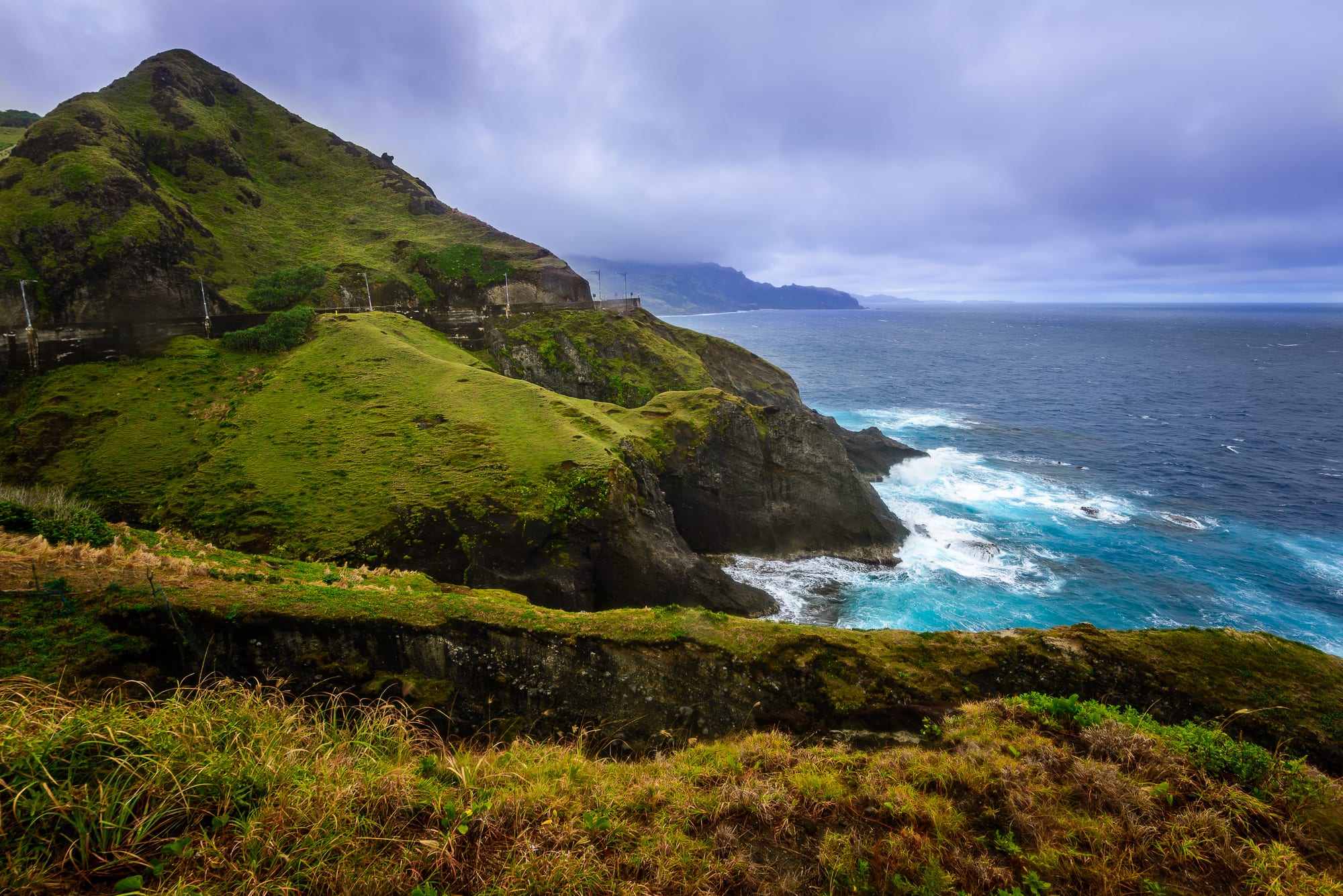
Green grassy hills ending in dark rocky cliffs above a turquoise sea with white surf, under a heavy grey sky

Philippines

Northern Luzon

Grassy hills and sea cliffs on the wind-swept coast of Batanes, the Philippines' northernmost province. (EdseastresD600 / Wikimedia Commons · CC BY-SA 4.0)

The northern third of Luzon, from the Ilocos coast across the pine-covered Cordillera to the Cagayan valley and out to the Batanes islands — a region of Ifugao rice terraces, highland peoples who largely resisted Spanish rule, Ilocano farming towns and the colonial streets of Vigan.

Explore Northern Luzon

History

The Cordillera's peoples — Ifugao, Bontoc, Kankanaey, Ibaloi, Kalinga and others — farmed their valleys in terraces long before Europeans arrived; how old the terraces are is still debated, with some researchers arguing that many were built within the last few centuries. Spain never fully controlled the mountains, and the highlanders kept their own law, religion and feasting traditions. The lowlands were another story. Juan de Salcedo explored the Ilocos coast in 1572, and Vigan became the seat of Spanish power in the north, growing rich on trade and, from 1782, on the tobacco monopoly that forced farmers in Ilocos and the Cagayan valley to grow the crop for the state.

The Ilocos produced repeated revolts: Diego Silang rose in 1762–63 and, after his assassination, his widow Gabriela Silang fought on; the Basi Revolt of 1807 broke out when Spain restricted the local sugarcane wine. Under American rule the Cordillera was opened by roads and missions, and Baguio was laid out from 1904, partly to a plan by the architect Daniel Burnham, as the colonial summer capital.

In the Second World War General Yamashita made his last stand in the Cordillera, holding out until he surrendered at Kiangan on 2 September 1945. The region later gave the country its most famous Ilocano, Ferdinand Marcos, born in Sarrat, Ilocos Norte, and during his rule Cordillera and Kalinga communities fought the Chico River dam project, which was shelved in the 1980s. The 1990 Luzon earthquake devastated Baguio. Batanes, the islands closest to Taiwan, has taken on new strategic weight in recent years.

Culture & Customs

Ilocano is the region's common language, spoken across the Ilocos, the Cagayan valley and in lowland parts of the Cordillera, with Ibanag and Itawes in Cagayan, Ivatan in Batanes, and many Cordillera languages in the mountains. Ilocanos have a reputation, which they enjoy, for thrift and hard work, and large numbers emigrated to Hawaii and California from the early 20th century.

Cordillera identity is distinct and proudly kept. Many families are Christian yet continue older rites: the cañao, a feast with animal sacrifice marking weddings, harvests and deaths, and burial customs such as Sagada's hanging coffins. The Ifugao carve bul-ul rice-god figures and chant the Hudhud, epic songs recognised by UNESCO as intangible heritage. Gongs called gangsa are played at festivals, and Kalinga women weave and wear striped textiles; the village of Buscalan in Kalinga is known for its traditional hand-tapped tattooing.

In the lowlands, town fiestas, Holy Week processions and the old Spanish churches set the calendar. Baguio's Panagbenga flower festival fills February with parades, and Vigan holds its own heritage festivals. In Batanes the Ivatan built low stone houses with thick lime walls and thatched roofs against typhoons, and women still use the vakul, a headgear of palm fibre that shields against sun and rain.

Daily Life

About 5 million people live in the Ilocos Region, fewer in Cagayan Valley and under 2 million in the Cordillera. Baguio, with around 370,000 people, is the mountains' city, a university and retirement town famous for its cool weather and traffic; Tuguegarao, Santiago and Cauayan anchor the Cagayan valley; Laoag, Vigan, San Fernando in La Union and Dagupan the coast.

Farming dominates. The Cagayan valley grows rice and corn, Ilocos grows tobacco, garlic and vegetables, and Benguet's terraced highland farms around La Trinidad supply much of the country's cabbage, carrots and strawberries. Baguio lives on education, tourism and an export-processing zone, and remittances from Ilocanos abroad support many households.

Life in the mountains follows the rice cycle and the market day, and young people increasingly leave for Baguio, Manila or overseas, leaving terraces untended in some villages. Road building, mining and dam proposals regularly set local communities against government and companies, and the rising number of weekend visitors in Baguio and Sagada has brought water shortages and debates over limits.

Food

Ilocano cooking is thrifty, vegetable-heavy and salted with bagoong, fermented fish paste. Pinakbet stews squash, eggplant, okra and bitter melon with bagoong; dinengdeng is a lighter vegetable broth; poqui-poqui is smoky grilled eggplant scrambled with egg. Bagnet, pork belly boiled then deep-fried until the skin blisters, is the famous meat, and Vigan longganisa is a small garlicky sausage. The Vigan and Batac empanada is a pastry filled with egg and longganisa, fried to order and eaten with sukang Iloko, sugarcane vinegar. Basi, a wine fermented from sugarcane, is the traditional drink.

The Cordillera eats plainly and well: pinikpikan, a chicken soup whose preparation involves beating the bird before cooking, sometimes flavoured with etag, salted and cured pork; heirloom varieties of highland rice; and tapuy, rice wine. Benguet and Sagada grow arabica coffee, Baguio's market sells strawberries from nearby La Trinidad, and its markets sell highland vegetables cheaply.

In the Cagayan valley, Tuguegarao's pancit batil patong is a noodle dish topped with minced carabao meat, liver and a poached egg. Batanes cooking uses what the islands grow: uvud, the pith of the banana stem, served with palek wine at festive occasions.

Attractions & Natural Wonders

The Cordillera is the centre of gravity. In Ifugao, the town of Banaue overlooks its rice terraces, and a walk from the road reaches the amphitheatre of Batad, with the Tappiya waterfall below; Batad, Bangaan, Mayoyao, Hungduan and Nagacadan make up the UNESCO World Heritage Site of the Rice Terraces of the Philippine Cordilleras. Sagada, in Mountain Province, has the hanging coffins of Echo Valley, burial caves and the caving route through Sumaguing. Baguio offers Burnham Park, Session Road, Camp John Hay, and the Mines View viewpoint, with strawberry farms at La Trinidad, and Mount Pulag, the highest peak in Luzon, rises on the Benguet border.

On the Ilocos coast, Vigan's Calle Crisologo and its mestizo quarter are a UNESCO World Heritage Site, and the churches of Paoay and Santa Maria are among the Baroque Churches of the Philippines. Further north lie Laoag, Batac's Marcos museum, the Cape Bojeador lighthouse, the white rock of Kapurpurawan, the Bangui wind farm and the beaches of Pagudpud. La Union's San Juan is the north's surf town, and Pangasinan has the Hundred Islands National Park off Alaminos.

The Cagayan valley follows the Cagayan River, the country's longest, through Isabela and Cagayan; near Tuguegarao are the Callao Cave, where the fossils of Homo luzonensis were found, and Palaui Island lies off the northern tip. Far offshore, Batanes has Basco beneath Mount Iraya, rolling pasture on its headlands, and the stone villages of Sabtang.

Cities in Northern Luzon

Planning basics

Budget

The north is cheaper than Manila and the beach islands. Homestays in Banaue, Batad and Sagada are inexpensive, and Ilocos and Cagayan towns have good-value hotels. Costs rise in Baguio at weekends and in festival season, and Batanes is the exception: flights, island tours and limited accommodation make it one of the dearer trips in the country.

Daily Budget Midrange
USD 55–130 (hotel or lodge, restaurants, local guides and hired vans; more in Batanes)
Daily Budget Shoestring
USD 25–40 (homestay or inn, local eateries, buses and jeepneys)

Carry cash for the mountain towns and Batanes, where cash machines are few, and book Batanes flights and rooms well ahead.

Safety

The region is among the calmer parts of the country, and crime against visitors is uncommon. The real hazards are landslides and closed roads in the Cordillera during heavy rain, steep terrace paths and slippery cave routes, and typhoons, which strike Cagayan, Isabela and Batanes hard. A small communist insurgency persists in some remote uplands but rarely touches tourist areas.

Avoid mountain roads during typhoon warnings, use registered guides for caves and treks, and respect burial sites and village rules in the Cordillera. Check current official travel advice before travelling.

Climate

Three climates share the region. The Ilocos coast has a sharp dry season from about November to April and heavy monsoon rain from June to September. The Cordillera is cool — Baguio, at around 1,500 metres, rarely passes 26°C and can drop near 10°C on winter nights — and very wet in the monsoon. The Cagayan valley is very hot in April and May, and Cagayan and Batanes lie directly on the typhoon track.

Summer
hot in the lowlands, often above 35°C in the Cagayan valley; mild in Baguio and Sagada, 15–25°C
Winter
dry and pleasant on the coast, 20–30°C; cold nights in the Cordillera and windy, cooler weather in Batanes

Transportation

Buses run from Manila up the expressway to Baguio, to Vigan and Laoag along the coast, and overnight to Banaue and to Tuguegarao. Mountain travel is slow: Baguio to Sagada on the Halsema Highway is a long, winding drive, and Banaue to Sagada is a few hours via Bontoc by van or jeepney. Laoag, Tuguegarao and Basco have airports with flights from Manila, and Batanes is reached by air, with its flights often disrupted by weather.

Allow spare days around mountain roads and Batanes flights, both of which close in bad weather, and hire local guides where towns require them, as Sagada does for caves.

Best Time to Visit

December to May suits most of the region, with dry roads in the mountains and clear skies on the Ilocos coast; the Cordillera is coldest, and clearest for sea-of-clouds views, from December to February. The terraces are greenest around the planting and growing months, which vary between villages. Batanes is best from about March to May, when seas and skies are calmest, and should be avoided in typhoon season.