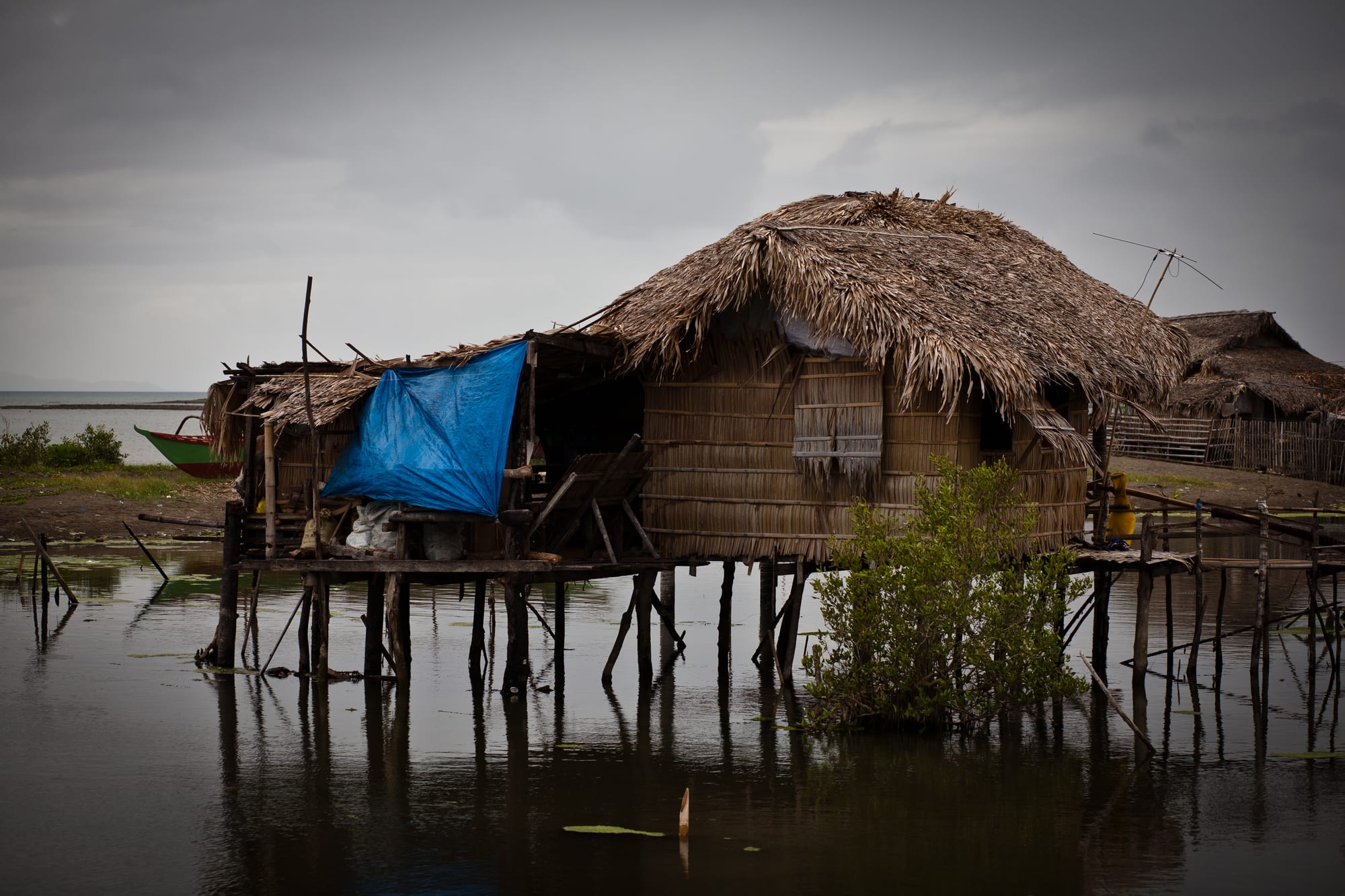
A thatched stilt house standing over shallow grey water on wooden poles, with a green outrigger boat and the sea behind

Bicol, Philippines

Donsol

A stilt house over the shallows on the coast at Donsol, Sorsogon. (Beyond Neon / Wikimedia Commons · CC BY 2.0)

A fishing town on the western coast of Sorsogon province, in the Bicol region of southern Luzon, facing the Ticao Pass. Little known until the late 1990s, when the whale sharks that feed in its plankton-rich waters became the basis of a community-run boat and snorkelling operation, it remains a small farming and fishing municipality of coconut groves, rice fields and coastal barangays.

Neighbourhoods

  • Poblacion
    • Local life
    • Markets
    • Close to transport

    The town centre, with the municipal hall, the parish church, the public market and the tricycle stands that link the barangays. Vans and buses from Legazpi and Sorsogon City set down here, and most of the town's shops, eateries and cash machines are within a few streets of each other.

    Open in Maps
  • Dancalan and the coast road
    • First-time visitors
    • Beaches
    • Boat trips

    The coastal barangay a few kilometres from the town centre where most resorts and guesthouses stand, strung along a grey-sand shore looking out to Ticao Island. The visitor centre where whale-shark boats are registered and briefed is here, and the beachfront is quiet outside the season.

    Open in Maps
  • The river and inland barangays
    • Quiet and residential
    • Nature

    Behind the coast the municipality is farmland — coconut groves, rice paddies and small settlements along the river that runs down to the sea through mangroves. Evening boat trips to watch fireflies in the riverside trees leave from here, and a few small lodges sit among the fields.

    Open in Maps

Things to do

Volcano country nearby

  • Mayon Volcanolandmark

    The near-symmetrical cone that dominates Albay province north of Donsol, the most active volcano in the Philippines, with a permanent danger zone closed around the summit.

    Open in Maps
  • Cagsawa Ruinslandmark

    The surviving bell tower of a church destroyed by Mayon's eruption of 1814, standing in a park in Daraga with the volcano behind it.

    Open in Maps
  • Daraga Churchlandmark

    A church of volcanic stone on a hill above Daraga, built by the Franciscans from 1772 and dedicated to Our Lady of the Gate; its façades, belfry and baptistry were listed as a National Cultural Treasure in 2007.

    Open in Maps
  • Bulusan Volcanolandmark

    An active volcano in southern Sorsogon, rising from the forest of its natural park, known for sudden steam-driven explosions and among the most frequently active in the country.

    Open in Maps
  • Bulusan Lakepark

    A lake at about 360 metres on Bulusan's south-eastern flank, ringed by rainforest at the heart of Bulusan Volcano Natural Park, with a walking trail around the shore.

    Open in Maps

Short trips from the town

  • Legazpineighborhood

    The regional city north of Donsol, with the bay boulevard, Ligñon Hill's viewpoint and the airport most visitors use.

    Open in Maps
  • Sorsogon Cityneighborhood

    The provincial capital on Sorsogon Bay, the administrative and market centre for the province, east by road across the peninsula.

    Open in Maps
  • Ticao Islandattraction

    The island across the Ticao Pass from Donsol, one of the three main islands of Masbate province, with quiet beaches and a strait known for its marine life.

    Open in Maps
  • Pilarneighborhood

    The neighbouring coastal town to the south on the road along Sorsogon's western shore, where whale sharks are also seen in Pilar Bay.

    Open in Maps

Seasonal events

  • Whale-shark seasonNovember to June, peaking February to May

    The months when whale sharks are seen off the coast and the registered boats go out daily, and the busiest stretch of the town's year.

  • Barangay fiestasthrough the year

    Each of the municipality's 51 barangays keeps the feast of its patron saint, with mass, processions and family meals.

Eat and drink

Long-standing places and food districts in Donsol. Hours, ratings and directions come from your maps app, always current.

Where people eat in Donsol

  • Donsol public marketmarket

    The municipal market in the Poblacion, where fish landed that morning, coconuts, chillies, taro leaves and pili nuts are sold, with cooked-food stalls at the edges.

    Open in Maps
  • Poblacion carinderiasneighborhood

    Small family eateries around the town centre serving trays of rice, stewed pork and fish with coconut milk and chilli — the cheapest and most local way to eat in town.

    Open in Maps
  • Dancalan beach roadneighborhood

    The resort and guesthouse strip along the coast, where most places serve grilled fish, Bicolano dishes and breakfasts for people going out on the boats.

    Open in Maps

Bicolano dishes to look for

  • Laing and pinangatrestaurant

    Dried or fresh taro leaves simmered in coconut milk with chilli and shrimp paste — laing served loose, pinangat wrapped into parcels around fish or shrimp.

    Open in Maps
  • Kinunotrestaurant

    Flaked fish cooked with coconut milk, chilli and malunggay leaves, a Bicol dish found in the coastal towns.

    Open in Maps

Experience Donsol

History

Donsol was a coastal settlement of fishing and farming families long before it drew any attention from outside. It became a municipality of Sorsogon province in the Spanish period, with the parish church and the plaza at its centre in the pattern used across the colonial Philippines, and its people lived on the sea, on coconut and on rice, as they largely still do. The name is generally explained as coming from a local plant, and the town's history through the 19th and 20th centuries is the ordinary history of a Bicol coastal municipality: typhoons, harvests, migration and the slow arrival of roads.

What changed everything was an animal that had always been there. For more than a century local people believed the butanding, the whale shark, to be dangerous. That changed in December 1997, when a diving instructor, Romir Aglugub, and his group swam with them and found them harmless, and by 1998 the sharks had become the emblem of Donsol, which took the title "Whale Shark Capital of the World". The animals gather in the plankton-rich water off the coast between November and June, with numbers peaking from February to May.

Rather than allow the sharks to be fished or the encounters to go unregulated, the municipality and conservation groups built an organised system around them: interaction is regulated through the local tourism office, boats are registered, visitors are briefed before going out, and WWF guidelines on how close swimmers may come are generally observed. Time magazine named the Donsol encounter the best animal encounter in Asia in 2004, and the income reshaped a town that had almost none before. Tourism now sits alongside fishing and farming rather than replacing them.

Culture & Customs

Donsol is Bicolano and thoroughly Catholic. The parish church and the fiesta calendar organise the year, and the regional devotion to Our Lady of Peñafrancia, whose September procession fills Naga a few hours to the north, is felt here too. Baptisms, weddings and town fiestas are large family occasions, and the extended family — grandparents, cousins, godparents — is the unit that matters most, as it is across the region.

Bikol languages are spoken at home, Tagalog is universal and English is taught in school and used with visitors, so the town's guides and boat crews work easily in three languages. Manners are the Filipino ones: indirectness in disagreement, respect for elders marked in speech, and a strong reluctance to embarrass anyone in public. Karaoke is a fixture of celebrations, and basketball courts stand in almost every barangay.

The whale shark has become part of the town's identity rather than simply a source of income. The butanding appears on signs and murals around the town, and the interaction rules are a matter of local pride and local enforcement, with boat crews trained to keep swimmers back from the animals. Alongside them, the evening trips to watch fireflies in the mangroves along the river have given the town a second, quieter attraction. The fishing calendar, the harvests of coconut and rice, and the storm season shape the rhythm of the year as much as any of this.

Daily Life

The municipality had about 51,800 residents at the 2024 census, spread over 51 barangays rather than concentrated in one town. The Poblacion holds the municipal offices, the market, the schools and the church; the rest of the population lives along the coast or inland among coconut groves and rice fields, in houses of concrete block, timber and iron sheet.

Fishing and farming remain the base of the economy. Boats go out for the day's catch, copra is dried from coconut, rice is grown on the flat land behind the shore, and pili nuts and vegetables come in from the uplands. Tourism adds work for boat crews, spotters, guides, resort staff, tricycle drivers and cooks, but it is seasonal by nature and stops when the sharks and the good weather go. As in most of Bicol, many families also depend on money sent home by relatives working in Manila or abroad.

Days start early, with boats leaving before dawn and children walking to school in uniform; afternoons are hot and slow; evenings are spent outside, on basketball courts, at sari-sari stores and in front of televisions. The persistent local issues are the ones common to the region — storm damage to houses and crops, the cost of rebuilding, patchy roads and water supply, and the balance between protecting the whale sharks and the pressure to grow the business around them.

Food

Donsol eats Bicolano, which means coconut milk and chilli in almost everything. Gata, coconut milk, thickens the stews; sili, chilli, is used more freely here than anywhere else in the country. Laing is dried taro leaves simmered slowly in coconut milk with chilli, shrimp paste and often pork; pinangat wraps fish or minced shrimp in taro leaves and cooks the parcels the same way. Bicol Express, pork stewed in coconut milk with a great quantity of chilli, is cooked in the Bicolano style and eaten nationwide.

The sea supplies the rest. Fish is grilled over coals, fried, or cooked into sinigang, a sour broth soured with tamarind or local fruit. Kinilaw cures raw fish in vinegar and calamansi with onion, ginger and chilli, and kinunot flakes fish into coconut milk with chilli and malunggay leaves. Squid, crab and shellfish come off the same boats that carry visitors out in the season.

Rice accompanies everything, and the day is punctuated by merienda, the mid-morning and mid-afternoon snack: boiled bananas, rice cakes, pancit noodles or bread with sweetened coffee. Pili nuts, grown mainly in Bicol, are roasted, candied and baked into tarts sold in the market and along the roads. Tuba, fermented coconut sap, is the traditional village drink, though bottled beer and instant coffee are more common. Sweets lean on coconut and sticky rice — suman, bibingka and biko among them.

Planning tools

Budget

Donsol is inexpensive by the standards of Philippine beach destinations. Rooms range from simple guesthouses in the Poblacion to beachfront resorts on the coast road, and food in carinderias costs very little. The main expenses are the registered whale-shark boat with its guide and fees, which is much cheaper when the cost is shared among a full boat, and the transport in from Legazpi.

Daily Budget Midrange
USD 55–110 (beach resort or hotel, restaurant meals, a boat trip, a van transfer)
Daily Budget Shoestring
USD 25–45 (guesthouse room, carinderia meals, tricycles and vans, a shared boat)

Ask at the visitor centre about joining other travellers on a boat, and carry cash — machines in a town this size can run out.

Best Time to Visit

The whale-shark season runs roughly from November to June and peaks from February to May, which is also the driest and calmest stretch of the year on this side of the peninsula and the best time for the crossing to the islands. Sightings are never guaranteed in any month. From about June to November typhoons and the southwest monsoon can stop boats altogether.

Suggested Number of Days

Two or three days allows for more than one attempt at a boat trip, which matters because weather and sightings are unpredictable. Longer stays are usually about adding the volcanoes and towns of the wider region.

First Visit
2–3 days
With Surroundings
4–5 days

Transportation

Tricycles are the way to move around the municipality, running between the Poblacion, the coast road and the outlying barangays for a few pesos. Vans and jeepneys connect the town with Legazpi, Sorsogon City and Pilar, and boats leave from the shore rather than any pier. Resorts arrange transfers, and there is little traffic of any kind after dark.

Agree the fare with a tricycle driver before setting off, and arrange the return trip in advance if going out to the inland barangays in the evening.

Airport & Station Connections

Most visitors fly from Manila or Cebu to Bicol International Airport near Legazpi and continue by van, jeepney or hired car in roughly an hour and a half to two hours. Buses from Manila to Legazpi or Sorsogon take most of a day or run overnight, with a connection onward. Sorsogon City is the other road approach, from the east.

Walkability

The Poblacion is small enough to cross on foot in a few minutes, and the beachfront at Dancalan is walkable end to end. Between the two, and out to the farming barangays, distances are several kilometres along a road without pavements, in heat and humidity, so almost everyone takes a tricycle. There is little street lighting away from the centre.

Safety

Donsol is a quiet rural municipality and crime against visitors is rare. The risks are at sea and in the weather: sun and currents on the boats, rough water in the monsoon months, and typhoons that can close the coast for days. Whale-shark encounters are regulated, and the rules — no touching, no flash photography and a set distance from the animal — exist for the sharks and for safety alike.

Follow the briefing and the interaction rules, do not go out in rough seas, and use a registered boat with life jackets. Monitor PAGASA for storms, keep away from volcanic danger zones, take dengue precautions year-round, and do not travel to the Sulu provinces or the Zamboanga peninsula. Check current official travel advice before travelling.

Climate

Tropical, hot and humid all year, with no cold season. The western Sorsogon coast is drier than the Pacific side of Bicol from about February to May, and wettest under the southwest monsoon and the typhoon months in the second half of the year. Rain can arrive in any month as short heavy showers.

Summer
hot and humid, typically 27–34°C, with the driest and calmest seas from March to May
Winter
warm, 23–31°C, with rain from the northeast monsoon and cooler nights

Local Customs

This is a small Catholic town where people know each other, and greetings matter: a nod, a smile and po and opo, the respectful particles added when speaking to elders. Older people may be greeted with the mano, touching the back of their hand to one's forehead. Dress modestly in church and in the town centre, and cover up over swimwear away from the beach. Bicolano and Tagalog are spoken, and English is widely understood.

Tipping is not obligatory but small amounts are appreciated by boat crews and guides; ask before photographing fishermen or people at home, and do not touch or chase marine life.

Common Payment Methods

The currency is the Philippine peso. Cash is the rule in Donsol: the market, carinderias, tricycles and most small lodgings do not take cards, though larger resorts may. There are only a handful of cash machines in the Poblacion and they can be empty or out of service, so most visitors draw money in Legazpi or Sorsogon City before arriving.