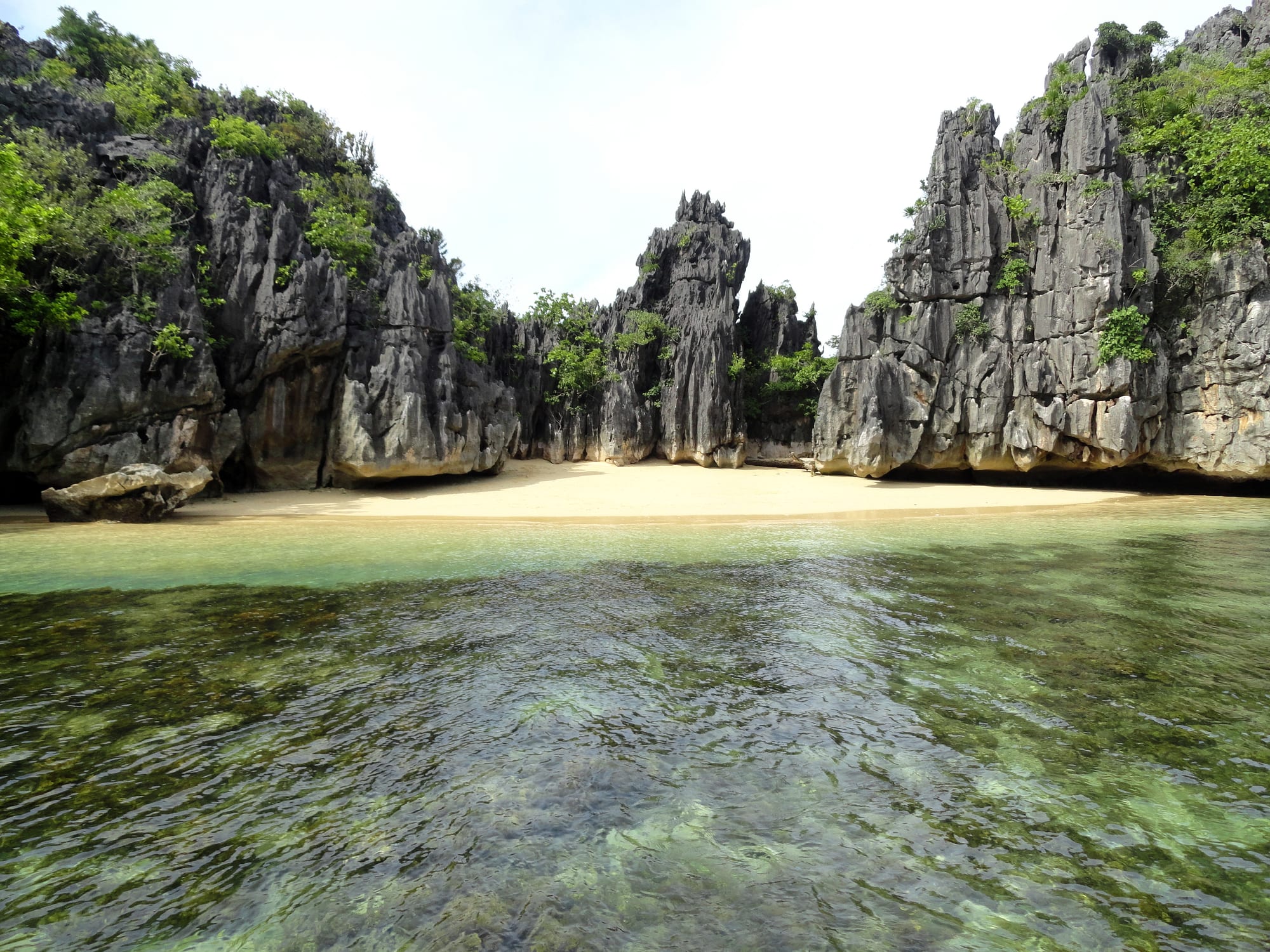
A small crescent of pale sand between jagged grey limestone cliffs topped with green scrub, with clear shallow water in front

Bicol, Philippines

Caramoan

A cove beneath limestone cliffs on Minalahos Island, off the Caramoan peninsula. (Fabio Achilli from Milano, Italy / Wikimedia Commons · CC BY 2.0)

A municipality on the peninsula that closes the northern side of Lagonoy Gulf, at the eastern edge of Camarines Sur in the Bicol region. Its coast is a maze of limestone islets, coves of pale sand and clear water reached by outrigger boat, while the town itself remains a quiet farming and fishing settlement with a colonial church at its centre.

Neighbourhoods

  • Poblacion
    • Local life
    • Markets
    • Historic centre

    The town centre, laid out around the plaza and the old stone church, with the municipal hall, the public market, schools and the small shops and eateries that serve the peninsula. It is several kilometres inland from the boat beaches and has the quiet feel of an ordinary Bicol town.

    Open in Maps
  • Paniman and Bikal
    • First-time visitors
    • Boat trips
    • Beaches

    The coastal barangays on the eastern shore where most island-hopping boats are hired and where a good share of the resorts and homestays stand. The beaches here are working ones, with outriggers pulled up on the sand and fishing gear alongside the visitors.

    Open in Maps
  • Guijalo
    • Close to transport
    • Quiet and residential

    The port barangay where boats from the mainland tie up, on the sheltered side of the peninsula. There is little to detain anyone beyond the pier, the waiting vans and a few eateries, but everything arriving by sea passes through it.

    Open in Maps
  • Gota and the eastern coast
    • Beaches
    • Resorts
    • Quiet

    A stretch of sand and headlands on the peninsula's Pacific-facing side, with resort accommodation and views out to the nearer islets. The coast road linking it to the town winds through coconut land and small settlements.

    Open in Maps

Things to do

Islands and beaches

  • Caramoan National Parkpark

    A national park of 347 hectares established in 1938, with caves, limestone formations, white sand beaches, an islet lake and a subterranean river, and trails laid out by local people.

    Open in Maps
  • Caramoan Peninsula coves and isletsbeach

    The small limestone islands off the eastern shore, each with a cove of pale sand between grey cliffs, visited by hired outrigger boat from the beach barangays.

    Open in Maps
  • Lagonoy Gulfattraction

    The wide gulf the peninsula encloses, one of the country's major fishing grounds with some 480 fish species, and the water crossed by boats to and from the mainland.

    Open in Maps

Short trips from the town

  • Garchitorenaneighborhood

    The municipality north of Caramoan, facing the same island-studded water, reached by a rough road or by boat.

    Open in Maps
  • Naganeighborhood

    The Bicolano heartland's church and university city about 75 kilometres away, with the Peñafrancia basilica, the cathedral and the road and air connections most visitors use.

    Open in Maps
  • Mount Isaroglandmark

    An active stratovolcano of 2,000 metres inland from the gulf, with fumaroles and hot springs, protected as a natural park, with waterfalls and trails on its lower slopes.

    Open in Maps

Eat and drink

Long-standing places and food districts in Caramoan. Hours, ratings and directions come from your maps app, always current.

Where people eat in Caramoan

  • Caramoan public marketmarket

    The town market in the Poblacion, with the day's fish, coconuts, taro leaves, chillies and vegetables from the peninsula's farms, and cooked-food stalls around it.

    Open in Maps
  • Poblacion eateriesneighborhood

    Family-run carinderias around the plaza serving rice with whatever has been cooked that morning — fish, pork stews and vegetables in coconut milk.

    Open in Maps
  • Paniman and Bikal beachfrontneighborhood

    Resort and homestay kitchens on the boat beaches, where grilled fish and simple Bicolano meals are cooked for guests, and packed lunches are made up for island trips.

    Open in Maps

Bicolano dishes to look for

  • Laing and pinangatrestaurant

    Taro leaves cooked in coconut milk with chilli and shrimp paste, served loose as laing or tied into parcels around fish or shrimp as pinangat.

    Open in Maps
  • Grilled fish and kinilawrestaurant

    Fish landed on the same beaches, grilled over coals or cured raw in vinegar and calamansi with onion, ginger and chilli.

    Open in Maps

Experience Caramoan

History

The Caramoan peninsula was settled long before the Spanish arrived, and its sheltered coves and river mouths supported fishing communities on a coast otherwise hard to reach. A Spanish missionary friar, Francisco de la Cruz y Oropesa, gave the place its name in 1619 and founded a settlement at Baluarte, which passed to the bishopric in 1696, and the town grew in the usual colonial pattern around a stone church and a plaza set back from the sea, out of the direct reach of raiders. The coast of Camarines Sur was attacked repeatedly by seaborne raiders from the south during the Spanish centuries, and settlements away from open water had a better chance of surviving.

For most of its history the peninsula's isolation defined it. Mountains and a poor road separated Caramoan from the rest of Camarines Sur, and the practical link to the provincial capital was by boat across Lagonoy Gulf, as it largely remains. Farming — coconut, rice, root crops — and fishing supported the population, and migration to Naga, Manila and abroad took many of the young away.

Tourism arrived late and quickly. The islets and beaches were known regionally but little visited until the 2000s, when improved boats and roads, provincial promotion and the filming of several national editions of the reality series Survivor on the peninsula — among them the American, Israeli, Serbian, Bulgarian, French, Indian, Czech and Romanian versions — brought Caramoan to wider notice. Filming has continued, with an Italian series shot on the islands in early 2026. Resorts, homestays and boat operators followed, and the municipality began charging visitor and environmental fees to manage the traffic. The change has been real but limited: Caramoan is still a working rural municipality, and outside the calm-season months the boats often stay on the sand.

Culture & Customs

The peninsula is Bicolano and Catholic, and the parish church at the centre of the Poblacion is the oldest institution in town. The religious calendar carries the year — Holy Week, the patronal fiesta with its processions, band music and food shared between households, and the wider Bicol devotion to Our Lady of Peñafrancia, whose September feast in Naga draws families from across the province, including this one.

Bikol is the language of daily life, with Tagalog and English used in school, government and with visitors. Life is organised around the extended family and the barangay, and reciprocity is expected: help with a house, a boat or a harvest is repaid in kind. Basketball courts and karaoke machines are fixtures of village life, and fiestas mean open houses where visitors are fed whether or not they were expected.

The sea sets much of the local identity. Men who now take visitors out among the islands grew up fishing the same water, and boat handling, weather reading and the names of every cove and rock are common knowledge rather than professional skill. Caramoan's brief fame as a television filming location is remembered with some amusement locally, and the arrival of outsiders has brought debates familiar across the Philippines about waste, building on the shore and who benefits from the visitors.

Daily Life

The municipality had about 50,400 residents at the 2024 census, spread across 49 barangays on a peninsula of hills, coconut groves and small coastal settlements. The Poblacion holds the market, the municipal offices, the schools and the health centre; most households live on the coast or in farming hamlets connected by narrow roads that flood and wash out in heavy rain.

The economy is farming, fishing and, increasingly, visitors. Coconut for copra is the main cash crop, with rice, root crops and vegetables grown for use at home and for the market; fishermen work Lagonoy Gulf and the waters around the islets. Boat crews, guides, cooks, drivers and resort staff earn from tourism in the calm months and go back to fishing and farming in the wet ones. Money sent home from relatives working in Manila or overseas underpins many households.

Days begin before dawn with boats and school runs and slow through the heat of the afternoon; evenings belong to the basketball court, the sari-sari store and the television. The recurring problems are storms that take roofs and crops, road and power supply that remain patchy, limited medical care, and the pressure that tourism puts on water, waste disposal and the small beaches themselves.

Food

Caramoan eats the Bicolano way, which means coconut milk and chilli. Gata, coconut milk, is the base of most stews, and sili, chilli, is used generously. Laing simmers dried taro leaves in coconut milk with chilli, shrimp paste and often pork; pinangat, from the same tradition, wraps fish or shrimp and seasonings in taro leaves and cooks the parcels in coconut milk. Bicol Express, pork stewed in coconut milk with a great deal of chilli, is cooked in the Bicolano style and served everywhere.

Seafood dominates, as it should on a peninsula. Fish is grilled whole over coals, fried, or cooked into sinigang, the sour tamarind broth, and kinilaw cures raw fish in vinegar and calamansi with onion, ginger and chilli. Squid, crab, shellfish and seaweed come in with the boats, and kinunot — flaked fish with coconut milk, chilli and malunggay leaves — is a Bicol dish found along this coast.

Rice accompanies everything, and merienda, the snack between meals, means boiled bananas, pancit noodles, rice cakes or bread with sweet coffee. Pili nuts, a Bicol speciality, are roasted, candied and baked into tarts; sticky-rice sweets such as suman and biko appear at fiestas. Tuba, fermented coconut sap, is drunk in the villages, alongside bottled beer and the instant coffee that is standard across the country.

Planning tools

Budget

Caramoan is cheap to stay in and eat in, with homestays and small resorts rather than large hotels, but getting there and getting onto the water cost more than most of Bicol. The boat for a day among the islands is the main expense and is far cheaper when shared, and the peninsula charges visitor and environmental fees collected by the municipality.

Daily Budget Midrange
USD 55–110 (resort room, restaurant meals, a boat for the day, transfers)
Daily Budget Shoestring
USD 25–45 (homestay or fan room, carinderia meals, a share of a boat, vans and tricycles)

Bring enough cash for the whole stay — machines on the peninsula are few and unreliable — and ask about sharing a boat with other guests.

Best Time to Visit

March to May is the most reliable window, when the seas are calmest for the island boats and rain is least likely on this Pacific-facing coast. The eastern side of Bicol has no true dry season, and the heaviest rain runs from about November to January under the northeast monsoon. Typhoons are possible from around June to November and can stop boats for days.

Suggested Number of Days

Two or three days is usual, with a spare one built in because weather cancels boats often enough to matter. Four or five suits a trip that takes in more of the province on the way through.

First Visit
2–3 days
With Surroundings
4–5 days

Transportation

There is no public transport of any use on the peninsula itself. Tricycles and habal-habal motorbike taxis run between the Poblacion, the port and the coastal barangays, resorts arrange pick-ups, and everything on the water is done by hired outrigger boat with a crew. Roads are narrow and in mixed condition, and some stretches are unsealed.

Agree the price and the stops of a boat trip before leaving the beach, and allow much longer than the map suggests for road journeys on the peninsula.

Airport & Station Connections

The usual route is to fly or take a night bus from Manila to Naga, then travel by van to the port at Sabang in San Jose and cross Lagonoy Gulf by boat to Guijalo, near Caramoan town, when the sea allows. A longer road route runs around the gulf through Presentacion. Crossings are cancelled in rough weather.

Walkability

The Poblacion is small and easily walked, and the beaches can be strolled end to end. The distances that matter — town to port, town to the boat beaches, one cove to the next — are several kilometres of hilly road in heat and humidity, so a tricycle or motorbike is the practical choice. Paths on the islets are short, rocky and sometimes sharp underfoot.

Safety

The peninsula is quiet and crime against visitors is rare. The real risks are at sea: sudden squalls, rough water on the Pacific side, overloaded boats and strong sun with no shade on the islets. Limestone is sharp, so shoes matter on the rocks, and medical facilities on the peninsula are basic, with anything serious meaning a journey to Naga.

Use registered boats with life jackets, ask about conditions before crossing the gulf, and carry water, sun protection and any medicines needed. Monitor PAGASA for storms, keep away from volcanic danger zones, take dengue precautions year-round, and do not travel to the Sulu provinces or the Zamboanga peninsula. Check current official travel advice before travelling.

Climate

Tropical and humid throughout the year, with rain possible in any month because the coast faces the Pacific and catches the northeast monsoon. The driest and calmest stretch is roughly March to May; the wettest runs from about November into January, and the peninsula lies on a common typhoon track.

Summer
hot and humid, typically 27–34°C, with the calmest seas from March to May
Winter
warm and often wet, 23–30°C, with northeast-monsoon rain and rougher water

Local Customs

Caramoan is a small Catholic municipality where the church, the plaza and the fiesta shape the year. Elders are greeted respectfully, with po and opo added in speech and sometimes the mano, the hand touched to the forehead. Swimwear belongs on the beach, not in town or in church, and asking before photographing people, boats or houses is expected. Bikol and Tagalog are spoken and English is widely understood.

Take rubbish off the islets, leave shells and coral where they are, and tip boat crews and guides modestly if the day has gone well.

Common Payment Methods

The currency is the Philippine peso, and Caramoan runs on cash. Homestays, eateries, boats, tricycles and market stalls expect notes, and only the larger resorts are likely to take a card. Cash machines on the peninsula are few and can be out of money or out of service, so most visitors withdraw what they need in Naga before crossing.