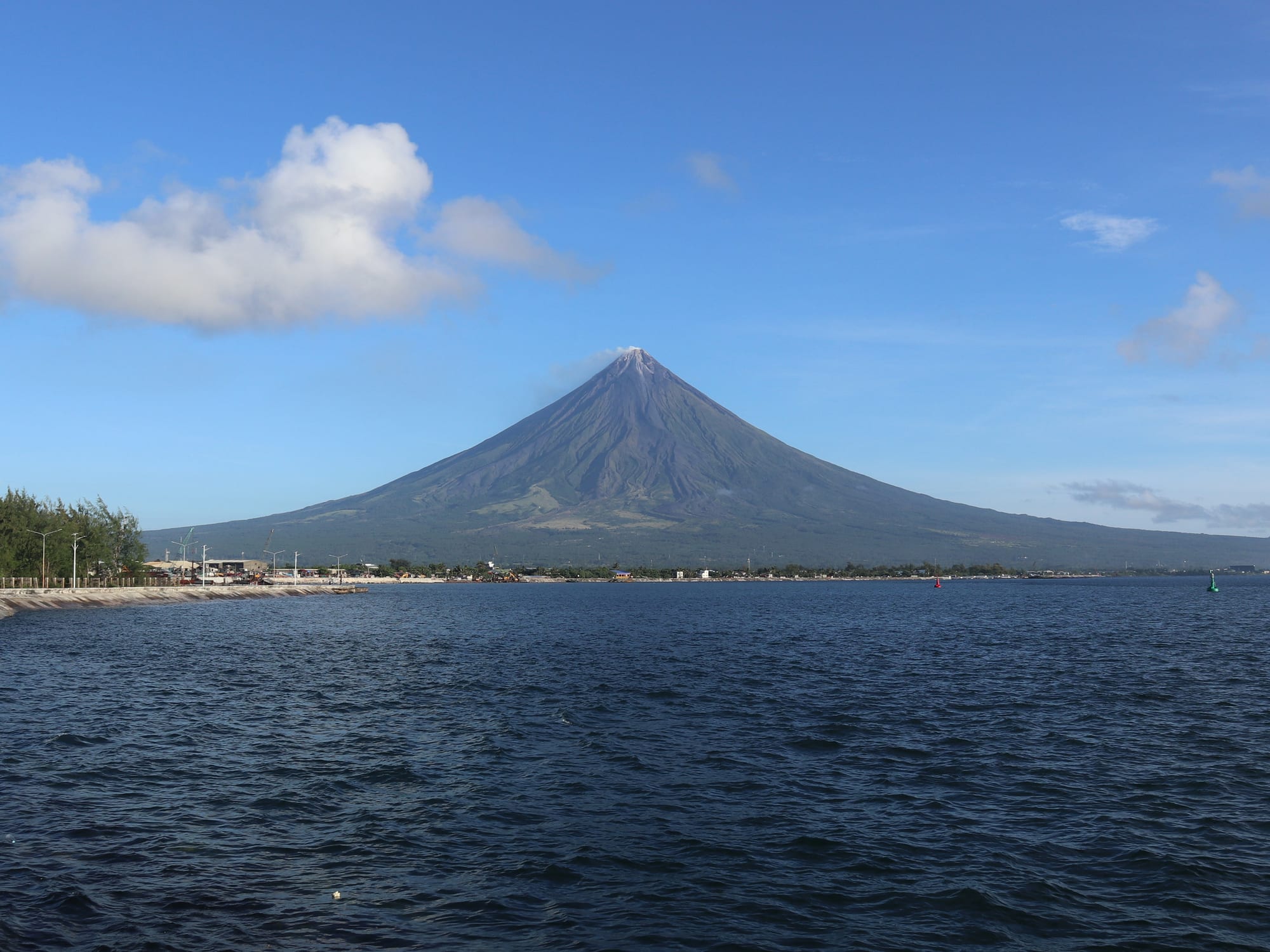
The symmetrical grey cone of Mayon volcano rising beyond a low shoreline, seen across the dark water of a gulf under a blue sky

Bicol, Philippines

Legazpi

Mayon seen across the Albay Gulf from Legazpi Boulevard. (Patrickroque01 / Wikimedia Commons · CC BY-SA 4.0)

The main city of Albay and the commercial centre of the Bicol region, on the Albay Gulf in south-eastern Luzon beneath the near-symmetrical cone of Mayon. A port and university city rebuilt many times after eruptions and typhoons, it is the base for the volcano's lava fields, the ruined church at Cagsawa and the coast around the gulf.

Neighbourhoods

  • Legazpi Port District
    • First-time visitors
    • Best for food
    • Close to public transport

    The commercial downtown by the harbour, with the public market, banks, hotels, bus and jeepney terminals and the waterfront development along the shore. The boulevard along the shore gives the standard view of Mayon across the water.

    Open in Maps
  • Albay District
    • Historic district
    • Parks
    • Students

    The older settlement inland, absorbed into the city, holding the provincial capitol, the cathedral, a park, schools and universities, and quieter streets of houses. It is the administrative and academic side of Legazpi rather than the commercial one.

    Open in Maps
  • Rawis and the northern coast
    • Quiet and residential
    • Sea views

    The strip running north along the gulf towards Santo Domingo, with resorts, seafood places and black-sand shores backed by the volcano. Traffic is lighter and the sea is never out of sight.

    Open in Maps
  • Bogtong and the Ligñon Hill area
    • Viewpoints
    • Walks

    The inland barangays where the city runs up against a low hill used as a viewpoint and a volcano observatory. Residential, close to the airport road, and the usual starting point for looking at Mayon from above the rooftops.

    Open in Maps

Things to do

The volcano and its landscape

  • Mayon Volcanolandmark

    The most active volcano in the Philippines, known for the symmetry of its cone; its permanent danger zone around the summit is closed, and eruptions force evacuations in the surrounding towns.

    Open in Maps
  • Ligñon Hillviewpoint

    A prehistoric cinder cone of about 156 metres some three kilometres from the port area, managed as a nature park, with a paved walk to a viewing deck over the city, the gulf and the volcano; it also holds the Mayon Volcano Observatory.

    Open in Maps
  • Mayon Volcano Natural Parkpark

    The protected area covering the volcano and its surroundings, first declared a national park in 1938 and reclassified as a natural park in 2000, taking in forest, old lava flows and the lahar channels that run down towards the towns.

    Open in Maps

Landmarks and museums

  • Legazpi Cathedrallandmark

    The cathedral of St Gregory the Great in the Old Albay District, seat of the diocese of Legazpi and the city's principal church.

    Open in Maps
  • Albay Provincial Capitollandmark

    The neoclassical seat of the provincial government in Albay District, set in grounds with a park and monuments to the province's history.

    Open in Maps
  • Albay Park and Wildlifepark

    A zoological and botanical park run by the provincial government, near the Daraga boundary, with gardens, a lagoon and a collection of animals, long used as a family outing.

    Open in Maps

Markets and the waterfront

  • Legazpi City Public Marketmarket

    The central market for Bicol produce — chillies, coconuts, pili nuts, taro leaves for laing and fish from the gulf.

    Open in Maps
  • Legazpi Boulevardtrail

    A shoreline road and promenade that also works as a seawall against storm surges, busy in the evening, with the volcano in view across the water on clear days.

    Open in Maps

Short trips from the city

  • Cagsawa Ruinslandmark

    The belfry of a church buried by Mayon's eruption of 1814, standing in a park at Barangay Busay in Daraga about 8 kilometres away, with the volcano behind it.

    Open in Maps
  • Daraga Churchlandmark

    A church of volcanic stone on a hill in the neighbouring town, built by the Franciscans from 1772 and dedicated to Our Lady of the Gate; its façades, belfry and baptistry were declared a National Cultural Treasure in 2007.

    Open in Maps
  • Camaligneighborhood

    A town on Mayon's southern side, a short drive west of the city, known above all for pinangat and for the caves in the hills behind it.

    Open in Maps
  • Santo Domingobeach

    The coastal town north of the city, with black volcanic sand beaches and small resorts within half an hour's drive.

    Open in Maps
  • Donsolneighborhood

    A Sorsogon fishing town roughly an hour and a half away, where whale sharks gather offshore from about November to June and are watched from registered boats under strict rules.

    Open in Maps

Seasonal events

  • Magayon Festivalaround May

    Albay's provincial festival, named after the legend of Daragang Magayon, with parades, sports, trade fairs and cultural shows centred on Legazpi.

  • Ibalong FestivalAugust

    A street festival built on the Bicol epic of Ibalong, with costumed figures of the heroes Baltog, Handyong and Bantong dancing through the city.

  • Holy WeekMarch or April

    Processions and services in the cathedral and the older churches of Albay and Daraga, and the busiest travel week of the first half of the year.

  • ChristmasDecember

    Dawn masses through the nine days before Christmas, lights along the boulevard and the return of family members working elsewhere.

Eat and drink

Long-standing places and food districts in Legazpi. Hours, ratings and directions come from your maps app, always current.

Bicol classics

  • Bicol Express and laingrestaurant

    Pork stewed in coconut milk with a great deal of chilli, and dried taro leaves simmered in coconut milk with shrimp paste — the two dishes that define the region's cooking.

    Open in Maps
  • Pinangatrestaurant

    Parcels of taro leaf wrapped around fish, shrimp or pork and cooked in coconut milk with chilli, associated above all with nearby Camalig.

    Open in Maps
  • Pili nuts and sili ice creammarket

    The pili nut, grown mainly in Bicol, is roasted, candied and baked into tarts, and chilli-flavoured ice cream is sold around the city as a local novelty.

    Open in Maps

Markets and food streets

  • Legazpi City Public Marketmarket

    Chillies, coconuts, taro leaves, pili nuts and fish from the Albay Gulf, with cooked-food stalls at the edges.

    Open in Maps
  • Legazpi Boulevard food stallsneighborhood

    Grills, seafood places and casual restaurants along the reclaimed waterfront, busiest in the evening when the heat drops.

    Open in Maps
  • Old Albay District eateriesneighborhood

    Carinderias, bakeries and student cafés around the capitol and the universities, serving rice meals, noodles and Bicolano home cooking.

    Open in Maps

Experience Legazpi

History

The settlement began as a coastal village on the Albay Gulf named Sawangan, given a Franciscan mission chapel in 1587 and renamed in 1856 for Miguel López de Legazpi, the Spanish commander who founded Manila. Its sheltered harbour made it the trading outlet for the abaca and coconut country inland, and the town grew alongside the older settlement of Albay, which held the provincial government.

Mayon has written much of the city's history. The eruption of 1 February 1814 buried Cagsawa and the towns nearby and killed an estimated 2,000 people; later eruptions and the lahars that follow heavy rain have repeatedly buried farmland and cut roads. Typhoons have done the same from the other direction: Typhoon Reming in 2006 sent volcanic debris down the slopes and killed more than a thousand people in Albay, and flooding remains a recurring emergency.

Japanese forces came ashore at Legazpi on 12 December 1941, and the city saw fighting again when American troops landed in April 1945. Its present charter dates from 1959, the third time Legazpi had been made a city, and the older town of Albay is now its second centre. Since then it has grown into the administrative and commercial capital of Bicol: regional offices, universities, hospitals, a port and, from October 2021, the Bicol International Airport at Daraga, which replaced the older airfield in the city.

Culture & Customs

Life here is lived in the shadow of a volcano, and the culture reflects it. Mayon's name is bound up with the legend of Daragang Magayon, a beautiful young woman whose story ends with her burial and the rise of the mountain, and the province's Magayon Festival takes its name from her. The Ibalong Festival in August dramatises the older Bicol epic of Baltog, Handyong and Bantong, heroes who cleared the land of monsters, with masked and costumed dancers through the streets.

Catholicism is deeply rooted. The cathedral and the older churches of Albay and Daraga anchor a calendar of fiestas, Holy Week processions and the dawn masses of Advent, and family obligations, godparenthood and homecomings carry real weight. Bicolano identity also rests on food — the regional reputation for chilli and coconut milk is worn with pride — and on a certain practised composure about disaster: evacuation routines, early warnings and rebuilding are a normal part of civic life rather than a crisis each time.

The city is young and educated, with several universities drawing students from across the region, and the evening promenade along the boulevard, with the volcano across the water, is the social ritual everyone shares. Handicrafts from the province — abaca weaving, pili-nut sweets, basketry and pottery from nearby towns — are sold in the city's markets and shops.

Daily Life

The city of Legazpi had about 210,600 residents at the 2024 census, and works as the regional centre for Bicol: government offices, courts, hospitals, universities and the head offices of regional businesses are here, along with a port and a growing number of call centres. Beyond the built-up area the economy is agricultural — coconut, abaca, rice and vegetables — and fishing works the Albay Gulf.

The two halves of the city keep different rhythms. The port district is busy from early morning with the market, the terminals and commerce; Albay District runs on the school and office day and empties in the evening. Jeepneys and tricycles are the way almost everyone moves, and traffic thickens around the market and the malls at the end of the working day.

Weather and the volcano are constants. Schools double as evacuation centres, barangay officials keep lists of households in the danger zones, and after each storm or ashfall there is a well-practised routine of clearing, repairing and replanting. Tourism, which has grown steadily since the airport opened, gives work to drivers, guides and resorts, and many households also rely on money sent home by relatives working in Manila or abroad.

Food

Legazpi eats Bicolano, which means gata and sili — coconut milk and chilli — in almost everything. Laing, dried taro leaves simmered slowly in coconut milk with shrimp paste or pork until dark and thick, is the regional standard. Pinangat, strongly associated with nearby Camalig, wraps fish, shrimp or minced pork in taro leaves and cooks the parcels in coconut milk with chilli. Bicol Express, pork stewed in coconut milk with a quantity of chilli that surprises visitors, took its name in Manila in the 1970s from the Bicol Express train that ran from the capital to Legazpi, and is now eaten across the country.

Fish and shellfish come from the Albay Gulf and the Lagonoy Gulf beyond it, and kinunot — flaked fish cooked with malunggay leaves and coconut milk — is a common home dish. Meals are rice-based and served all at once, with vinegar and chilli on the table, and the heat level in Bicol kitchens is genuinely higher than elsewhere in the Philippines.

The pili nut is the province's great speciality: grown mainly in Bicol, it is roasted salted, candied into brittle, baked into tarts and turned into a soft marzipan-like sweet, and shops around the city sell boxes of it to take home. Chilli-flavoured ice cream is the other local souvenir, half joke and half genuine. The public market is where all of this starts — sacks of chillies, coconuts split to order, bundles of taro leaves and fish landed that morning.

Planning tools

Budget

Legazpi is inexpensive even by Philippine standards. Hotels in the port district and around the capitol cost little, carinderia meals less, and jeepneys and tricycles are cheap. The main additional costs are organised trips — the all-terrain-vehicle rides over Mayon's old lava and lahar fields, a hired van for the Albay towns, and the whale-shark boat and guide fees at Donsol.

Daily Budget Midrange
USD 50–110 (hotel or coastal resort, restaurant meals, a hired van, an ATV or boat trip)
Daily Budget Shoestring
USD 20–35 (guesthouse room, carinderia meals, jeepneys and tricycles)

Share vans and boats with other travellers to cut costs, and carry cash beyond the city, where card payment is rare.

Best Time to Visit

March to May is the driest and clearest stretch, the best chance of seeing the cone without cloud and the height of the whale-shark season at Donsol. Rain falls in most months on this side of Luzon, heaviest from about November to January, and the typhoon season runs roughly from June to November, when the peninsula takes the brunt of Pacific storms.

Suggested Number of Days

Two days cover the city and the nearby Albay towns comfortably. Three to five allow the wider province and the Sorsogon coast. Cloud often hides the volcano, so an extra day improves the odds of a clear view.

First Visit
2 days
With Surroundings
3–5 days

Transportation

Jeepneys and tricycles cover the city and the neighbouring towns cheaply, with terminals in the port district; tricycles handle short hops and jeepneys the runs to Daraga, Camalig and Tabaco. Vans and buses leave for the rest of Albay and Sorsogon from the terminals, and a hired van with a driver is the usual way to combine the volcano viewpoints, Cagsawa and the coast.

Agree fares for tricycles and hired vans before setting out, and allow extra time in the wet season, when roads around the volcano can flood.

Airport & Station Connections

Bicol International Airport, in Daraga just outside the city, opened in 2021 and has flights from Manila and Cebu. Buses from Manila run overnight and by day, taking most of a day down the peninsula, and vans and buses connect Naga, Sorsogon and Tabaco, the port for ferries to Catanduanes. Matnog, at the peninsula's tip, is the ferry link to Samar and the rest of the Visayas.

Walkability

The port district is compact and flat, and the market, the terminals and the boulevard are within a kilometre or so of each other. Albay District is a jeepney ride inland rather than a comfortable walk, and the heat, humidity and traffic discourage long distances at midday. The boulevard is the pleasant walk, especially in the late afternoon.

Safety

Crime against visitors is low and the city is generally relaxed; ordinary care in markets and terminals is enough. The hazards here are natural: Mayon, whose permanent danger zone around the summit is closed and whose eruptions force evacuations, lahar and flash floods on its slopes during heavy rain, and typhoons that flood the lowlands. Ashfall can close the airport and disrupt travel.

Monitor PAGASA for storms, keep away from volcanic danger zones, take dengue precautions year-round, and do not travel to the Sulu provinces or the Zamboanga peninsula. Check current official travel advice before travelling.

Climate

Hot, humid and wet, with no genuine dry season. Rain can fall in any month, the heaviest coming with the northeast monsoon from about November to January, and the driest, clearest weather arriving between March and May. The city lies on the typhoon track, and storms are part of the calendar rather than an exception.

Summer
hot and humid, generally 27–34°C, with afternoon storms and the typhoon season starting from June
Winter
warm and often wet, about 23–30°C, with the heaviest rain from November to January

Local Customs

Bicolano is spoken everywhere, with Tagalog and English widely understood, and the region is known for devout Catholicism, a taste for chilli and an easy sense of humour about life beside a volcano. Evacuation drills and warnings are taken seriously and visitors are expected to follow them. Churches expect covered shoulders and knees, and elders are greeted with the traditional touch of the hand to the forehead.

Tipping is modest and optional, chilli levels in Bicol dishes are higher than elsewhere in the country, and instructions from guides and local authorities about the volcano's danger zone are not negotiable.

Common Payment Methods

The currency is the Philippine peso. Cards are accepted in hotels, malls and larger restaurants in the city, and cash machines are easy to find in the port district, but markets, jeepneys, tricycles, boats and small eateries deal only in cash. Carry enough before heading into the province.