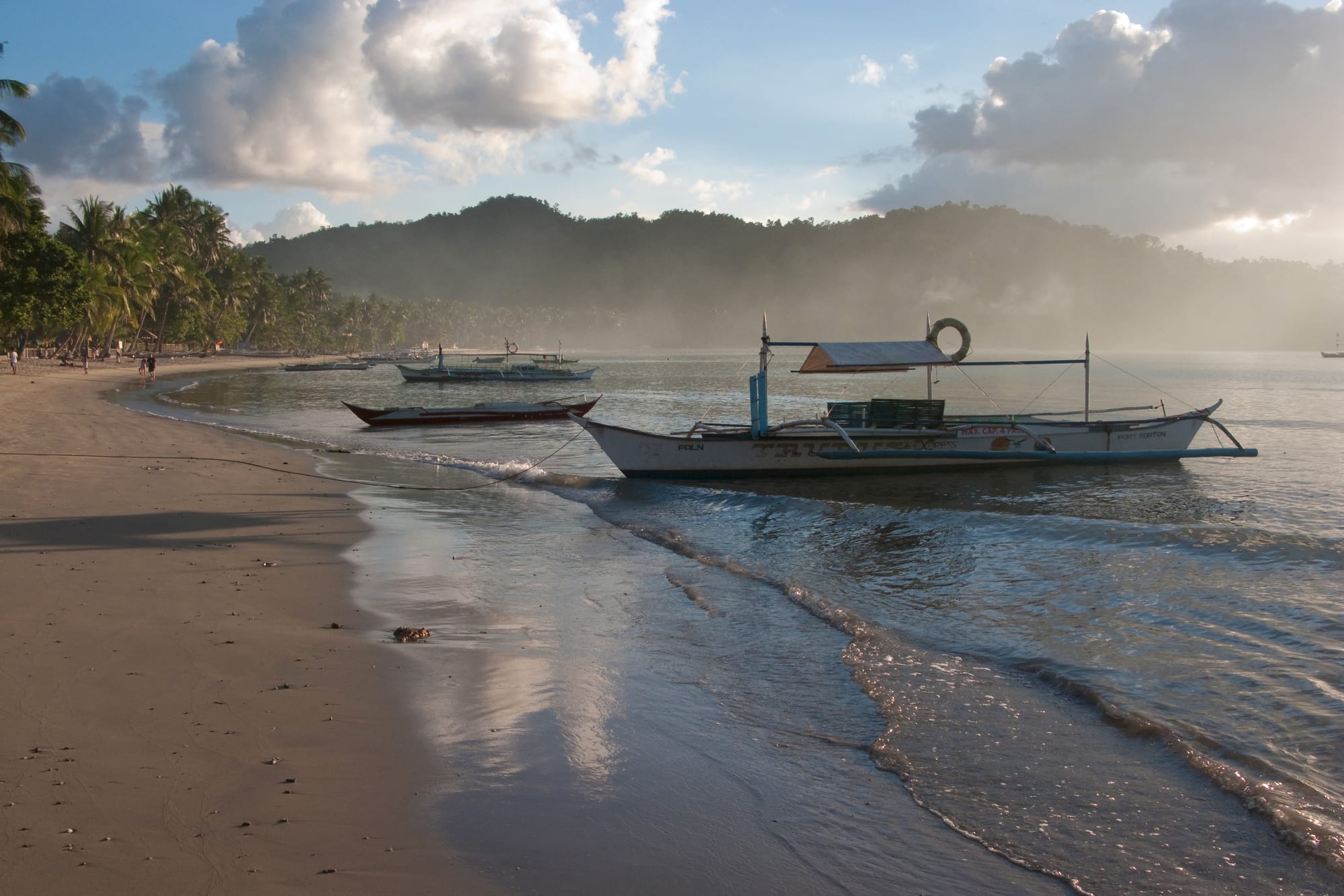
Outrigger fishing boats resting in shallow water off a curving sand beach backed by palms and low forested hills

Palawan & Mimaropa, Philippines

Port Barton

Outrigger boats on the beach at Port Barton, on the west coast of Palawan. (Vyacheslav Argenberg / Wikimedia Commons · CC BY 4.0)

A small beach village on the west coast of Palawan, in the municipality of San Vicente, set on a wide bay scattered with islands and reefs. For years it was hard to reach and it remains far quieter than El Nido, with outrigger boats drawn up on the sand, a single sandy main street and very little lighting after dark.

Neighbourhoods

  • The beachfront
    • First-time visitors
    • Beaches
    • Sunsets

    The curve of sand along the bay, with guesthouses, small resorts and open-sided restaurants set back under the palms and the boats pulled up in front of them. Everything a visitor needs is within a few minutes' walk, and the sun sets straight out to sea.

    Open in Maps
  • The village streets
    • Local life
    • Cheap eats
    • Quiet and residential

    A short grid of sandy lanes behind the beach where most residents live, with sari-sari shops, a basketball court, small carinderias, the school and the chapel. There are few street lights, so torches are useful at night.

    Open in Maps
  • The northern headland and Pamuayan
    • Walks
    • Waterfalls
    • Getting away from the crowd

    The coast north of the village, reached by a rough track that passes small farms on its way to a waterfall and a scatter of quiet coves. Accommodation is sparse and simple, and the walk out is the point.

    Open in Maps

Things to do

The bay and the beaches

  • Port Barton beachbeach

    The village's own beach, a long shallow curve of grey-gold sand that is calm enough for swimming and faces the sunset.

    Open in Maps
  • Island-hopping in Port Barton Bayattraction

    Outrigger boats run day trips around the islets and sandbars in the bay, stopping to snorkel over coral gardens and to eat grilled fish on a beach.

    Open in Maps
  • Pamuayan Fallsattraction

    A waterfall and pool in the forest north of the village, reached on foot or by motorbike along a rough track.

    Open in Maps

Nearby coast

  • Long Beach, San Vicentebeach

    A 14.7 km stretch of white sand along the coast at San Vicente, the longest white-sand beach in the Philippines and still largely undeveloped.

    Open in Maps
  • San Vicenteattraction

    The municipal centre up the coast, with the local government offices, a market and the area's small airport, open to commercial flights since 2017.

    Open in Maps

Short trips from the village

  • Puerto Princesa Subterranean River National Parkattraction

    A navigable river running through a limestone cave to the sea, a UNESCO World Heritage Site reached from Sabang on the coast south of the village.

    Open in Maps
  • El Nidoattraction

    The karst bays and lagoons of northern Palawan, some three to four hours north by van, and the usual next stop for travellers heading up the coast.

    Open in Maps
  • Roxasattraction

    The junction town on the east coast where the road from Port Barton meets the main highway.

    Open in Maps

Seasonal events

  • Holy WeekMarch or April

    Services in the village chapel and the busiest week of the dry season, when Filipino families fill the guesthouses.

  • Christmas seasonDecember, with dawn Masses from mid-month

    Simbang Gabi dawn Masses, carolling along the lanes and lanterns on the houses, followed by full boats and rooms around New Year.

Eat and drink

Long-standing places and food districts in Port Barton. Hours, ratings and directions come from your maps app, always current.

Where people eat

  • The beachfront restaurantsneighborhood

    A line of small open-sided kitchens along the sand serving grilled fish, curries, pasta and Filipino rice meals, many run by families who also keep the guesthouse behind.

    Open in Maps
  • Village carinderiasneighborhood

    Simple canteens in the streets behind the beach, where a plate of rice with whatever has been cooked that morning costs a fraction of beachfront prices.

    Open in Maps
  • Boat-trip lunchesrestaurant

    Island-hopping boats cook lunch on a beach — fish and chicken over charcoal, rice, aubergine and fruit — which is how most visitors eat in the middle of the day.

    Open in Maps

Experience Port Barton

History

Port Barton is a young settlement in an old landscape. The coasts and forests of Palawan have been inhabited for tens of thousands of years, and the island's Indigenous peoples — the Tagbanwa, Batak and Palaw'an — lived by fishing, hunting and swidden farming long before any town appeared on this bay. Spain held Palawan loosely, ruling from Puerto Princesa after its founding in 1872, the year the bay became the centre of Spanish naval operations in the province, and the west coast north of the capital remained thinly populated and largely unadministered.

The modern village grew through migration in the 20th century, as families from the Visayas and Luzon moved to Palawan in search of land and fish, a movement that continued after the Second World War and gave much of the province its mixed, frontier character. Port Barton became one of several small fishing settlements in the municipality of San Vicente, which was created in 1969 out of territory that had belonged to Puerto Princesa and Taytay.

Tourism arrived slowly, and lateness is the reason the place feels as it does. The road in from the highway was poor for decades, electricity was limited, and travellers who came stayed in simple beach huts. El Nido and Coron grew into resort towns while Port Barton did not. Development has since reached the municipality — better roads, a small airport at San Vicente, plans for the long beach up the coast — and how much building the bay should absorb is the question that now divides opinion locally.

Culture & Customs

Life here follows the rhythms of a fishing village that happens to receive guests. Most residents are Catholic, and the chapel, the fiesta and the Christmas dawn Masses anchor the year. Tagalog and Visayan languages are both heard, a reflection of where the settlers came from, with Cuyonon and other Palawan languages in the wider province; English is widely understood by anyone working in tourism. Basketball is played on the village court in the cooler hours, and karaoke is a standard feature of any celebration.

The atmosphere that visitors notice — slow, informal, sociable — is partly circumstance. Limited power and few street lights mean evenings are spent outside, talking, and the small number of restaurants throws people together. Boat captains, guides and guesthouse families are usually the same households, and a good deal of village income passes through the island tours.

Courtesy matters more than it might appear. Residents dress modestly away from the sand, greet each other in passing and expect visitors to do the same; swimwear in the shops or the chapel is noticed. The reefs in the bay are protected locally and fees from boat trips go towards that work, so guides are firm about not touching coral, not feeding fish and not leaving rubbish on the islands. Conservation here is a livelihood question as much as an environmental one.

Daily Life

Port Barton is a barangay of a few thousand people within the municipality of San Vicente, which had about 33,800 residents at the 2024 census. Fishing is still the underlying economy: boats go out before dawn, and the catch is sold in the village, sent to Roxas or Puerto Princesa, or cooked for guests the same evening. Coconut, rice and small-scale farming fill in around it.

Tourism now employs a large share of the working population — as boat crews, guides, cooks, housekeepers, drivers and builders — and the work is strongly seasonal, busy from December to May and very quiet in the monsoon months, when some businesses close and families fall back on fishing and farming. Children go to school in the village and travel to San Vicente or Puerto Princesa for further study; many young adults leave for Manila or for work overseas.

Infrastructure is the constant subject. Power cuts happen and generators are common, mains water and waste disposal have not kept pace with new guesthouses, mobile signal comes and goes, and the road in still washes out in heavy rain. The health centre handles minor cases only. Against that, the improvements underway in San Vicente — roads, the airport, land bought up along the long beach — raise the question of whether Port Barton will stay as it is, and few expect it to.

Food

The food is coastal Filipino cooking without much ceremony. Fish comes off the boats and goes onto charcoal within hours: tuna, tanigue, snapper and squid, served whole with rice, calamansi and a dipping sauce of soy and chilli. Kinilaw, raw fish cured in vinegar and calamansi with onion, ginger and sometimes coconut milk, is eaten all along Palawan's coasts, and prawns and crab appear when the catch allows.

Around that sits the national repertoire: adobo, meat simmered in vinegar, soy and garlic; sinigang, a sour tamarind broth; pancit noodles; and grilled pork skewers from a roadside grill in the evening. Carinderias in the lanes serve rice with a choice from a few pots, and sari-sari shops sell bread rolls, eggs, instant coffee and biscuits. Breakfast for most residents is rice with dried fish or longganisa sausage and a fried egg.

Because the village lives on visitors, the beachfront kitchens also cook curries, pasta and pancakes, often better than the setting suggests. Fruit is local and seasonal — mango, banana, papaya, pineapple — and fresh buko, young coconut, is drunk straight from the shell. Tuba, fermented coconut sap, is the village alcohol alongside bottled San Miguel, and halo-halo, shaved ice with sweet beans and milk, is the afternoon standby in the heat.

Planning tools

Budget

Port Barton is cheap by Palawan standards and much cheaper than El Nido or Coron. Simple fan rooms and guesthouses cost little, boat tours are sold at fixed group rates, and there is almost nothing to spend money on after dark. Beachfront resorts and air-conditioned rooms are the main way the daily figure rises.

Daily Budget Midrange
USD 60–130 (beachfront room with air conditioning, restaurant meals, private boat hire)
Daily Budget Shoestring
USD 25–45 (guesthouse or dorm, carinderia meals, a shared group boat tour)

Bring enough cash from Puerto Princesa or Roxas: the village has very few cash machines, they can be empty, and most places do not take cards.

Best Time to Visit

December to May, with March to May the calmest and clearest for boat trips and snorkelling. January to April is the busiest stretch. The southwest monsoon from June to October brings heavy rain and swell on this coast, when tours are often cancelled and some guesthouses close; the compensation is lower prices and an almost empty beach.

Suggested Number of Days

Two or three days is the usual stay, long enough for a boat trip and a slow day on the sand. Anyone walking to the waterfalls and the northern coves, or waiting out weather, tends to stay longer — the village has a reputation for keeping people beyond their plans.

First Visit
2–3 days
With Surroundings
4–5 days

Transportation

There is no public transport inside the village, and none is needed: everything is within a ten-minute walk. Tricycles and motorbike hire cover the rough tracks inland and along the coast, and outrigger boats are the practical way to reach the islands, the nearby beaches and, in good weather, points up the coast.

Tracks out of the village are sand and gravel and can be difficult after rain, so anyone hiring a motorbike should be confident on loose surfaces.

Airport & Station Connections

Almost everyone comes by road from Puerto Princesa, three to four hours away by shared van, the last stretch on a side road off the main highway. Vans also run from El Nido in roughly three to four hours. San Vicente, up the coast, has a small airport with limited flights, and boats occasionally connect the village with other points on the coast in calm weather.

Walkability

Entirely walkable. The beach is the main thoroughfare and the village behind it is a few sandy lanes, all flat. There are few street lights, so a torch or a phone light is worth having after dark, and the tracks to the waterfall and the northern coves are uneven and muddy in the wet season.

Safety

The village is quiet and crime is rare, though ordinary care with valuables in shared rooms applies. The risks are practical: boats at sea in poor weather, currents and sun on snorkelling trips, sandflies on the beach at dawn and dusk, unlit lanes and rough tracks at night, and a clinic that can handle only minor problems, with the nearest hospital hours away in Puerto Princesa.

Use boats with life jackets and decline trips when the sea looks rough, carry insect repellent and a torch, and take out insurance that covers evacuation. Monitor PAGASA for storms, keep away from volcanic danger zones, take dengue precautions year-round, and do not travel to the Sulu provinces or the Zamboanga peninsula. Check current official travel advice before travelling.

Climate

Hot and humid all year. The dry season runs from about December to May, the southwest monsoon from June to October, when this west-facing coast gets heavy rain and rough seas. Palawan lies south of the main typhoon belt and is struck less often than Luzon, though storms do reach it.

Summer
hot and humid, generally 28–34°C, driest and calmest from March to May
Winter
warm and mostly dry, 24–31°C, with breezier seas from December to February

Local Customs

This is a small, church-going village where visitors are guests rather than the majority. Swimwear is for the beach and shirts are expected in the lanes, the shops and the chapel. Greetings are exchanged in passing, older people are addressed respectfully, and noise carries at night in a place with thin walls and early risers. Tipping is not expected, though boat crews are often given something at the end of a trip.

Ask before photographing people or their homes, carry rubbish back from the islands, and do not touch or stand on coral.

Common Payment Methods

The currency is the Philippine peso, and Port Barton runs largely on cash. Card payment is accepted by only a handful of resorts and tour operators, cash machines are few and unreliable, and mobile signal can be patchy, which affects electronic payment too. Most visitors draw money in Puerto Princesa before setting out.