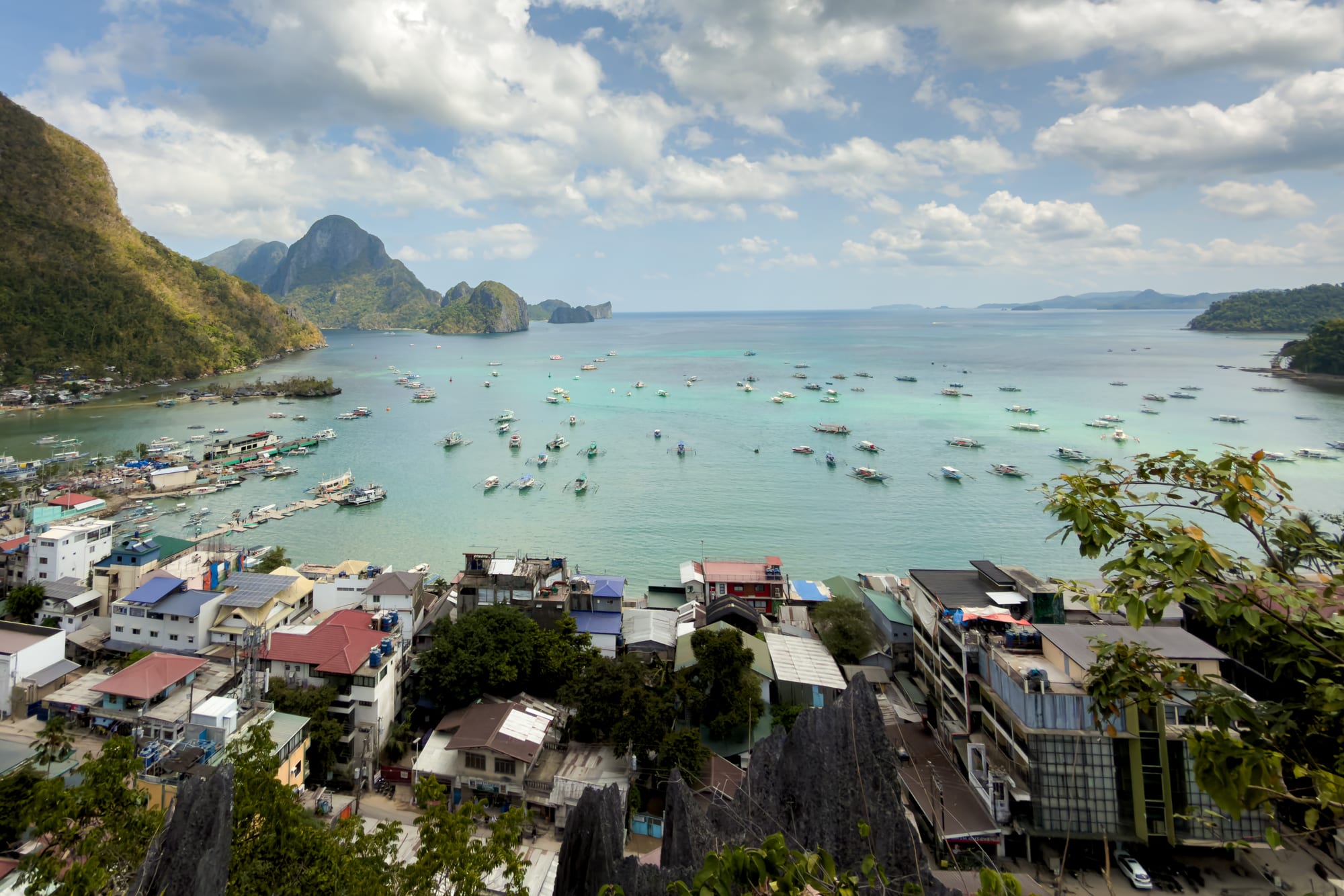
Aerial view over the roofs of a small town to a turquoise bay crowded with outrigger boats, with green karst islands on the horizon

Palawan & Mimaropa, Philippines

El Nido

El Nido town and Bacuit Bay seen from the slopes of Taraw Cliff, northern Palawan. (Micluna / Wikimedia Commons · CC BY-SA 4.0)

A town at the northern tip of mainland Palawan, wedged between a limestone cliff and the water of Bacuit Bay, whose islands and lagoons it exists to reach. Within a generation it has gone from a fishing and collecting village, named for the swiftlet nests gathered on its cliffs, to one of the busiest tourist destinations in Palawan.

Neighbourhoods

  • The Poblacion
    • First-time visitors
    • Nightlife
    • Best for food

    The town centre, a grid of narrow streets between the beach and the foot of Taraw Cliff, packed with guesthouses, dive shops, tour offices, bars and restaurants. Boats leave from the sand at the end of the street, and almost everything in town is a few minutes' walk away.

    Open in Maps
  • Corong-Corong
    • Quiet and residential
    • Sunsets
    • Value

    The bay immediately south of town, where the road from Puerto Princesa arrives. Accommodation is cheaper and calmer than in the centre, the beach is better for watching the sun go down than for swimming at low tide, and tricycles run into town in a few minutes.

    Open in Maps
  • Marimegmeg and Las Cabanas
    • Beaches
    • Sunsets
    • Bars

    A sandy stretch a few kilometres south of the Poblacion with beach bars and mid-range resorts, reached by tricycle along the coast road. It has a proper swimming beach and views west across the bay.

    Open in Maps
  • Lio
    • Resorts
    • Quiet
    • Close to the airport

    A planned resort estate on a long beach north of town, beside the small airport, with hotels, a short row of shops and restaurants and a great deal more space than the centre. It is a drive from the Poblacion rather than a walk.

    Open in Maps
  • Nacpan and the northern beaches
    • Beaches
    • Quiet
    • Day trips

    Kilometres of open sand backed by coconut palms about an hour north of town by tricycle or motorbike, with a scattering of simple resorts and beach bars. The surf and currents are stronger here than in the sheltered bay.

    Open in Maps

Things to do

Bacuit Bay and the islands

  • Bacuit Bayattraction

    The bay in front of the town, scattered with limestone islands, lagoons and reefs, and the reason almost everyone comes; boats work set island-hopping routes across it.

    Open in Maps
  • Cadlao Islandattraction

    The nearest of the Bacuit islands and the highest, its peak some 640 m above the water directly opposite the town, with beaches and a lagoon on its far side.

    Open in Maps
  • Miniloc Islandattraction

    The island whose Big and Small Lagoons, enclosed by high limestone walls and entered by a narrow gap, are the best-known stop on the island-hopping tours.

    Open in Maps

Land, cliffs and caves

  • Taraw Cliffviewpoint

    The jagged limestone wall behind the town, climbed on guided routes for the view over the Poblacion, the bay and its islands.

    Open in Maps
  • Dewil Valley and Ille Cavelandmark

    An archaeological area east of town where a limestone tower and rock shelter have yielded human burials and remains thousands of years old.

    Open in Maps
  • El Nido Airporttransit hub

    The small concrete airstrip at Lio, about 4 km north of the town proper, used by turboprop flights.

    Open in Maps

Short trips from the town

  • Taytayneighborhood

    An old town on the east coast with Fort Santa Isabel, a 17th-century Spanish coastal fort, and boats out to the islands of Taytay Bay.

    Open in Maps
  • San Vicenteneighborhood

    The municipality down the coast known for a very long stretch of sand and for the quiet beaches around Port Barton.

    Open in Maps

Eat and drink

Long-standing places and food districts in El Nido. Hours, ratings and directions come from your maps app, always current.

Where people eat in El Nido

  • El Nido public marketmarket

    The municipal market near the town centre, where fish, squid and crab come in from the boats alongside rice, vegetables and fruit; the surrounding stalls cook cheap Filipino meals.

    Open in Maps
  • Rizal Street and the Poblacion streetsneighborhood

    The main streets of the town centre, lined with small restaurants, bakeries and bars serving everything from Filipino grills to pizza and Thai food, for a mix of visitors and residents.

    Open in Maps
  • Corong-Corong seafood grillsneighborhood

    A run of open-sided restaurants along the southern bay where fish and shellfish are picked from a counter and grilled over coals.

    Open in Maps

Palaweño dishes to look for

  • Inihaw na isdarestaurant

    Whole fish grilled over charcoal and served with rice, calamansi and a dipping sauce of soy and vinegar — the standard meal on this coast.

    Open in Maps
  • Kinilawrestaurant

    Raw fish cured in vinegar or calamansi juice with onion, ginger and chilli, sometimes with coconut milk added.

    Open in Maps
  • Tamilokrestaurant

    The woodworm of the mangroves, eaten raw with vinegar and onion, offered in Palawan as a local dare rather than an everyday dish.

    Open in Maps

Experience El Nido

History

The name comes from the Spanish for "the nest": the cliffs and caves around the bay hold the nests of swiftlets, built from hardened saliva and collected for the Chinese soup trade, a dangerous business carried out on bamboo scaffolds high on the limestone. The settlement was known as Bacuit until 1954, when it was renamed El Nido. People had lived in this corner of Palawan for far longer than either name suggests: the rock shelter at Ille Cave in the Dewil Valley, a short way inland, has yielded burials and remains going back thousands of years, among the important prehistoric sites of the Philippines.

For most of the 20th century El Nido was a remote fishing municipality at the end of a bad road, its economy built on fish, coconut and the nest trade. Diving and small-scale tourism began in the last decades of the 20th century, when island resorts opened in the bay and word of the lagoons spread among divers. The waters were given protected status in 1984 and the designation was widened in 1998, so that the El Nido-Taytay Managed Resource Protected Area, covering Bacuit Bay, the mainland and part of the neighbouring municipality, became the framework within which tourism has grown.

Growth came fast after 2010, as the road from Puerto Princesa improved, low-cost flights reached Palawan, and the airport at Lio opened the town to direct arrivals. Guesthouses, tour offices and bars filled the Poblacion; visitor numbers rose steeply. With them came the problems of a small town taking in far more people than it was built for — waste, water supply, sewage reaching the bay, and building on land not meant for it. Managing that growth inside a protected area has become the municipality's central problem.

Culture & Customs

El Nido's population is a mix, and that is the point about its culture. Alongside families long established on this coast are migrants from the Visayas and Luzon who came for work in fishing and later in tourism, and Palawan's Indigenous communities live in the municipality's interior and outer barangays. Tagalog and English are heard everywhere in town, Cuyonon and other Palawan languages at home; the result is a place that feels less rooted in one tradition than most Philippine towns.

Catholicism sets the calendar, as it does across the country. The parish church stands a street back from the beach, Holy Week empties the offices and fills the boats with Filipino visitors, and the town fiesta and Christmas bring home relatives working in Manila or abroad. Basketball courts, karaoke and the evening sari-sari store are the ordinary social life behind the bars of the main street.

The other culture here is the visitor economy: boat crews, guides, divers, tour sellers, cooks and drivers, many of them seasonal, with an international layer of dive instructors and resort staff. It has brought money and English and a certain worldliness, and also a sharp local debate about how much more the bay can take. Conservation is a live local issue rather than a slogan: the town and its bay sit inside a protected area, and how much building and boat traffic the coast can take is argued over here as much as anywhere.

Daily Life

About 51,000 people live in the municipality, which is the figure the 2024 census gives, spread over more than a dozen barangays, with only a fraction of them in the crowded Poblacion; the rest live in fishing and farming settlements along the coast and inland, and on the islands of the bay. The town centre is dense, low-rise and busy, and building has spread along the coast road in both directions.

Fishing and coconut farming still support many households, and much of the fish eaten and sold in town comes off local boats, but tourism now dominates the cash economy. Work is seasonal in a way that shapes the year: the dry months bring long days for boat crews, guides and hotel staff, and the monsoon brings repairs, quieter streets and a return to fishing. Prices for rent, food and fuel are higher than in most of Palawan because nearly everything arrives by road or boat.

The strains of fast growth are the town's daily subject. Water supply, rubbish collection, sewage treatment, the power supply and the state of the roads all lag behind the number of people, and the reef and the bay bear the consequences. Residents are also aware how exposed the town is to a bad season — a storm, a ferry accident, a drop in visitors — after the long closure of travel earlier in the decade.

Food

Seafood is the foundation. Fish, squid, prawns and crab come off the boats and go straight onto charcoal: inihaw na isda, whole grilled fish with calamansi, soy and chilli, is the everyday meal, with rice and a vegetable dish alongside. Kinilaw cures raw fish in vinegar or calamansi with onion, ginger and chilli, sometimes enriched with coconut milk. Sinigang, a sour tamarind broth, and adobo, meat braised in vinegar, soy and garlic, are on nearly every menu, as they are across the country.

Palawan has its own curiosities. Tamilok, the shipworm taken from rotting mangrove wood and eaten raw with vinegar, is the one visitors are dared into; crocodile meat and cashew products are sold as souvenirs from Puerto Princesa. Coconut appears in the cooking of the coastal towns, and seaweed salad with tomato and onion is common on the coast.

In town itself the food is deliberately international: pizza, burgers, Thai and Indian dishes, smoothie bowls and espresso sit beside Filipino grills along the main streets, and bakeries sell pandesal in the morning. The cheapest and most local eating is at the market and the carinderias behind it, where rice comes with whatever has been stewed that day. Halo-halo, shaved ice with milk, beans and fruit, is the standard afternoon relief from the heat, and the local drinks are San Miguel beer, fresh calamansi juice and buko, young coconut, cut open at a roadside stall.

Planning tools

Budget

El Nido is among the more expensive places in the Philippines. Rooms in the Poblacion cost well above the national average in the dry season, restaurant prices reflect the cost of shipping everything in, and the island tours, park and environmental fees, and transport from Puerto Princesa all add up. Sleeping in Corong-Corong, eating where the boat crews eat and joining a group tour rather than hiring a boat privately make the biggest difference.

Daily Budget Midrange
USD 90–190 (resort or boutique hotel, restaurant meals, a private boat or a dive day, transfers)
Daily Budget Shoestring
USD 35–60 (dorm or fan room, market and carinderia meals, a group island tour, tricycles)

Bring cash: machines run out, queues are long and many small businesses add a surcharge for cards. An environmental fee is collected from visitors, so keep the receipt.

Best Time to Visit

December to May is the season, with March to May the calmest for boats and diving and the clearest underwater. January and Holy Week are the busiest and dearest weeks of the year. From about June to October the southwest monsoon brings heavy rain and rough water, and tours are cancelled on bad days, though prices fall and the islands are empty.

Suggested Number of Days

Three or four days allows for more than one day on the water, which matters because weather cancels boats. Five to seven suits a stay that adds the northern beaches and the coast further south, or a crossing on to the Calamian Islands.

First Visit
3–4 days
With Surroundings
5–7 days

Transportation

Tricycles are the local transport, running fixed short hops between the Poblacion, Corong-Corong, Marimegmeg and Lio, with higher fares to the northern beaches; motorbikes and scooters are widely rented. Everything on the water is by outrigger bangka, either on a shared tour or hired privately with a crew. Vans and buses leave from town for Puerto Princesa, and ferries cross to Coron in calm weather.

Tricycle fares to the outer beaches are agreed in advance, and the coast roads are narrow, unlit and slippery after rain, so ride carefully.

Airport & Station Connections

The small airport at Lio, about 4 km north of the town proper, takes turboprop flights. Most visitors instead fly into Puerto Princesa and travel roughly 270 km north by van or bus, which takes about five to six hours on a winding road. Fast ferries link El Nido with Coron in the Calamian Islands, weather permitting, in three to four hours.

Walkability

The Poblacion is small and entirely walkable: the beach, the tour offices, the market and most restaurants are within a few streets, though the lanes are narrow, busy with tricycles and often without pavements. Everything outside the centre — Corong-Corong, the southern beaches, Lio, Nacpan — means a tricycle or a motorbike, and walking along the coast road in the heat is uncomfortable.

Safety

El Nido is a relaxed town and violent crime is rare, but it is busy and seasonal, so theft from rooms, beaches and boats happens. The bigger risks are on the water: boats overloaded on busy days, sudden squalls, jellyfish in some months, sharp limestone and coral, and swimmers going further than they should in currents. Medical facilities are basic, with serious cases flown or driven to Puerto Princesa.

Choose registered boats with life jackets and shaded seating, wear shoes on the rocks, and keep valuables out of sight on the beach. Monitor PAGASA for storms, keep away from volcanic danger zones, take dengue precautions year-round, and do not travel to the Sulu provinces or the Zamboanga peninsula. Check current official travel advice before travelling.

Climate

Tropical, hot and humid, with a clear dry season from about December to May and a wet southwest monsoon from June to October, when the west coast takes heavy rain and rough seas. Northern Palawan lies south of the main typhoon belt and is struck less often than Luzon, though not never.

Summer
hot and humid, typically 28–34°C, driest and calmest from March to May
Winter
warm and mostly dry, 24–31°C, with windier seas from December to February

Local Customs

El Nido is used to visitors, and dress and behaviour are relaxed on the beaches, but swimwear is not worn in the town's shops, market or church, and the Philippines is a conservative country away from the sand. Greetings are friendly and unhurried; po and opo mark respect when speaking to elders. Tagalog and English are the working languages, with Cuyonon and other Palawan languages spoken at home.

Do not touch or stand on coral, take rubbish back off the islands, and ask before photographing people.

Common Payment Methods

The currency is the Philippine peso. Larger hotels, dive shops and restaurants take cards, often with a surcharge, but tricycles, market stalls, small eateries and many tour operators want cash. The town's cash machines are few for the number of visitors and are regularly empty or offline, so most people draw money in Puerto Princesa or Manila first.