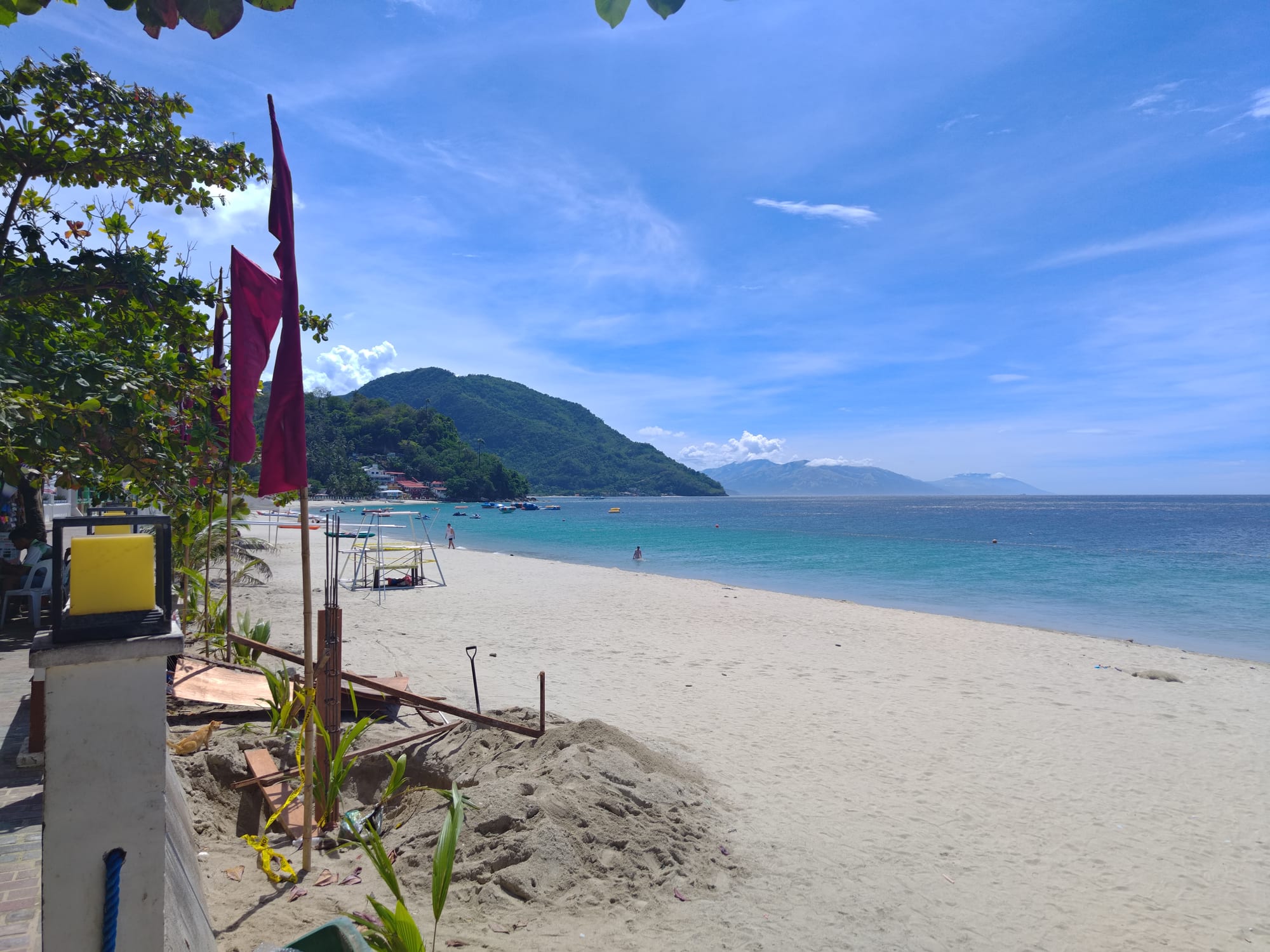
A broad white sand beach curving towards a green forested headland, with small boats moored in turquoise water

Palawan & Mimaropa, Philippines

Puerto Galera

White Beach at San Isidro, on the western side of Puerto Galera. (TheFrirish / Wikimedia Commons · CC0)

A town of small bays and headlands on the northern tip of Mindoro, facing Batangas across the Verde Island Passage. Its sheltered harbour gave it a Spanish name meaning port of the galleons; today the coral reefs offshore have made it one of the best-known diving centres in the Philippines, and the beaches draw weekend crowds from Manila.

Neighbourhoods

  • Poblacion and Muelle Bay
    • First-time visitors
    • Ferries and transport
    • Quiet evenings

    The town proper, set around the sheltered inlet of Muelle Bay where the ferries from Batangas tie up. The municipal offices, the church, the market, banks and the pier are all here, and the pace is that of an ordinary Philippine town rather than a resort.

    Open in Maps
  • Sabang
    • Diving
    • Nightlife
    • Best for food

    A tight strip of dive shops, guesthouses, restaurants and bars along a small east-facing beach a few kilometres from the town centre, reached by road or by outrigger boat. Most of the reefs that made Puerto Galera's name are minutes offshore, and the village stays busy after dark.

    Open in Maps
  • White Beach and San Isidro
    • Beaches
    • Families
    • Sunsets

    The long pale beach west of the town, the busiest stretch of sand in Puerto Galera and the one most Manila weekenders head for. Resorts, beach bars and boat operators line the back of the sand, and the sun sets over the water.

    Open in Maps
  • Aninuan and Talipanan
    • Quiet and residential
    • Beaches
    • Walks

    Two quieter beaches further west along the same coast, backed by coconut palms and the slopes of Mount Malasimbo. Accommodation is lower-key and more spread out, and an Iraya Mangyan community lives inland from Talipanan.

    Open in Maps

Things to do

Beaches and the bays

  • White Beachbeach

    The wide western beach at San Isidro, a few kilometres from the town centre, lined with resorts and boat operators and known for its sunsets.

    Open in Maps
  • Sabang Beachbeach

    The small, sheltered beach that fronts the dive village east of town, where outriggers and dive boats are pulled up between trips.

    Open in Maps
  • Muelle Bayattraction

    The deep, almost enclosed harbour that gave the town its name and still shelters the ferries, bangka boats and yachts.

    Open in Maps
  • Talipanan Beachbeach

    A quiet stretch of grey-gold sand at the western end of the coast road, below the forested slopes of Mount Malasimbo.

    Open in Maps

Diving and the sea

  • Verde Island Passageattraction

    The strait between Mindoro and Luzon, called by marine scientists the centre of the centre of marine shorefish biodiversity, whose reefs and currents are the reason divers come here.

    Open in Maps

Short trips from the town

  • Tamaraw Fallsattraction

    A roadside waterfall dropping into pools beside the highway towards Calapan, in the Puerto Galera barangay of Villaflor.

    Open in Maps
  • Calapanattraction

    The provincial capital of Oriental Mindoro, about 51 km away by road, with the island's main ferry link to Batangas and its biggest market.

    Open in Maps
  • Mount Halconattraction

    One of the hardest climbs in the Philippines, rising above 2,500 m in the interior of Mindoro, reached from the Calapan side.

    Open in Maps

Seasonal events

  • Holy WeekMarch or April

    Processions and church services in the Poblacion, and the busiest week of the year on the beaches as families travel from Manila.

  • Christmas seasonDecember, with dawn Masses from mid-month

    Simbang Gabi dawn Masses, lanterns and carolling in the town, followed by full resorts between Christmas and New Year.

Eat and drink

Long-standing places and food districts in Puerto Galera. Hours, ratings and directions come from your maps app, always current.

Food districts and markets

  • Puerto Galera public marketmarket

    The town market near the pier, where the day's fish, calamansi, bananas and vegetables are sold and small eateries cook simple rice meals.

    Open in Maps
  • Sabang waterfrontneighborhood

    The densest run of restaurants and bars in the municipality, a mix of Filipino kitchens and places opened by long-settled foreign divers, all within a few minutes' walk of the beach.

    Open in Maps
  • White Beachneighborhood

    Beachfront grills and canteens serving fish and seafood cooked to order, with tables set out on the sand in the evening.

    Open in Maps

Local classics

  • Grilled fish and kinilawrestaurant

    Tuna, tanigue and lapu-lapu grilled over charcoal, and kinilaw, raw fish cured in vinegar or calamansi with onion and ginger, are the staples of almost every menu on the coast.

    Open in Maps

Experience Puerto Galera

History

People were trading along this coast long before Spain arrived. Chinese traders are thought to have known these sheltered inlets before the Spanish arrived, although no evidence of a Chinese settlement here has been found, and northern Mindoro lay on the routes that linked the islands to China and the wider Malay world. The Mangyan peoples of the interior, among them the Iraya, were the island's earlier inhabitants and still live in communities inland from the coast.

The Spanish name records what the harbour was used for: puerto de galeras, the port of the galleons, a refuge deep enough and enclosed enough for ships to shelter and be repaired. Spanish ships came through the passage from Batangas in 1570 and named the place; a settlement grew around Muelle Bay and served as the island's seat of government until 1663, when the capital was moved to Baco. It was also exposed: raiders from the sultanates of the south attacked the Mindoro coast repeatedly, and coastal towns were built and rebuilt around that threat. In the Second World War the island was fought over, with American forces landing near San Jose in south-western Mindoro in December 1944.

Puerto Galera's modern life began under water. Its reefs and the currents of the Verde Island Passage attracted divers from the 1970s onwards, and Sabang grew from a fishing village into a strip of dive shops and guesthouses. In 1973 the area was designated a UNESCO Man and Biosphere reserve, and the bay is the only one in the Philippines on the list of the Club of the Most Beautiful Bays of the World. The opening of faster boats from Batangas turned it into Manila's nearest beach weekend.

Culture & Customs

The town's culture has two layers that rarely mix. One is that of an ordinary Tagalog-speaking coastal municipality: the church on the plaza, the fiesta, the basketball court in every barangay, karaoke at family gatherings, and a calendar shaped by Catholic feasts. Holy Week and the Christmas season, with its dawn Masses in the weeks before the 25th, are the fixed points of the year.

The other is the international diving community that has grown up at Sabang since the 1970s. A number of foreign divers settled permanently, married locally and opened shops and restaurants, and the village has an unusually mixed population for a town of this size, with menus, signage and conversation to match. The relationship between resort business and municipal life — water, waste, building on the shore, the fees charged to visitors — is a constant local subject.

Inland, the Iraya Mangyan maintain their own language and traditions, and are known for their basketry, sold from a community settlement near Talipanan. Mangyan groups across Mindoro have historically been pushed away from the coast by lowland settlement, and their land rights remain a live issue. Visitors are generally welcomed in the villages, but the ordinary courtesies apply: ask before photographing, and buy directly from the weavers.

Daily Life

About 42,000 people live in the municipality, the figure the 2024 census gives, spread across the Poblacion and its twelve other barangays, coastal and inland. Tourism is the dominant employer — resorts, dive shops, boat crews, tricycle drivers, construction — and much of the work is seasonal, busiest from December to May and thin in the monsoon months. Fishing continues alongside it, as does small-scale farming of coconuts, bananas and calamansi on the slopes behind the coast.

The day starts early. Boats go out before dawn, the market by the pier is at its busiest in the first hours of the morning, and by mid-afternoon the heat has emptied the streets. Ferries from Batangas set the rhythm of arrivals, and Friday evening brings a wave of weekenders from Manila that recedes on Sunday night.

Growth has brought familiar pressures. Water supply, sewage and rubbish disposal struggle to keep up with the resorts, and the state of the reefs and the coastal water is watched closely, since both the fishing and the tourism depend on them. Power cuts occur, the coast road is narrow and steep in places, and heavy rain can cut it. Many young people leave for Manila or for work abroad, and remittances support households here as they do across the country.

Food

Seafood is the foundation. Tuna, tanigue, lapu-lapu and squid are grilled over charcoal or fried and served with rice, and kinilaw — raw fish cured in vinegar or calamansi with onion, ginger and chilli — is the dish most associated with this coast. Sinigang, a sour soup soured with tamarind or calamansi, and paksiw, fish simmered in vinegar, use the same catch. Prawns and crab appear when the boats have had a good night.

Beyond the sea the food is standard Tagalog home cooking: adobo simmered in vinegar, soy and garlic; pork lechon kawali; pancit noodles at celebrations; and rice with everything. Carinderias in the Poblacion serve a few pots of whatever was cooked that morning, chosen by pointing. Mindoro's calamansi, the small green citrus grown across the island, goes into drinks, dipping sauces and marinades, and the local bananas are eaten fried as banana cue, rolled in caramelised sugar.

To drink there is San Miguel beer, fresh buko juice straight from the coconut, and tuba, the fermented sap of the coconut palm, which is a village drink rather than a resort one. Halo-halo — shaved ice with sweet beans, fruit and milk — is the afternoon answer to the heat. On the beach strips the cooking broadens, with long-established foreign-run kitchens turning out European and other dishes alongside the Filipino menus.

Planning tools

Budget

Puerto Galera is one of the cheaper beach destinations within reach of Manila. Guesthouses inland and in the Poblacion cost little, while beachfront resorts on White Beach and Sabang charge considerably more, and prices rise sharply at Christmas, New Year and Holy Week. Diving, boat hire and the environmental fee collected from visitors are the main extras.

Daily Budget Midrange
USD 70–150 (beachfront resort room, restaurant meals, a boat trip or a couple of dives)
Daily Budget Shoestring
USD 25–45 (guesthouse or fan room, carinderia meals, jeepneys and shared boats)

Carry cash: cash machines are limited and sometimes empty, and many small resorts and dive shops prefer pesos.

Best Time to Visit

December to May, the dry season, with March to May the calmest months for diving and boat trips. Visibility underwater is generally best in the dry months. From June to November the southwest monsoon brings heavy rain and rough crossings, and ferries from Batangas can be suspended for days when a typhoon passes. Weekends and public holidays are busy year-round.

Suggested Number of Days

Two or three days suit most visits, enough for the beaches and a boat trip. Divers and anyone adding the waterfalls and the interior of Mindoro should allow four or five. Rough seas in the monsoon months can add a day at either end.

First Visit
2–3 days
With Surroundings
4–5 days

Transportation

The coast is linked by a single road, and tricycles and jeepneys run between the Poblacion, Sabang and White Beach for small fares. Outrigger boats connect the beaches directly, often faster than the road, and are hired for reef and island trips. Motorbikes can be rented, though the hill roads are steep and rough in places.

Agree the fare for a tricycle or a boat before setting off, and expect boat trips to be cancelled in strong winds.

Airport & Station Connections

Nearly everyone arrives by sea. Ferries and outrigger boats cross the Verde Island Passage from Batangas City, about 40 km away, in roughly one to two hours, landing at Muelle in the town, at Sabang or at White Beach. Batangas port is two to three hours by bus or van from Manila, so the whole journey usually takes most of a day. Larger roll-on ferries also run from Batangas to Calapan, further down the coast.

Walkability

Each settlement is easily walked end to end — Sabang's strip and White Beach both take only a few minutes — but the distances between them are several kilometres of hilly road with little pavement, so tricycles or boats are used instead. Paths to the quieter western beaches are flat and pleasant.

Safety

Puerto Galera is relaxed and generally safe, with petty theft on the busy beaches the main crime concern. The real risks are at sea: strong currents in the Verde Island Passage, overloaded or poorly equipped boats, and crossings attempted in bad weather. Diving here reaches depths and currents that suit experienced divers, and there are sandflies on some beaches.

Use registered boats with life jackets, dive within qualifications and with an established shop, and use insect repellent on the sand. Monitor PAGASA for storms, keep away from volcanic danger zones, take dengue precautions year-round, and do not travel to the Sulu provinces or the Zamboanga peninsula. Check current official travel advice before travelling.

Climate

Hot and humid all year, with a dry season from about December to May and a wet southwest monsoon from June to October. Rain comes in heavy bursts rather than all day, and northern Mindoro sits on the edge of the typhoon belt, so storms between June and November can close the sea crossing.

Summer
hot and humid, generally 28–34°C, driest and calmest from March to May
Winter
warm and mostly dry, 24–31°C, with cooler nights and windier seas from December to February

Local Customs

Tipping is not obligatory but small amounts are appreciated, and resorts may add a service charge. Swimwear belongs on the beach: shirts and shorts are expected in the town, the market and above all in church. Catholic practice is taken seriously, and Holy Week is quiet in the Poblacion even while the beaches are full. Older people are greeted respectfully, often with po and opo in speech.

Ask before photographing people, particularly members of the Mangyan communities inland, and buy their woven work directly rather than bargaining hard.

Common Payment Methods

The currency is the Philippine peso. Larger resorts and dive shops take cards, but most restaurants, tricycles, boats and market stalls are cash only. There are a few cash machines in the Poblacion and at Sabang, and they can run out at weekends, so it is worth arriving with pesos from Batangas or Manila.