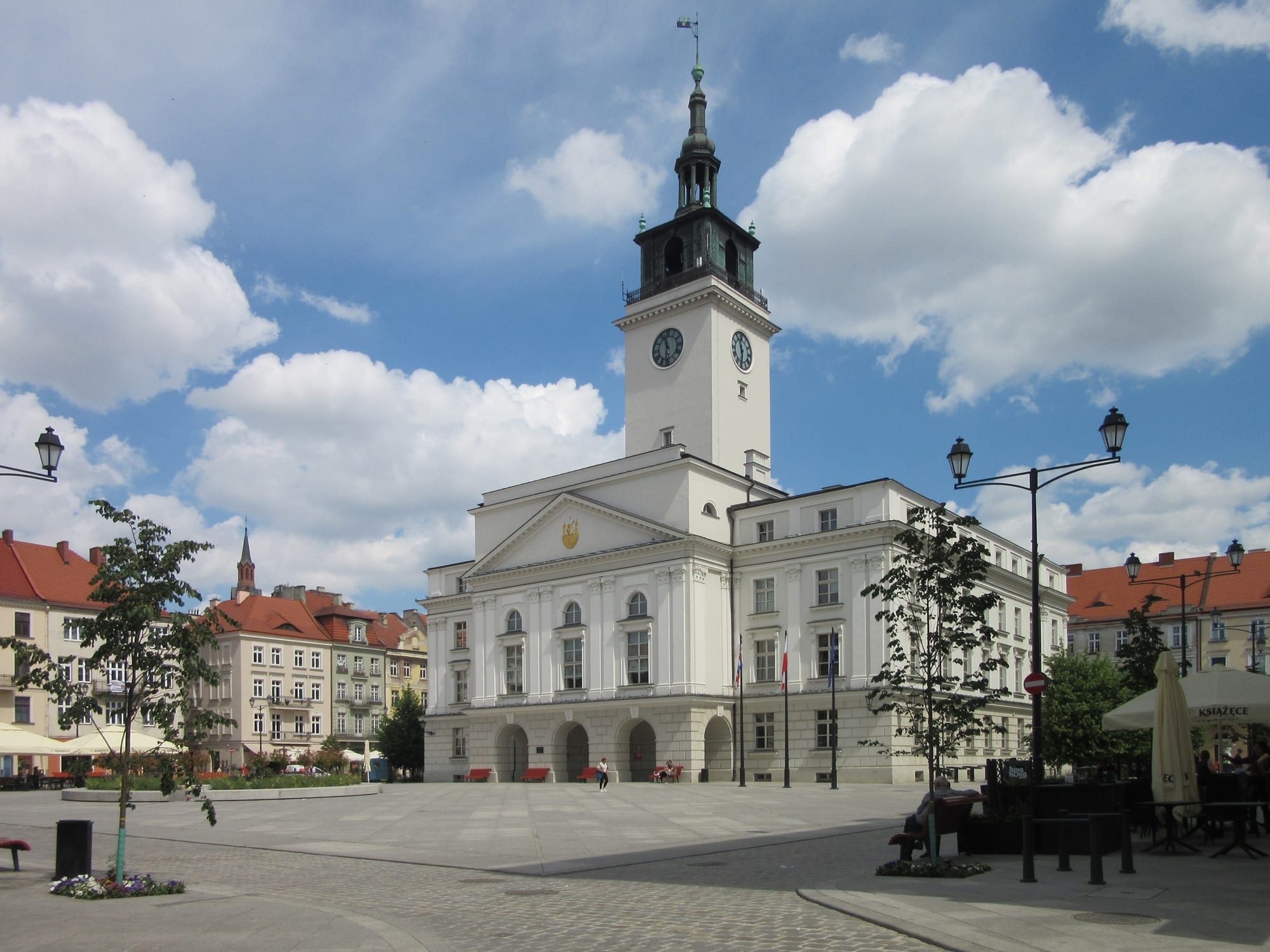
A white classical town hall with a tall clock tower on a paved market square, with red-roofed houses and summer clouds

Poznań & Western Poland, Poland

Kalisz

The town hall on Kalisz's Main Market Square. (Peżot / Wikimedia Commons · CC BY-SA 4.0)

Greater Poland's second city, on the Prosna river in the south-east of the province, and one of the oldest towns in Poland, often linked with the Calisia named by Ptolemy on the amber route. A medieval ducal seat and later a piano-making and textile town, it was burned in 1914 and rebuilt, and today has a centre of river islands, a market square and a park laid out in 1798.

Neighbourhoods

  • Old Town
    • First-time visitors
    • Historic district
    • Best for food

    The centre stands on two islands in the Prosna, around the Main Market Square. The town hall and the houses around the square were rebuilt between the wars after the destruction of 1914, and the cathedral, the Franciscan church and the old Jesuit college are a few streets away.

    Open in Maps
  • Nowe Miasto and the City Park
    • Parks
    • Arts and culture

    The historic New Town on the right bank of the Prosna, where Bolesław the Pious built a ducal castle before 1279. Beside it the City Park, laid out in 1798 and crossed by the river and its canals, holds the city theatre.

    Open in Maps
  • Zawodzie
    • Historic district
    • Archaeology

    The oldest part of the city, site of a small Piast-era fortress, where excavations have been turned into an archaeological reserve with a rebuilt gate, rampart and defence tower.

    Open in Maps
  • Szczypiorno
    • Quiet and residential
    • Sport

    A district added to the city in 1976, where early handball games were played in Poland — the reason the sport is called szczypiorniak in Polish.

    Open in Maps

Things to do

Famous landmarks

  • Cathedral of St Nicholaslandmark

    A cathedral on a 13th-century site with a Gothic star-vaulted chancel, known for its version of a Rubens Descent from the Cross and paintings and stained glass by Włodzimierz Tetmajer.

    Open in Maps
  • Town hall and Main Market Squarelandmark

    The town hall, rebuilt for the third time after 1914 in a style recalling the Renaissance, with a high tower and a viewing point, at the centre of the rebuilt square.

    Open in Maps
  • Basilica of the Assumptionlandmark

    The collegiate basilica on St Joseph's Square that is the sanctuary of St Joseph, rebuilt in brick in 1353, with a chapel commemorating the priests who died at Dachau and a monument to Pope John Paul II, who prayed here in 1997.

    Open in Maps
  • Franciscan church and monasterylandmark

    A church founded by Bolesław the Pious, with a 13th-century chancel, whose monastery walls incorporate parts of the Gothic town walls.

    Open in Maps
  • Stone Bridgelandmark

    Most Kamienny, built in 1825 over the Prosna, the oldest bridge in the city.

    Open in Maps

Museums and archaeology

  • Kalisz Piast Stronghold Archaeological Reservemuseum

    The excavated Piast-era fortress at Zawodzie, with a reconstructed gate, rampart and defence tower, the rebuilt foundations of its Romanesque collegiate church, exhibitions on the fortress and on folk life, and events through the summer.

    Open in Maps
  • Museum of the Kalisz Regionmuseum

    Muzeum Okręgowe Ziemi Kaliskiej, founded in 1906, with archaeology, ethnography, history and coins, and a sandstone grave slab thought to be that of Duke Mieszko III the Old.

    Open in Maps

Parks, the river and the stage

  • City Parkpark

    An English-style park of about 24 hectares founded in 1798, the oldest municipal park in Poland, crossed by the Prosna and its canals.

    Open in Maps
  • Wojciech Bogusławski Theatreattraction

    The city theatre in the park, heir to the troupe Bogusławski founded in 1801, which hosts the annual Kalisz Theatre Meetings.

    Open in Maps
  • Kalisz Philharmonicattraction

    The city's orchestra, founded in 1974, the same year as the International Jazz Pianists Festival.

    Open in Maps

Short trips from the city

  • Gołuchów Castlemuseum

    An early Renaissance castle of 1550–1560, now a branch of the National Museum in Poznań, in a landscape park of 158 hectares.

    Open in Maps
  • Ostrów Wielkopolskiattraction

    The neighbouring town to the south-west, which forms a single conurbation with Kalisz.

    Open in Maps

Seasonal events

  • Archaeological FairJune

    A fair of early medieval crafts and re-enactment at the Zawodzie reserve.

  • Kupala NightJune

    A midsummer night celebration at the Zawodzie reserve, named after the old Slavic festival now known as St John's Night.

  • Piast FeastAugust

    A summer festival of the early Piast era at the reconstructed stronghold in Zawodzie.

Eat and drink

Long-standing places and food districts in Kalisz. Hours, ratings and directions come from your maps app, always current.

Kalisz classics

  • Andruty kaliskiemarket

    Thin, lightly sweet wafers first recorded in Kalisz at the beginning of the 19th century and protected in the European Union since 2009 — the city's best-known food.

    Open in Maps
  • Milk barsrestaurant

    Bar mleczny, cheap canteens serving Polish home cooking, a survival of the communist era.

    Open in Maps

Food streets

  • Main Market Squareneighborhood

    Restaurants and cafés surround the square at the heart of the old town.

    Open in Maps
  • Śródmiejska Streetneighborhood

    The main street of the centre, with a mix of restaurants and bars.

    Open in Maps

Experience Kalisz

History

Roman-era finds suggest that a settlement here was a stop on the Amber Road, and Kalisz is often identified with the Calisia mentioned by Ptolemy in the 2nd century, though some historians doubt the link. The medieval town probably began in the 9th century as a castellany and small fort at Zawodzie. It received town rights between 1253 and 1260, and in 1264 Bolesław the Pious issued the Statute of Kalisz here, a charter protecting Jews that drew Jewish migration to Poland for centuries. Capital of a voivodeship from 1314, it resisted the Teutonic Knights in 1331, and Casimir the Great made peace with the Order here in 1343. Duke Mieszko III the Old was buried in the town.

A Jesuit college opened in 1584, but Poznań gradually overtook Kalisz. A fire in 1792 destroyed much of the centre, and in 1793 Prussia took the town. After 1815 it was a provincial capital under Russian rule, close to the Prussian border; trade and industry grew, Chopin visited three times, the railway reached it in 1902, and it became one of Poland's leading centres of piano making. In August 1914 German forces shelled and burned the city: of about 68,000 inhabitants, only 5,000 remained a year later.

Rebuilt in the 1920s, with a new town hall opened in 1925, Kalisz had about 81,000 people in 1939, a third of them Jewish. Under German occupation hundreds of Poles were murdered in the Winiary forest and some 30,000 Jews were killed in the Holocaust. It was a voivodeship capital again from 1975 to 1998, became a diocese in 1992 and was visited by Pope John Paul II in 1997.

Culture & Customs

Kalisz is proud of its age, and the Piast stronghold at Zawodzie, with its summer fairs, Kupala Night and Piast Feast, keeps the early medieval past in view. The city's theatre traces its history to the troupe Wojciech Bogusławski established in 1801, and since 1961 it has hosted the Kalisz Theatre Meetings. The Kalisz Philharmonic and the International Jazz Pianists Festival both date from 1974, and in 1969 the city staged Poland's first rock festival.

Religion is central to its public life. The city is the seat of a Catholic diocese, and the collegiate basilica is the sanctuary of St Joseph, with a chapel remembering the priests who died at Dachau. There are 19 Catholic churches as well as Protestant and Orthodox congregations. The Jewish community, which made up around a third of the town for much of the 19th and early 20th centuries, was destroyed in the Holocaust.

Sport has a special place: handball was first played in Poland in the district of Szczypiorno, which gave the game its Polish name, szczypiorniak, and MKS Kalisz plays in the top division. The women's volleyball club Calisia has won the national title four times, and the rowing club founded in 1894 is one of the oldest in Poland.

Daily Life

About 98,000 people lived in Kalisz at the end of 2025, down from a peak of about 110,000 in 2000; it is the second-largest city in Greater Poland and forms a conurbation with Ostrów Wielkopolski and Nowe Skalmierzyce. The city is divided into 23 residential districts, many named after the villages, farms and colonies absorbed since 1853. The historic centre sits on two islands in the Prosna, with the New Town on the right bank.

There is little heavy industry, but several large employers: the Winiary food plant, part of the Nestlé group, the food company Colian, the Big Star jeans factory and two aircraft-engine plants, WSK-Kalisz and a branch of Pratt & Whitney Canada. Piano making was long the city's speciality; the Calisia piano factory went out of business in 2007. The University of Kalisz is the main higher-education institution, alongside branches of Poznań's universities.

Winter smog is a recurring problem: westerly winds, the deep river valley, coal heating and traffic often push pollution above permitted limits.

Food

Kalisz's best-known speciality is andruty kaliskie, thin and lightly sweet wafers first recorded at the beginning of the 19th century in the city and the Kalisz Land. They were added to Poland's list of traditional products in 2005 and have been protected by the European Union since 2009, and they are the usual edible souvenir of a visit. The city's sweet-making history includes a gingerbread and biscuit factory founded in 1892.

Everyday menus are those of Greater Poland and of Poland as a whole: pierogi, gołąbki — cabbage leaves stuffed with meat — kotlet schabowy, the breaded pork cutlet, and soups such as żurek, a sour rye soup, and rosół, a clear broth that traditionally opens a three-course dinner. The city also has milk bars, bar mleczny, which serve cheap home cooking.

Eating out centres on the Main Market Square and the streets of the old town such as Śródmiejska. On St Martin's Day, 11 November, the St Martin's croissant with white poppy-seed filling, traditional in Poznań and parts of Greater Poland, appears in bakeries across the region.

Planning tools

Budget

Kalisz is inexpensive by Polish standards, with lower prices for rooms and meals than Poznań or Wrocław. Museum and reserve tickets are modest, and the park, the square and the churches cost nothing.

Daily Budget Midrange
USD 100–180 (city-centre hotel, restaurant meals, museum tickets, a trip to Gołuchów)
Daily Budget Shoestring
USD 40–70 (guesthouse, milk bars and bakeries, city buses)

Buy andruty from bakeries in the city as an inexpensive local souvenir.

Best Time to Visit

May to September, when the park is at its best and the archaeological reserve holds its summer events, from the June fair and Kupala Night to the Piast Feast in August. Winter is cold and grey, and can bring smog to the river valley.

Suggested Number of Days

Most first visits take one or two days, enough for the compact centre and its museums. Allow two to three days to include the castles and towns of the surrounding countryside, which are easier with a car.

First Visit
1–2 days
With Surroundings
2–3 days

Transportation

The centre is compact and best seen on foot. Kalisz Bus Lines run the city buses, which also serve the surrounding area, and a car or regional bus is the easiest way to reach Gołuchów and the countryside.

Check bus and train times in advance: Kalisz is not a rail hub, and some destinations are better served by bus.

Airport & Station Connections

The station, opened in 1902 and now on the Łódź–Forst line, has trains via Ostrów Wielkopolski to Poznań and Wrocław and east to Łódź, some continuing to Warsaw. Buses run frequently to Poznań and Wrocław. The nearest airports — Poznań–Ławica, Wrocław and Łódź — are each about 120 kilometres away, roughly two hours' travel. National roads 12 and 25 cross in the city.

Walkability

The old town, the park, the theatre and the main churches lie close together on the river islands and the banks of the Prosna, linked by short bridges, and are easy to cover on foot. Zawodzie and the outer districts are a bus ride away.

Safety

Poland is a safe country with low violent crime. Kalisz is a quiet provincial city where ordinary care with belongings is enough. In winter, the river valley, coal heating and traffic often push air pollution above permitted limits.

On smoggy winter days limit long outdoor exertion, and check for ticks after walks in the countryside. Check current official travel advice before travelling.

Climate

A temperate transitional climate, classed as humid continental with warm summers, with prevailing west and south-west winds. The city lies in the deep valley of the Prosna, which traps winter smog. In Poznań, January averages about −1°C and July about 18°C, and July is the rainiest month.

Summer
warm, with July in Poznań averaging about 18°C and days often reaching 30°C
Winter
cold and grey, with January in Poznań averaging about −1°C and frequent smog in the valley

Local Customs

A tip of about 10 per cent is usual in restaurants. Kalisz is the seat of a Catholic diocese and the sanctuary of St Joseph, so churches are busy places of worship. Residents take pride in the city's claim to be one of the oldest towns in Poland.

Dress modestly and keep quiet in churches during Mass.

Common Payment Methods

The currency is the złoty (PLN). Cards and contactless payment are accepted almost everywhere, though a little cash helps at bakeries and milk bars. Cash machines (bankomat) are common, and exchange offices (kantor) offer euro and dollar exchange.