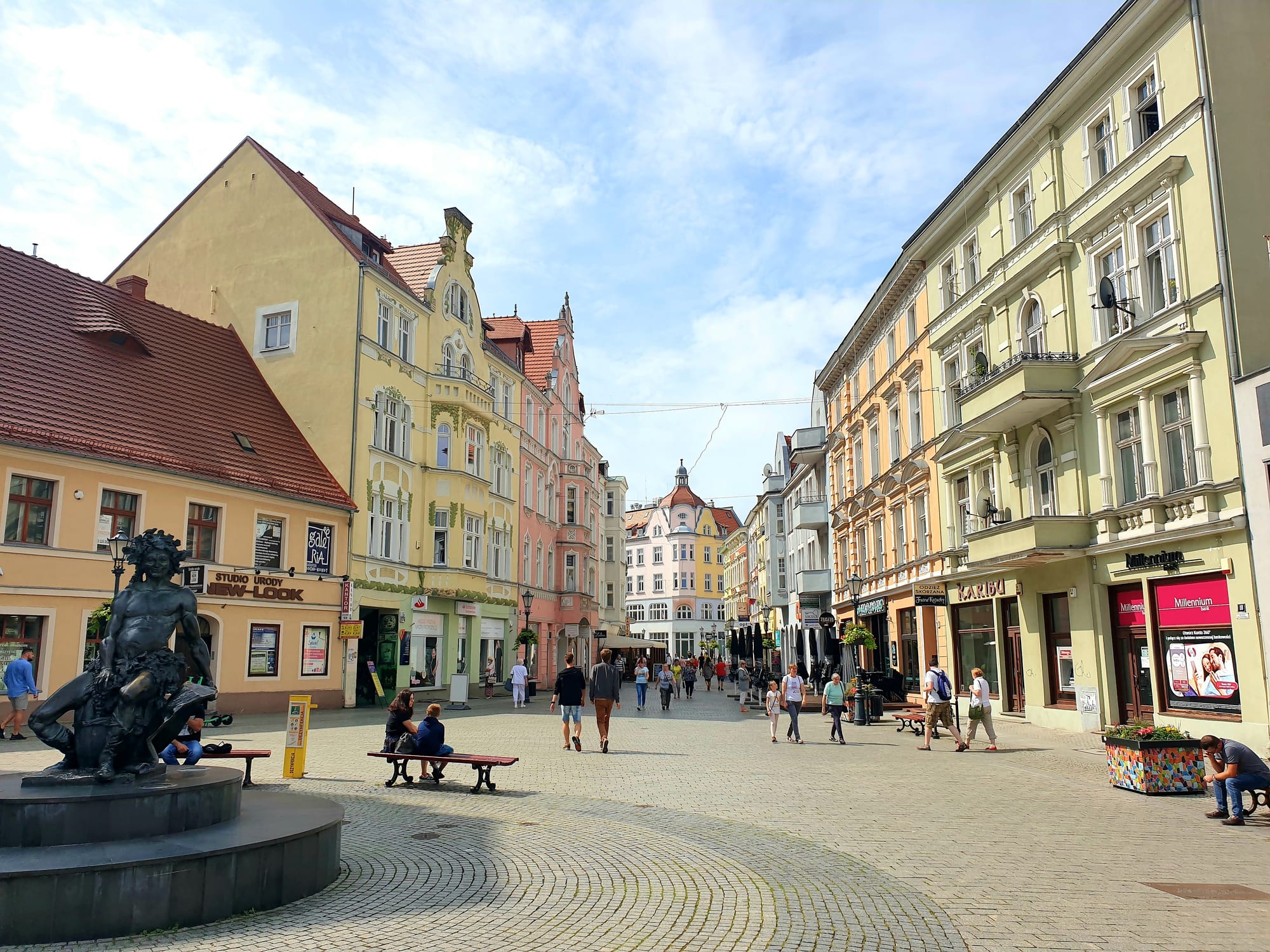
A cobbled pedestrian street of pastel town houses with a dark bronze fountain figure in the foreground

Poznań & Western Poland, Poland

Zielona Góra

The pedestrian street in the centre of Zielona Góra. (LZG / Wikimedia Commons · CC BY-SA 4.0)

The largest city of Lubusz Voivodeship in western Poland, a former Silesian cloth and wine town that was German Grünberg until 1945. Wooded hills cover about half its area, vineyards are being replanted on the slopes, and the Winobranie wine festival fills the old town each September. Today it is a university city and the seat of the regional assembly.

Neighbourhoods

  • Old Town
    • First-time visitors
    • Best for food
    • Historic district

    The medieval centre around the Old Market Square, with the town hall, the co-cathedral of St Hedwig, the timber-framed church of Our Lady of Częstochowa and a pedestrian street of town houses. The railway and bus stations are about ten minutes' walk away.

    Open in Maps
  • Wine Hill
    • Views
    • Parks

    The hill above the old town, once called Brick Hill, where a replanted city vineyard, the Palm House and an 1818 winegrower's house sit in a park, with viewing terraces at the Palm House.

    Open in Maps
  • Nowe Miasto
    • Quiet and residential
    • Countryside

    The former rural municipality around the city, merged into it in 2015, which made Zielona Góra one of the largest cities in Poland by area. It takes in villages, woods and palace parks such as Ochla, with its open-air museum, and Stary Kisielin.

    Open in Maps

Things to do

Old town landmarks

  • Town halllandmark

    The 15th-century Gothic town hall on the Old Market Square, whose 54-metre tower leans slightly; a bugle call, the 'Hymn of the Lubusz Land', is played from it every day at noon.

    Open in Maps
  • Co-cathedral of St Hedwiglandmark

    A Gothic hall church founded in 1294 and dedicated to St Hedwig of Silesia, the oldest building in the city and co-cathedral of the Diocese of Zielona Góra-Gorzów.

    Open in Maps
  • Church of Our Lady of Częstochowalandmark

    A timber-framed church built between 1743 and 1777 as a Protestant meeting house and reconsecrated as a Catholic church after 1945.

    Open in Maps
  • Łaziebna Towerlandmark

    A rectangular tower of 1487, also called the Hunger Tower, a surviving piece of the medieval town walls.

    Open in Maps
  • Bacchus figuresattraction

    Small bronze figures of the wine god dotted around the city since a Bacchus monument was unveiled in 2010 — 84 by the end of August 2026 — with a map available from the tourist information centre.

    Open in Maps

Museums and the arts

  • Lubusz Land Museummuseum

    Muzeum Ziemi Lubuskiej, the regional museum, which since 2006 has housed Poland's only permanent exhibition on the history and culture of wine, along with a museum of torture.

    Open in Maps
  • Ethnographic Museum in Ochlamuseum

    An open-air museum of rural buildings on the edge of the city, with fairs and craft days through the year.

    Open in Maps
  • Lubusz Theatreattraction

    The city theatre, in a modernist building of 1931 designed by the Berlin architect Oskar Kaufmann, which opened as an opera house.

    Open in Maps
  • Zielona Góra Philharmonicattraction

    The city's concert hall, with classical and some popular programmes and open-air promenade concerts in front of the building in summer.

    Open in Maps

Vineyards and green spaces

  • Palm Housepark

    A glasshouse built in 1961 onto the 1818 house of the winegrower August Grempler on Wine Hill, surrounded by a reconstructed vineyard, a maze and a wine cellar selling only wines of the Lubusz region.

    Open in Maps
  • Anna German Amphitheatrepark

    An open-air amphitheatre in a park on the Piast Hills, run by the city's cultural centre and named after the singer Anna German since 1987.

    Open in Maps

Speedway and sport

  • Falubaz Zielona Góraattraction

    Speedway is the city's most popular sport, and Falubaz, one of Poland's most successful teams, races in the top division.

    Open in Maps

Short trips from the city

  • Zatonieattraction

    A village south-east of the city whose 17th-century palace, inherited by Dorothea of Courland in the 19th century and burned in 1945, stands as a preserved ruin in a large landscape park.

    Open in Maps
  • Paradyż Abbeylandmark

    The former Cistercian abbey at Gościkowo, formerly Paradyż, where monks made wine from 1250; it is now a theological seminary and a Historic Monument of Poland.

    Open in Maps
  • Christ the King statue, Świebodzinlandmark

    A 33-metre statue of Christ completed in 2010, rising to 52.5 metres with its mound.

    Open in Maps
  • Łagówattraction

    A village on an isthmus between two forest lakes, with a castle of the Knights Hospitaller.

    Open in Maps

Seasonal events

  • Winobraniefirst half of September

    A nine-day wine festival held since 1852, opening on a Saturday when Bacchus and his Maenads receive the keys of the town, with a parade, a folklore festival, street theatre, concerts and market stalls across the centre.

  • Lubusz Open Cellars and Vineyards FestivalMay

    Wine cellars and vineyards in and around the city open to visitors.

  • Kozzi Film FestivalJune

    A festival of film and theatre held in the city each summer.

  • Young Wine FestivalDecember

    A celebration of the year's new wine, held as the Christmas market fills the pedestrian street.

Eat and drink

Long-standing places and food districts in Zielona Góra. Hours, ratings and directions come from your maps app, always current.

Wine and drink

  • Palm House wine cellarrestaurant

    The Palm House on Wine Hill has a restaurant inside the glasshouse and a cellar that sells only wines from the Lubusz region.

    Open in Maps
  • Lubusz vineyardsneighborhood

    Small wineries in and around the city, most of them founded since 2001, making mainly white wines.

    Open in Maps

Food streets

  • Old Market Square and the pedestrian streetneighborhood

    Cafés, pubs and restaurants around the market square and along the pedestrian street, the centre of the city's eating and drinking.

    Open in Maps

Experience Zielona Góra

History

A farming settlement grew up in the valley of the Złota Łącza stream under Mieszko I. Henry the Bearded brought settlers in 1222 and the town received its charter in 1323. The church of St Hedwig was founded in 1294, and the first vineyards around the town are recorded in 1314. Cloth and wine made Grünberg prosperous: Sigismund the Old allowed its cloth to be sold across Poland in 1505, although the town passed to Bohemia in 1506 and to the Habsburgs in 1526.

The Thirty Years' War brought plundering and fires, the Counter-Reformation suppressed Lutheranism, and witch trials followed from 1640. Prussia took the town in 1742. Cloth-making moved to factory production in the early 19th century, and English industrialists bought mills in the 1870s and 1880s. Under Nazi rule the synagogue was destroyed in 1938, and during the Second World War the city held 42 forced-labour camps and three subcamps of Gross-Rosen.

The Red Army took the town with little fighting on 14 February 1945. The remaining German inhabitants were expelled, and Poles from the eastern lands annexed by the Soviet Union settled in their place. On 30 May 1960 the city saw the first large-scale protests against the communist authorities since the war, yet a Soviet song festival held from 1965 to 1989 earned it the nickname "Red Mountain". It was a voivodeship capital from 1950 to 1998, its population passed 100,000 in 1980, the University of Zielona Góra opened in 2001, and in 2015 the surrounding rural municipality was merged into the city.

Culture & Customs

Wine is the city's emblem. Zielona Góra is one of two places in Poland where wine grapes are grown, mainly for white wines, and at its peak some 2,500 vineyards lay within the town. Production dwindled in the communist era and the last wine factory closed in the 1990s, but small wineries have returned since 1990, and in 2015 a 33-hectare municipal vineyard at Zabór was the largest in Poland. The Winobranie, held since 1852, takes over the centre for nine days each September, and dozens of small Bacchus figures stand in the streets. Since 2010 St Urban has been the city's patron saint, and his relics are carried in procession during the festival.

The city's culture took shape after 1945, when settlers from all over Poland and the former eastern lands made their homes in a German town. It is known for cabaret, with a cabaret festival among its annual events, and for its Philharmonic, the Lubusz Theatre and the International Folklore Festival held during Winobranie. The singer Anna German gives her name to the amphitheatre in the park on the Piast Hills.

Sport is followed passionately. Speedway is the most popular, and Falubaz Zielona Góra, seven times Polish team champions, is among the best-supported clubs in the country. The basketball club Zastal has had a run of success in recent years, and Lechia plays football in the third tier.

Daily Life

About 139,000 people lived in Zielona Góra in mid-2025, making it the largest city in Lubusz Voivodeship. It shares the role of regional capital with Gorzów Wielkopolski: the elected regional assembly sits here, the government-appointed governor in Gorzów. Since the 2015 merger, green areas cover more than half of the city's area, and the rural district of Nowe Miasto is part of it.

The University of Zielona Góra, created from a polytechnic and a teacher-training college, is the largest higher-education institution in the region, and some 18,000 students live in the city. The economy is led by electronics and IT — including a maker of satellite television decoders — alongside the Luksusowa vodka distillery. An economic activity zone has operated since 2005 and an industrial and technology park since 2010. Registered unemployment was 2.5 per cent at the end of 2022. A transport interchange opened beside Zielona Góra Główna station in 2019, with city buses to every part of Zielona Góra.

Food

Zielona Góra's table is built around its drinks. Local wineries make mostly white wine from vineyards replanted on the slopes around the city, and the Lubusz Wine and Honey Trail runs through the city. Luksusowa, a potato vodka made since 1928, has been distilled in the city since the borders moved west after the Second World War, and local beers are popular too.

Everyday menus offer Polish staples: pierogi, gołąbki — cabbage leaves stuffed with meat — kotlet schabowy, the breaded pork cutlet, and soups such as żurek, a sour rye soup, and rosół, a clear meat broth. A milk bar in front of the railway station serves inexpensive everyday meals.

The Old Market Square and the pedestrian street hold most of the cafés, pubs and restaurants, and the Palm House on Wine Hill has a restaurant under glass and a cellar selling only Lubusz wines. During the Winobranie the centre becomes one large market of food and wine stalls.

Planning tools

Budget

Zielona Góra is cheaper than Poznań or Wrocław, with modest prices for meals and buses.

Daily Budget Midrange
USD 100–200 (city-centre hotel, restaurant meals, museum tickets, wine tastings)
Daily Budget Shoestring
USD 40–70 (hostel or guesthouse, milk bars and bakeries, city buses)

Pick up the map of the Bacchus figures at the tourist information centre — following them is a free way to see the city.

Best Time to Visit

May to September, with the vineyards in leaf and the open-cellar days in May and June. Early September brings the nine-day Winobranie, the busiest and liveliest time of the year. December has the young wine festival and the Christmas market; winters are otherwise grey and quiet.

Suggested Number of Days

One or two days cover the old town, the museums and Wine Hill. Three or four allow time for the vineyards, palaces and lakes of Lubusz, which are far easier with a car; festival week needs more time and earlier planning.

First Visit
1–2 days
With Surroundings
3–4 days

Transportation

The centre is compact and walkable. Municipal buses run across the city and its outlying villages, with a few frequent routes, night lines and a single flat fare within the city; every bus has a ticket machine. Taxis from the established companies are easy to find. A car is the practical way to reach the vineyards and the Lubusz lakes.

Validate bus tickets on boarding, and note that some lines do not run at weekends.

Airport & Station Connections

Zielona Góra Główna station, about ten minutes' walk from the old town, has trains to Poznań, Wrocław, Szczecin, Warsaw and Kraków and direct services to Berlin. The bus station is next to it. Zielona Góra Airport at Babimost, 35 kilometres north-east of the centre, has domestic flights to Warsaw. By road the city lies on the S3 expressway, and the German border crossings at Świecko, Gubin and Słubice are within reach.

Walkability

The old town, the pedestrian street, the theatre and the museums are all within a short walk of each other, and the station is ten minutes from the market square. Outer districts and the villages of Nowe Miasto need a bus or car.

Safety

Poland is a safe country with low violent crime. Zielona Góra is a calm university city; the busiest moments are the evenings of the wine festival, when the centre is crowded.

Watch bags in festival crowds, obey forest-fire warnings and entry bans in the woods in dry weather, and check for ticks after walks. Check current official travel advice before travelling.

Climate

A mild transitional climate with strong oceanic influence. The wooded hills have small differences between day and night, and in the summer half of the year their nights are on average 0.5 to 1.5°C warmer than in Poznań, Wrocław or Słubice.

Summer
warm, with July in Poznań averaging about 18°C and days often reaching 30°C
Winter
cool and grey, with January in Poznań averaging about −1°C

Local Customs

A tip of about 10 per cent is usual in restaurants. Wine is part of local identity, and the festival doubles as the Days of Zielona Góra.

Dress modestly and keep quiet in churches during Mass.

Common Payment Methods

The currency is the złoty (PLN). Cards and contactless payment are accepted almost everywhere, though a little cash helps at bakeries, market stalls and festival stands. Cash machines (bankomat) are common, and exchange offices (kantor) offer euro and dollar exchange.