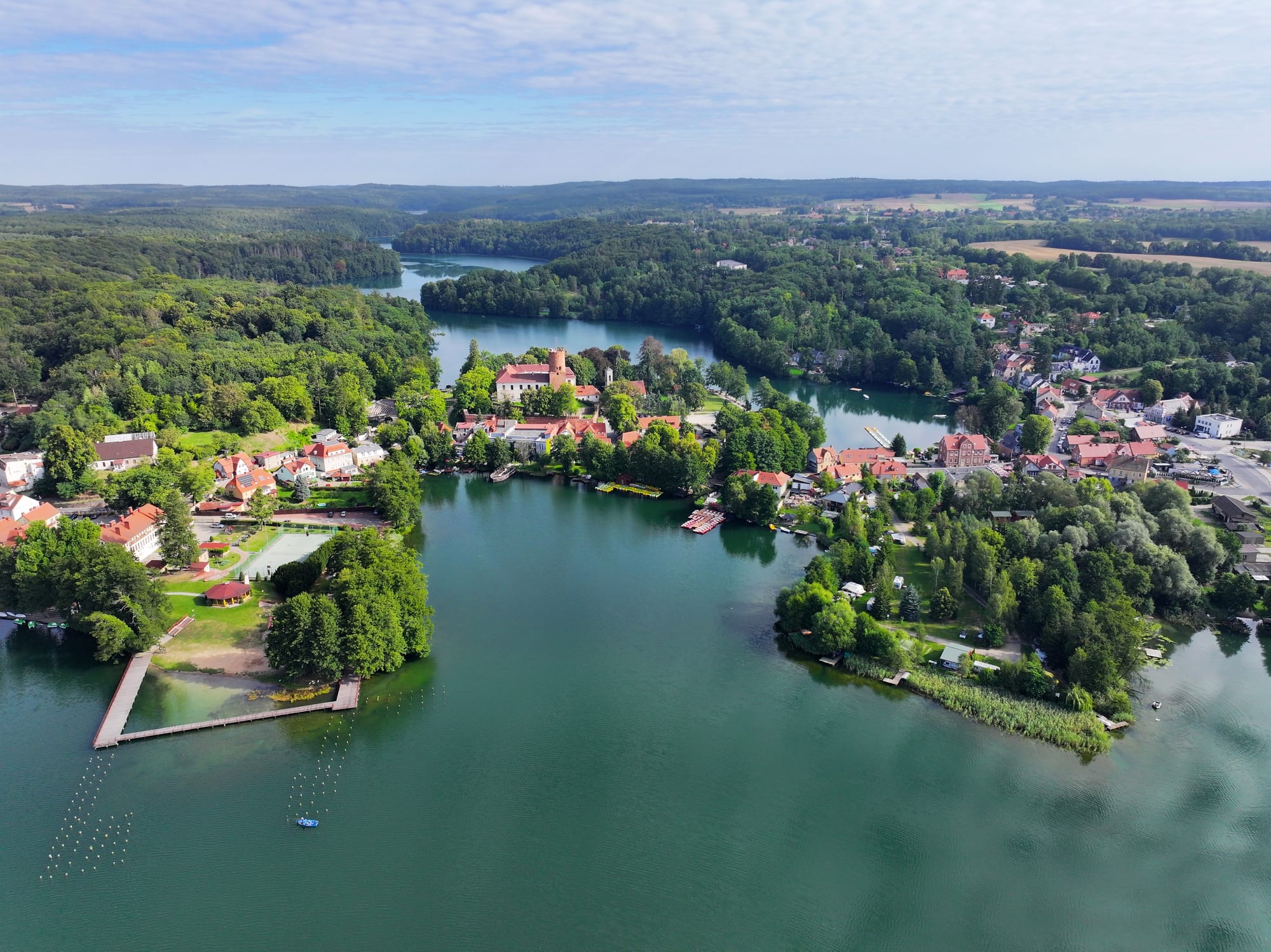
Aerial view of a village with a red-brick castle tower between two green lakes surrounded by forest

Poland

Poznań & Western Poland

Łagów in Lubusz, with its castle of the Knights Hospitaller between two forest lakes. (TomaszPrzezdziecki / Wikimedia Commons · CC BY 4.0)

Poland's western lowlands between the Warta and the Oder — Greater Poland around Poznań and Gniezno, cradle of the Polish state, and Lubusz on the German border around Zielona Góra and Gorzów, a land of pine forests, lakes and vineyards — known for orderly towns, prosperous farms and a strong regional pride.

Explore Poznań & Western Poland

History

Greater Poland, Wielkopolska, is where the Polish state began. The Polans' ruler Mieszko I accepted Christianity in 966, and Poznań received Poland's first bishopric in 968, while Gniezno, the traditional first capital, became an archbishopric in the year 1000 when Emperor Otto III came to venerate the relics of St Adalbert. Bolesław the Brave was crowned the first king in 1025, and the island of Ostrów Lednicki between the two towns preserves the ruins of an early ducal residence. Later Kraków took over as capital, but Poznań grew into a rich trading city.

After the Partitions, Greater Poland fell to Prussia. Under German rule its Poles answered pressure to Germanise with "organic work" — cooperatives, banks, schools and savings societies — which shaped the region's reputation for thrift and efficiency. In December 1918 the Greater Poland Uprising won most of the province back for the reborn Poland, one of the two most successful Polish risings.

Lubusz had a different past, belonging for centuries to Brandenburg and Silesia. It was German until 1945, when its population was expelled and replaced by settlers from central Poland and the lost eastern lands. In June 1956 Poznań's workers rose against the communist government, a revolt crushed by the army but remembered as the first of Poland's great protests.

Culture & Customs

Poznaniacy have a national reputation for being thrifty, orderly and hard-working, a stereotype they half enjoy. Their dialect, gwara poznańska, mixes Polish with German loanwords: a potato is a pyra. Local pride runs through the football club Lech Poznań and the memory of the 1918 uprising, whose outbreak is commemorated every year on 27 December.

St Martin's Day on 11 November, also Independence Day, is Poznań's great festival, with a parade and St Martin's croissants eaten across the city. The noon butting of the two mechanical goats on the town hall tower is the city's best-known ritual. Gniezno's cathedral remains the seat of the Primate of Poland, and the basilica at Licheń near Konin, the largest church in Poland, draws large pilgrimages.

Lubusz's culture is younger, formed after 1945 by settlers who took over German towns. Zielona Góra has built its identity around wine: the Winobranie festival each September and small Bacchus figures dotted in the streets. The region's closeness to Germany is felt in cross-border shopping, commuting and twin towns along the Oder.

Daily Life

Poznań has about 540,000 people, and its metropolitan area has over a million. Kalisz, Konin, Gniezno, Leszno and Piła are the other Greater Poland towns, while Lubusz's two capitals, Zielona Góra and Gorzów Wielkopolski, have more than 100,000 people each.

Poznań's economy combines the Poznań International Fair, one of the country's largest trade-fair grounds, with car and bus production, food processing, breweries and IT and business services. About 60% of Greater Poland's land is fertile farmland. Lubusz has furniture and wood factories, logistics along the A2 motorway, and a revived wine industry.

The pace is steady and practical. Poznań is a student city with a busy old town, and the lake district of Lubusz fills with weekend visitors from Poznań, Wrocław and Berlin in summer. Drought and water shortages in farming, and the future of lignite mining and power plants around Konin, are current issues.

Food

Poznań's best-known speciality is the rogal świętomarciński, a large croissant filled with white poppy seed, nuts and dried fruit and glazed, eaten on St Martin's Day and protected by EU designation. Everyday regional dishes include pyry z gzikiem, potatoes with curd cheese mixed with onion and chives and soured cream, szare kluski, grey dumplings made with grated raw potato, and czernina, a sweet-sour soup made with duck's blood. Bakeries sell szneka z glancem, a yeast bun with icing.

Greater Poland's rich farms also produce sausages, smoked meats and cold cuts, duck and goose, and the region brews Lech beer in Poznań.

Lubusz is the heart of Polish wine. Vineyards on the slopes around Zielona Góra date back to the Middle Ages, faded after 1945, and have been replanted since the 1990s, with wineries open to visitors on the Lubusz Wine and Honey Trail. Honey from the region's forests and river fish, such as pike and zander from the lakes, complete the table.

Attractions & Natural Wonders

Poznań's Old Market Square surrounds the Renaissance town hall, whose goats appear at noon, with colourful merchant houses and museums. Ostrów Tumski holds the cathedral with the Golden Chapel, where Mieszko I and Bolesław the Brave are commemorated, and the Porta Posnania heritage centre. The Imperial Castle, built for Kaiser Wilhelm II, the Croissant Museum and Lake Malta are nearby, and Wielkopolska National Park lies just south of the city.

The Piast Route leads east to Ostrów Lednicki and Gniezno, whose cathedral holds St Adalbert's silver shrine and the 12th-century bronze Gniezno Doors. South of Poznań are Kórnik castle and Rogalin's palace and ancient oaks.

In Lubusz, Zielona Góra has its vineyards, the Wine Hill with a palm house, and Bacchus figures around the old town. The Lubusz lakes include Łagów, with its castle of the Knights Hospitaller between two lakes, Lubniewice and Sława lake. Nearby are the Międzyrzecz Fortified Region of wartime bunkers and tunnels, home to large numbers of hibernating bats, the huge Christ the King statue at Świebodzin, Ujście Warty National Park's wetlands, and Muskau Park at Łęknica, a UNESCO World Heritage landscape garden shared with Germany.

Cities in Poznań & Western Poland

Planning basics

Budget

Western Poland is moderately priced. Poznań hotels fill and prices rise during large trade fairs, when booking ahead matters, but restaurants and transport are reasonable. Gniezno, Zielona Góra, Gorzów and the lake villages of Lubusz are cheaper, with guesthouses and holiday cabins by the water in summer.

Daily Budget Midrange
USD 120–240 (old-town hotel, restaurant meals, museum and castle tickets, a winery visit)
Daily Budget Shoestring
USD 45–80 (hostel, milk bars and bakeries, regional trains and trams)

Check Poznań's trade-fair calendar before booking, and visit Gniezno as an easy day trip by train.

Safety

The region is safe, with only the usual pickpocketing around Poznań's station and old town and some late-night rowdiness on weekends. In summer the dry pine forests of Lubusz carry a real risk of forest fires, and ticks are common in the woods and meadows.

Obey forest-fire warnings and entry bans in dry weather, and check for ticks after walks. Check current official travel advice before travelling.

Climate

The west is one of the mildest and driest parts of Poland, with warm summers, relatively short winters and the influence of Atlantic air. Parts of Greater Poland receive among the lowest rainfall in the country, and droughts are an increasing concern. Lubusz, with its sandy soils and sheltered slopes, is warm enough for grapes.

Summer
warm, 22–29°C, with occasional heatwaves and thunderstorms
Winter
cool, around −3 to 3°C, with frequent grey days and little lasting snow

Transportation

Poznań is a rail hub, with fast trains to Warsaw and direct services to Berlin, and an airport at Ławica. Gniezno is a short train ride from Poznań. Zielona Góra has a small airport at Babimost and rail links, and Gorzów connects by rail via Kostrzyn and Krzyż. The A2 motorway crosses the region from Warsaw to the German border. A car helps for the lakes and castles.

Use trains between the cities and a car for the Piast Route and the Lubusz lake villages.

Best Time to Visit

May to September suits the cities, the Piast Route and the lakes, with July and August best for swimming in Lubusz. Zielona Góra's grape harvest festival, the Winobranie, takes place in September, and Poznań celebrates St Martin's Day on 11 November with parades and the famous croissants. Christmas brings a market to Poznań's old town.