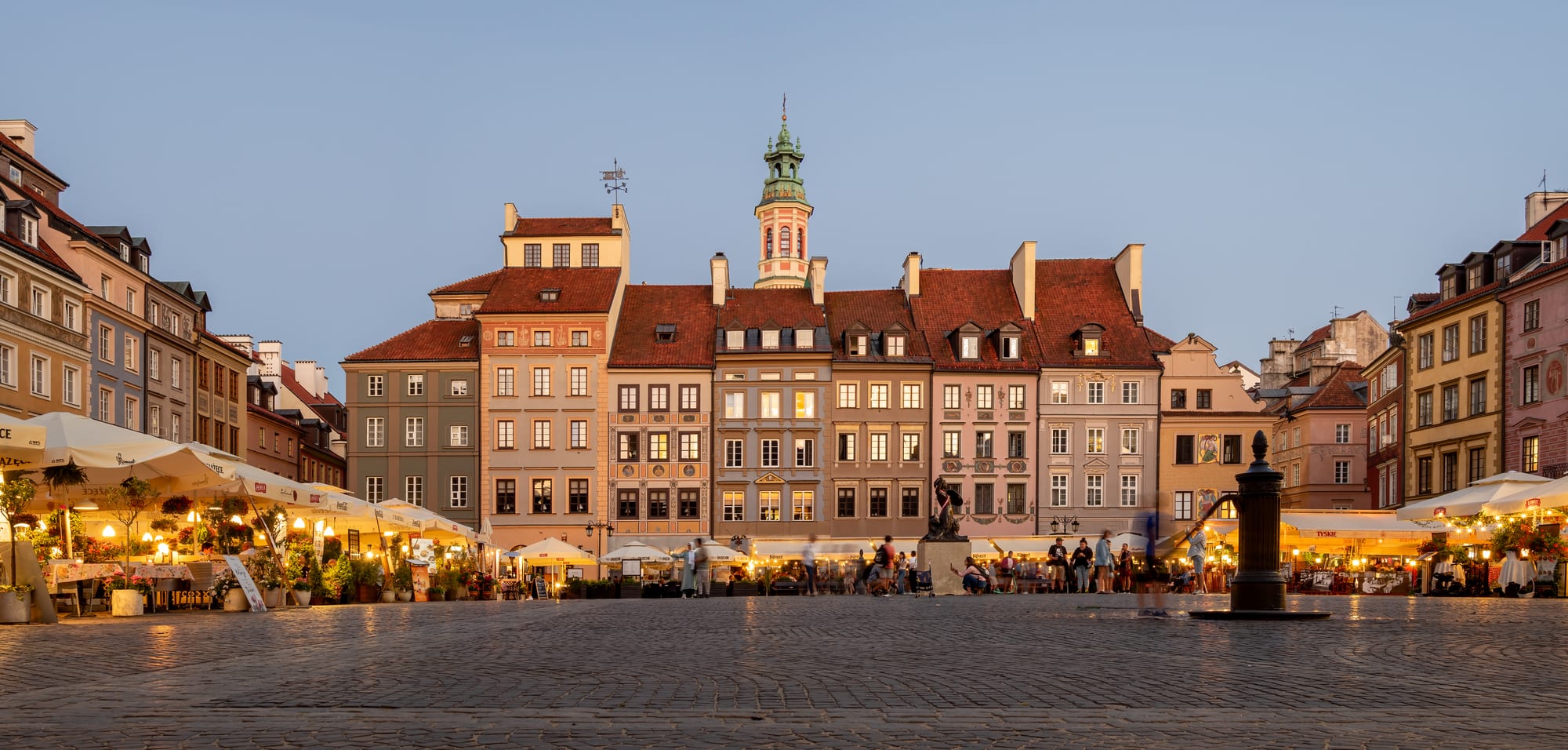
Colourful tall townhouses with red roofs and a small tower lining Warsaw's cobbled Old Town square at dusk

Poland

Warsaw, Mazovia & Łódź

The Old Town Market Square in Warsaw, rebuilt after 1945 from paintings, photographs and surviving fragments. (Rhododendrites / Wikimedia Commons · CC BY-SA 4.0)

The flat heart of central Poland along the middle Vistula, joining the capital Warsaw and its Masovian hinterland with the old textile city of Łódź — a region of rebuilt and reinvented cities, Chopin's birthplace at Żelazowa Wola, the early royal seat of Płock and the orchards and folk-art villages between them.

Explore Warsaw, Mazovia & Łódź

History

Mazovia was a separate duchy for much of the Middle Ages, ruled by a branch of the Piast dynasty. Płock, on its bluff above the Vistula, was the residence of the dukes Władysław Herman and Bolesław III Wrymouth in the late 11th and early 12th centuries, and both lie buried in its cathedral. Warsaw grew later, as a fortified market town of the Masovian dukes, and the duchy was absorbed into the Polish crown in 1526. When King Sigismund III Vasa moved his court from Kraków around 1596, Warsaw began its rise as the capital of the Polish–Lithuanian Commonwealth, sitting conveniently between Kraków and Vilnius.

After the Partitions most of the region fell to Russia, and Warsaw became the capital of the tsarist-ruled Congress Kingdom, crushed after the risings of 1830 and 1863. Łódź, a small town in 1820, was chosen for textile manufacturing and exploded into a city of Polish, Jewish, German and Russian workers and mill owners, earning the name "Polish Manchester".

The Second World War fell hardest here. The Germans sealed Warsaw's Jews into a ghetto, whose fighters rose in 1943, and then razed the city after the Warsaw Uprising of 1944; Łódź held the Litzmannstadt ghetto, the last in occupied Poland to be liquidated, in 1944. Warsaw was rebuilt as the communist capital, Łódź lost its mills after 1989, and both have since been transformed — Warsaw into a business capital, Łódź through the conversion of its factories.

Culture & Customs

Warsaw's identity rests on its destruction and rebirth: the city marks 1 August, the anniversary of the Uprising, with sirens at 5 p.m. when traffic and pedestrians stop, and its streets are dotted with plaques recording wartime executions. Most of today's Varsovians descend from post-war arrivals, and the old Warsaw street dialect survives mainly in songs and literature.

Chopin is the region's cultural patron. He was born at Żelazowa Wola and grew up in Warsaw, where his heart is kept in a pillar of the Holy Cross Church, free concerts are played beneath his monument in Łazienki Park on summer Sundays, and the Chopin Competition is held every five years.

Łódź has a different spirit — industrial, multicultural in memory and creative now. The National Film School, whose graduates include Andrzej Wajda, Roman Polański and Krzysztof Kieślowski, earned it the nickname "HollyŁódź", and its mill owners' palaces and street murals give it a gritty character proud of being unlike the capital.

Folk culture is strongest in the countryside. Łowicz, in Łódź province, is known for its striped costumes and paper cut-outs called wycinanki, and the Kurpie forest villages of northern Masovia make tall Easter palms decorated with flowers.

Daily Life

Warsaw has about 1.8 million people and a metropolitan area of over three million, making it by far the largest city in Poland; Łódź has about 650,000, having shrunk since 1989, and Radom and Płock are the other main centres. The capital's economy runs on government, finance, corporate headquarters, IT and services, and its glass towers around the Palace of Culture keep multiplying. Płock is dominated by the Orlen oil refinery, and Masovia's farms include the huge apple orchards around Grójec, south of Warsaw.

Łódź has reinvented itself around logistics, business services, universities and its converted mills, and its new underground Fabryczna station brought it closer to the capital.

The rhythm is metropolitan in Warsaw — long commutes, early starts, busy riverside boulevards on summer evenings — and slower in the small towns, where Sunday Mass and the family lunch still frame the week. Housing costs in Warsaw, the large Ukrainian community that arrived after 2022 and the gap between the booming capital and the stagnating smaller towns of Masovia are the issues of the moment.

Food

Central Poland's cooking is the national table at its most familiar, with a few local signatures. Warsaw claims flaki po warszawsku, tripe soup with marjoram and nutmeg, and pyzy, round potato dumplings often filled with meat. Its cake is the wuzetka, a chocolate sponge filled with whipped cream, and on All Saints' Day street sellers near the cemeteries offer pańska skórka, a pink-and-white chewy sweet.

Łódź keeps zalewajka, a sour rye soup with potatoes that was once the food of mill workers, and its many ethnic communities left traces in a taste for Jewish-style breads and German-style sausages. Łowicz is known for its dairy cooperative and its cheeses and jams, and the Grójec orchards supply apples for cider, juice and the szarlotka apple cake served across the region.

Warsaw has become Poland's most varied place to eat, with Vietnamese restaurants founded by a community that arrived in the communist era, a strong vegan scene, revived milk bars and food halls in the old Koneser vodka works in Praga, which also houses the Polish Vodka Museum.

Attractions & Natural Wonders

Warsaw's Old Town, rebuilt after 1945 and listed by UNESCO, centres on the Market Square, the Royal Castle and the Barbican walls, and the Royal Route runs south past the university to Łazienki Park, with its Palace on the Isle, and on to Wilanów Palace. The Warsaw Rising Museum, the POLIN Museum of the History of Polish Jews, the Copernicus Science Centre, the Palace of Culture's viewing terrace and the Praga district across the river complete the city. Kampinos National Park, a forest of dunes and marshes, begins at Warsaw's north-western edge.

About 50 kilometres west, Żelazowa Wola preserves the manor house where Chopin was born, now a museum with summer recitals in its garden. Further on, in Łódź province, the Radziwiłł palace at Nieborów and the romantic Arkadia garden lie near Łowicz, whose museum and churches show off regional folk art.

Łódź itself offers Piotrkowska Street, some four kilometres of 19th-century façades, Manufaktura in the Poznański cotton mill, the Księży Młyn workers' estate, the Museum of Art, one of the world's oldest museums of modern art, and the Radegast station memorial to the ghetto.

North-west of Warsaw, Płock's Cathedral Hill holds the Romanesque-rooted cathedral with its ducal tombs and the castle above the Vistula, and to the south of the capital stand the ruins of the Masovian dukes' castle at Czersk.

Cities in Warsaw, Mazovia & Łódź

Planning basics

Budget

Warsaw is the most expensive city in Poland for hotels and restaurants, though still well below Western European capitals, and public transport is cheap and excellent. Łódź is noticeably cheaper for the same quality of hotel, often in converted factories, and Płock and the small towns of Masovia cost less again.

Daily Budget Midrange
USD 130–260 (central hotel, restaurant meals, museum entries, intercity trains to Łódź)
Daily Budget Shoestring
USD 55–90 (hostel, milk bars and canteens, a public-transport day ticket)

Stay in Łódź and visit Warsaw by train for lower hotel prices, and use Warsaw's 24-hour or weekend transport tickets.

Safety

The region is safe, with the usual big-city issues of pickpocketing in Warsaw's Old Town, around Warszawa Centralna station and on crowded trams. Some inner-city Łódź streets are run-down and quiet at night but not dangerous for visitors. Large marches in Warsaw on Independence Day, 11 November, have seen clashes in past years.

Watch belongings at Warsaw's central station and on trams, and avoid the route of the 11 November march. Check current official travel advice before travelling.

Climate

Central Poland has the typical lowland climate of the country, a little drier than the coast and the south, with warm summers and cold, often grey winters. Snow cover is irregular and is usually brief in Warsaw and Łódź, while the heat island of the cities makes summer afternoons feel warmer than the countryside.

Summer
warm, 20–28°C, with thunderstorms and occasional heatwaves above 30°C
Winter
cold and cloudy, around −5 to 2°C, with spells of frost and light snow

Transportation

Warsaw is the hub of the Polish rail network and of the country's air traffic through Chopin Airport. Warsaw and Łódź are linked by frequent trains to Łódź Fabryczna, and the two cities are also joined by motorway. Warsaw has a two-line metro, trams and buses; Łódź has an extensive tram system. Żelazowa Wola is easiest to reach by car, and Płock by bus or train from Warsaw.

Buy Warsaw–Łódź tickets ahead on the faster services, and allow half a day for Żelazowa Wola if relying on public transport.

Best Time to Visit

May to September suits walking both cities, with free Chopin concerts in Łazienki Park on summer Sundays and Łódź's Piotrkowska at its busiest on summer evenings. Early autumn is mild and quieter. Warsaw hosts the International Chopin Piano Competition every five years in October, and December brings Christmas lights and a market in the Old Town.