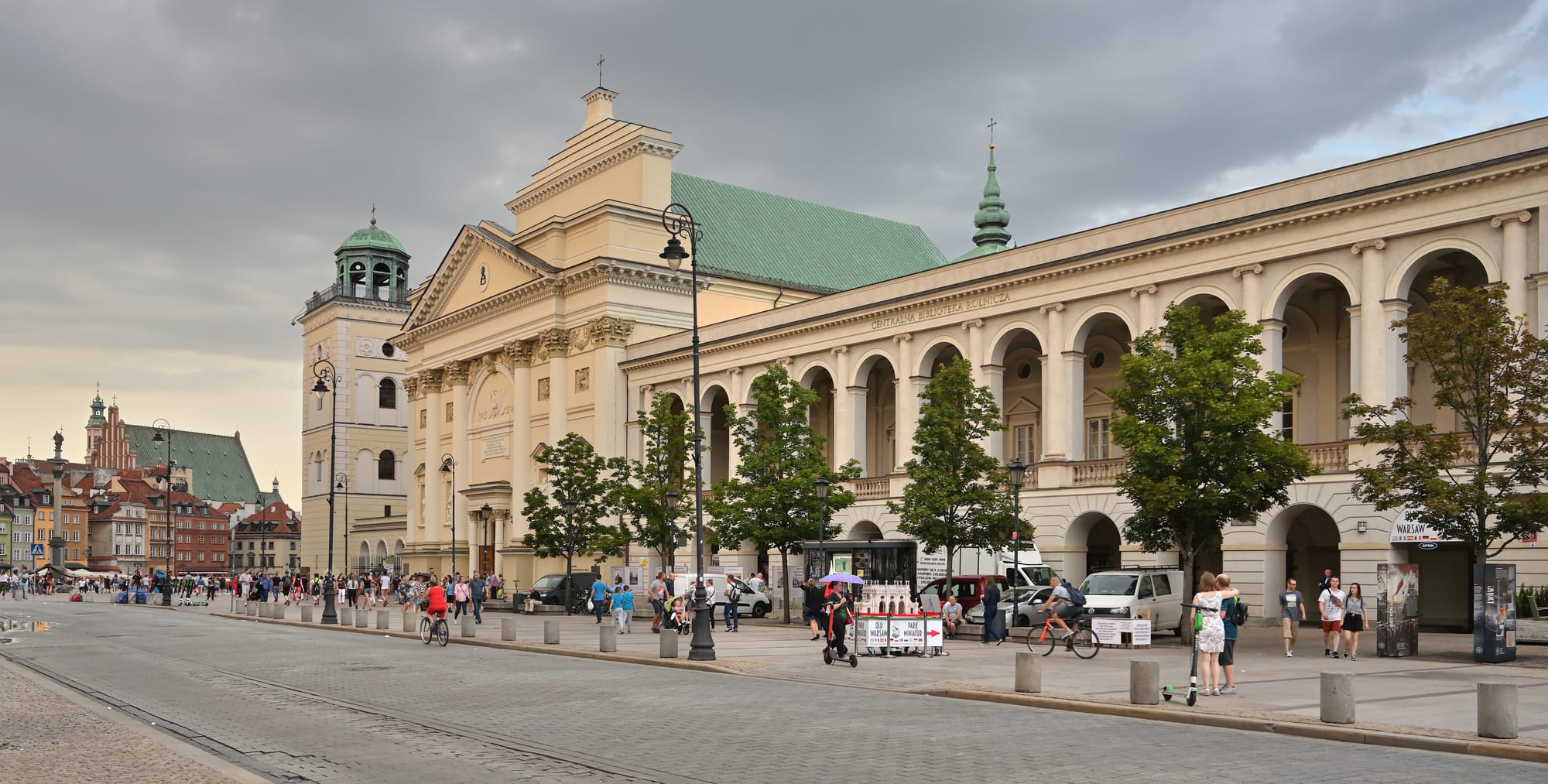
The cream façade of St Anne's Church on a wide cobbled Krakowskie Przedmieście, with Old Town houses and cyclists to the left

Warsaw, Mazovia & Łódź, Poland

Warsaw

Krakowskie Przedmieście and St Anne's Church at the start of Warsaw's Royal Route, by Castle Square. (Cayambe / Wikimedia Commons · CC BY-SA 4.0)

Poland's capital and largest city, on the Vistula in the east-centre of the country — a Masovian river town that became the seat of kings after 1596, was almost entirely destroyed in the Second World War and was rebuilt around a carefully reconstructed Old Town. Today it is the country's business centre, with glass towers rising around the Stalin-era Palace of Culture.

Neighbourhoods

  • Old Town and New Town
    • First-time visitors
    • Historic district

    The two founding quarters of the city, rebuilt after 1945 and listed by UNESCO in 1980. The Market Square, the Royal Castle, St John's Cathedral and the Barbican walls are here, and Marie Curie's birthplace stands in the quieter New Town just to the north.

    Open in Maps
  • Śródmieście
    • Close to public transport
    • Shopping
    • Nightlife

    The city centre, from the Royal Route of Krakowskie Przedmieście and Nowy Świat to the Palace of Culture and the skyscrapers around the central station. The southern part, Śródmieście Południowe, is known for its many restaurants and bars.

    Open in Maps
  • Powiśle
    • Riverside
    • Nightlife
    • Students

    The low-lying strip between the escarpment and the Vistula, in the 17th and 18th centuries home mostly to the poor. The university library, the Copernicus Science Centre and the riverside boulevards now make it one of the liveliest parts of the city on summer evenings.

    Open in Maps
  • Praga
    • Local life
    • Bars and clubs
    • Pre-war streets

    The right bank of the Vistula, a separate town until it was attached to Warsaw in 1791. Its older streets, the Koneser vodka works and down-to-earth clubs give it a rougher, more independent feel.

    Open in Maps
  • Mokotów
    • Quiet and residential
    • Parks

    A large southern district of modernist pre-war housing estates, office blocks and green space, including Mokotów Field. Many of Warsaw's businesses are registered here, and it is a common base for longer stays.

    Open in Maps
  • Żoliborz
    • Quiet and residential
    • Architecture

    A leafy residential district north of the centre, laid out between the wars around squares with radiating streets such as Wilson Square, with villas, co-operative housing and a metro station at its heart.

    Open in Maps

Things to do

Royal Warsaw and landmarks

  • Royal Castlelandmark

    The residence of Polish kings, destroyed in the war and rebuilt in 1971–1984, whose collections include the Lanckoroński Collection with two paintings by Rembrandt.

    Open in Maps
  • Sigismund's Columnlandmark

    The column in Castle Square honouring Sigismund III Vasa, the king who moved the court to Warsaw — erected in 1644, the first secular monument in the form of a column in modern history.

    Open in Maps
  • St John's Archcathedrallandmark

    A brick Gothic church of the 14th century in the Old Town, the city's archcathedral, rebuilt after its destruction in 1944.

    Open in Maps
  • Warsaw Barbicanlandmark

    A semicircular fortified outpost between the Old and New Towns, a remnant of the walls that once enclosed the medieval city.

    Open in Maps
  • Palace of Culture and Scienceviewpoint

    The 237-metre Stalinist tower given by the Soviet Union, designed in the spirit of Moscow's 'Seven Sisters', with theatres, a congress hall and a viewing terrace.

    Open in Maps
  • Wilanów Palacelandmark

    The baroque residence of King John III Sobieski in the south of the city, with old-master paintings inside and a formal garden.

    Open in Maps

Museums and memorials

  • Warsaw Uprising Museummuseum

    A museum of the 63-day rising of 1944, which also runs the Warsaw Fotoplastikon, a 1905 stereoscopic theatre.

    Open in Maps
  • POLIN Museum of the History of Polish Jewsmuseum

    A large museum covering a thousand years of Jewish life in Poland, built in the area of the wartime ghetto.

    Open in Maps
  • Monument to the Ghetto Heroeslandmark

    The memorial to the Warsaw Ghetto Uprising, launched by Jewish fighters on 19 April 1943.

    Open in Maps
  • Fryderyk Chopin Museummuseum

    A museum of the composer's life and music, one of many places in the city linked to Chopin.

    Open in Maps
  • National Museummuseum

    One of the country's largest art collections, from antiquity to the present, including one of the best collections of paintings in Poland.

    Open in Maps
  • Copernicus Science Centremuseum

    An interactive science museum on the Vistula with more than 450 exhibits on which visitors carry out experiments themselves.

    Open in Maps
  • Museum of Modern Artmuseum

    The city's modern art museum, which opened its new building in October 2024.

    Open in Maps
  • Neon Museummuseum

    A collection of rescued neon signs from the socialist era, which moved in 2025 from a former factory in Praga to the Palace of Culture and Science.

    Open in Maps

Parks and the river

  • Łazienki Parkpark

    A 76-hectare royal park of pavilions, bridges and cascades around the Palace on the Isle, with peacocks and squirrels, and the 1926 Chopin monument where pianists give summer concerts.

    Open in Maps
  • Saxon Gardenpark

    One of the oldest public parks in the city, once part of a royal palace, beside the Tomb of the Unknown Soldier.

    Open in Maps
  • Krasiński Gardenpark

    The park of the baroque Krasiński Palace on the edge of the Old Town, near the Warsaw Uprising Monument.

    Open in Maps

Music, sport and nights out

  • Grand Theatreattraction

    The home of the Polish National Opera on Theatre Square, one of the largest theatres in Europe, its company established in 1778.

    Open in Maps
  • Warsaw Philharmonicattraction

    The concert hall of the National Philharmonic Orchestra, a central venue of the Chopin Piano Competition.

    Open in Maps
  • Polish Army Stadiumattraction

    Legia Warsaw's football ground on Łazienkowska Street, just south-east of the centre; the club has a following across the country.

    Open in Maps
  • National Stadiumattraction

    The large stadium on the Praga bank used for national football matches and major concerts.

    Open in Maps

Short trips from the city

  • Kampinos National Parkpark

    Forest, dunes and marshes beginning at the city's north-western edge, the last remaining part of the Masovian Primeval Forest.

    Open in Maps
  • Żelazowa Wolamuseum

    The small manor house where Fryderyk Chopin was born in 1810, now a museum set in a park; in summer pianists play inside the house for an audience outside.

    Open in Maps

Seasonal events

  • WiankiMidsummer, June

    Thousands gather on the banks of the Vistula on Midsummer's Night, in a festival rooted in the old custom of girls floating wreaths of herbs on the water.

  • Chopin concerts in Łazienki Parksummer Sundays

    Free piano recitals beneath the Chopin monument in Łazienki Park.

  • Warsaw Uprising anniversary1 August

    At 5 p.m. sirens sound and traffic and pedestrians stop across the city in memory of the rising of 1944.

  • Warsaw Autumnsecond half of September

    An annual international festival of contemporary music.

  • Warsaw Film FestivalOctober

    An annual festival showing more than 100 films, with awards for the best and most popular.

  • International Chopin Piano CompetitionOctober, every five years

    A piano competition devoted to Chopin's music, held first in 1927 and every five years since 1955.

Eat and drink

Long-standing places and food districts in Warsaw. Hours, ratings and directions come from your maps app, always current.

Warsaw classics

  • Milk barsrestaurant

    Bar mleczny — no-frills self-service canteens from the communist era serving cheap home-style Polish meals, still popular and revived in recent years by nostalgia.

    Open in Maps
  • Wedel Chocolate Loungecafe

    The historic chocolate lounge of the Wedel confectioners on Szpitalna Street, long one of the city's best-known meeting places.

    Open in Maps
  • Vietnamese restaurantsneighborhood

    Cheap and plentiful across the city, run by a Vietnamese community that is one of the largest immigrant groups in Warsaw.

    Open in Maps

Food halls and districts

  • Hala Koszykimarket

    A restored early 20th-century market hall in the centre, now a food hall and a popular meeting place.

    Open in Maps
  • Koneserneighborhood

    The old Koneser vodka works in Praga, converted into a mixed complex of flats, offices and entertainment venues, including the Polish Vodka Museum.

    Open in Maps
  • Śródmieście Południoweneighborhood

    The southern part of the centre, singled out as the heart of the city's newer food scene.

    Open in Maps

Experience Warsaw

History

Warsaw grew from a small fishing town on the left bank of the Vistula and became the seat of the Duchy of Masovia in 1413. Its fortunes changed after 1596, when Sigismund III Vasa decided to move his royal court from Kraków; Italian architects remodelled the Royal Castle and the marketplace, and by the 18th century the city had overtaken Gdańsk as the largest in Poland. It was the capital of the Polish–Lithuanian Commonwealth until 1795, when Stanisław II Augustus had made it a centre of the arts, and then of Napoleon's Duchy of Warsaw.

Under Russian rule in the 19th century industry transformed the western borough of Wola, and the population boomed: the census of 1897 counted 626,000 people. Warsaw became one of Europe's most densely populated cities, known for its boulevards and architecture, and in 1901 more than a third of its people were Jewish.

The Second World War destroyed it. The Germans sealed the city's Jews into a ghetto, whose fighters rose on 19 April 1943; on 1 August 1944, with the Red Army nearing, the Home Army began the Warsaw Uprising, and between 150,000 and 200,000 Polish civilians died. About 85 per cent of the city was destroyed, including the Old Town and the Royal Castle. The communist authorities rebuilt the historic core from paintings and drawings — UNESCO listed it in 1980 — while laying out wide avenues and raising the Palace of Culture and Science, a gift from the Soviet Union. Since 1989 Warsaw has become a business capital, and after 2022 it took in the second-largest single group of Ukrainian refugees.

Culture & Customs

Warsaw's identity is bound up with destruction and rebirth. Plaques across the centre mark wartime executions, the Uprising Museum tells the story of the rising of 1944, and on 1 August the city stops at 5 p.m. as sirens sound. The reconstructed Old Town, with its Market Square and mermaid statue, is treated less as a stage set than as a statement that the city survived.

Music is the other constant. Chopin, born nearby at Żelazowa Wola, grew up here, and his heart is kept in a pillar of the Holy Cross Church; pianists play beneath his monument in Łazienki Park on summer Sundays, and every five years the International Chopin Piano Competition fills the Philharmonic. The Grand Theatre, home of the national opera, and the National Theatre, founded in 1765, lead more than 30 major theatres, and festivals run from Warsaw Autumn's contemporary music to the Jazz Jamboree and the Warsaw Film Festival. Marie Curie was born in the New Town, and the city keeps several places associated with her.

Football divides along club lines: Legia Warsaw, the army club, has supporters across Poland, while Polonia, its smaller rival, plays near the Old Town. At Midsummer thousands gather by the river for Wianki, a festival descended from the custom of floating wreaths on the water. Varsovians tend to be brisk, ambitious and proud of the city's comeback, and the city's growth since 1989 has come mainly from people moving in.

Daily Life

Warsaw's population is officially put at about 1.86 million (end of 2024), with around 3.5 million in the metropolitan area, making it the seventh most populous city in the European Union. In the 2021 census almost 99 per cent of residents identified as Polish, but the city has drawn large Ukrainian, Vietnamese and Belarusian communities, and the arrival of Ukrainians after 2022 added roughly a tenth to its population.

The economy runs on government, finance, corporate offices and services: the city has more than half a million registered businesses, concentrated in Śródmieście, Mokotów, Wola and Praga-Południe, and the towers of the centre and of Wola keep multiplying. Most people live away from the commercial centre in large housing estates and commute by metro, tram or bus, from Ursynów in the south to Białołęka across the river.

The rhythm is metropolitan: early starts, long commutes and busy evenings on the riverside boulevards and in the bars of the southern centre in summer. Weekends empty into the parks, the Kabaty Woods and the forest at the city's edge.

Food

Traditional Varsovian food is hearty. The local menu runs from flaki po warszawsku, tripe soup, to pyzy dumplings, and ends with the wuzetka, a chocolate sponge and cream cake that originated in the city. The Wedel chocolate lounge on Szpitalna Street, run by the Wedel confectionery company, has long been one of the city's favourite meeting places, and on All Saints' Day, 1 November, the city's cemeteries are where pańska skórka, a pink-and-white candy, is sold.

In the 20th century Warsaw was known for its state-run milk bars, the bar mleczny, cheap self-service canteens serving soups, dumplings and home-style dinners. Several survived the end of communism and others have reopened on a wave of nostalgia, and they remain popular.

The city is now Poland's most varied place to eat. A large Vietnamese community runs restaurants across the capital, there is a large vegan scene, and the southern part of Śródmieście is known for its newer cafés and restaurants. Hala Koszyki, a restored market hall, has become a popular food hall, and in Praga the old Koneser vodka works holds the Polish Vodka Museum.

Planning tools

Budget

Warsaw is the most expensive city in Poland for hotels and restaurants, but still well below Western European capitals. Public transport is cheap, milk bars and Vietnamese restaurants keep food costs low, and several museums and all the royal parks are free or inexpensive. Hotel prices rise for big concerts, congresses and the Chopin Competition.

Daily Budget Midrange
USD 130–260 (central hotel, restaurant meals, museum entries, taxis by app)
Daily Budget Shoestring
USD 55–90 (hostel bed, milk-bar meals, a public-transport day ticket)

Buy 24-hour or weekend public-transport tickets, and walk the Royal Route, the Old Town and Łazienki Park, which cost nothing.

Best Time to Visit

May to September, when the parks are green, the Vistula boulevards are busy in the evenings and free Chopin recitals are held in Łazienki Park on Sundays. Early autumn is mild and brings the film and contemporary music festivals. Winters are cold and grey.

Suggested Number of Days

Three or four days suit a first visit to the capital, which has many large museums and spreads across both banks of the river. Allow five or six to add trips into the Masovian countryside and the forest at the city's edge; a strong interest in music or wartime history adds more.

First Visit
3–4 days
With Surroundings
5–6 days

Transportation

Warsaw Public Transport runs the metro, trams, buses and the SKM commuter trains on one ticket system. The metro has two lines, and the tram network of about 146 km is the second-largest in Poland. In summer, ferries cross the Vistula and historic trams and buses run on special lines. Taxi apps are widely used.

Validate a paper ticket on boarding, and use taxi apps rather than unmarked cabs at the stations.

Airport & Station Connections

Warsaw Chopin Airport, the busiest in Poland, is in the Włochy district about 10 km from the centre, linked by trains as well as buses and taxis. Low-cost and charter flights also use Warsaw-Modlin, about 35 km to the north, and Warsaw-Radom, about 90 km to the south. Warszawa Centralna is the hub of the national rail network, with fast trains to Kraków, Gdańsk, Wrocław, Poznań and Łódź.

Walkability

The Old Town, the Royal Route and the centre around the Palace of Culture are pleasant on foot, and the riverside boulevards make an easy walk. Beyond that the city is large and its post-war avenues are wide, so the metro and trams are needed to reach Wilanów, Praga, Mokotów or Żoliborz. Pavements can be icy in winter.

Safety

Poland is a safe country with low violent crime. In Warsaw the main risks are pickpockets in the Old Town, around Warszawa Centralna station and on crowded trams and buses. A large nationalist march is held every year on Independence Day, 11 November.

Watch belongings at the central station and on trams, never leave a drink unattended, and keep away from the route of the 11 November march. Check current official travel advice before travelling.

Climate

Warsaw has a temperate climate with warm summers and cold, often grey winters, and is among the driest major cities in Europe, with about 550 mm of rain a year; July is the wettest month.

Summer
warm — the daily average in July is about 20°C, and afternoons may reach 30°C
Winter
cold — the daily average in January is about −1.5°C, with frost and spells of snow

Local Customs

A tip of around 10 per cent is usual in restaurants; saying thanks while handing over the money is taken to mean 'keep the change'. Drinking alcohol in public places outside bars and their terraces is illegal and can bring a fine. The city's wartime past is present everywhere, in plaques marking executions and in the stop at 5 p.m. on 1 August, and is treated with respect.

Proof of age is strictly required to buy alcohol (the legal age is 18). Dress modestly in churches, and stand still with everyone else if the sirens sound on 1 August.

Common Payment Methods

The currency is the złoty (PLN), not the euro. Cards and contactless payment are accepted almost everywhere, including on trams and buses, and ATMs are easy to find; carry a little cash for small bakeries and market stalls.