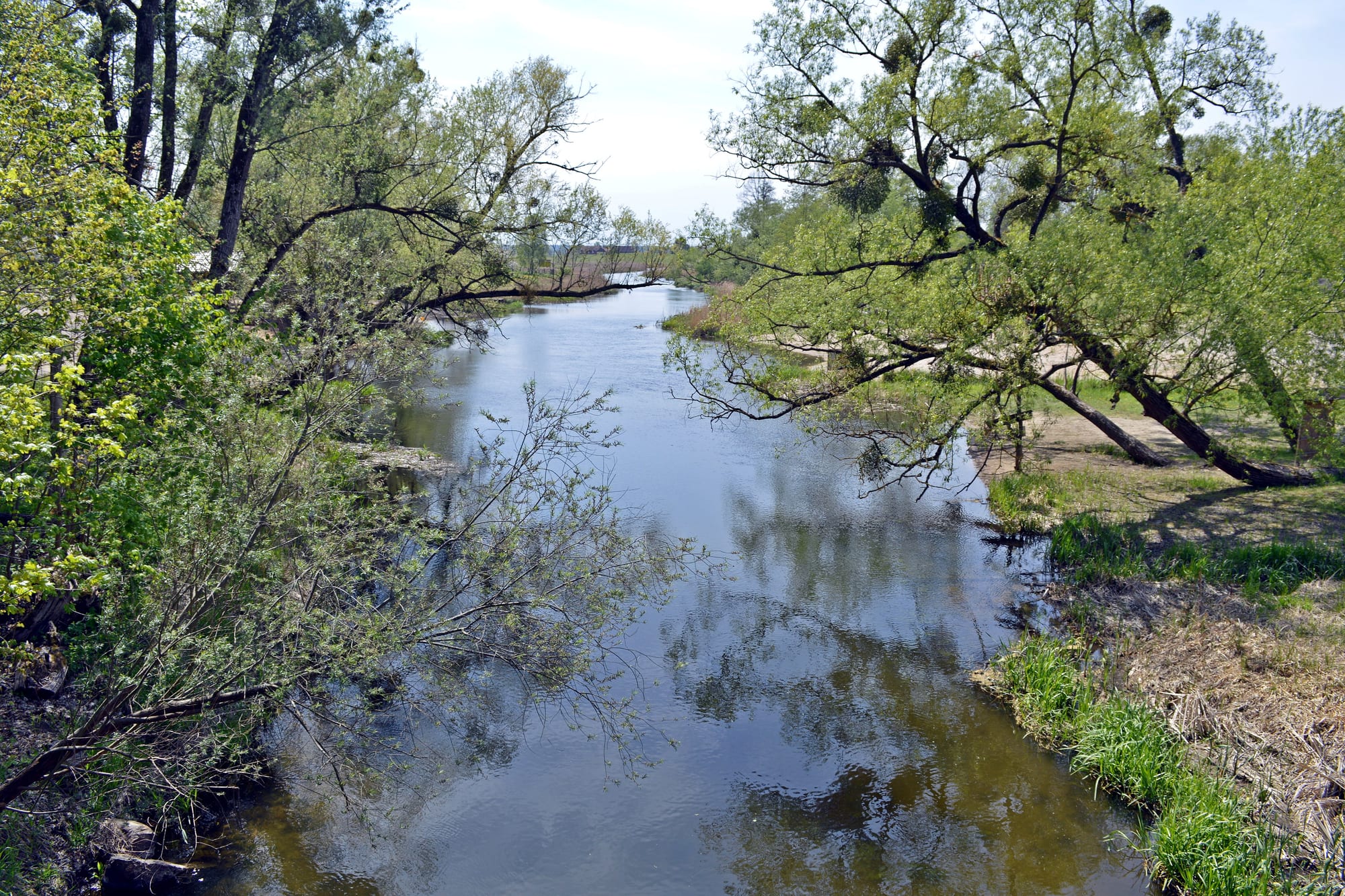
A calm river reflecting the sky, winding between willows and birches in fresh spring leaf

Poland

Masuria & the Northeast

The Krutynia river at Ukta, part of Masuria's best-known canoe trail through the Pisz Forest. (Connie Mazur / Wikimedia Commons · CC BY-SA 4.0)

Poland's green north-eastern corner, bordering Russia's Kaliningrad region, Lithuania and Belarus — the lakes and forests of Warmia and Masuria around Olsztyn, once part of East Prussia, and Podlaskie around Białystok, a borderland of Catholic, Orthodox and Tatar communities with the primeval Białowieża Forest and the Wolf's Lair bunkers.

Explore Masuria & the Northeast

History

The Baltic Prussians, pagan relatives of the Lithuanians, lived here until the Teutonic Knights conquered them in the 13th century and brought German, Polish and later Lithuanian settlers. Warmia became a Prince-Bishopric, which passed under the Polish crown in 1466; Nicolaus Copernicus served its chapter, administering Olsztyn castle and working as a canon in Frombork, where he died in 1543. The Order's remaining lands became the Lutheran Duchy of Prussia in 1525, whose southern districts — Masuria — were settled by Polish-speaking Protestants from Mazovia.

Masuria stayed in Prussia and later Germany, and a 1920 plebiscite voted overwhelmingly to remain German. In 1914 the Russians were defeated at the Battle of Tannenberg near Olsztyn, and in the Second World War Hitler spent long periods at his Wolf's Lair headquarters near Kętrzyn, where Claus von Stauffenberg's bomb failed to kill him on 20 July 1944. In 1945 the southern part of East Prussia became Polish, and its German population fled or was expelled.

Podlaskie followed a different path, as a borderland between the Polish crown and the Grand Duchy of Lithuania. Białystok grew around the Branicki family's estate and, in the 19th century under Russian rule, into a textile town with a large Jewish majority, which was murdered in the Holocaust. Poland and Lithuania had fought their greatest battle against the Teutonic Knights, at Grunwald in 1410, on land that is now in Warmia-Masuria.

Culture & Customs

The post-1945 population of Warmia and Masuria came from all over Poland and from the lost eastern lands, joined in 1947 by Ukrainians forcibly moved in Operation Vistula, so the region has a patchwork identity. Old Prussian brick churches, manor houses and village layouts survive, and a small German minority and the Warmian Catholic tradition, with roadside shrines and the baroque pilgrimage church at Święta Lipka, remain.

Podlaskie is Poland's most varied region in faith and language. Orthodox Christians, many of them Belarusian, form a large minority around Hajnówka and Bielsk Podlaski, where onion-domed churches stand beside Catholic ones and the holy mountain of Grabarka, covered in crosses left by pilgrims, is the centre of Polish Orthodoxy. Descendants of Muslim Tatars who served the Commonwealth keep wooden mosques at Kruszyniany and Bohoniki, and a Lithuanian minority lives around Puńsk near the border. Białystok remembers Ludwik Zamenhof, creator of Esperanto, who grew up amid the city's mix of languages.

Across the north-east, life outdoors — sailing, kayaking, mushrooming, berry-picking and ice fishing — is a central part of regional culture.

Daily Life

Białystok has about 290,000 people and Olsztyn about 170,000; Elbląg, Ełk, Suwałki, Łomża and Giżycko are the other main towns. Both provinces are among Poland's least densely populated, and many villages have lost young people to the big cities and abroad.

Farming, especially dairy, forestry, furniture and food processing are important, with the Podlaskie dairy cooperatives among the largest in Poland. Tourism drives the lake districts in summer, when Mikołajki, Giżycko and the marinas fill with sailors from across the country. Białystok and Olsztyn have universities and growing service sectors, and Białystok is home to the producers of Żubrówka, the bison-grass vodka.

Proximity to Russia and Belarus shapes current life. Since the 2021 migrant crisis a steel fence runs along the Belarus border, troops are stationed in the forests, and the Suwałki Gap — the narrow strip between Kaliningrad and Belarus — has become a focus of NATO defence planning.

Food

The north-east's cooking shows Lithuanian, Belarusian, Jewish and Tatar influence. Kartacze, large oval potato dumplings stuffed with minced meat, are the signature dish of the Suwałki area, related to Lithuanian cepelinai. Babka ziemniaczana, a baked potato cake, and kiszka ziemniaczana, potato stuffed into sausage casing, are Podlaskie staples, and the Tatars contributed pierekaczewnik, a layered pastry filled with apples or meat.

The regional showpiece is sękacz, a tall, knobbly cake baked in layers on a rotating spit over an open fire, cut to show rings like a tree trunk.

Masuria's lakes supply the table with pike, zander, tench and eel, and small whitefish such as vendace are smoked and sold in lakeside villages. Wild mushrooms, blueberries and cranberries from the forests go into soups, sauces and preserves, and fish soup and fried fish are standard fare in the resorts.

Attractions & Natural Wonders

The Great Masurian Lakes form a waterway of lakes and canals from Węgorzewo to Ruciane-Nida, including Mamry, Niegocin and Śniardwy, the largest lake in Poland. Giżycko has the 19th-century Boyen Fortress, Mikołajki is the sailing capital, and the Krutynia river offers a classic canoe trail through the Pisz Forest. Near Kętrzyn, the Wolf's Lair at Gierłoż preserves the blasted bunkers of Hitler's headquarters, and Święta Lipka's baroque church stands nearby.

Olsztyn has its castle of the Warmian chapter with Copernicus's astronomical table and a walled old town. Frombork's hilltop cathedral holds Copernicus's tomb, Lidzbark Warmiński has the bishops' Gothic castle, and the Elbląg Canal lifts boats over hills on rail-mounted inclined planes. Grunwald's battlefield has a museum and an annual re-enactment.

In Podlaskie, Białystok's Branicki Palace and gardens earned it the nickname "Versailles of Podlasie". Tykocin keeps a restored baroque synagogue. The Białowieża Forest has a strict reserve entered only with a guide, a bison show reserve and Białowieża village, while the Biebrza and Narew marshes and Wigry National Park, near Suwałki, protect wetland and lake landscapes, with the Augustów Canal running through forest.

Cities in Masuria & the Northeast

Planning basics

Budget

The north-east is one of the cheapest parts of Poland. Olsztyn and Białystok have inexpensive hotels, and farm-stays, guesthouses and campsites dominate the countryside. Prices rise in the Masurian sailing resorts of Mikołajki and Giżycko in July and August, when boat charters are the main expense.

Daily Budget Midrange
USD 110–220 (lakeside hotel or agritourism farm, restaurant meals, kayak or yacht hire, guided forest walk)
Daily Budget Shoestring
USD 45–75 (guesthouse or campsite, canteens and fish bars, regional buses)

Book yacht charters and summer lakeside rooms early, and consider a hire car, since public transport between villages is sparse.

Safety

The region is safe for visitors. The main hazards are natural: sudden summer squalls on the big lakes that capsize yachts, thin ice in winter, and ticks in the forests and meadows, which carry Lyme disease and tick-borne encephalitis. Along the Belarus border, a militarised fence and restricted zones have at times closed areas near the border, including parts of the Białowieża area.

Watch weather warnings before sailing, check for ticks after walks, and respect border-zone signs near Belarus. Check current official travel advice before travelling.

Climate

The north-east has Poland's most continental lowland climate. Summers are warm and pleasant for the lakes, but winters are the coldest outside the mountains, with long frosts and snow cover — the Suwałki area is known as Poland's cold pole — and lakes that often freeze hard enough for ice fishing and ice sailing.

Summer
warm, 20–27°C, with lake water warming to swimming temperatures in July and August
Winter
cold, often −5 to −10°C, with lasting snow and frozen lakes

Transportation

Trains link Warsaw with Białystok and with Olsztyn in a few hours; Olsztyn-Mazury airport at Szymany has a few flights. The lake towns and the Wolf's Lair are reached by regional buses and trains, but a car makes the region far easier. In summer, tourist boats cross the Great Masurian Lakes. Białowieża is reached by bus or car via Hajnówka.

Rent a car for the lakes and Podlaskie, and book Białowieża's strict-reserve walks with a licensed guide.

Best Time to Visit

June to early September for sailing, kayaking and swimming, with July and August busiest. May and early June are best for birdwatching in the Biebrza marshes, and September for the forests and autumn colours without the crowds. The Battle of Grunwald re-enactment draws large crowds each July, and winter suits cross-country skiing and ice sports.